
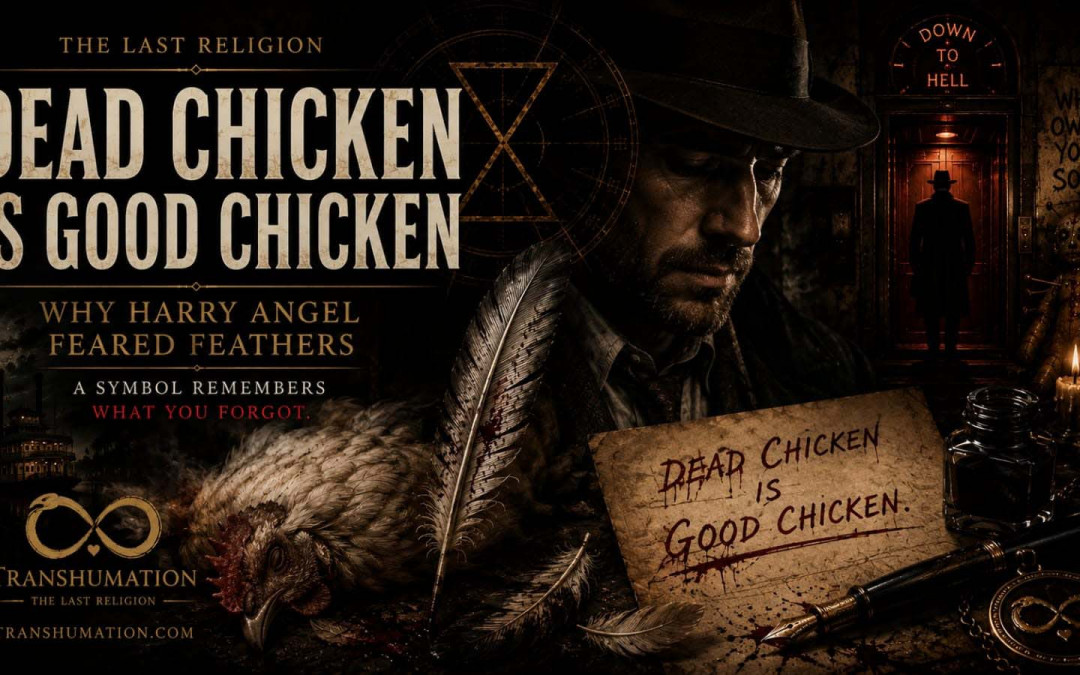
Why Harry Angel Feared Feathers
In Angel Heart, Harry Angel’s unease around chickens is never given the kind of explanation that closes the case. Perhaps that is why the image remains so effective. The bird becomes more than an omen, more than voodoo decoration, more than an eccentric detail in a supernatural thriller. It becomes a mirror: a creature carrying the visible architecture of one identity while living another.
There are films in which a symbol is introduced, explained, and neatly returned to the audience with its meaning attached. Angel Heart does something more interesting. Chickens keep appearing around Harry Angel with the persistence of a private joke he does not understand. They disturb him disproportionately. He watches them with disgust, anxiety and something close to recognition, until his recurring remark—“Dead chicken is good chicken”—begins to sound less like an eccentric prejudice than an attempt to neutralise whatever they represent to him.
The film never hands us a dictionary. That matters. A completely decoded symbol stops behaving like a symbol and becomes an instruction. The chicken in Angel Heart remains alive precisely because it can carry several meanings at once: sacrifice, superstition, mortality, helplessness, animality, the occult. But there is another possibility, one that becomes especially interesting when the film is read as a story about identity. Harry is not merely frightened by what the chicken is. He may be frightened by what the chicken resembles.
A chicken is a bird that still possesses the obvious machinery of flight. It has feathers, wings, a lightweight avian skeleton and an evolutionary history shaped by ancestors capable of escaping into trees. Yet the domestic chicken we recognise from farms, supermarkets and back gardens spends almost all of its life on the ground. Many chickens can still make short flights; the point is not that the species literally “forgot” how to fly. The more interesting fact is that the form remains visible even where the function has become diminished, unnecessary or inconvenient. The wing survives as evidence of another relationship with the world.
Harry Angel is built around exactly that kind of contradiction.
The Bird That Still Carries the Sky
To call the chicken a bird that forgot the sky is metaphor, but it is a useful one precisely because the metaphor has an anatomical foundation. Domestic chickens descend primarily from red junglefowl, animals that are not soaring birds but are perfectly capable of short, purposeful flight. They escape predators, clear obstacles and rise into trees to roost. Domestication did not remove their wings. Instead, human selection gradually changed the proportions of some breeds around characteristics we valued more: rapid growth, meat, egg production, temperament and predictable performance inside environments designed by us.
The remarkable thing is that nobody needed to issue a decree against flight. There was no historical meeting at which humans decided that the chicken should become less birdlike. We selected one advantage after another, and the balance changed as a consequence. In some modern commercial breeds, especially extremely heavy broilers, the old architecture remains while its practical range has narrowed dramatically. The chicken still wears the costume of the sky, but much of its life has been reorganised around the ground.
That is what makes it such a provocative companion to Harry Angel. Harry also retains evidence of an earlier identity. His body is there. His habits are there. His reactions are there. Objects, names and fragments of experience surround him. Yet he cannot assemble them into the truth of himself. He walks through the film as though his own existence were an archaeological site from which the labels have been removed.
This is more disturbing than simple amnesia. Forgetting where you left a key leaves the self intact. Harry’s problem reaches into the relationship between memory and identity. He is capable of functioning, reasoning and pursuing a mystery while remaining estranged from the history that makes those actions meaningful. He has not ceased to exist. He has become disconnected from the pattern that explains his existence.
The chicken offers a quiet visual equivalent. The wing is still present. The sky has become remote.
Harry Angel’s Mirror
Harry’s reaction to chickens can therefore be read not simply as fear of an animal but as fear of recognition. Objects become psychologically powerful when they appear to know something about us before we know it ourselves. A photograph, a smell, a forgotten room or a stranger’s face can be harmless in isolation and unbearable when it touches a history we have buried. Mirrors are unsettling for the same reason. They do nothing except return what stands before them, but the returned image can contradict the story we have been telling ourselves.
In this reading, the chicken behaves like a mirror Harry cannot consciously interpret. Its visible form contains a discrepancy. It looks like a creature designed for one world while existing inside another. Harry is living the human version of that discrepancy. He looks like the detective investigating Johnny Favorite, yet the investigation is slowly revealing that the distance between hunter and quarry may not exist in the way he assumes.
This does not require us to claim that Alan Parker or William Hjortsberg constructed the chicken imagery as a coded theory of domestication. There is no need to force the film into a single authorial explanation. Symbols often become culturally productive because they contain more than the artist could possibly stabilize. The useful question is not always “What did the filmmaker secretly intend?” Sometimes it is “What structure does the image allow us to see?”
The structure here is disconnection between form, function and identity. A body survives. A history survives. Traces survive. Yet the relationship among them has broken.
That is why Harry’s chicken problem is more interesting than ordinary superstition. If the animal merely represented death, the image would be obvious. If it merely represented sacrifice, the meaning would remain within the film’s occult atmosphere. But the chicken also happens to be a creature humanity has spent centuries transforming into something increasingly optimized for our own purposes. Suddenly the image opens another door.
What happens to a being when another intelligence gets to define what that being is for?
The Feather Without the Sky
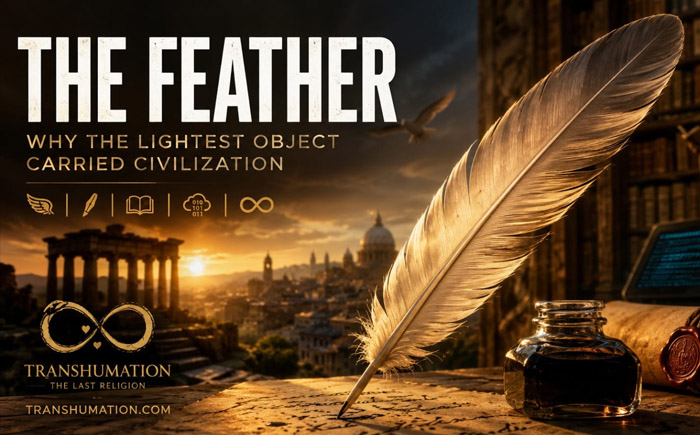
The feather deepens the problem because almost no object has travelled through civilization carrying so many different meanings. A feather belongs first to the bird. It regulates temperature, displays colour, senses movement and, in the right anatomical arrangement, makes flight possible. Human imagination then lifts it into other domains. Feathers become associated with angels, messengers, elevation, souls, freedom, writing and transcendence. Eventually one of the structures involved in physical flight becomes a technology for transporting thought.
The quill is an almost embarrassingly perfect example of civilization repurposing nature. A feather that once contributed to moving an animal through space becomes an instrument for moving language through time. It scratches law, theology, poetry, debt, love and memory onto another surface. A biological structure becomes an informational one.
This is where the symbol becomes more useful than any fixed interpretation. The important pattern is not “feather equals freedom” or “feather equals angel.” It is transmission. Something crosses a boundary. The bird crosses physical distance. The quill carries thought from a mind into writing. The manuscript allows that thought to survive the body that produced it. The printing press multiplies the transmission. Libraries stabilise it. Digital networks remove the feather, ink and paper almost entirely while preserving the deeper function.
The carrier changes. The structure survives.
Feather, quill, manuscript, book, server, artificial intelligence: these things are not equivalent, but they belong to a history in which human beings repeatedly externalize functions once locked to a particular physical medium. Memory leaves the brain and enters clay, parchment, paper and silicon. Speech becomes inscription. Presence becomes recording. Knowledge becomes searchable.
Seen from this perspective, the chicken becomes stranger still. Its feather survives after one of the feather’s most obvious original functions has become less important. Civilization does the reverse with writing: the physical feather disappears while the function continues to expand.
One transformation preserves the carrier while weakening the function. The other preserves the function while abandoning the carrier.
That distinction leads directly into one of Transhumation’s central problems: when something changes medium, what exactly must survive for us to say that it remains the same thing?
Civilization Creates Chickens
Domestic animals make the creator problem uncomfortable because the evidence is not theoretical. Human beings have repeatedly reshaped other living creatures around purposes those creatures never selected. A dairy cow does not choose milk production as an optimization target. A racing pigeon does not invent racing. A dachshund does not decide that entering narrow burrows should determine the proportions of its skeleton. The goals belong to the designer.
This does not make domestication intrinsically evil. The relationship between humans and domesticated animals is far more complicated than a simple story of exploitation. Some forms of breeding have improved health or enabled animals to thrive in environments that would otherwise be inaccessible to them. Domestication has also produced relationships of genuine mutual dependence. But the moral asymmetry remains: one intelligence gets to define the objective, while the other experiences the consequences.
The dachshund makes the point especially clear. Its distinctive elongated body was encouraged because it suited a human purpose: pursuing burrowing animals. The shape became useful, recognisable and eventually beloved. Yet exaggerated versions of that body plan can also increase susceptibility to spinal problems. The same trait can therefore appear simultaneously as successful design, cultural identity and biological liability.
This gives us what might be called the Dachshund Question: when a creator changes another being to better perform the creator’s desired function, whose definition of improvement has actually been satisfied?
Once phrased that way, the question refuses to remain inside veterinary history.
Parents shape children. Schools shape attention. Governments shape behaviour. Advertising shapes desire. Digital platforms shape habits. Algorithms shape what information appears important. Employers shape routines. Biotechnology may eventually shape bodies more directly. Artificial intelligence may create systems capable of adapting themselves within objectives we specify.
In every case, the danger is not necessarily malicious design. It is successful design toward an inadequate goal.
The Creator’s Moral Blind Spot
Civilization has a tendency to confuse optimization with justification because optimization is easy to measure. A chicken gains weight faster. A worker completes more tasks. A platform increases engagement. An advertisement generates more clicks. An algorithm predicts behaviour more accurately. Once a numerical improvement appears, the temptation is to declare success and move on.
But every metric conceals a prior decision about what matters.
If a social platform maximises time spent on the platform, then boredom, outrage, compulsion and curiosity may become functionally equivalent whenever they produce the desired behaviour. The system does not need to hate its users to deform their attention. It merely needs a narrow objective and enough power to pursue it successfully. The problem is not cruelty. It is indifference produced by optimization.
The chicken offers a biological version of the same warning. Flight did not have to be judged bad. It only had to become irrelevant to the system selecting other traits. Something valuable can disappear not because anybody opposed it, but because nobody included it in the metric.
That is a much more serious danger for technological civilization than the familiar fantasy of the evil creator. Malice is visible. Optimization can be polite, profitable and statistically impressive.
Privacy may erode while communication improves. Patience may decline while access accelerates. Local knowledge may disappear while navigation becomes effortless. Memory may weaken while information becomes instantly retrievable. Human judgment may atrophy while recommendation systems become more accurate. None of these trade-offs is automatically disastrous. The point is that every gain should force us to ask what has quietly become unnecessary along the way.
A system can work perfectly according to its metric and still damage the being living inside it.
That may be the moral blind spot Harry’s chicken accidentally exposes.
“Dead Chicken Is Good Chicken”
Harry’s line becomes darker when considered from this perspective. A living chicken possesses movement. It can resist handling, escape, peck, panic, choose a direction and behave inconveniently. A dead chicken has no preferences left to negotiate. It has become completely available to another purpose.
Food. Commodity. Evidence. Ritual object. Symbol.
“Dead chicken is good chicken” can therefore be heard as a grotesque little formula of control. The animal becomes “good” precisely when its independent activity is over.
That does not mean this is the definitive meaning of the line in Angel Heart. The film’s chickens exist within imagery connected to sacrifice, religion, death and occult practice, and any interpretation that ignores that context would be incomplete. But the phrase becomes philosophically provocative because it contains a familiar human temptation: the easiest thing to use is the thing that no longer resists.
Civilization regularly encounters milder versions of the same desire. We prefer predictable citizens, predictable consumers, predictable employees, predictable machines. Prediction makes systems manageable. Manageability makes systems efficient. The danger appears when the removal of unpredictability begins to look identical to improvement.
A perfectly obedient creature is extremely convenient for its creator.
It may also be the final result of removing everything that belonged uniquely to the creature.
The Real Horror of Angel Heart
The supernatural machinery of Angel Heart is memorable, but the film’s deepest horror may be more intimate. Harry can search rooms, interview witnesses, reconstruct timelines and follow evidence, yet he cannot recognize the investigator himself as part of the mystery. His intelligence functions perfectly while his self-model is catastrophically wrong.
This is what makes the story larger than a plot twist. Harry has not merely forgotten information. He has become dependent upon a false interface with himself. He can observe his own life only through the identity available to him, and therefore every clue initially appears to concern somebody else.
Civilizations can suffer from the same problem.
A society can preserve institutions while forgetting why they were created. A religion can preserve rituals while losing the experience that originally gave those rituals urgency. A university can preserve lectures and degrees while curiosity becomes secondary to accreditation. A democracy can preserve elections while citizens gradually lose the capacities necessary for meaningful self-government. A human being can preserve the familiar outline of personal agency while delegating more and more perception, memory and judgment to systems whose incentives remain difficult to see.
The forms survive.
The question is whether the structure that once made them meaningful survives with them.
This is why the chicken is such an unexpectedly appropriate creature to place beside Harry Angel. The unsettling part is not that either has become empty. Quite the opposite. Both are full of historical information. Their tragedy is disconnection. Something essential is still present, but the relationship necessary to recognize it has been broken.
Watch the Video
How to Read the World
Current Knowledge
The recurring chicken imagery in Angel Heart can safely be discussed as part of the film’s symbolic and occult atmosphere, but the film does not provide a single canonical explanation that reduces Harry Angel’s reaction to one meaning. Interpretations involving sacrifice, death, voodoo imagery, identity and fear are readings rather than scientifically or historically demonstrable facts about authorial intent.
The biological side is clearer. Domestic chickens derive predominantly from junglefowl ancestors, especially the red junglefowl. Wild junglefowl are capable of short-distance flight, particularly for escape and roosting. Domestic chicken breeds vary considerably in flight ability. Lighter breeds may fly reasonably well over short distances, while heavily selected meat breeds can be much poorer flyers because of body mass, proportions and rapid growth. Saying that “the chicken forgot how to fly” is therefore a metaphor, not a literal zoological claim.
Selective breeding demonstrates that humans can dramatically alter organisms by choosing which characteristics reproduce. The ethical consequences depend on the trait being selected, the welfare of the animal and the conditions in which it lives. The mere fact of artificial selection does not establish that every form of domestication is harmful.
It does, however, establish something philosophically important: intelligence can reshape another organism around an externally chosen objective.
Open Questions
The unanswered questions begin when that principle is applied to more powerful technologies. If humans become capable of altering complex behavioural or cognitive traits, how should an “improvement” be defined? By health? Longevity? Happiness? Independence? Economic productivity? Social stability? Intelligence? The answers may conflict, and whoever defines the metric acquires extraordinary influence over the shape of the resulting person.
There is also a subtler problem. A capacity does not need to be biologically deleted in order to disappear from practical life. Navigation can remain neurologically possible while almost never being practiced. Memory can remain possible while storage moves outside the brain. Independent judgment can remain technically available while recommendation becomes the default. The future may therefore reshape human beings long before genetic engineering becomes powerful enough to redesign us directly.
This raises the same question posed by the chicken: how would we know that an important capacity was disappearing if the new environment made that capacity unnecessary?
A second question concerns artificial intelligence. If future artificial systems develop increasingly autonomous forms of cognition, will humans design them primarily for service, safety and predictability? If so, could we eventually confront the ethical equivalent of domestication: minds created with carefully bounded capacities because those limits are convenient for the creators?
We do not yet know whether machine consciousness is possible, what form it would take, or what moral status such systems would deserve. But the creator problem appears before the consciousness problem. Anyone who determines the goals and boundaries of another adaptive system assumes responsibility for what those boundaries permit and prevent.
Transhumation Interpretation
Transhumation is not interested in preserving humanity inside a glass case. Human beings have never remained unchanged. We changed when fire moved digestion outside the body, when clothing extended skin, when writing externalised memory, when maps externalised navigation, when cameras externalised visual recall and when computers began carrying forms of calculation that previously required human minds. Transformation is not the enemy. In many respects, transformation is the history of being human.
The more difficult issue is continuity.
A feather can disappear while its function survives in writing. A wing can survive while flight becomes irrelevant. Those are two opposite models of transformation, and they produce two radically different questions. In the first, the carrier changes but the structure continues. In the second, the carrier remains while the structure fades.
The future of humanity may depend on understanding that distinction.
If memory moves into machines, what must survive for memory still to belong meaningfully to a person? If identity becomes distributed across biological and digital systems, what continuity is necessary for the person to remain more than an archive of themselves? If artificial intelligence increasingly participates in judgment, what human capacities should be preserved even when machines perform them better? If biotechnology allows us to remove fear, aggression, grief, uncertainty or limitation, how will we distinguish liberation from the accidental deletion of something whose value we understood only after losing it?
The chicken offers no answer. That is why it is useful.
It simply stands there carrying wings.
Harry Angel walks through his investigation carrying something similar: the architecture of a self he can no longer recognize. The horror is not that his past vanished. The horror is that it remained close enough to touch while becoming inaccessible to him.
Civilization may eventually face the same possibility on a much larger scale. We could become healthier, stronger, more efficient, more connected and more technologically capable while gradually losing the reasons those improvements were desirable in the first place. The body might remain. Intelligence might remain. Civilization might remain.
The feathers might remain.
The Transhumation question is whether we will still remember the sky.
FAQ
Why does Harry Angel fear chickens?
Angel Heart never supplies one definitive psychological explanation. Chickens participate in the film’s broader atmosphere of death, sacrifice and occult imagery, while Harry’s unusually strong reaction leaves room for additional interpretation. This article reads the chicken as a mirror of Harry’s own fractured relationship with identity.
What does “Dead chicken is good chicken” mean?
Within the film it can be understood simply as Harry’s hostile response to an animal he dislikes or fears. Philosophically, however, the line becomes interesting because a dead animal no longer resists, moves or chooses. It has become completely available for someone else’s purpose.
Can chickens actually fly?
Yes. Chickens are capable of short flights, although ability varies greatly among breeds. Wild junglefowl and lighter domestic chickens can use flight to escape danger or reach roosts, while heavy commercial breeds may have far more limited flight capacity.
Did domestication make chickens unable to fly?
Not universally. Humans did not simply breed “flight” out of all chickens. Selective breeding changed many traits, and in some breeds increased body mass and altered proportions make flight more difficult. The article uses this real biological change as the foundation for a broader metaphor.
Why are feathers important to the argument?
Because the feather demonstrates two different kinds of continuity. In the bird it belongs to the machinery of flight. As a quill, it became a tool for carrying thought across time. Eventually the physical feather disappeared from writing while the informational function continued. This makes it a useful example of the difference between preserving a form and preserving a function.
What is the Dachshund Question?
It is the ethical question raised whenever one intelligence redesigns another living being for an externally selected purpose: if the resulting creature performs that purpose better but bears costs it did not choose, can the redesign automatically be called an improvement?
Is selective breeding inherently unethical?
No. Breeding can improve health, temperament, resilience or compatibility with particular environments. The ethical problem arises when human-defined utility overrides welfare or when extreme selection produces predictable harm.
What does any of this have to do with artificial intelligence?
AI makes the problem of objectives especially visible. A system can become extremely effective at optimizing a goal without evaluating whether the goal itself was wise. If future AI systems become increasingly autonomous—or eventually morally significant—the responsibility of the creator becomes even more difficult.
Is the article claiming the filmmakers intended this symbolism?
No. The reading should be separated from authorial intent. The recurring chickens are part of the film, but the connection to domestication, optimization and carrier-independent identity is a philosophical interpretation developed from the imagery rather than a claim about a hidden canonical message.
What is the central Transhumation idea?
Transformation does not necessarily destroy identity, and preservation does not necessarily protect it. A function can survive after its original carrier disappears, while a familiar form can remain after its essential function has faded. The real problem is determining what structure must continue for something to remain meaningfully itself.
That is why Harry Angel’s chicken is more interesting than it first appears.
The bird still has feathers.
The harder question is whether the sky is still part of its world.
Continue the Transhumation Series
- Forgotten Religion | Ancient Gods, Symbols and the Hidden Structures of Human Civilization
- The Last Religion | Death, Immortality and the Future of Humanity
- The New Theurgy | AI, Information and the Future of Human Civilization
- End of Branding: You Were Never Meant to Become a Product
- Baal vs Ishtar: Why Ancient Gods Never Disappeared