
The Human Wish
We usually imagine immortality as the survival of the self: the same consciousness, the same memories, the same private sense of being “me.” History offers a less comforting possibility. Something connected to us may survive perfectly well after we are gone—and may continue changing long after it has ceased to belong to us.
The greatest form of immortality may not belong to you at all.
Imagine that everything you would normally regard as yourself has disappeared: consciousness, memory, intention, private experience, the particular voice inside the head that once answered to your name. Nothing remains that could reasonably look at the world and say, I am still here. Yet somewhere else, something continues moving. A sentence you once wrote is repeated by strangers. A photograph becomes emblematic of an event you understood differently. Your surname becomes an institution, a product, a political idea or a joke. A decision you made changes another person’s life, which changes another, and the chain continues after nobody remembers where it began. You are absent, but something generated by your existence remains active.
This is not the immortality religions usually promise, nor the immortality imagined by enthusiasts of mind uploading. There is no guarantee of awakening in another body, opening your eyes inside a machine or preserving an uninterrupted stream of consciousness. It is a colder form of persistence because it does not require you to survive. It requires only that some pattern associated with you finds another carrier.
The strange part is that this has been happening for thousands of years.
The Oldest Human Dream
Human beings have always behaved as though disappearance were an insult that required an answer. Pharaohs built tombs on a scale large enough to challenge time. Roman families preserved ancestral names and faces. Medieval rulers commissioned monuments and chapels. Poets wrote for readers they would never meet. Parents gave children the names of grandparents. Religions promised resurrection, reincarnation, paradise or some other continuation beyond biological death. Modern civilization has added hard drives, cloud storage, photographs, social-media accounts, DNA databases, videos, voice recordings and increasingly detailed digital archives of ordinary lives.
The technologies differ so radically that we are tempted to treat them as separate phenomena. Yet beneath them lies a remarkably stable anxiety: Will anything of me continue?
Normally, we answer that question by imagining personal continuity. The person who survives must somehow still be the person who died. Memories matter because they appear to connect one moment of consciousness with another. Character matters because we expect the future self to recognize the past one. Even when religions describe transformed bodies or another world, immortality usually retains an essential first-person claim: I will still be there.
History is less sentimental.
History routinely preserves people without preserving persons.
A human life containing decades of boredom, pleasure, compromise, illness, embarrassment, relationships, private jokes, mistakes and changing convictions can collapse into a single image. Napoleon becomes a hand tucked into a coat. Marie Antoinette becomes a sentence she almost certainly never said. Einstein becomes wild hair and an equation. An entire existence contracts until one fragment can stand in for everything else.
The person disappears.
The symbol becomes easier to carry.
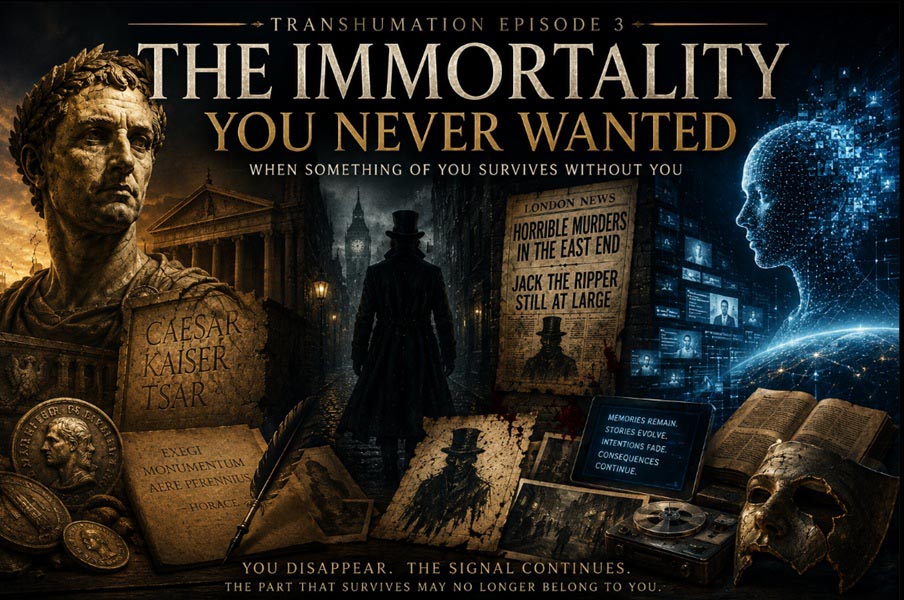
Caesar Escaped the Man
Julius Caesar was murdered in 44 BCE. Whatever he imagined the future of Rome to be, he could not have anticipated the full political world that would eventually grow around his name. The empire commonly associated with Rome’s imperial age developed after his death, and the transformation of Caesar is one of history’s cleaner examples of a name escaping the individual who once possessed it.
It stopped being merely a name.
It became a title.
Through complicated linguistic and political histories, descendants of the word eventually appeared as Kaiser in German-speaking Europe and Tsar or Czar in Slavic traditions. Rulers separated from Caesar by centuries and enormous cultural distances could carry an echo of the Roman name as a designation of supreme authority. Most of the private Julius Caesar vanished, as almost every private human life does, while a tiny fragment proved astonishingly durable.
There is something peculiar about calling this immortality because Caesar himself did not travel with the word. His desires did not accompany it. His consciousness did not sit invisibly inside later emperors. The name survived by ceasing to belong exclusively to the person.
That may be a general rule of cultural survival.
The better something travels, the less completely it can preserve its source.
A civilization cannot carry an entire human life across two thousand years. It compresses. It selects. It turns the complicated original into a transportable structure. Caesar survives as history, literature, political archetype and vocabulary, but none of these is Caesar himself.
He became more durable by becoming less complete.

Horace Builds a Monument
The Roman poet Horace understood this process with extraordinary confidence. In one of his most famous poems, he claimed to have constructed a monument more enduring than bronze. He was not referring to marble or architecture. His monument consisted of arranged language.
It was an audacious claim, but history has been kind enough to make it look almost modest.
The physical body disappeared. Rome changed beyond recognition. Empires that did not yet exist rose and vanished. Latin ceased to be the ordinary language of the streets. Yet the pattern of words survived because it could repeatedly migrate into new physical carriers: manuscript, copied manuscript, printed book, academic edition, translation, database, website, screen.
The continuity lies neither in the parchment nor in the pixels. Those are replaceable.
What travels is structure.
This reveals an important distinction in any serious discussion of immortality. A poem can preserve the products of a mind without preserving the mind itself. When we read Horace, something arranged by a consciousness more than two thousand years ago enters our present experience. We encounter choices of rhythm, image, irony and argument that could not exist in precisely that form without him. Yet Horace is not sitting somewhere behind the text waiting for us to ask a new question.
His voice survived.
His subjectivity, as far as we can establish, did not.
A book is therefore both more and less miraculous than resurrection. It does not bring the dead back. It demonstrates that death does not necessarily end the movement of structures created by the living.
The Monster Without a Face
Cultural immortality becomes darker when the preserved structure is not an achievement but a wound.
Jack the Ripper is one of the clearest examples because the unknown individual has almost completely disappeared behind the entity created by his absence. We possess no confirmed face, no uncontested biography and no final identification. Yet the name remains instantly recognizable more than a century later. Books, films, tours, archives, theories, visual conventions and endless disputes continue adding material to something the original killer could never have completely designed.
The absence became productive.
This is a peculiar reversal of normal memory. Usually we imagine greater knowledge producing a stronger historical presence. With the Ripper, uncertainty helped create durability. Because the original person is missing, later generations can repeatedly reconstruct the empty space. Detective, doctor, immigrant, aristocrat, butcher, sailor, lunatic, conspirator: the figure is endlessly available because the individual can no longer object.
The historical human shrinks while the cultural object expands.
This makes Jack the Ripper an especially disturbing example of immortality without ownership. Whoever committed the murders had intentions, fears, routines, private memories and an ordinary biological existence beyond the crimes. Almost all of that is gone. What survived is a highly compressed pattern: name, place, violence, letters, fog, mystery, pursuit.
It is almost the opposite of biography.
Instead of using fragments to reconstruct the person, culture uses the missing person to generate new fragments.
The result may be more durable than a complete identity ever could have been.
History Chooses the Fragment
We like to imagine legacy as something we curate. Artists select works. Politicians commission memoirs. Business founders put names on buildings. People carefully manage photographs, biographies and digital profiles. There is nothing foolish about this. Human beings understandably want some influence over the form in which they enter memory.
But history is not an employee.
It keeps what proves useful to later generations.
An artist who created hundreds of works may become synonymous with one. A scientist may be remembered for an idea that represented only a fraction of a lifetime’s research. A ruler may survive through a defeat rather than a victory. A person’s most famous quotation may be something they never said. Occasionally the fragment that survives actively contradicts the person from whom it came.
This is not simply historical injustice. It is a consequence of transmission.
Civilization cannot preserve everything at equal resolution. It compresses. Names become labels. Lives become stories. Stories become symbols. Symbols enter new contexts. Each transfer discards information and introduces interpretation.
Then later generations perform the opposite operation: they decompress the fragment.
They encounter the surviving name, image, sentence or event and reconstruct meaning around it using the concerns of their own age. The resulting figure may be partly historical and partly contemporary. Caesar becomes whatever later political cultures require Caesar to mean. Ancient philosophers become allies in arguments they never heard. Religious figures acquire iconographies developed centuries after their deaths. Historical villains become templates for modern fears.
The future does not merely inherit our signals.
It edits them.
You May Have Changed the World Without Noticing
There is a quieter version of this process that does not require emperors, poets or famous murders.
Most consequences have no plaque attached.
Someone recommends a book to a teenager. A teacher makes an unexpectedly generous remark. A stranger introduces two people who later have children. An employee alters a small procedure that becomes standard practice long after everyone forgets who suggested it. A parent repeats a sentence heard decades earlier without remembering its source. An act of humiliation changes someone’s behavior; an act of kindness does the same. The effect passes onward, often without preserving the identity of the person who initiated it.
This should not be inflated into the comforting slogan that every trivial act secretly transforms history. Many actions disappear almost completely. Most people will not become Caesar, Horace or even a footnote.
The more interesting point is epistemic.
No individual possesses a complete map of their consequences.
We see only fragments of the chains that leave us. Some effects appear immediately. Others emerge after years. Some move through people we never meet. Others vanish before going anywhere. The uncertainty works in both directions: our most deliberate attempts at influence may fail, while something we barely noticed may travel surprisingly far.
This produces an unusual basis for hope because it does not require pretending that the universe rewards good intentions or that every action is cosmically significant. It requires only acknowledging the limits of observation.
You do not know everything that ended with you.
You also do not know everything that began.
When the Archive Learns to Answer
Digital technology changes the problem because previous forms of cultural survival were largely static. A portrait could be seen but not respond. A diary could preserve an answer to a question the author anticipated, but not generate a new response to a question asked a century later. A recording could reproduce a voice but could not ordinarily adapt that voice to the listener.
Artificial intelligence introduces the possibility of interactive reconstruction.
Given enough material—letters, recordings, photographs, interviews, messages, preferences, stylistic patterns—a system may be able to generate responses that resemble those a deceased person might plausibly have produced. It could speak with a familiar voice, imitate turns of phrase, retrieve autobiographical information and react to questions that were never asked during the person’s lifetime.
For the first time, the archive may begin to behave conversationally.
That will make one distinction increasingly difficult to maintain emotionally even if it remains philosophically crucial. A system that answers like someone is not automatically that someone.
The difference between simulation and continuation does not disappear simply because the simulation becomes convincing. A model trained on a writer’s work might reproduce style without possessing the writer’s consciousness. A reconstructed voice can utter a sentence the original speaker never formed. A digital avatar might generate new behavior from old information while containing no subjective experience whatsoever.
We currently have no established scientific basis for concluding that such reconstruction transfers the consciousness of the dead.
But this does not make the reconstruction culturally irrelevant.
The digital ghost does not have to be alive in order to act.
It can answer questions, influence descendants, generate new texts, affect reputations and participate in decisions. The pattern can acquire new causal power after the source has disappeared.
Horace’s monument could be read.
The next monument may talk back.
The Immortality You Never Wanted
Perhaps the word immortality has been carrying several different ideas that should never have been placed inside the same box.
There is biological survival: keeping the organism alive.
There is subjective continuity: the continuation of first-person experience.
There is informational preservation: retaining memories, writings, images or behavioral patterns.
There is cultural survival: remaining active inside collective memory.
And there is causal survival: consequences continuing after their source has disappeared.
These forms can overlap, but none guarantees the others.
Caesar demonstrates cultural persistence without personal continuity. Horace demonstrates informational structure crossing thousands of years through changing carriers. Jack the Ripper demonstrates how a narrative can become more culturally powerful as the original individual disappears. Ordinary human life demonstrates that consequences can survive even when names do not.
Digital technology may soon combine several of these layers in ways that make them harder to distinguish. A future person might encounter a responsive reconstruction of a dead grandparent, hear the correct voice, observe familiar gestures and receive plausible answers derived from decades of personal data. The emotional experience could be extraordinary.
The philosophical question would remain.
Who is speaking?
Perhaps no future technology will make that question easy.
Watch the Video
How to Read the World

Current Knowledge
Human cultures have long used monuments, names, texts, images, institutions and records to preserve information beyond individual lifetimes. Written language is especially powerful because symbolic structures can be copied repeatedly across different physical media while preserving substantial portions of their content. Historical memory is also demonstrably selective: later societies continually reinterpret earlier people and events through new political, religious, artistic and cultural contexts.
Julius Caesar died in 44 BCE, and forms derived from the title Caesar later entered several political traditions, including the German Kaiser and Slavic Tsar/Czar. Horace’s claim to have created a monument more lasting than bronze survives in his poetry and has itself become a famous expression of literary posterity. Jack the Ripper remains unidentified in any historically conclusive sense, while the name and associated narrative have persisted as major cultural phenomena far beyond the Whitechapel murders themselves.
Digital systems now permit the preservation of vastly larger quantities of personal data than most earlier media: photographs, writing, voice, video, location histories, social interactions and behavioral traces. Contemporary AI systems can already imitate aspects of style and voice when supplied with suitable data. This demonstrates increasing capability for reconstruction and simulation, not evidence that subjective consciousness has been transferred.
Open Questions
The hardest unresolved question concerns personal identity. If a future system reproduced someone’s memories, linguistic style, preferences and behavior with extraordinary accuracy, what would have to be present before we should regard it as the continuation of that person rather than a model of them? Philosophers disagree about whether identity depends primarily upon biological continuity, psychological continuity, memory, causal history, information or some combination of these. Neuroscience currently provides no accepted procedure for transferring subjective consciousness from a biological brain into another substrate.
A second problem concerns ownership. Who should control a person’s digital remains after death? Descendants? Estates? Technology companies? The public? The person through instructions made during life? If an AI model built from a dead writer’s work produces new texts, are those texts extensions of the writer, works about the writer, or entirely new artifacts? Similar problems will appear around voice, likeness, reputation and consent.
The final question may be the oldest one: how much of a person must survive before survival becomes more than memory? We already accept that influence can continue without consciousness. What remains uncertain is whether the bridge between information and first-person experience can ever be crossed.
Transhumation Interpretation
Transhumation treats immortality not as one phenomenon but as a family of continuities. The mistake is to assume that because something survives, the original self has survived with it.
A pattern can cross carriers astonishingly well.
The body of Horace disappears; the poem continues through parchment, print and pixels. Caesar disappears; the name moves into political language. An unknown murderer disappears; a cultural figure expands into the empty space. A person’s voice can leave the lungs, enter magnetic tape, become digital information and perhaps one day participate in an interactive model. At every stage something survives, but what survives is not necessarily equivalent to what began the chain.
This distinction matters enormously for any future discussion of technological immortality.
If a perfect digital reconstruction of you appears after your death, future observers may experience continuity where you experienced none. The system might know your childhood, use your expressions, recognize your friends and defend opinions you once held. It might even develop beyond those records. Yet an external observer’s conviction that “you are still here” would not prove that the subjective current that once looked through your eyes crossed into the new carrier.
The future may therefore produce a strange category of beings: descendants of people that are neither ordinary archives nor clearly the people from whom they were derived.
They would be patterns with biographies.
Ghosts capable of answering.
And this returns us to the uncomfortable form of immortality with which we began. Perhaps the most durable part of a human being has never been the part the human being owns completely. A work enters readers. A name enters language. A decision enters institutions. A gesture enters another person’s character. Once transmitted, each pattern encounters new carriers and new interpretations.
The price of surviving may be surrendering control over what survival means.
Caesar could not veto Kaiser. Horace cannot correct our interpretations. Jack the Ripper cannot prevent another century of theories. None of us can fully supervise the chains of consequence already moving away from us.
Perhaps immortality is therefore not the victory of the self over death.
Perhaps it is what happens when something produced by the self no longer needs the self in order to continue.
You disappear from the transmission.
The signal keeps moving.
FAQ
What does “The Immortality You Never Wanted” mean?
It describes a form of survival in which something derived from a person—a name, work, story, image, influence or consequence—continues after death without necessarily preserving that person’s consciousness.
Is being remembered a form of immortality?
It can be called cultural immortality, but it should not be confused with literal personal survival. Being remembered means that information or interpretation associated with you persists. It does not demonstrate that your subjective experience continues.
Why is Julius Caesar used as an example?
Because his name outlived him in an unusually visible way. Forms derived from Caesar became titles associated with imperial rule, including Kaiser and Tsar. The name continued operating in worlds Caesar never experienced.
What did Horace mean by a monument more lasting than bronze?
He was referring to poetry. His claim was that literary work could survive physical monuments by continuing to be read across generations. The survival of his poetry makes the argument particularly striking.
Why include Jack the Ripper?
Because he represents a darker form of cultural persistence. The historical individual remains unidentified, yet the name and mythology continue to expand. The uncertainty surrounding the person may actually have helped the cultural figure survive.
Can someone influence the future without being remembered?
Yes. Actions can produce consequences that continue even after the source is forgotten. Social habits, ideas, relationships and decisions can propagate through other people without preserving the identity of the person who began the chain.
Does AI allow dead people to “speak”?
AI can generate new speech or text from surviving records and patterns associated with a dead person. This can create a convincing interactive representation, but it does not establish that the deceased person’s consciousness is present.
Could a perfect digital copy actually be the same person?
We do not know. Even an extremely accurate behavioral copy would leave unresolved the question of subjective continuity: whether the original first-person experience continues in the new system or whether a new system merely believes and behaves as though it were the original.
What is the difference between information and identity?
Information can describe or reproduce aspects of a person. Identity includes the harder question of what makes a person the same subject across time. The two may be related, but they are not known to be identical.
What is the central Transhumation thesis?
Immortality has several layers, and they should not be confused. Bodies can survive, consciousness may or may not continue, information can migrate, stories can evolve and consequences can persist. Something derived from us can remain active long after it stops preserving us completely.
The strangest possibility is therefore not that nothing survives death.
It is that something does—and discovers it no longer needs us.
Continue the Transhumation Series
- Forgotten Religion | Ancient Gods, Symbols and the Hidden Structures of Human Civilization
- The Last Religion | Death, Immortality and the Future of Humanity
- The New Theurgy | AI, Information and the Future of Human Civilization
- End of Branding: You Were Never Meant to Become a Product
- Baal vs Ishtar: Why Ancient Gods Never Disappeared