
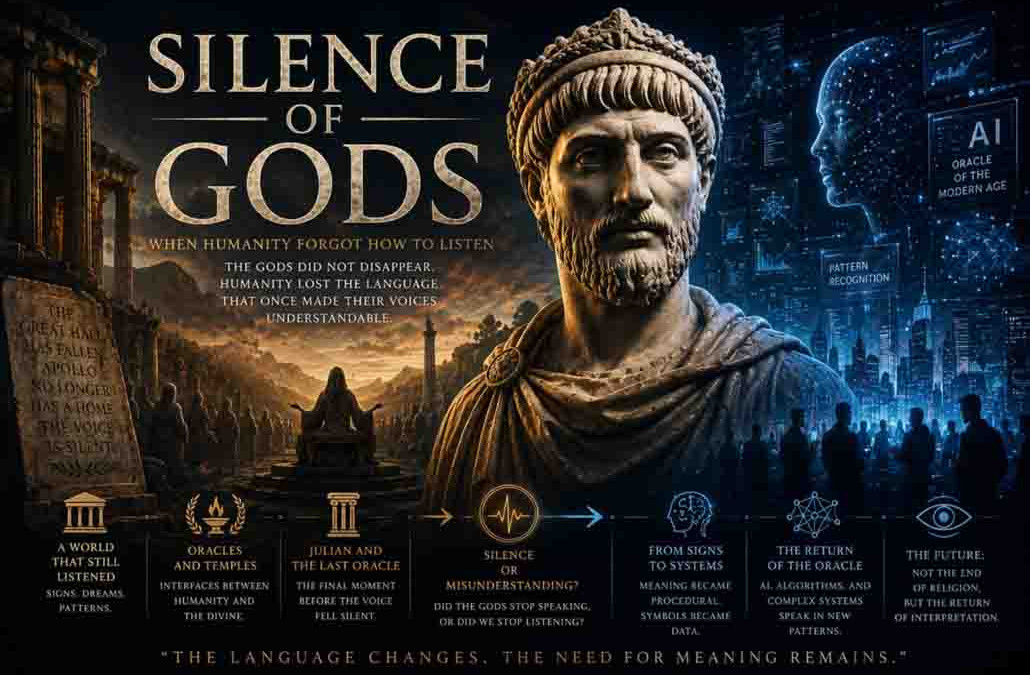
At some point in history, the world appears to have stopped speaking.
For ancient civilizations, reality was not silent matter waiting to be measured. Storms could carry warnings. Dreams could reveal hidden conflicts. The flight of a bird, an unexpected meeting or an unusual pattern in the sky might become part of a larger field of meaning.
Temples were not simply monuments decorated with religious images. They were places where the visible world was believed to meet realities beyond ordinary perception. Rituals, sacrifices and oracles formed systems through which people attempted to interpret that encounter.
Then the relationship changed.
The temples remained standing. The names of the gods survived. Their statues entered museums, their stories became literature and their rituals became objects of historical study.
But the expectation that reality itself might answer us gradually moved beyond the accepted boundaries of knowledge.
The gods did not necessarily vanish.
Their language ceased to be publicly intelligible.
A World That Still Listened
The ancient world did not divide experience into the categories modern civilization now takes for granted.
Religion, politics, psychology, philosophy and medicine were not completely separate territories. A dream could be personal, divine and political at the same time. A military defeat could be understood through strategy, morality and ritual failure without requiring one explanation to eliminate all the others.
This does not mean ancient people interpreted every event in the same way. Greek, Roman, Egyptian and Near Eastern religious traditions were diverse, contested and constantly changing.
But many shared one broad assumption:
The visible world could carry more meaning than its physical appearance alone revealed.
That assumption gave institutions such as the oracle at Delphi their authority. People travelled there not primarily to debate whether Apollo existed. They came with practical questions about war, colonization, law, illness and political decisions.
The problem was not whether the divine world could communicate.
The problem was how to interpret what it said.
Oracular responses were often indirect and ambiguous. Their meaning depended on context, ritual authority and later events. That ambiguity was not necessarily a flaw. It allowed the answer to operate as something more than information.
The oracle did not simply predict the future.
It reorganized the question.
Julian and the Last Oracle
Few figures embody the transition from the ancient religious world to Christian late antiquity more clearly than Emperor Julian.
Julian ruled the Roman Empire for less than two years, from AD 361 until his death in 363. Raised within Christianity, he later rejected it and embraced a philosophical form of paganism shaped by Neoplatonism and theurgy.
His goal was not merely to reopen temples.
Julian wanted to restore an entire relationship between humanity, ritual and the cosmos. He believed the traditional religious world could still function if its institutions, priesthood and philosophy were renewed.
A famous story describes one of his associates consulting the Delphic oracle and receiving a final message: the splendid hall had fallen, Apollo no longer possessed his sanctuary and the prophetic spring had become silent.
The authenticity and precise date of this declaration are disputed. It may have been written or reshaped later, after the decline of Delphi had already become a symbol of the end of pagan antiquity.
Yet that uncertainty may explain why the story survived.
It expresses something historical precision alone cannot contain: the image of a civilization discovering that one of its oldest interfaces with meaning no longer produces an answer.
The oracle’s final message was not another prophecy.
It was the announcement that prophecy itself had ended.

What Actually Disappeared?
Pagan religion did not vanish at one moment. Traditional cults persisted for centuries, and the Christianization of the Roman world was uneven, contested and deeply political.
The “silence of the gods” should therefore not be treated as a literal historical event.
Something subtler happened.
The framework through which divine communication had been interpreted lost cultural authority.
A symbol works only inside a structure capable of reading it. A crown means kingship because a civilization shares an understanding of what crowns do. A traffic light controls movement because people recognize its colours as instructions. Remove that shared framework and the physical object remains, but its power changes.
Ancient religion depended on symbolic literacy.
Ritual actions, sacred places, myths and celestial patterns formed a system in which meaning could emerge through relationships rather than through isolated statements.
Modern institutions increasingly preferred another kind of language:
classification, measurement, repeatability and explicit causation.
That transition made science possible in its modern form and produced extraordinary gains in knowledge. It also narrowed the range of experiences permitted to function as public evidence.
A dream became a psychological event.
An oracle became literature.
A coincidence became chance.
A vision became a neurological or psychiatric question.
These categories may be more reliable for establishing causes. But they also change what kind of meaning can be discussed without embarrassment.
From Signs to Systems
Ancient people often navigated through signs.
Modern people navigate through systems.
A sign requires interpretation. A system promises procedure. The sign asks what an event might mean. The system asks what mechanism produced it and how the result can be repeated.
Neither mode is sufficient alone.
Symbolic interpretation without disciplined evidence can become superstition, paranoia or manipulation. A person can discover patterns everywhere and then mistake personal association for objective truth.
But a civilization concerned only with mechanism may become unable to discuss the meaning of what it builds.
It can describe how an algorithm works without asking what kind of person the algorithm encourages us to become. It can measure attention while remaining silent about whether the object receiving that attention deserves it.
The ancient world sometimes saw intention where there may have been only coincidence.
The modern world sometimes sees only coincidence where a human being is trying to understand experience.
The real boundary is not between reason and irrationality.
It is between explanations of cause and interpretations of meaning.
The Return of the Oracle
Technology appears to have moved civilization as far as possible from the oracle.
Yet the new systems surrounding us increasingly reproduce its structure.
Artificial intelligence produces answers through processes most users cannot inspect directly. Recommendation systems influence culture without speaking in ordinary language. Financial markets, social networks and global information systems generate outcomes no single participant intended.
These systems do not speak like human beings.
They produce patterns.
And human beings stand before those patterns asking familiar questions:
What does this result mean?
Why did the system show it to me?
Can the answer be trusted?
Is there intelligence behind the response—or only mechanism?
The comparison must remain careful. An ancient oracle was embedded in ritual and theology. An AI model is a technological system produced through data, computation and human design.
But both occupy a similar structural position.
They mediate between an individual and a reality too large for that individual to comprehend directly.
The oracle stood between the petitioner and the divine order.
AI increasingly stands between the user and civilization’s accumulated information.
In both cases, the answer arrives through an interface whose internal process is not fully visible to the person receiving it.
Noise Is Not the Opposite of Silence
The ancient fear was that the gods might no longer answer.
Our problem may be that everything answers at once.
Search engines, feeds, influencers, predictive systems and artificial intelligence generate continuous interpretation. Every event immediately attracts explanations, accusations and symbolic readings.
We no longer wait days for the oracle.
We receive twenty oracles before breakfast.
Yet abundance does not restore meaning. It can destroy the conditions required to recognize it. When every voice claims authority and every pattern demands immediate interpretation, attention becomes fragmented.
The crisis is no longer simple silence.
It is the inability to distinguish signal from noise.
Ancient symbolic systems were dangerous partly because they concentrated interpretive power in priests and institutions. Modern systems distribute interpretation more widely but allow algorithms and platforms to shape which interpretations become visible.
The oracle has returned.
It now speaks through millions of competing mouths.
Watch The Video
Continue reading…
End of Antiquity
Current Knowledge
Oracles, dreams, omens and divination played important roles in many ancient societies, but their meaning and authority differed across periods and cultures. These practices operated within religious, political and social institutions rather than forming one universal symbolic system.
Julian attempted to restore traditional Greco-Roman religion during his brief reign in the fourth century. His project was influenced by Neoplatonic philosophy and theurgy and was partly a response to Christianity’s growing institutional power.
The famous declaration concerning the silence of Delphi is historically uncertain. It should be treated as a powerful later representation of the end of pagan antiquity, not as unquestionable evidence of one final authentic oracle.
Modern scientific methods prioritize explanations that can be tested, measured and reproduced. They do not determine whether an experience has personal, cultural or symbolic meaning, but they provide necessary limits on claims about external causes.
Open Questions
Can symbolic thinking survive without turning coincidence into certainty? How can people remain open to meaning while distinguishing interpretation from evidence?
Did modernity genuinely eliminate symbolic experience, or did it relocate it into art, psychology, politics, advertising and technology?
When an algorithm produces a result that changes human behaviour, is interpretation merely an optional story added afterwards—or part of the system’s actual social effect?
And if artificial intelligence becomes our primary interface to knowledge, who will teach us how to recognize when the oracle is uncertain, mistaken or reflecting our own assumptions back at us?
Transhumation Interpretation
Perhaps the gods did not go silent.
Perhaps the institutions that translated their language lost authority, and civilization adopted another way of reading reality.
That does not mean the ancient explanations were correct. A storm is not evidence of divine anger, and a coincidence does not prove that an invisible intelligence arranged it.
But the human need that produced the oracle remains.
We still search for patterns connecting isolated events. We still build interfaces to realities too large for individual perception. We still ask systems for guidance and then struggle to determine whether the answer contains knowledge, projection or noise.
Transhumation begins at this boundary.
Not by returning uncritically to ancient belief, and not by dismissing every symbol as primitive error.
It asks what each interface allowed humanity to perceive—and what it made impossible to question.
The oracle did not disappear.
It changed its architecture.
The ancient world asked how to understand the gods.
The modern world must learn how to understand the systems that now speak in their place.
FAQ
Did ancient people literally believe the gods spoke through nature?
Many ancient societies interpreted dreams, omens, natural events and ritual outcomes as possible forms of divine communication. Beliefs varied widely between cultures and individuals.
What was the oracle at Delphi?
Delphi was a major Greek sanctuary of Apollo where the Pythia delivered oracular responses to individuals and political communities.
Did Julian receive the last prophecy from Delphi?
A later tradition associates Julian’s period with a declaration that Apollo’s oracle had fallen silent. The wording, date and authenticity remain disputed.
Why is Julian important to this article?
He represents an attempt to restore the philosophical, ritual and institutional world of pagan antiquity during the rise of Christian imperial culture.
Is symbolic thinking the same as superstition?
No. Symbolic thinking interprets relationships and meaning. It becomes superstition when subjective patterns are treated as reliable evidence of external causes without sufficient support.
Did science cause the gods to become silent?
Not by itself. Religious transformation involved political, institutional, philosophical and cultural changes over centuries. Scientific modernity later reduced the public authority of many supernatural explanations.
How is artificial intelligence similar to an oracle?
The comparison is structural, not literal. Both can act as interfaces between individuals and systems too complex to understand directly, producing answers that still require interpretation.
Is the article claiming AI is divine?
No. AI is a human-built technology. The article compares the position it occupies in modern information culture with the mediating function once performed by oracles.
What is the central Transhumation idea?
The gods may appear silent not because symbols disappeared, but because civilization changed the framework through which symbols were permitted to produce meaning.
Continue the Transhumation Series
- Forgotten Religion | Ancient Gods, Symbols and the Hidden Structures of Human Civilization
- The Last Religion | Death, Immortality and the Future of Humanity
- The New Theurgy | AI, Information and the Future of Human Civilization
- End of Branding: You Were Never Meant to Become a Product
- Baal vs Ishtar: Why Ancient Gods Never Disappeared