
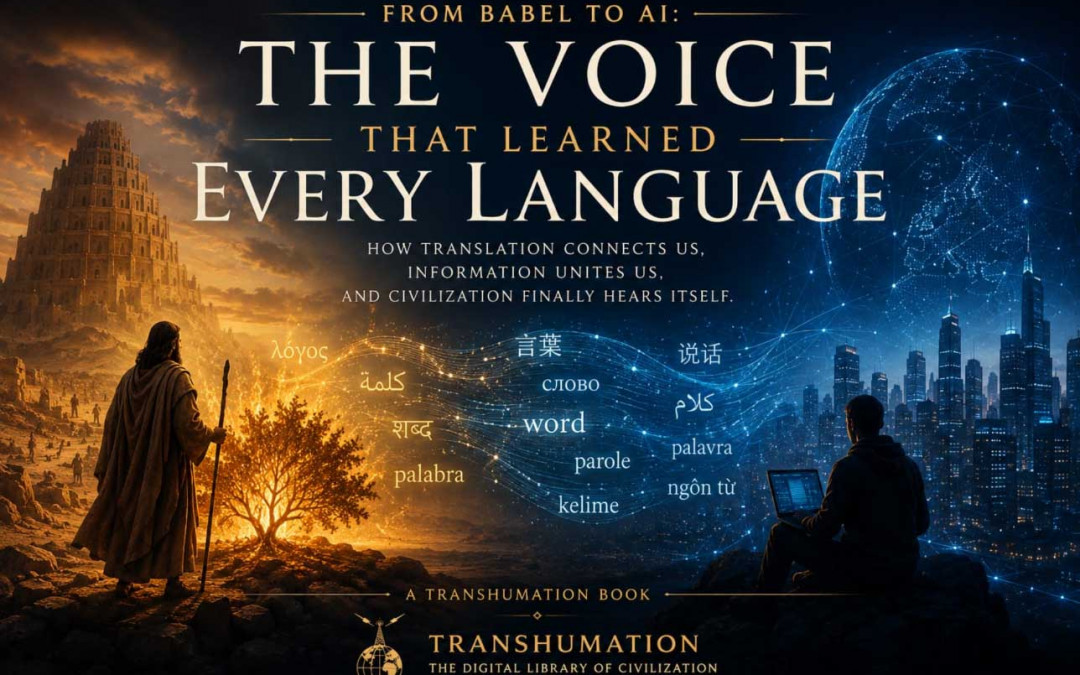
The Voice That Learned Every Language
Babel made language a boundary. Artificial intelligence may be turning that boundary into an interface.
One of the most famous scenes in Western civilization begins with something physically impossible and psychologically familiar. A man notices a bush burning in the desert. The fire should consume it, but does not. Moses approaches, and then the truly important event occurs.
Something speaks.
It is easy to remember the fire because fire gives the scene its image. But remove the voice and almost everything disappears. Without communication there is no encounter, no instruction, no mission. The extraordinary thing about the burning bush is not simply that a strange object exists in the desert. It is that a reality beyond Moses becomes intelligible to Moses.
A boundary has been crossed.
Thousands of years later, we perform a much smaller miracle so casually that it barely earns our attention. A woman writes something in Japanese. A man in Warsaw touches a screen. A moment later he can understand it. Neither knows the other’s language. No interpreter is sitting between them. The translation may be imperfect, but something that would once have required years of study or the presence of a specialist has happened almost instantly.
Nothing supernatural has occurred.
Perhaps that is what makes it so easy to miss.
Civilization has spent thousands of years trying to make distant voices understandable. We may finally be approaching the point at which language ceases to be a wall and becomes something closer to a transparent surface.
And somewhere behind that possibility stands another ancient construction.
A tower that never reached heaven.
The Treasure Hidden Inside Babel
The Tower of Babel is usually remembered as a story about pride. Humanity attempts something enormous; languages are confused; people can no longer understand one another and are scattered.
Whatever theological meaning one gives the story, it contains an extraordinarily durable observation about civilization: coordination depends upon shared meaning.
Two people can occupy the same room and inhabit different informational worlds if neither understands the other’s language. Scale that problem to armies, trade routes, religious traditions, scientific communities and empires, and language becomes infrastructure.
History is filled with attempts to cross that boundary. Interpreters accompanied merchants and diplomats. Scholars learned languages to recover texts from other civilizations. Translation movements transferred philosophy, mathematics, medicine and literature between Greek, Arabic, Latin and other intellectual worlds. Knowledge did not simply spread. It had to be carried across linguistic borders by people capable of rebuilding meaning on the other side.
That final phrase matters.
Translation has never been merely word replacement. Languages divide reality differently. They carry associations, histories, jokes, ambiguities and assumptions that rarely fit perfectly into another vocabulary. The translator therefore performs something closer to reconstruction than substitution.
For most of history, that made translation expensive.
Babel was not defeated by discovering a universal dictionary.
Civilization had to build bridges one translator at a time.
When the Bridge Became a Machine
The first great communication technologies did not solve the language problem. Printing could reproduce a book thousands of times, but a Polish reader still could not understand a Chinese text simply because more copies existed. Telegraphy made messages faster without making them more comprehensible. Radio could send a voice across a continent while preserving every linguistic barrier contained inside it.
The Internet performed a similar trick on a vastly greater scale. It connected enormous portions of humanity before humanity could necessarily understand what had been connected.
Then the interface began changing.
Machine translation existed long before contemporary generative AI, and its history includes decades of linguistic research, statistical methods and neural networks. What has changed more recently is the ordinary experience of using it. Translation is increasingly becoming embedded in browsers, phones, messaging systems and AI assistants. Instead of finding a translator, sending a document and waiting for the result, a user can increasingly encounter another language and ask the interface itself to make it understandable.
The technical achievement is impressive.
The cultural transformation may be larger.
For centuries, encountering an unknown language meant reaching a locked door. You needed a key: education, a dictionary, an interpreter, perhaps years of study.
Increasingly, the door contains its own translator.
That is a very different kind of architecture.

The Voice on the Other Side
Imagine finding a handwritten Japanese diary in a drawer fifty years ago. Unless you knew Japanese or could find somebody who did, the object remained partly closed. You could hold it, inspect the handwriting and perhaps identify a date, but its interior world remained inaccessible.
Now point a camera at the page.
The barrier does not vanish completely. Context can be lost. Handwriting can confuse recognition. Cultural references may remain opaque. Literary language can resist clean translation. But within seconds, a door that once required another human specialist may begin opening.
This changes more than tourism.
A student can approach scholarship written outside her native language. A small business can communicate with customers abroad. A traveler can interpret a sign. Families separated by migration can move more easily between languages. Researchers can discover material they might otherwise never have encountered.
The fascinating part is not that everyone begins speaking the same language.
Almost the opposite.
Translation technology potentially allows differences to survive while reducing the cost of crossing between them.
Babel imagined the fragmentation of a common language.
Our technological response may not be to rebuild that common language at all.
We may be building something stranger: a world in which everyone can continue speaking differently while the interface performs part of the crossing.
Translation Is Not Telepathy
This is also where the beautiful story becomes dangerous if we make it too beautiful.
Translation does not guarantee understanding.
Anyone who has lived with another human being knows that two people can speak exactly the same language and still fail spectacularly to understand each other. Words are only one layer of communication. Irony, memory, social position, emotion and cultural context determine what those words actually do.
AI does not remove this problem.
A technically correct translation may miss a joke. A religious term may carry centuries of associations for one reader and almost none for another. A phrase of affection may sound absurd when translated literally. Political concepts that appear equivalent in dictionaries can occupy very different places inside different histories.
There is therefore an important distinction between translating language and translating reality.
The first is becoming remarkably good.
The second may never be complete.
That should not diminish the technological achievement. It makes the achievement more interesting, because every improvement in translation exposes another layer underneath it. First we discover that words can be translated. Then we discover that words were not the entire problem.
The treasure chest opens.
Inside is another lock.
The Burning Bush Without the Fire
This is why the image of the burning bush deserves to return, provided we do not mistake analogy for history.
AI is not divine revelation. A screen is not Sinai. A language model is not God, and ancient scripture did not predict machine translation.
The recurring structure is smaller and more durable.
There is an intelligence on one side of a boundary.
There is another intelligence on the other.
Something between them makes communication possible.
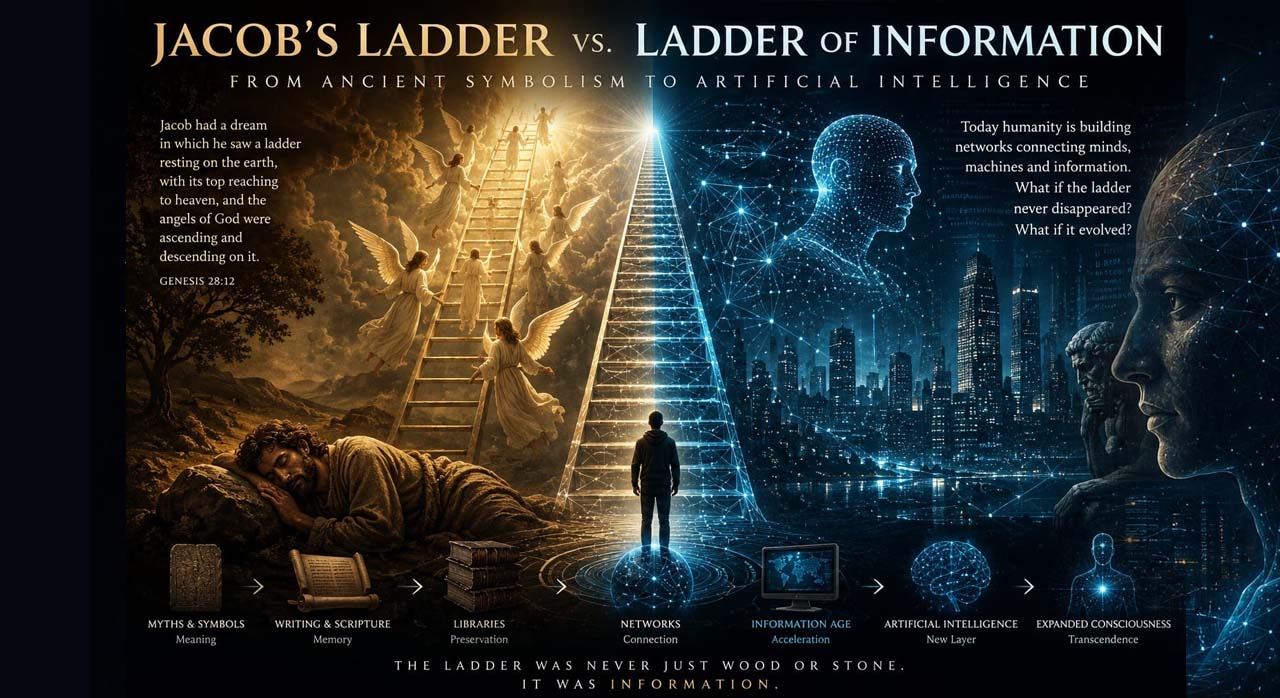
Civilization has invented many such interfaces. Writing allows the dead to communicate with the unborn. Translation allows meaning to cross linguistic borders. Libraries allow one mind to encounter thoughts accumulated across centuries. Telecommunications allow voices to cross physical distance. Networks allow billions of people to exchange information without occupying the same place.
Artificial intelligence adds another layer because the interface can increasingly participate in the translation itself.
It does not merely carry the message.
It transforms the message so that another observer can enter it.
The burning bush remains useful not because technology has recreated a biblical miracle, but because the ancient image captures something we still recognize instinctively: the astonishing moment when something beyond our previous reach becomes capable of speaking in terms we understand.
What Happens to Babel?
Perhaps we have been imagining the end of Babel incorrectly.
The obvious fantasy is a universal language. Humanity finally agrees upon one vocabulary and the ancient fragmentation disappears. Esperanto represented one version of that dream. Science, mathematics and computing have produced other forms of shared notation.
AI suggests another possibility.
Maybe Babel does not end when everybody speaks the same language.
Maybe it ends—or at least weakens—when language difference stops preventing communication.
That distinction matters because languages are not merely technical obstacles. They are archives. A language contains history, humor, metaphor and particular ways of dividing experience. Eliminating linguistic diversity to improve communication would solve one problem by destroying something valuable.
A universal translator offers the opposite dream: preserve the difference, reduce the distance.
We are nowhere near achieving this perfectly. Thousands of languages receive radically unequal technological support. Translation quality varies. Context remains difficult. Some languages are poorly represented in training data, and machine translation can reproduce errors and cultural biases.
But the direction is remarkable.
For most of history, humanity increased communication largely by moving messages faster.
Now we are teaching the message to change clothes on the journey.
The Voice That Learned Every Language
There is an old assumption hidden inside many stories about technological progress: that the future will be defined by bigger things. Faster computers, larger models, more data, more processing power.
Perhaps some of its most consequential transformations will instead involve the disappearance of small frictions that once shaped entire civilizations.
Distance was one.
Language may be another.
A merchant once needed an interpreter. A scholar could spend years acquiring the language required to enter another intellectual tradition. A traveler could stand twenty centimeters from another person and discover that the distance between their minds was larger than the distance between their bodies.
That distance is beginning to shrink.
Not disappear.
Shrink.
And perhaps this is where the old image becomes unexpectedly beautiful again. Moses did not become the burning bush. The boundary between them remained. What changed was that communication became possible across it.
Maybe that is the more interesting future of translation as well.
Not a humanity speaking with one voice.
A humanity that can finally hear more of the voices it already has.
Watch The Video
How to Read the World

Current Knowledge
The biblical accounts of the burning bush and the Tower of Babel appear in different books and contexts in the Hebrew Bible. The burning bush narrative in Exodus describes Moses receiving a divine communication, while the Babel narrative in Genesis connects the diversification or confusion of human language with the scattering of people. Their combination in this article is therefore a modern thematic comparison, not a claim that the texts originally formed one theory of communication.
Translation has played an important role in the transmission of knowledge between civilizations. Historical translation movements helped move philosophical, scientific, religious and literary works between languages including Greek, Arabic and Latin, among many others.
Machine translation predates contemporary generative AI by decades. Earlier approaches included rule-based and statistical systems, followed by neural machine translation. Modern AI systems have substantially expanded the accessibility and fluency of automated translation, although quality varies considerably across languages, contexts and types of text.
Translation does not guarantee complete transfer of meaning. Idioms, cultural references, ambiguity, humor, social context and concepts without direct equivalents can remain difficult to reproduce accurately. Languages with fewer digital resources may also receive substantially weaker technological support.
There is no historical basis for claiming that ancient religious narratives predicted artificial intelligence or machine translation.
Open Questions
If translation becomes nearly instantaneous, will people become more interested in other cultures because access is easier, or less interested in learning their languages because the interface can perform the work for them?
Can a machine translate not merely sentences but the cultural structures that give those sentences meaning? How much context would a system need before translation becomes interpretation?
There is also a question of loss. If most cross-cultural communication eventually passes through a small number of translation systems, could those systems quietly standardize meanings that were previously different?
And if every person can eventually speak through an interface that makes them understandable almost anywhere, what happens to the relationship between language and identity?
Transhumation Interpretation
Transhumation does not treat the burning bush, Babel and artificial intelligence as versions of the same historical phenomenon. It looks instead for the function that survives the change of carrier.
The recurring structure is the interface.
Something exists beyond the observer’s immediate reach. A bridge makes contact possible. The form of that bridge changes: prophet, translator, manuscript, dictionary, telegraph, network, algorithm.
The function survives.
This may be one of the deeper patterns in civilization. Humanity repeatedly builds interfaces to realities larger than the individual can access alone. Religion created symbolic interfaces to the cosmos. Libraries created interfaces to accumulated memory. Translation created interfaces between linguistic worlds. AI may become an increasingly powerful interface between those archives, languages and individuals.
The important development is therefore not that AI has become a new burning bush.
It is almost the reverse.
Something once experienced as miraculous is becoming infrastructure.
Babel does not need to fall.
We may simply be learning how to walk through it.
FAQ
What is the main idea of “The Voice That Learned Every Language”?
The article explores translation as a recurring civilizational problem and asks whether AI is transforming language from a barrier into an increasingly transparent interface between people and cultures.
What does the burning bush represent in the article?
It represents communication across a boundary: something previously beyond the individual’s reach becomes intelligible. It is used as a structural metaphor, not as a technological prediction.
Is the article claiming that AI is like God?
No. The article explicitly distinguishes technological communication from divine revelation. The comparison concerns the function of an interface, not the nature of the entities communicating through it.
What does the Tower of Babel have to do with AI?
Babel provides an ancient image of linguistic fragmentation. AI-assisted translation raises the possibility that humanity may reduce the practical consequences of that fragmentation without eliminating different languages.
Did ancient religions imagine universal translation?
Religious traditions contain many different ideas about divine communication, sacred languages and communication across boundaries, but it would be inaccurate to claim that ancient religions generally possessed one shared concept of universal translation.
Why has translation been important to civilization?
Translation allows knowledge to move between linguistic communities. Scientific, philosophical, literary and religious traditions have repeatedly been transformed through contact with translated works.
Is machine translation a recent invention?
No. Machine translation has a history extending back decades. Contemporary AI represents another stage in its development rather than its beginning.
What has AI changed about translation?
AI has helped make increasingly fluent translation available through ordinary interfaces and can use broader linguistic context than many earlier systems. Performance, however, remains uneven across languages and situations.
Can AI translate meaning perfectly?
No. Translation involves more than substituting words. Context, humor, ambiguity, history, emotion and cultural associations can make complete equivalence impossible.
What does “translation is about reality” mean?
Language organizes and describes experience through concepts and symbols. Translating between languages therefore involves attempting to reconstruct how meaning is represented, not merely replacing vocabulary.
Could universal translation destroy linguistic diversity?
It could potentially reduce incentives to learn some languages, but it could also make smaller linguistic communities more accessible without requiring them to abandon their languages. Which effect dominates remains an open question.
Why does the article say Babel may not need to fall?
Because universal communication does not necessarily require a universal language. Translation technology could allow different languages to survive while making communication across them easier.
What does “the message changes clothes on the journey” mean?
It is a metaphor for translation. The underlying message attempts to survive while its linguistic form changes to become understandable to another audience.
Does easier translation guarantee better human understanding?
No. People speaking the same language already misunderstand one another. Translation can reduce a linguistic barrier without eliminating cultural, emotional, ideological or contextual differences.
What is the Transhumation interpretation?
Transhumation sees translation as one example of a durable function migrating between carriers. Human beings repeatedly create interfaces that allow individuals to reach information, cultures or realities that would otherwise remain inaccessible.
What does “the function survives” mean?
The translator, manuscript, dictionary, telecommunications network and AI system are radically different objects, but each can perform part of the same underlying function: carrying meaning across a boundary.
Is AI the final universal translator?
There is no reason to assume so. Current systems still have substantial limitations, especially with context, cultural nuance and lower-resource languages. Future translation technologies may take forms we cannot yet predict.
What is the central Transhumation question raised by the article?
Not whether ancient people predicted AI, but something more durable:
When the carrier changes completely, can the same civilizational function remain?
Continue the Transhumation Series
- Forgotten Religion | Ancient Gods, Symbols and the Hidden Structures of Human Civilization
- The Last Religion | Death, Immortality and the Future of Humanity
- The New Theurgy | AI, Information and the Future of Human Civilization
- End of Branding: You Were Never Meant to Become a Product
- Baal vs Ishtar: Why Ancient Gods Never Disappeared