
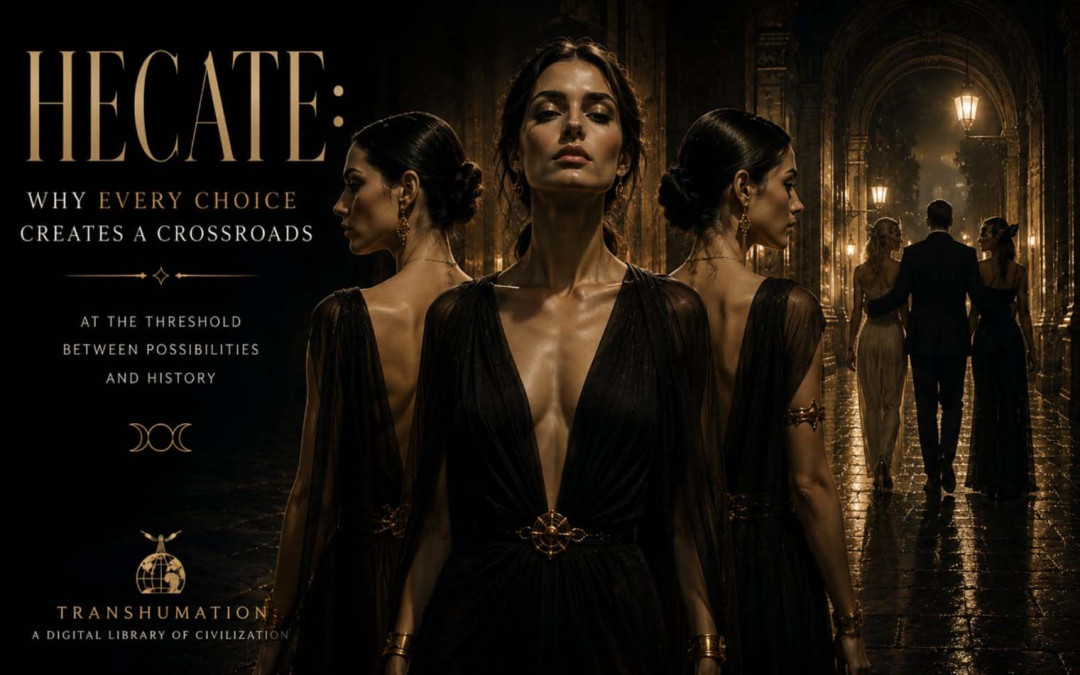
Choice Creates a Crossroads
Long before decision theory, algorithms and infinite menus, an ancient goddess was already waiting in the one place every possible future eventually has to pass through.
There is a peculiar moment on every journey when the map becomes less useful.
You reach a fork in the road. Both paths are real. Both disappear somewhere beyond what you can see. For a few seconds nothing has happened yet: the journey can still become either journey. Then you choose one road, begin walking, and something almost invisible occurs. The other landscape does not vanish from the world, but it vanishes from your life.
Ancient travelers knew this feeling without needing a theory of decision-making. Roads were dangerous, information was scarce, and choosing incorrectly could mean losing hours, missing shelter or arriving somewhere you had never intended to go. It is hardly surprising that crossroads accumulated stories, rituals and supernatural associations.
Among the figures associated with such places was Hecate.
Today she is frequently introduced as a goddess of witchcraft, magic and the occult. Those associations are real, particularly in later traditions, but they can obscure something older and perhaps more interesting. Hecate was also connected with boundaries, entrances, roads and crossroads. Images and shrines associated with her could mark places where one territory, direction or condition became another.
That makes her useful for Transhumation for a reason that requires no belief in ancient gods.
She stands beside a structure we still inhabit.
The instant before one possible world becomes the world we actually enter.
The Place Where Nothing Has Happened Yet
A crossroads is an unusual object because its importance comes almost entirely from what has not happened.
Before the traveler chooses, several routes remain available. Afterward, one becomes biography while the others become counterfactuals: lives that might have existed but did not.
We usually reserve dramatic language for dramatic decisions—marriage, emigration, children, careers, war—but ordinary life is constructed from smaller crossings. You accept an invitation and meet somebody you would otherwise never have known. You reject a job and remain in a city for another year. You open one book rather than another, answer one message, miss one train, walk into one restaurant.
Most produce nothing memorable. A few reorganize everything that follows.
The difficulty is that we rarely know which kind we are facing when we arrive.
This is what makes the crossroads more interesting than the familiar slogan that „life is about choices.” The traveler at the fork possesses something extraordinarily valuable and extraordinarily temporary: multiple accessible futures.
The moment she begins walking, possibility acquires a cost.
A road chosen is also a road abandoned.
That is not a failure of freedom. It may be what gives freedom its weight.
Hecate at the Gate
The historical Hecate is more complicated than the modern image of a torch-bearing witch goddess suggests. Her cult and representation changed across centuries and regions of the Greek and Roman worlds. She could be associated with liminal places, doorways, night, torches, protection, the household and eventually magic and ghosts. Triple-bodied or triple-formed representations became especially characteristic of her iconography.
What we should resist is turning all of this into a secret ancient philosophy of decision-making. There is no surviving Greek manual telling us that Hecate’s three bodies encode a modern theory of branching futures.
The historical evidence gives us something better than that.
It gives us the threshold.
A doorway matters because it is neither simply inside nor simply outside. A crossroads matters because it temporarily contains more than one direction. Dawn and dusk fascinated ancient cultures for a similar reason: each occupies the unstable territory between conditions.
Hecate belongs unusually well to this geography of the between.
That suggests a more interesting question than asking what ancient Greeks „really meant” by every feature of her imagery.
Why do human cultures repeatedly place special meaning at boundaries?
Perhaps because a boundary is where categories become visible. We notice land when we reach the sea. We notice childhood when we begin leaving it. We notice an era when something begins replacing it.
And we notice choice most clearly when two futures can no longer be kept at once.
Three Is Where the Experiment Begins
There is another temptation surrounding Hecate: the number three.
Her triple form is visually irresistible. Three faces, three directions, three bodies. Once you begin looking for threes, civilization supplies them enthusiastically—triads, trinities, beginning-middle-end, birth-life-death, thesis-antithesis-synthesis. The pattern can become so seductive that almost anything can be made to fit it.
That is exactly where Transhumation should become suspicious of itself.
There is no good historical basis for declaring that Hecate’s triple form means that „one is coincidence, two is pattern and three is meaning.” Nor can we simply infer from her iconography that ancient people understood the triangle as some universal metaphysical law.
But three does possess an interesting structural property independent of Hecate.
One point marks a position. Two establish a relation or line. Three non-collinear points can define a triangle and enclose an area. Something new becomes possible.
That mathematical fact does not explain Hecate.
It gives us an experiment.
Instead of claiming that the goddess secretly means the geometry, we can ask whether her triple imagery and the geometry of three illuminate the same broader fascination: the moment when separate possibilities begin producing structure.
That question is much harder to prove.
Which is precisely why it is worth keeping.
The Road Creates the Traveler
We normally imagine choice as something performed by a stable person.
First there is you. Then you choose.
But biography suggests a more complicated relationship. Choices do not merely emerge from identity. Repeated choices help manufacture it.
A person chooses to write every morning and eventually becomes a writer. Someone accepts responsibility for another person and discovers capacities that had previously existed only as possibilities. Someone lies once, discovers that it works, lies again, and gradually constructs a system in which further lies become necessary.
The traveler chooses the road.
Then the road begins changing the traveler.
This is where the crossroads connects directly with the argument of Freedom Is Not Arbitrariness. Freedom cannot mean preserving every possibility indefinitely, because a life constructed that way could never acquire much form. Building anything—an expertise, relationship, institution, character—requires possibilities to be surrendered.
A pianist becomes capable of playing Rachmaninoff partly by spending thousands of hours not doing other things.
The limitation creates the capacity.
This makes choice stranger than the modern consumer version of freedom suggests. The important question may not be how many options we possess. It may be which options are capable of changing the person who selects them.
The deepest crossroads does not ask, „Which road do you want?”
It asks:
Who exists at the end of each one?
The Machine With a Million Roads
For most human beings who ever lived, the field of practical choice was narrow. Geography, family, sex, class, law, religion, wealth and simple access to information constrained enormous parts of life.
Modernity has not abolished those constraints, and they remain radically unequal. But for many people it has multiplied visible alternatives to a degree that would have been difficult for earlier societies to imagine.
A phone can display thousands of potential partners, careers, destinations, opinions, products and identities before breakfast.
At first glance this appears to be the ultimate victory of freedom.
But there is a strange problem.
A crossroads with three roads demands a decision. A crossroads with three million roads may produce paralysis.
Digital systems therefore increasingly choose before we choose. Search engines rank. Recommendation systems filter. Dating applications order possibilities. Navigation software proposes a route. Streaming platforms decide which tiny fraction of their libraries we are likely to encounter.
The crossroads has not disappeared.
It has acquired an architect.
That may be one of the most important transformations of choice in the information age. The old traveler worried about which road to take. The modern traveler must also ask why these particular roads appeared on the screen in the first place.
Who built the crossroads?
Who removed the other exits?
Who placed one road at the top?
And who benefits when we take it?
Hecate becomes unexpectedly contemporary here—not as a supernatural explanation, but as a reminder to notice the threshold itself.
The Fourth Figure at the Crossroads
There is an appealing Transhumation idea hidden in Hecate’s triple imagery, provided we label it clearly as interpretation rather than antiquity.
Imagine three roads.
The geometry appears to contain three possibilities, but the structure is incomplete. Something else must be present for those roads to become choices.
The observer.
Without a traveler, there are merely roads. Without an agent capable of acting, there is no decision, responsibility or abandoned future.
The fourth element is therefore not necessarily another road.
It is the one who must choose among them.
This changes the image considerably. Hecate no longer needs to represent an oracle telling the traveler which future is correct. Perhaps her more interesting position is beside the traveler at the moment when certainty becomes impossible.
She carries torches, after all.
A torch illuminates some distance.
Not the entire road.
That may be a much better model of human decision than the fantasy of perfect knowledge. We rarely know enough. We see a little way forward, carry fragments of experience, estimate consequences and move.
The future remains dark beyond the radius of the light.
And still the road must be chosen.
The Crossroads We Are Building
Civilizations encounter these moments too.
Artificial intelligence is one. Biotechnology may be another. Digital identity, longevity, autonomous systems and the increasingly intimate connection between biological humans and informational environments are opening possibilities whose consequences cannot yet be fully mapped.
It is tempting to describe this dramatically as humanity standing at the crossroads.
History warns against that language. Civilizations have repeatedly believed themselves to be living at the decisive turning point of everything.
Perhaps there is no final crossroads.
Perhaps civilization is a sequence of them.
Agriculture altered the possible forms of human settlement. Writing changed memory. Printing changed the distribution of knowledge. Industrialization transformed production and environment. Computing altered information. AI may change the relationship between knowledge and the individual again.
None created the future alone.
Each altered the roads available at the next intersection.
That is the more durable Hecate structure.
A choice creates consequences. Consequences create conditions. Conditions determine which choices become possible next.
The crossroads produces another crossroads.
The Road Behind Us
Perhaps this is why the old goddess has survived so easily in the imagination.
Not because modern people secretly worship Hecate, and not because an ancient symbol contains a hidden technical manual for the twenty-first century. She survives because the situation represented by the threshold never disappeared.
We still arrive at places where several futures are possible and none is guaranteed.
We still want somebody to tell us which road is correct.
We still carry only enough light to see part of the way.
The modern world has given us extraordinary maps, predictions, algorithms and models, but it has not removed the fundamental condition of the traveler. Information can improve a decision. It cannot live the consequences for us.
And perhaps that is the treasure hidden at the crossroads.
We usually imagine freedom as having many roads.
But freedom becomes real only when one of them is taken.
The unchosen roads remain behind as ghosts: possible careers, possible cities, possible relationships, possible civilizations. They mattered because they could have happened.
Then somebody moved.
The map became a journey.
Possibility became history.
And somewhere at the edge of the road, an ancient figure with a torch suddenly looks less ancient than she did before.
Watch The Video
How to Read the World
Current Knowledge
Hecate was an ancient Greek goddess whose roles and associations developed considerably over time. Ancient literary, archaeological and artistic evidence connects her with several domains, including boundaries, entrances, roads and crossroads, torches, night, protection, ghosts and, particularly in later traditions, magic and witchcraft.
Crossroads and doorways could have religious significance in ancient Greek practice, and offerings associated with Hecate were made in liminal locations. The precise meanings and practices varied across periods and communities.
Hecate was represented in multiple forms. Triple-bodied or triple-formed representations became an important part of her iconography, particularly in association with boundaries and crossroads. The famous Hekataion type is associated with this development.
There is no established historical evidence that Hecate’s triple representation encoded the modern proposition „one is coincidence, two is pattern, three is meaning.” That idea belongs to the Transhumation interpretation developed in this article.
Similarly, the geometric observation that three non-collinear points define a triangle is mathematically valid, but connecting this property with Hecate’s ancient religious symbolism is an interpretive comparison rather than an established historical explanation.
Modern psychological and behavioral research does support the broader observation that choice can become difficult when people face large or complicated sets of options, although the popular claim that „more choice always makes people less happy” is too simplistic. Effects depend on context, stakes, individual differences and how alternatives are presented.
Digital recommendation and ranking systems increasingly mediate the options users encounter. They do not merely respond to choices; they can influence the informational environment in which choices are made.
Open Questions
Why did crossroads acquire supernatural and ritual importance across different cultures? Was this primarily a consequence of practical uncertainty and danger, or do liminal locations attract symbolic meaning for deeper psychological reasons?
Why did triple imagery become particularly powerful in representations of Hecate? Which elements can be securely reconstructed historically, and which interpretations are products of later traditions?
Does greater access to choices actually increase human agency, or can systems containing enormous numbers of possibilities transfer power toward whoever filters and ranks those possibilities?
As AI systems increasingly recommend actions rather than merely provide information, where does assistance end and the architecture of choice begin?
And perhaps the largest question remains impossible to answer in advance: can humanity recognize a genuinely historic crossroads while standing inside it, or does a crossroads become visible only after we have already taken the road?
Transhumation Interpretation
Transhumation treats Hecate not primarily as „the goddess of magic,” but as a possible interface for a recurring structure: the threshold at which several possibilities become one experienced history.
This does not mean that ancient Greeks possessed the Transhumation philosophy or secretly encoded modern decision theory in Hecate. The historical goddess and the modern interpretation must remain separate.
The structural proposition is simpler:
possibility → choice → consequence → new conditions → new possibility.
The traveler does not merely choose between worlds. By choosing, the traveler helps construct the conditions from which the next choice will emerge.
This also suggests a possible relationship between Hecate and Baal within the Transhumation vocabulary. Hecate can represent the visible crossroads: the moment of choice. Baal can represent the structure produced afterward, when repeated choices harden into systems, institutions, habits and rules.
Hecate opens the road.
Baal builds the city at its end.
And eventually that city determines which roads its inhabitants can see.
The deeper question is therefore not simply whether humanity is free.
It is whether we can recognize the crossroads before the road becomes architecture.
FAQ
Who was Hecate?
Hecate was an ancient Greek goddess associated with several domains, including boundaries, crossroads, entrances, torches, night and protection, and later especially with magic, ghosts and witchcraft.
Was Hecate really a goddess of crossroads?
Yes. Crossroads and liminal spaces are historically attested aspects of her cult and iconography, although they were only part of her much broader religious identity.
Why was Hecate represented in triple form?
Triple representations of Hecate became an important part of her iconography, especially in relation to boundaries and crossroads. Scholars have proposed different interpretations, and no single modern symbolic explanation should be treated as certain.
Does Hecate’s threefold form represent past, present and future?
That is a popular later interpretation, but it should not automatically be presented as the original or universal ancient meaning of her triple form.
Does the number three have a special meaning in Transhumation?
It can. Transhumation is interested in the structural transition from isolated elements toward relations and patterns. However, this is a philosophical framework of the project, not a claim about what ancient worshippers of Hecate believed.
Why does the article compare three points with a triangle?
Three non-collinear points can define the first polygon and enclose an area. The article uses this mathematical property as a modern structural analogy rather than as an explanation of Hecate’s historical iconography.
Why are crossroads important symbolically?
Crossroads combine uncertainty, alternative directions and the necessity of choosing. They therefore provide a powerful physical metaphor for decisions and transitions.
Why does every choice create a crossroads?
A meaningful choice separates possible futures. Selecting one path changes the conditions under which later decisions will be made, effectively helping create the next crossroads.
Does choosing reduce freedom?
In one sense, yes: choosing one path can eliminate alternatives. But it can simultaneously create capacities, relationships and opportunities that would not exist without commitment.
Why can having too many choices become a problem?
Large or complex sets of options can increase cognitive demands, comparison and uncertainty. The effect is contextual, however, and more choice does not automatically produce paralysis.
What do algorithms have to do with Hecate?
Modern algorithms increasingly rank and filter the alternatives people encounter. The article uses the crossroads metaphor to ask not only which road we choose, but who determines which roads become visible.
Is standing still also a choice?
Sometimes, but not universally. Failing to act can have consequences and therefore function like a decision, although circumstances can also prevent a person from acting meaningfully.
What is the „fourth figure” in the article?
It is a Transhumation interpretation. Three roads do not constitute a meaningful choice without an observer or agent capable of selecting among them. The traveler completes the structure.
What does Hecate’s torch symbolize here?
Historically, torches are genuinely associated with Hecate. In the Transhumation interpretation, the torch becomes a metaphor for limited knowledge: enough illumination to choose a direction, but not enough to see the entire future.
Is humanity currently at a crossroads because of AI?
AI is creating consequential new choices concerning work, knowledge, autonomy, surveillance, creativity and human-machine relationships. Whether this period will ultimately rank among civilization’s greatest turning points can only be judged retrospectively.
What is the central idea of the article?
A crossroads is not merely a place containing several roads. It is a temporary condition in which several futures remain possible. Choice converts one of those possibilities into history.
What is the Transhumation interpretation of Hecate?
Hecate represents the boundary between possibility and realized history: not an oracle that tells us which road to choose, but a figure standing at the point where choice becomes consequence.
What is the relationship between Hecate and Baal in Transhumation?
Hecate represents the crossroads where a choice remains visible. Baal represents the structure that can emerge afterward as choices accumulate into habits, institutions and systems.
What is the most important question raised by the article?
Not simply „Which road should we take?”
But:
„Who built the crossroads—and what will our choice make possible at the next one?”
Continue the Transhumation Series
- Forgotten Religion | Ancient Gods, Symbols and the Hidden Structures of Human Civilization
- The Last Religion | Death, Immortality and the Future of Humanity
- The New Theurgy | AI, Information and the Future of Human Civilization
- End of Branding: You Were Never Meant to Become a Product
- Baal vs Ishtar: Why Ancient Gods Never Disappeared