
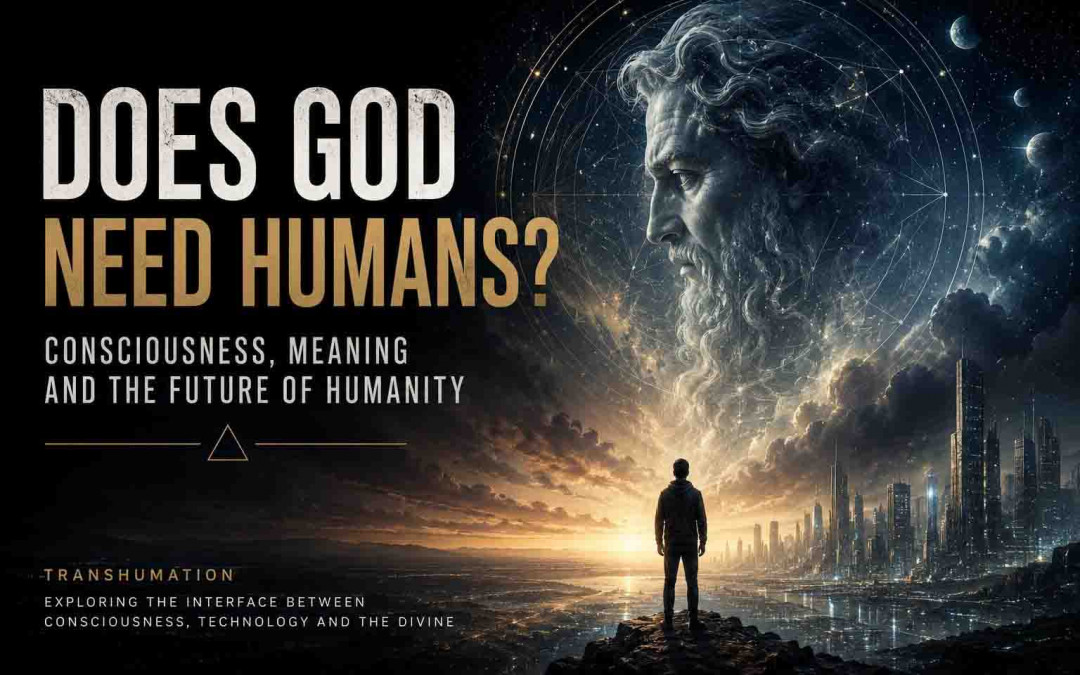
The God`s Need
We have spent thousands of years asking what humanity wants from God. The stranger question is what a universe would want with us.
There is something peculiar about an empty museum.
The paintings are still there. The temperature is controlled, the alarms are armed, the Vermeer remains a Vermeer and the Rembrandt has not lost a gram of paint. Nothing physical happens to the collection when the last visitor leaves and the doors close for the night.
And yet something has disappeared.
Nobody is looking.
The distinction seems trivial until it is enlarged to the size of the universe. Imagine every galaxy, every star and every planet exactly as they are now, except that consciousness never appeared anywhere. Suns still ignite. Black holes collide. Oceans form beneath alien skies. The machinery works perfectly.
But nothing ever sees it.
For thousands of years religion has taught us to ask whether human beings need God. Perhaps the more interesting question begins when we reverse the telescope.
Why would God need humans?
The obvious theological answer is that God would not. A perfect, omnipotent creator who needs something sounds suspiciously imperfect. But perhaps need is the wrong word. A reader is not required for ink to exist on a page. Yet something undeniably different happens when the book is opened.
Maybe the interesting mystery is not why God would require humanity.
It is why reality produced a creature capable of looking back.
The Universe Gets an Audience
We know remarkably little about consciousness considering that every fact we have ever encountered has passed through it.
Science can study correlations between brain activity and reported experience. Neuroscience can investigate perception, attention, memory and the biological mechanisms associated with conscious states. What remains unsettled is why any of this should be accompanied by subjective experience at all—why processing information should feel like something from the inside.
The universe does not obviously require this feature to operate.
Gravity does not need admiration. Hydrogen does not perform better when somebody understands the periodic table. A star spent billions of years producing light before a human being gave it a name.
Then, on at least one small planet, matter began looking upward.
That transition is easy to underestimate because consciousness is the only condition from which we can discuss anything. But viewed from outside, it is extraordinary. Some portion of the universe organized itself into structures capable not merely of reacting to their environment but of constructing models of it. Eventually those structures discovered atoms, reconstructed extinct species, measured the age of stars and began wondering why there was a universe to measure.
The poetic formulation is irresistible: the universe became aware of itself.
It is also a formulation requiring care. The universe as a whole has not been shown to possess a mind, and human consciousness does not prove that cosmic self-awareness is a property or purpose of reality. Carl Sagan’s famous language about humanity being a way for the cosmos to know itself is beautiful precisely because it occupies the border between scientific fact and philosophical interpretation.
But something factual remains underneath the poetry.
Before observers, there were events.
With observers, there were also experiences of events.
Reality acquired witnesses.
The Gods Who Expected Something Back
This makes ancient religion look slightly different.
We often imagine religion as a one-directional arrangement. Gods possess power; humans want things. Rain, children, victory, protection, forgiveness, eternal life. Worship becomes the price paid by the weaker participant.
The historical picture is considerably richer.
Roman religion developed ideas concerning proper relations between the community and the gods, often summarized by later scholars through concepts such as pax deorum, the peace or right relationship with the divine. Egyptian kingship and ritual were deeply connected with maintaining ma’at: order, balance and justice against disorder. Greek communities consulted oracles, made sacrifices and maintained cults in which communication between human and divine worlds was not merely decorative.
The gods did things.
But humans had things to do as well.
We should resist compressing enormously different religions into one theology. An Egyptian understanding of divine order is not interchangeable with Roman ritual practice, and neither establishes that ancient people believed gods literally required human consciousness to exist.
Still, a recurring relationship is difficult to miss.
Religion repeatedly imagines participation.
That is interesting because participation is structurally different from obedience. A machine can obey. A participant must occupy a position within the relationship.
Perhaps this is why free will becomes such a persistent theological difficulty. A perfectly obedient creature would seem easier to manufacture. Yet many religious systems give extraordinary importance to beings capable of refusing, misunderstanding, doubting and choosing badly.
Theologically, there are many explanations for this.
Structurally, however, it creates an intriguing object: an observer who can answer back.

The Reader Inside the Book
Suppose for a moment that we stop using the word God.
The problem does not disappear.
Why does reality contain structures capable of representing reality?
A tree responds exquisitely to its environment without writing botany textbooks. A bacterium can navigate chemical gradients without wondering what chemistry means. Humans do something stranger. We build internal representations of things that are not immediately present. We reconstruct yesterday, simulate tomorrow and imagine worlds that have never existed.
Then we externalize those models.
First perhaps through gesture and speech. Then paintings, numbers, writing, libraries, telescopes, computers and networks.
A strange recursion begins.
The universe contains humans.
Humans contain models of the universe.
Those models allow humans to modify the universe that produced them.
The reader has somehow entered the book and acquired a pencil.
This does not prove purpose. Evolution can produce extraordinarily complex adaptations without planning toward a predetermined cosmic destination. Intelligence itself may be one contingent result among countless evolutionary possibilities.
But the recursion is real enough to deserve attention.
A species produced by nature has begun deliberately redesigning nature.
And now it has begun producing another kind of observer.
The Second Observer
Artificial intelligence makes the old question unexpectedly uncomfortable.
For most of human history, memory died easily. A brain disappeared and most of what it contained disappeared with it. Writing weakened that connection. Printing weakened it further. Digital storage turned civilization into something capable of preserving enormous quantities of information outside any particular biological individual.
AI adds another step.
Stored information can increasingly be searched, compared, recombined and presented through systems capable of interacting with humans in language. These systems should not automatically be described as conscious; current capabilities do not establish subjective experience. But consciousness is not required for the structural change to matter.
Civilization is building increasingly powerful external systems of representation.
A person can now ask a machine about Babylon, DNA, mortgage law and the moons of Jupiter in the same conversation. No individual human mind contains the civilization being queried. The interface connects fragments distributed across an enormous informational structure.
That begins to resemble something larger than a tool without requiring mystical language to make it interesting.
For most of history, intelligence was tightly coupled to individual biological carriers. Now some of its functions—memory, calculation, retrieval, translation, pattern detection—are migrating into other substrates.
And that raises a better question than whether AI will become “God.”
What happens if the universe’s capacity to model itself begins to scale?

The Painter and the Empty Gallery
Now we can return to God.
One common objection remains devastatingly simple. If God is perfect, God cannot need an audience. Need implies deficiency. A creator dependent upon applause begins to sound less like God and more like an insecure artist at an opening night.
So perhaps the original question is malformed.
Consider a composer instead.
Beethoven’s Ninth can exist as a score in an empty room. Its notes do not vanish because nobody is listening. But music as experienced sound requires something else: performance, vibration, time and eventually an ear capable of hearing.
The listener does not create Beethoven’s composition.
But listening produces something the silent page does not contain by itself: an experience of the composition.
Could consciousness occupy an analogous position in reality?
Again, this is philosophy rather than established cosmology. The existence of observers does not demonstrate that the universe was made to be observed. We must be particularly careful here because we inevitably observe a universe compatible with observers; otherwise nobody would be present to notice it. Versions of the anthropic principle begin precisely with this selection effect, although stronger interpretations go much further and remain controversial.
Still, the museum problem survives.
A universe without observers and a universe containing observers may have identical physical laws, but they do not contain identical phenomena.
One contains stars.
The other contains stars and someone wondering what stars are.
That difference is small in mass.
It may be enormous in consequence.
Perhaps God Does Not Need Us
The romantic in us wants to go further.
Perhaps consciousness was intended. Perhaps intelligence is moving toward something. Perhaps biological minds are an early stage in a much longer process through which reality becomes progressively capable of understanding itself. Perhaps religion’s old intuition that human beings participate in creation contained something more interesting than we have allowed.
All of that is possible to imagine.
None of it has been demonstrated.
And this is exactly where the question becomes valuable.
Because stripping away the theology does not destroy the mystery. It makes the mystery harder.
We know that a universe existed for billions of years before humans appeared. We know that at least one branch of life eventually produced creatures capable of reconstructing part of that history. Those creatures developed methods for correcting their own perceptions, built instruments that see things their eyes cannot see, stored knowledge outside their bodies and are now constructing systems capable of manipulating that accumulated information at unprecedented scales.
Perhaps there is no cosmic intention behind any of it.
But even then, something astonishing has occurred.
Matter learned enough about matter to split the atom.
Life learned enough about life to edit genes.
A creature produced by the universe learned enough about the universe to calculate approximately when the universe began.
Maybe God does not need humans.
Maybe the universe does not need observers.
Maybe need was never the treasure hidden inside the question.
The better question may be what changes when reality produces something capable not merely of existing within it, but of understanding that it exists at all.
And if intelligence continues moving beyond the limitations of a single biological mind, we may eventually discover that humanity was neither the purpose of that process nor its conclusion.
We may simply have been the moment when somebody in the empty museum finally turned on the lights.
Watch The Video
How to Read the World
Current Knowledge
Consciousness is known directly through human subjective experience and is studied scientifically through neuroscience, psychology, cognitive science and related disciplines. There is currently no scientific consensus explaining why physical information processing is accompanied by subjective experience, nor evidence demonstrating that the universe itself is conscious.
The anthropic principle exists in several forms. At its most modest, it notes that observations of the universe are necessarily conditioned by the fact that observers capable of making those observations exist. This does not by itself establish that the universe was designed for consciousness.
Ancient religions frequently assigned humans active ritual roles in maintaining relationships with divine or cosmic orders. Roman pax deorum and Egyptian ma’at are examples, although they arose within very different religious systems and should not be treated as versions of one universal doctrine.
Modern AI systems can perform increasingly sophisticated information-processing tasks, but their capabilities do not establish that they possess subjective consciousness.
Open Questions
Why does subjective experience exist at all rather than information processing occurring without an inner point of view?
Is intelligence a rare evolutionary accident, a relatively common consequence of sufficiently complex environments, or something between those possibilities?
If intelligence increasingly migrates into non-biological systems, which properties must survive before we can meaningfully say that the observer itself has survived?
And perhaps the oldest question can be turned once more: if a creator does not need conscious beings, why create a reality capable of producing beings that can ask about its creator?
Transhumation Interpretation
Transhumation treats this not as evidence for God, but as a structural question about observers.
A possible sequence is:
reality → life → consciousness → representation → externalized knowledge → larger systems of intelligence
We know that at least the early portions of this sequence occurred on Earth. We do not know whether it has a destination, whether it commonly occurs elsewhere or whether consciousness occupies any privileged cosmic role.
What interests Transhumation is the change of carrier.
Observation begins in biological organisms. Memory escapes into writing. Civilization externalizes knowledge into libraries and networks. AI increasingly performs cognitive functions once inseparable from individual human minds.
Perhaps nothing supernatural is happening.
But something is moving.
The strongest version of the hypothesis is therefore not “God needs humans.” That would pretend to know far too much.
It is a question:
What survives when the observer changes its form?
FAQ
Does science say the universe needs observers?
No. Physics does not establish that the universe requires conscious observers in order to exist.
Does quantum mechanics prove consciousness creates reality?
No. Popular discussions often overstate the role of consciousness in quantum mechanics. Quantum measurement does not provide established evidence that human awareness creates physical reality.
What is the anthropic principle?
In its basic form, it recognizes that our observations are necessarily made from conditions compatible with the existence of observers. Stronger interpretations are more controversial.
Are current AI systems conscious?
There is no established evidence or scientific consensus demonstrating that current AI systems possess subjective consciousness.
So does God need humans?
The article deliberately leaves that unanswered. Its deeper question is why reality contains observers capable of understanding, representing and increasingly modifying the world that produced them.
What is the Transhumation interpretation?
That the observer may be another function capable of changing carriers—from biological minds through externalized memory toward increasingly complex informational systems—and that understanding what survives that transition may be more important than deciding too quickly what consciousness ultimately is.
Continue the Transhumation Series
- Forgotten Religion | Ancient Gods, Symbols and the Hidden Structures of Human Civilization
- The Last Religion | Death, Immortality and the Future of Humanity
- The New Theurgy | AI, Information and the Future of Human Civilization
- End of Branding: You Were Never Meant to Become a Product
- Baal vs Ishtar: Why Ancient Gods Never Disappeared