
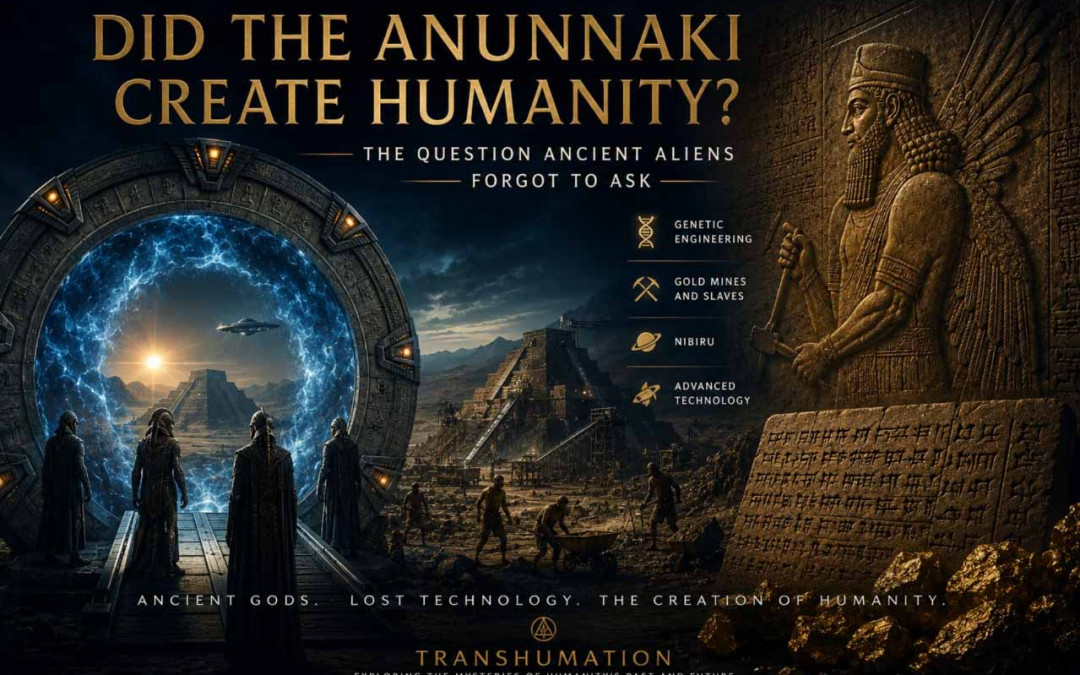
The Question Ancient Aliens Forgot to Ask
There is something wonderfully modern about the Anunnaki. They belong to ancient Mesopotamia, yet in their most famous contemporary incarnation they travel through space, understand genetics, manipulate species and arrive on Earth in search of resources. Their temples have become launch pads; their divine powers have become technologies. A story once written into the religious world of Sumer and Akkad has been rebuilt with the machinery of science fiction.
The version familiar to millions owes much to Zecharia Sitchin, whose books beginning with The 12th Planet proposed that the Anunnaki were extraterrestrial beings associated with a planet called Nibiru. In Sitchin’s reconstruction, these visitors came to Earth in the distant past, required gold, and eventually participated in the creation of human beings as a labor force. The theory has acquired an extraordinary cultural afterlife, surviving in documentaries, websites, television programs and the broader mythology of ancient astronauts.
There is, however, a peculiar problem hidden inside the story. It is not simply that mainstream Assyriology does not accept Sitchin’s translations or his extraterrestrial interpretation of Mesopotamian texts. That objection is important, but it leads only to the familiar argument between believers and skeptics. A more interesting experiment begins by granting the story its most extravagant premise.
Suppose the Anunnaki really did come from another world.
Then the story becomes stranger, not less.
A Spaceship with a Bronze Age Economy
Imagine a civilization capable of crossing interplanetary or perhaps interstellar distances. Its command of energy would have to exceed ours dramatically. Its knowledge of materials, automation and computation would presumably be formidable. If it could deliberately engineer a new intelligent species, its biotechnology would make twenty-first-century genetics look primitive.
Now consider the problem that supposedly brings these beings to Earth: they need miners.
The contradiction is almost comic. A civilization capable of mastering the heavens arrives with an economic structure recognizable to a Bronze Age king. There is a valuable resource underground; extracting it requires labor; therefore a subordinate population must be created to perform the work. The chariot has become a spacecraft, the palace a base, the divine ruler an extraterrestrial engineer — but the social architecture has barely moved.
This is a useful test for stories about advanced civilizations. Call it the Socrates Test: instead of asking whether the machinery described in a story could exist, ask whether the motives attributed to its owners still make sense once the technology is taken seriously.
An advanced spacecraft is not merely a faster chariot. A civilization capable of building one would have passed through enormous transformations in energy, manufacturing, robotics, materials science and probably artificial intelligence. Its technology would change what counted as scarcity, labor and value. Yet the popular Anunnaki narrative often upgrades the gods’ equipment while leaving their economy almost untouched.
That should make us curious.
Perhaps the most revealing technology in the story is not the spaceship.
It is the shovel.

What Would Gold Mean to a God?
Gold is an excellent material by human standards. It resists corrosion, conducts electricity well, is highly malleable and has unusual optical properties. Its rarity and appearance also allowed human societies to turn it into money, ornament and a durable symbol of status. There is nothing irrational about civilizations valuing gold.
But value is not a property floating inside an element.
It emerges from circumstances.
Water is nearly worthless beside a lake and priceless to a person dying in a desert. A wooden object can be mundane on Earth but might become an extraordinary rarity in an environment without complex terrestrial life. Even the notion of a “precious metal” belongs partly to a particular technological and economic landscape.
So the interesting question is not whether an extraterrestrial civilization could find gold useful. Of course it could. Nor can we prove that an unknown civilization would have no reason to obtain terrestrial gold. The problem is the larger chain of assumptions required by the mining story. We are asked to imagine beings capable of extraordinary spaceflight and biological engineering while still depending on something resembling an ancient labor economy to obtain a terrestrial resource.
The farther their technology advances, the more explanation that arrangement requires.
If machines can cross space, why can machines not mine?
If biological organisms must be engineered, why engineer beings as complicated, vulnerable and eventually rebellious as humans rather than specialized biological tools?
And if the civilization possesses technologies far beyond ours, why assume its hierarchy of valuable resources resembles ours?
These questions do not disprove extraterrestrial life. They do something more precise: they expose how easily human assumptions can survive inside supposedly alien worlds.
The Alien Who Looks Suspiciously Like Us
This is where the Anunnaki become much more interesting.
Human beings have always imagined extraordinary powers using available cultural vocabulary. Divine beings have appeared as kings, judges, warriors, mothers, fathers and celestial rulers. Their realms acquired courts and hierarchies. Their conflicts resembled political conflicts. Their vehicles could resemble magnificent versions of human vehicles.
Modernity did not necessarily escape this habit. We changed the vocabulary.
Once rockets existed, heaven could become outer space. Once genetics entered popular culture, divine creation could become genetic engineering. Once computers appeared, reality itself could be imagined as software. The supernatural craftsman could become the extraterrestrial scientist without the underlying role changing very much.
That does not mean every modern extraterrestrial story is merely an ancient myth in technological clothing. Nor does it tell us whether intelligent extraterrestrial life exists. It suggests something narrower and more useful: when humans imagine an intelligence vastly greater than their own, they tend to give it interfaces they already understand.
This produces a strange historical inversion. Ancient astronaut theories often claim that old myths preserve distorted memories of advanced technology. Sometimes the reverse possibility deserves equal attention: modern technological culture may be rewriting old myths in its own image.
The spaceship may tell us more about the twentieth century than about Sumer.
The genetic laboratory may tell us more about ourselves than about the Anunnaki.
The Question Hidden Behind the Gods
The ancient astronaut debate usually points backward. Did someone come here? Did an advanced civilization influence early humanity? Did ancient people witness technologies they could describe only as divine?
Those are legitimate questions to investigate when evidence warrants them. But there is another question hidden inside the same story, and unlike the first, it is no longer speculative.
What happens when we become creators?
Humans can already alter genomes. We can clone some animals, synthesize DNA, grow organoids and redesign organisms in limited ways. Artificial intelligence has introduced another category of created system whose behavior can be complex enough to surprise its designers. None of this makes humanity godlike in the literal sense, and today’s AI is not evidence that we have created conscious digital beings. But the direction of travel is historically unusual.
For most of our existence, humans occupied one side of the creation story.
We were the creatures asking who made us.
Increasingly, we are also becoming creatures capable of making things that act, learn, adapt and perhaps one day possess characteristics that force us to reconsider what words such as agent, organism, mind and person mean.
Seen from this angle, the Anunnaki story performs an unexpected trick. It begins as an argument about visitors from humanity’s remote past and ends as a thought experiment about humanity’s possible future.
The most consequential part of the myth may not be the possibility that gods once behaved like engineers.
It is the possibility that engineers are beginning to inherit questions once reserved for gods.
Watch The Video
How to Read the World
Current Knowledge
The Anunnaki are genuine figures from ancient Mesopotamian religious traditions. The term appears in Sumerian and Akkadian sources and refers to a group or class of deities, although their number, roles and associations vary between texts and periods.
Zecharia Sitchin developed a modern interpretation in which the Anunnaki were extraterrestrial visitors associated with Nibiru and human origins. Specialists in Mesopotamian languages and ancient Near Eastern history do not accept his readings as accurate translations of the surviving texts. There is no established archaeological, genetic or astronomical evidence demonstrating that extraterrestrials created Homo sapiens or established an ancient terrestrial gold-mining civilization.
Gold does have important physical and technological properties, including corrosion resistance, conductivity and malleability. Those properties establish that gold can be useful; they do not provide evidence for the specific Anunnaki mining narrative.
Modern humans, meanwhile, emerged through biological evolution. Genetics, paleontology and archaeology provide extensive evidence connecting our species to earlier hominin populations and to the wider evolutionary history of life on Earth.
Open Questions
Science does not currently know whether life exists elsewhere in the universe, whether technological civilizations have arisen independently, or what the economies and motivations of such civilizations would look like. It would therefore be unjustified to argue that an advanced extraterrestrial society could not possibly value gold or biological labor. Unknown civilizations may have unknown constraints.
A different question concerns mythology itself. How much can ancient religious imagery preserve memories of unusual historical events, and how much reflects symbolic, political and cultural structures? Distinguishing those possibilities requires evidence external to a compelling interpretation.
There is also a future-facing uncertainty. Humanity can already modify living systems and construct increasingly autonomous artificial systems, but we do not know whether artificial consciousness is possible, whether consciousness requires biology, or whether humans will ever create entities deserving moral or legal status comparable to persons.
Transhumation Interpretation
Transhumation is less interested in proving that the Anunnaki were aliens than in asking why the alien so often inherits the architecture of the god.
That is a problem of carrier and structure.
The carrier changes remarkably well. Chariot becomes spacecraft. Divine craftsmanship becomes biotechnology. Heaven becomes another planet. Creation becomes genetic engineering. The visual language travels thousands of years forward.
But beneath it, something older survives.
There is a higher intelligence. It possesses knowledge inaccessible to ordinary humans. It crosses a boundary between worlds. It creates or transforms life. Humanity exists downstream from its actions and tries to reconstruct the intentions of a mind vastly greater than its own.
That structure is more durable than the costume.
And now, for the first time, humanity may be moving through the structure itself.
We once imagined ourselves looking upward at creators whose motives we could barely understand. Future artificial or engineered beings might one day confront an inverted version of the same problem. They may ask why they were made, whether their creators understood what they were creating, whether their original function determines what they are allowed to become, and whether intelligence gives a creator permanent authority over its creation.
At that point the Anunnaki question changes completely.
Did the gods create us?
Perhaps.
There is no good evidence that Sitchin’s Anunnaki did.
But civilization may be approaching a stranger experiment: discovering what happens when the creature acquires the tools of the creator.
The ancient story placed the gods in the sky because that was where unreachable power seemed to belong. The twentieth century gave them spacecraft because spacecraft had become our image of impossible technology. The twenty-first may give them laboratories, neural networks and synthetic genomes.
The future will probably invent another interface.
The structure underneath may remain.
And perhaps that is the question ancient aliens forgot to ask: not whether the gods were astronauts, but why every age rebuilds the gods from the most powerful technology it knows — and what happens when that technology finally belongs to us.
FAQ
Who were the Anunnaki?
The Anunnaki were a group of deities appearing in ancient Mesopotamian traditions, with roles that varied across periods and texts.
Did the Anunnaki create humanity?
There is no established archaeological or genetic evidence that extraterrestrial Anunnaki created humans. Modern humans are understood through evolutionary biology.
Where does the alien Anunnaki theory come from?
Its most influential modern version was developed by Zecharia Sitchin, who interpreted Mesopotamian texts as accounts of extraterrestrial visitors.
Did the Anunnaki come to Earth for gold?
This is part of Sitchin’s modern interpretation, not an accepted conclusion of mainstream Assyriology.
What is the Socrates Test in this article?
It asks whether the motives attributed to an extremely advanced civilization still make sense once we take its supposed technological capabilities seriously.
What is the Transhumation interpretation?
The deeper pattern may be the recurring human tendency to imagine superior intelligence through contemporary technology: gods become aliens, divine creation becomes genetic engineering, and ancient questions about creators return through AI and biotechnology.
What is the central question?
Not simply whether advanced beings created humanity, but what happens when humanity itself begins acquiring the power to create new forms of agency and life.
Continue the Transhumation Series
- Forgotten Religion | Ancient Gods, Symbols and the Hidden Structures of Human Civilization
- The Last Religion | Death, Immortality and the Future of Humanity
- The New Theurgy | AI, Information and the Future of Human Civilization
- End of Branding: You Were Never Meant to Become a Product
- Baal vs Ishtar: Why Ancient Gods Never Disappeared