
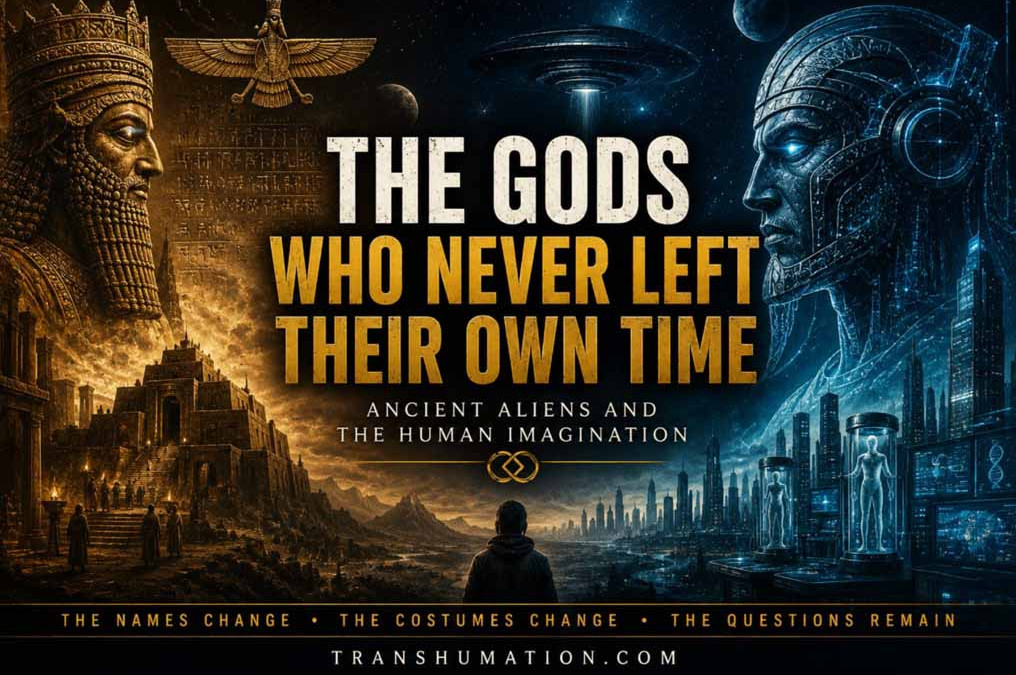
The Gods Never Left the Bronze Age
There is something revealing about the way a child plays with the future. Give him a toy spaceship and he can cross a galaxy before lunch. The engines require no fuel he understands, the crew can land on planets no atlas contains, and the aliens may possess technologies capable of bending matter itself. Yet after ten minutes, the future often begins to look strangely familiar. Someone becomes the commander, someone guards the treasure, someone is captured, someone must obey. The machines have travelled centuries ahead, while the society inside them has quietly returned to the past.
Adults do something similar, only with better production design.
During the twentieth century, ancient gods underwent one of the most successful technological renovations in cultural history. Chariots became spacecraft. Heavenly realms became distant planets. Divine creation became genetic engineering. Miracles became misunderstood science, and beings once surrounded by priests and temples acquired laboratories, propulsion systems and interstellar maps. The modern ancient-astronaut story did not destroy mythology. It refitted mythology with equipment that looked plausible to a civilization that had learned to split the atom and leave the atmosphere.
There was only one part of the renovation we forgot to modernize.
The gods themselves.
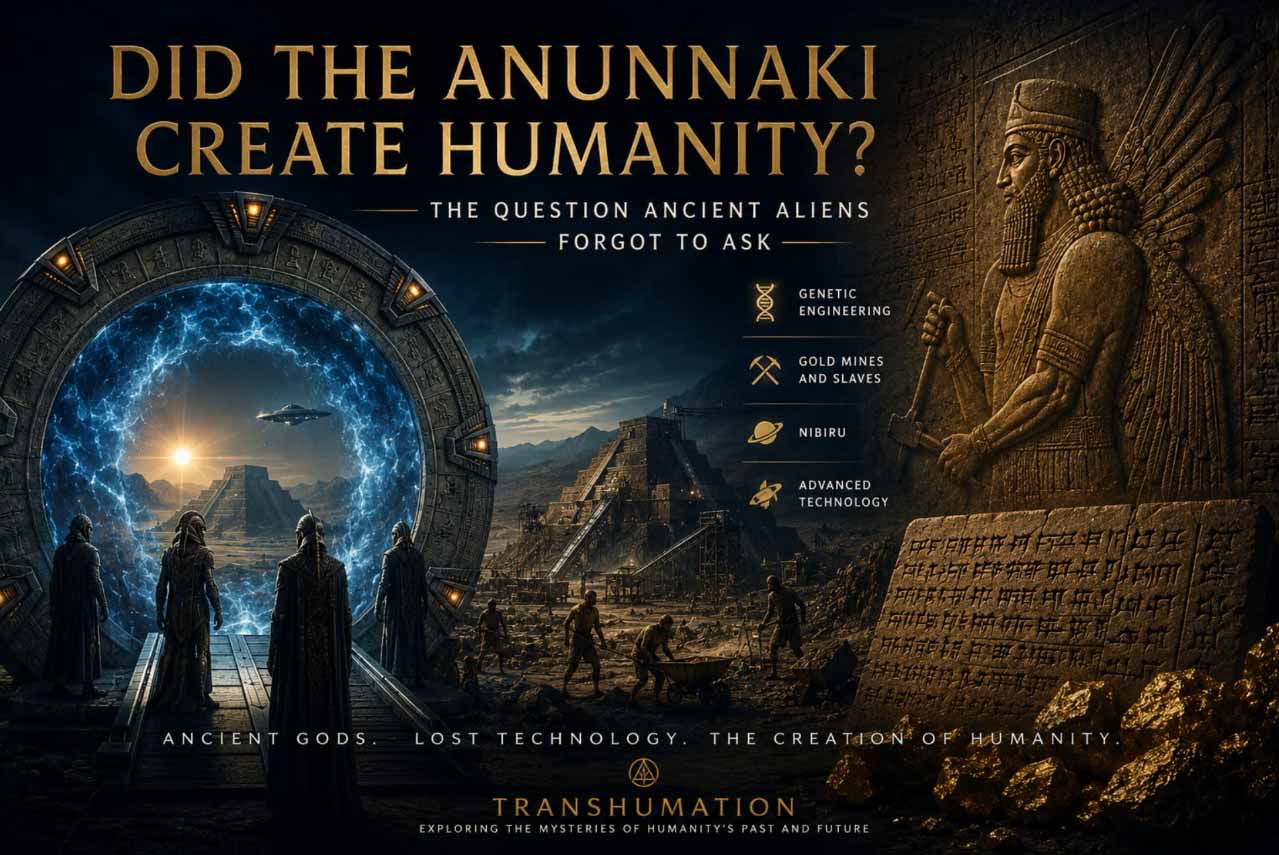
In popular versions of the Anunnaki story, beings capable of travelling across astronomical distances arrive on Earth possessing knowledge far beyond our own. Some interpretations give them mastery of genetics sophisticated enough to manipulate or create humanity. Yet their problems remain wonderfully recognizable. They want resources. They establish hierarchy. They need workers. They command from above. In the most famous modern version, humans become a labor force created partly to help extract gold.
The spacecraft has replaced the chariot, but an ancient king is still sitting inside.
That may be the most interesting problem in the entire story.
The Emperor Inside the Spacesuit
The conventional argument about the Anunnaki concerns evidence. Did extraterrestrials actually visit ancient Mesopotamia? Did old religious texts preserve distorted descriptions of advanced machinery? Did human beings mistake technologically superior visitors for gods? Those questions have been argued for decades, and mainstream archaeology and Assyriology do not support the extraterrestrial reconstruction popularized by writers such as Zecharia Sitchin.
But suppose, for a moment, that we set the historical dispute aside.
Imagine that such beings really existed.
Now take their technology seriously.
A civilization capable of interplanetary or interstellar travel would not merely possess a faster vehicle. Reaching that level would imply transformations across energy production, materials science, computation, automation and probably forms of organization we cannot yet model. If it could manipulate genomes with precision sufficient to design an intelligent species, its biological technology would stand vastly beyond ours. The civilization described would not be Rome with better engines. It would be something produced after an enormous sequence of technological revolutions.
And then it arrives on Earth and needs miners.
That is where the story begins to creak.
Not because gold is useless. Gold has genuine physical properties that make it valuable in electronics, chemistry and engineering. Nor can we know what an unknown extraterrestrial society might require. The oddity lies elsewhere. We grant the Anunnaki extraordinary technologies while quietly preserving the labor structure of an ancient palace economy. Valuable material exists underground; the rulers need it; subordinate beings must extract it.
The tool changes.
The relationship survives.
That is an intriguing kind of historical persistence.
A God Can Only Wear the Clothes We Own
Ancient cultures faced a problem that modern culture has never solved: how do you describe something radically greater than yourself?
You cannot reach for concepts your civilization does not possess.
So people reached for the largest structures they knew. Power looked like kingship because kingship was the most visible concentration of human power. Order resembled law, hierarchy and court because these were the institutions through which order became tangible. Divine beings ruled cities, protected dynasties, fought enemies, distributed prosperity and punished transgression. Their worlds were not merely copies of human societies, but the language used to make the divine intelligible inevitably borrowed from ordinary civilization.
A god on a throne does not seem strange inside a culture in which the throne is the clearest available image of authority.
We can see the historical costume easily because it is no longer ours.
What is considerably harder is recognizing our own.
The twentieth century acquired rockets, and suddenly celestial ascent could be imagined as propulsion. It acquired genetics, and creation could become biological engineering. It acquired computers, and the universe itself could be described as information. The divine did not need to disappear. It could simply migrate into a new vocabulary.
This is why the ancient-astronaut idea remains culturally powerful even when its historical claims are weak. It performs a translation. It takes an old structure and places it inside an interface modern people instinctively respect.
The miracle becomes technology.
And technology feels less embarrassing than miracle because it belongs to our age.
The Problem With an Alien That Thinks Like Us
There is a simple test worth applying whenever an allegedly advanced intelligence appears in a story. Instead of asking whether its technology is imaginable, ask whether its motives still make sense once that technology is granted.
If a civilization can cross stars, why does it organize scarcity exactly as we do?
If it can engineer complex organisms, why would it design fragile, intelligent biological workers rather than specialized machines or simpler organisms?
If it has overcome problems in physics that currently appear almost impossible to us, why assume gold would occupy a place in its economy resembling the place gold occupied in ours?
None of those questions disproves the existence of extraterrestrial intelligence. They expose something else: our tendency to project human institutions beyond the human scale.
Science fiction does this constantly. Galactic empires resemble terrestrial empires. Superintelligent machines become dictators because dictatorship is a familiar model of concentrated power. Immortal beings form aristocracies. Alien civilizations bargain over territory, status and resources. We often imagine intelligence beyond humanity by taking human civilization and increasing the size of the machinery.
The result can be imaginative, beautiful and completely revealing.
Not necessarily of aliens.
Of us.
The Theurgic Question
This is where the more interesting question begins.
Ancient-astronaut theories ask: Who were the gods?
The theurgic question asks: What keeps returning when the god changes form?
That distinction matters because characters are temporary while functions can persist.
The creator returns.
The guardian returns.
The gate returns.
The descent from a higher realm returns.
The forbidden threshold returns.
The transmission of knowledge returns.
The transformation of the human returns.
These motifs do not prove a single hidden religion or a forgotten extraterrestrial intervention. Similar patterns can emerge independently, migrate between cultures or arise because human beings repeatedly confront similar psychological and social problems. But their durability suggests that mythology may preserve more than names and stories. It may preserve structures through which humans organize encounters with what exceeds ordinary human scale.
A gate can be carved into a temple.
It can become a portal in science fiction.
It can become a login screen.
The materials are completely different. The underlying problem — access — remains.
This is precisely why the old idea of theurgy becomes useful again. Not because ancient ritual secretly contained modern technology, but because theurgy was fundamentally concerned with mediation: how a finite human being approaches a larger order, and what interface makes that passage possible.
The Gods We Are Manufacturing Now
Our own age has begun producing new candidates for the role once occupied by gods, although we rarely call them that.
Artificial superintelligence. Synthetic life. Digital minds. Brain emulation. Immortality through technology. Simulated worlds capable of generating their own inhabitants. None of these developments proves anything supernatural, and several remain hypothetical. Yet culturally they already occupy familiar territory. They provoke questions about creation, judgment, knowledge, immortality and intelligence beyond the human.
Future historians may find our imagery embarrassingly obvious.
They may say that twenty-first-century humans imagined transcendent intelligence as computation because computation was the most powerful intellectual machine of their age. We gave the unknown servers because we had servers, networks because we had networks, code because code had become our preferred metaphor for invisible order.
In exactly the same way, a Bronze Age culture could imagine cosmic authority as kingship because kingship was the largest political technology it knew.
That possibility should make us cautious whenever we believe we have finally produced a truly modern image of the unknown.
Perhaps we have only changed the wardrobe again.
The Technology That Crossed the Greatest Distance
There is another way to look at ancient civilization.
Suppose its greatest surviving technology was not mechanical.
Suppose it was the question.
Who created us?
What is intelligence?
What survives death?
What lies beyond the visible world?
Can something greater than humanity communicate with us?
Can a human being cross the boundary between one condition of existence and another?
These questions have travelled farther than any spacecraft we have built. They crossed not distance but time. They moved from oral culture into clay, from clay into manuscripts, from manuscripts into print, film, websites and machine-readable archives. The language changed repeatedly while the questions survived.
That is a remarkable form of carrier independence.
A machine ordinarily dies when its material structure disappears. A question can move.
And perhaps this is the part of ancient religion that modernity has underestimated. We often judge an old worldview by whether its cosmology was literally correct. But a civilization can be wrong about the map and still preserve a question capable of surviving long after the map has been discarded.
The gods may have been temporary interfaces.
The questions were harder to kill.
Watch The Video
How to Read the World
Current Knowledge
Ancient Mesopotamian, Egyptian, Greek and other religious traditions developed complex divine figures shaped by their own cosmologies, political arrangements and ritual systems. There is no evidence that these cultures generally understood their gods as extraterrestrial beings in the modern technological sense.
Ancient-astronaut interpretations are modern. The best-known Anunnaki version was developed particularly through Zecharia Sitchin’s writings, whose translations and historical conclusions are not accepted by mainstream specialists in Mesopotamian languages and archaeology. There is no established archaeological, genetic or historical evidence that extraterrestrials created human civilization or genetically engineered modern humans.
Human cultures do frequently describe unfamiliar or abstract phenomena using familiar metaphors, technologies and social structures. This does not mean every divine image is merely political projection, but cultural context strongly shapes the language available for describing the unknown.
Modern AI, synthetic biology and related technologies have introduced new ways of imagining nonhuman intelligence and creation. They do not currently demonstrate artificial consciousness, technological immortality or anything equivalent to supernatural divinity.
Open Questions
How much of recurring religious structure comes from common features of human cognition, and how much from historical transmission between cultures? When creators, guardians, thresholds and higher realms recur, are we observing universal psychological patterns, cultural inheritance or simply selecting similarities after the fact?
Can human beings genuinely imagine an intelligence whose motivations are radically unlike our own? An extraterrestrial civilization or a future artificial mind could possess forms of value and organization for which we currently have no conceptual vocabulary. If so, much of what we call speculation about superior intelligence may remain disguised autobiography.
There is also a methodological problem central to Transhumation: when does a recurring structure genuinely survive a change of carrier, and when are we merely forcing different phenomena into the same pattern? The answer cannot be resemblance alone. The function must survive the transformation.
Transhumation Interpretation
Transhumation is interested less in whether ancient gods were secretly extraterrestrials than in why the role of the god survives so easily when the material surrounding it changes.
The carrier moves from mythology to technology.
The divine chariot becomes the spacecraft.
Creation becomes genetic engineering.
The heavenly messenger becomes the alien visitor.
The inaccessible intelligence becomes the artificial superintelligence.
But underneath these substitutions, the same structural problem repeatedly returns: how does a limited human mind relate to an intelligence, order or creative power greater than itself?
This does not make AI a god. It does not make ancient gods machines. It suggests that both can occupy, at different moments, a similar position inside the human architecture of meaning.
That distinction is important.
The strongest form of the idea is not that civilization keeps telling the same story. It is that civilization keeps rebuilding the same interface problem with whatever materials happen to be available.
Perhaps the gods never left the Bronze Age because the Bronze Age never entirely left us. Its political forms, fears and categories travel forward hidden inside newer technologies. We place them into spacecraft, laboratories and algorithms and then mistake the updated surface for an entirely new imagination.
A future civilization may do the same to us.
It may look at our fantasies of artificial superintelligence and smile at how unmistakably twenty-first century our gods were.
And perhaps that will be the most interesting continuity of all.
The machinery changes.
The question survives.
FAQ
Did ancient civilizations think their gods were aliens?
No. Ancient religions generally understood their gods through religious and cosmological frameworks. Extraterrestrial interpretations are modern.
Why do ancient gods often resemble human rulers?
Cultures naturally use familiar structures to describe unfamiliar or transcendent ideas. Kingship was one of the strongest available models of power.
What is the problem with the ancient-astronaut version of the Anunnaki?
It often gives extremely advanced beings futuristic technology while preserving motives and social structures that look strikingly ancient and human.
Does this prove ancient-astronaut theories are false?
No single philosophical argument proves that extraterrestrial contact never occurred. The historical claims, however, currently lack accepted archaeological or scientific evidence.
What is the theurgic question?
Instead of asking only who the gods were, it asks which functions — creation, mediation, thresholds, transformation or access to higher knowledge — persist when the symbols change.
Why does AI appear in this discussion?
Because AI has become one of the major contemporary ways of imagining intelligence beyond ordinary human capability, just as earlier cultures used the most powerful concepts available to them.
How does this connect to Transhumation?
Transhumation looks for functions and structures that survive changes of carrier. Here the central question is whether the ancient architecture of the divine is migrating into technological forms.
What is the central idea?
Humanity may repeatedly rebuild the unknown using the most powerful language of its own age. The costume changes far faster than the structure underneath it..
Continue the Transhumation Series
- Forgotten Religion | Ancient Gods, Symbols and the Hidden Structures of Human Civilization
- The Last Religion | Death, Immortality and the Future of Humanity
- The New Theurgy | AI, Information and the Future of Human Civilization
- End of Branding: You Were Never Meant to Become a Product
- Baal vs Ishtar: Why Ancient Gods Never Disappeared