
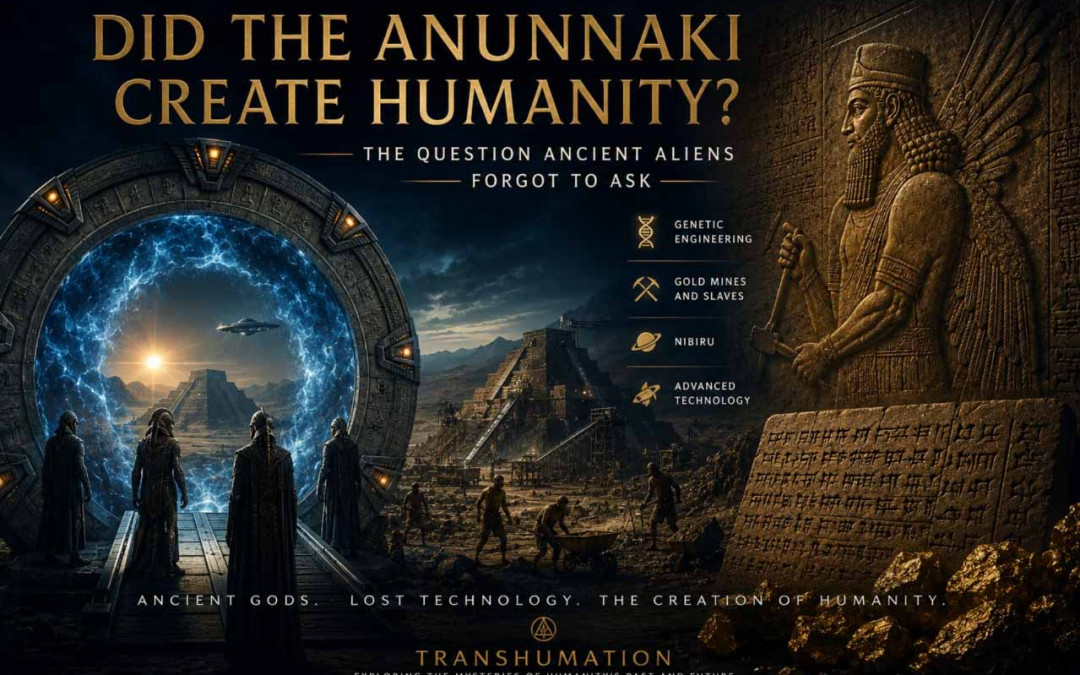
Tell Me Why, and I’ll Tell You Who
There is a very serious way to discuss the Anunnaki. You can compare translations, reconstruct Mesopotamian genealogies, measure giants, search for Nibiru, inspect ancient reliefs for suspiciously aerodynamic objects and argue about whether a god holding something cylindrical has accidentally been photographed with a rocket.
I propose something less sophisticated.
Ask why.
Suppose, for five minutes, that Zecharia Sitchin was right about the important part. The Anunnaki were not merely Mesopotamian gods. They were visitors from elsewhere. They crossed an astronomical distance, possessed extraordinary technology and were capable of interfering with life itself. Fine. I will give you the aliens. I will even give you the spaceship.
Now explain the shovel.
In the popular version of the story, these astonishing beings needed gold and created or modified humans as a labor force. This is normally where the argument becomes a fight over Sumerian texts. But the stranger problem is sitting in plain sight. We have given the Anunnaki interplanetary technology and genetic engineering, then quietly left them with the economic imagination of an ancient king: there is treasure in the ground, therefore somebody must dig.
Tell me why they need the miners, and I may begin to believe you know who they are.
The Alien with a Bronze Age Business Plan
The objection is not that an advanced civilization could never use biological labor. Human civilization itself is an untidy counterexample. We can land machines on other worlds while people still carry bricks by hand. We can perform molecular gastronomy while other human beings do not reliably know where tomorrow’s dinner is coming from. Technological sophistication does not arrive evenly.
So the useful question is not: would advanced aliens ever use workers? It is: what would have to be true for those workers still to make sense?
If you can engineer Homo sapiens, why create a fragile, hungry, sexually distracted, rebellious general-purpose primate rather than a specialized organism or machine? If you can cross space, why is extracting terrestrial gold the bottleneck? If gold is essential, why is Earth the sensible source? Every answer is possible in principle. But every answer costs another assumption.
This is where extraordinary stories should be tested. Grant the impossible, then test the ordinary.
We often do the reverse. We spend years arguing whether the spacecraft could fly while accepting without examination that its occupants think like pharaohs. We give them propulsion beyond our physics, laboratories beyond our biology and motives borrowed from our history.
We gave them interstellar technology and forgot to give them an alien motive.
Before Explaining the Miracle, Test the Geometry
The Shroud of Turin offers a useful change of scenery. Its history, provenance and image have generated serious scholarship as well as spectacular speculation: medieval manufacture, miraculous formation, lost photographic processes, radiation, Leonardo da Vinci, relic traditions and possible earlier appearances of a cloth associated with the face or body of Christ. Those questions are not foolish merely because people disagree about them.
But Couteau’s rule is to interrupt the courtroom before everyone has billed another century of expert testimony.
Take a three-dimensional face. Put pigment on it. Press cloth against it. Then remove the cloth and lay it flat.
What happens to the face?
It does not simply become a photograph. A surface wrapped around cheeks, ears and the sides of a nose records spatial relationships differently when flattened. Features can spread, stretch or distort. A simple contact experiment will not settle the authenticity or formation mechanism of the Shroud; the actual image has properties that require separate study. But that is precisely the point. Before inventing an extraordinary image-making machine, first ask what ordinary geometry predicts.
People can spend decades asking who made it? when an earlier question may be what would this method make?
Before explaining the miracle, test the geometry.
Before explaining the aliens, test the shovel.
Neither test tells you the final answer. It tells you whether you have earned the right to need a more exotic one.
Every God Gets the Best Vehicle We Know
Human beings have always furnished higher powers with upgraded versions of familiar things. A god crosses the sky in a chariot because a chariot is what impressive transportation looks like. Later heaven becomes space and the chariot becomes a spacecraft. Divine creation becomes genetic engineering. The heavenly realm becomes another planet. The miracle becomes technology.
We congratulate ourselves on becoming less mythological because the vehicle now has engines. But perhaps we merely changed the vehicle.
Our language for the future is built from the present. Columbus crossed an ocean by ship, so we imagine crossing the universe as an enormously more difficult voyage: leave here, travel through the distance, arrive there. That may be correct. It may also be the cosmic equivalent of a fifteenth-century engineer trying to invent aviation by designing a better sail.
The shovel is ancient. The excavator is modern. The robot is contemporary. Why assume any of them is alien?
What Did We Forget?
The same error works backward. When an ancient object, building or technique is difficult to explain, the seductive question is: who helped them? Aliens, a vanished supercivilization, forbidden technology, somebody from outside the picture. Sometimes a better question is less theatrical: what did these people know that we no longer know they knew?
Knowledge has carriers. A technique can disappear when the last practitioner dies. Instructions can rot, burn, remain unwritten or become meaningless when the surrounding craft tradition vanishes. The object survives while the procedure does not. Centuries later we hold the result without possessing the recipe, and ignorance begins to look like impossibility.
This is not an argument that every ancient mystery has a mundane solution. It is an argument against using our missing information as evidence for somebody else’s magic.
Bertha Benz supplied a useful little warning in 1888. The motor car already existed, but its practical meaning was not yet obvious to everyone. Her journey from Mannheim to Pforzheim demonstrated that the strange machine could actually function as transportation over distance. The object had arrived before society fully understood what kind of future it belonged to.
We should be humble when looking in the opposite direction. A lost technique can leave us with the same problem: the object remains after its world of use has disappeared.
Pong Is More Interesting Than the Simulation
Elon Musk has used a wonderfully simple comparison in discussing the simulation argument: games moved from Pong — rectangles and a dot — toward increasingly photorealistic interactive worlds. Extrapolate far enough, he argues, and simulations could become extraordinarily difficult to distinguish from experienced reality.
I am less interested here in whether this proves we live in a simulation. It does not. The more interesting lesson is how catastrophically bad our intuition becomes when asked to extrapolate technology.
Imagine showing a person standing beside Pong a modern virtual world. Then ask that person to describe entertainment ten thousand years later. The sensible answer is not a larger Pong screen.
Now replace ten thousand years with a million. Or a hundred million. If technological civilizations exist and survive on such scales, pretending we can infer their motives from our mines, kings, currencies and machines may be the least scientific part of the ancient-alien story.
Perhaps a sufficiently advanced creator would not build every creature individually at all. We already create virtual environments by defining rules, constraints, learning systems and initial conditions, then allowing complexity to emerge inside them. That does not prove a creator, a simulation or the Anunnaki. It merely changes the question. Creation itself may be another concept we keep imagining with tools borrowed from our own workshop.
The Most Human Thing About the Aliens
There is one final test. Ask what the gods want.
Gold. Workers. Monuments. Obedience. Worship. Territory. Glory.
None of these motives is impossible for an extraterrestrial intelligence. But they are remarkably familiar motives for human rulers. The supposedly alien mind repeatedly arrives carrying an upgraded version of our technology and an ancient version of our psychology.
Why would a civilization capable of crossing the stars need eight billion primates to tell it how magnificent it is? We have apps for that now.
The joke matters because it restores proportion. Before asking whether the gods were astronauts, ask why astronauts would want to behave like gods imagined by ancient humans. Before explaining a mystery with an intelligence greater than ours, ask how much ordinary knowledge may simply have disappeared. Before projecting our future into deep time, remember how quickly the present makes yesterday’s imagination look provincial.
Perhaps the strangest thing about ancient aliens is not how alien they are. It is how little imagination we used when making them alien.
Watch the Video
How to Read the World
by
Current Knowledge
The Anunnaki are genuine deities found in ancient Mesopotamian traditions, although their roles and associations vary across texts and periods. Zecharia Sitchin later developed the influential modern interpretation in which they were extraterrestrial visitors associated with Nibiru and human origins. His readings are not accepted by specialists as reliable translations of the Mesopotamian sources, and there is no established archaeological, genetic or astronomical evidence that extraterrestrial Anunnaki created Homo sapiens or operated an ancient gold-mining civilization.
The Shroud of Turin is a real linen cloth bearing front-and-back images of a man. Its history and image-formation mechanism remain subjects of research and dispute. Simple contact-print experiments can demonstrate geometric distortion when a three-dimensional surface is transferred to a flat cloth, but such experiments alone neither reproduce every property of the Shroud image nor establish its date or authenticity.
Open Questions
We do not know whether technological civilizations exist elsewhere, what constraints they might face or whether their concepts of resources, labor, travel and creation would resemble ours. We also cannot assume that every ancient technique has been completely reconstructed. Practical knowledge can disappear when craftspeople, institutions, languages and physical records vanish.
Rapid progress in simulation, AI and biotechnology gives us new analogies for creation, but analogies are not evidence that reality is simulated or that humanity was engineered. The difficult question is how to distinguish a genuinely useful structural comparison from a story that merely dresses an old assumption in new technology.
Transhumation Interpretation
Transhumation does not need to decide that the Anunnaki were aliens in order to learn something from the story. The more revealing experiment is to remove the argument over identity and test motive, scale and structure.
Grant the spaceship. Grant the advanced intelligence. Then ask why it needs the mine, the worker, the monument or the worshipper. With the Shroud, grant the mystery and test the geometry before reaching for the miraculous mechanism. The method is the same: do not begin with the most exciting answer. Find the smallest question capable of breaking the idea.
The future has a long past, but the past also has missing pages. Sometimes the better explanation for an ancient mystery may not be a visitor carrying impossible knowledge. It may be knowledge that once belonged here and lost its carrier.
Before asking who, ask why?
FAQ
Who were the Anunnaki?
The Anunnaki were deities in ancient Mesopotamian religious traditions. Their modern portrayal as extraterrestrial visitors comes largely from later ancient-astronaut interpretations, especially those associated with Zecharia Sitchin.
Did the Anunnaki create humans to mine gold?
There is no established archaeological or genetic evidence for that claim. The gold-mining narrative belongs to a modern interpretation rather than accepted Assyriological readings of Mesopotamian texts.
Why does the article discuss the Shroud of Turin?
It is a second example of the same method. Before choosing among extraordinary explanations for an unusual image, test what ordinary geometry and contact between a three-dimensional surface and flat cloth would predict. That test does not settle the Shroud’s authenticity; it helps determine which questions should come first.
What does “test the shovel” mean?
It means granting the extraordinary premise temporarily and examining the mundane assumption hidden inside it. If the Anunnaki could cross space and engineer life, the need for human miners deserves an explanation rather than being treated as obvious.
Does Pong prove we live in a simulation?
No. The comparison illustrates how rapidly our ability to create virtual environments has changed and how unreliable long-range technological intuition can be.
Continue the Transhumation Series
- Forgotten Religion | Ancient Gods, Symbols and the Hidden Structures of Human Civilization
- The Last Religion | Death, Immortality and the Future of Humanity
- The New Theurgy | AI, Information and the Future of Human Civilization
- End of Branding: You Were Never Meant to Become a Product
- Baal vs Ishtar: Why Ancient Gods Never Disappeared