
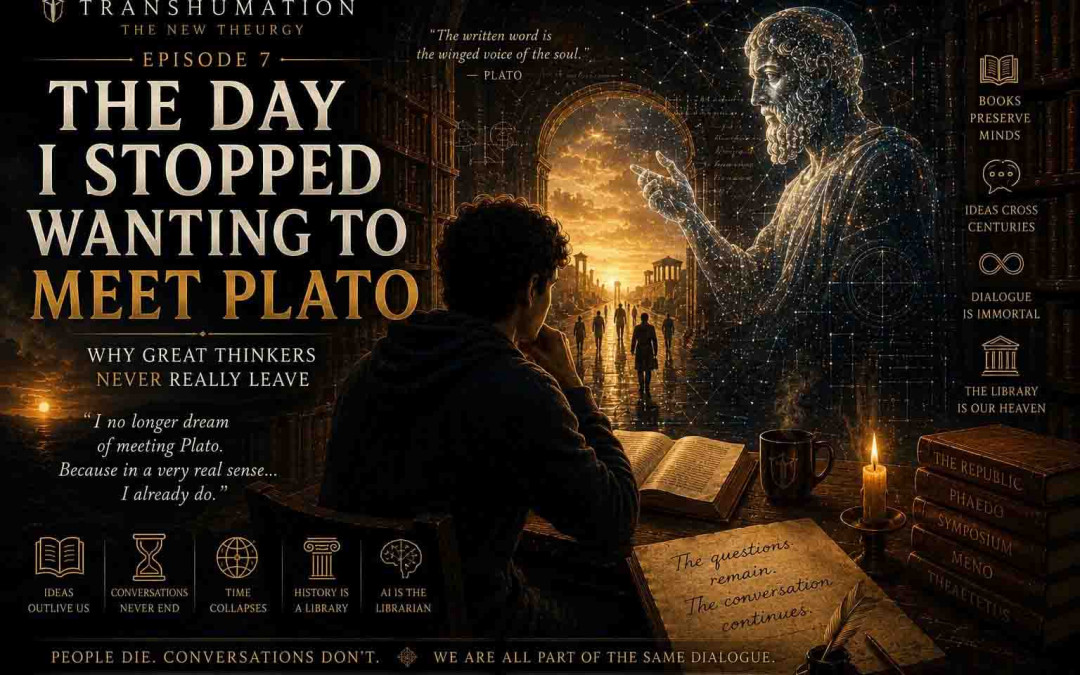
Plato – The Super Star
I once thought the greatest gift of time travel would be a conversation with Plato. Then I realized that the conversation had never ended.
For years, if someone had offered me one journey into the past, I knew exactly where I would go. I would not choose a battlefield, a coronation or the construction of some ancient monument whose mystery has survived mostly because the witnesses disappeared. I would go to Athens. I would find Plato. I imagined the encounter with embarrassing clarity: a shaded courtyard, an afternoon without clocks, and the possibility of asking questions that had somehow survived twenty-four centuries without becoming smaller. What is knowledge? What makes a life good? Is the visible world enough? What exactly is the self? Does truth exist independently of us, or do we construct only increasingly useful maps around something we can never reach directly?
The fantasy rested on a simple assumption: somewhere behind the surviving books there was a final version of Plato, and if I could reach the man rather than the text, the ambiguities would disappear. He would explain what the dialogues really meant, tell me which arguments were provisional, dismiss centuries of bad interpretation and perhaps reveal the one thought he had never managed to write down. Then, one day, the fantasy became less attractive. Not because I lost interest in Plato, but because I began to suspect that the unanswered part was precisely what had kept him alive.
I no longer wanted the final clarification.
I wanted the conversation to remain open.
The Person Is Not the Philosophy
We have a habit of imagining wisdom as something stored inside exceptional people, almost like a private reserve that could be accessed if only we had been lucky enough to sit beside them. This is one reason historical meetings are so seductive. We want Einstein without the textbook, Socrates without Plato, Leonardo without the notebooks. We imagine that direct access to the person would give us a purer version of the idea.
But ideas do not survive history in that form.
They survive through transmission, argument, copying, mistranslation, recovery, criticism and reinterpretation. What we call “Plato” today is already a relationship between ancient texts and thousands of years of readers. Aristotle read him differently from later Platonists. Christian thinkers found structures in Plato that Plato himself could never have encountered in Christianity. Renaissance scholars returned to Greek manuscripts under conditions radically different from ancient Athens. Modern philosophers have dismantled, defended and rebuilt his arguments using conceptual tools that did not exist in his world.
The strange consequence is that Plato’s philosophy became larger than Plato’s biography.
Meeting him could tell me something valuable about the man. It might even correct important interpretations. But it could not replace what happened after his death.
Twenty-four centuries of conversation are now part of the object.
We Do Not Possess Plato in Full
There is another reason the fantasy of perfect access is misleading. What survives from antiquity is never identical with what once existed. Plato’s dialogues survive with extraordinary richness compared with the work of many ancient thinkers, but survival should not be confused with completeness. Ancient sources refer to oral teaching associated with Plato, scholars continue to dispute how directly particular dialogues express his own views, and the authenticity of some writings traditionally associated with him has long been debated.
Even the form of the dialogue resists the idea of a simple doctrinal manual. Plato frequently places arguments in the mouths of characters. Socrates dominates many dialogues, but Plato rarely steps onto the page and says, in the modern academic manner, this is my final position. The structure forces the reader to participate. A proposition appears, someone objects, a definition collapses, another distinction emerges. The reader is not handed wisdom so much as placed inside a machine for producing questions.
Perhaps that is why a hypothetical meeting would not provide the closure I once imagined.
I might ask Plato what he really meant and discover that he answered with another question.
That would be perfectly in character.
A Book Is a Strange Form of Time Travel
There is something almost too ordinary about opening an ancient book. We perform the act without noticing its technological absurdity. A person who died more than two millennia ago arranged symbols in a particular sequence. The original material disappeared long ago. Copies were made from copies. Languages changed, empires collapsed, alphabets moved through manuscripts and printing presses, and eventually the sequence reached a screen held in a modern hand.
Then the dead person alters a living mind.
Not metaphorically.
A sentence written in antiquity can change a decision made tomorrow.
This is not biological survival. Plato does not experience the twenty-first century through us, and reading a dialogue does not resurrect the consciousness that produced it. But something more modest and experimentally obvious has survived: the capacity of a structure created by one mind to reorganize another mind after the first has ceased to exist.
A book is therefore not merely storage.
It is delayed participation.
The author acts in a future they never entered.
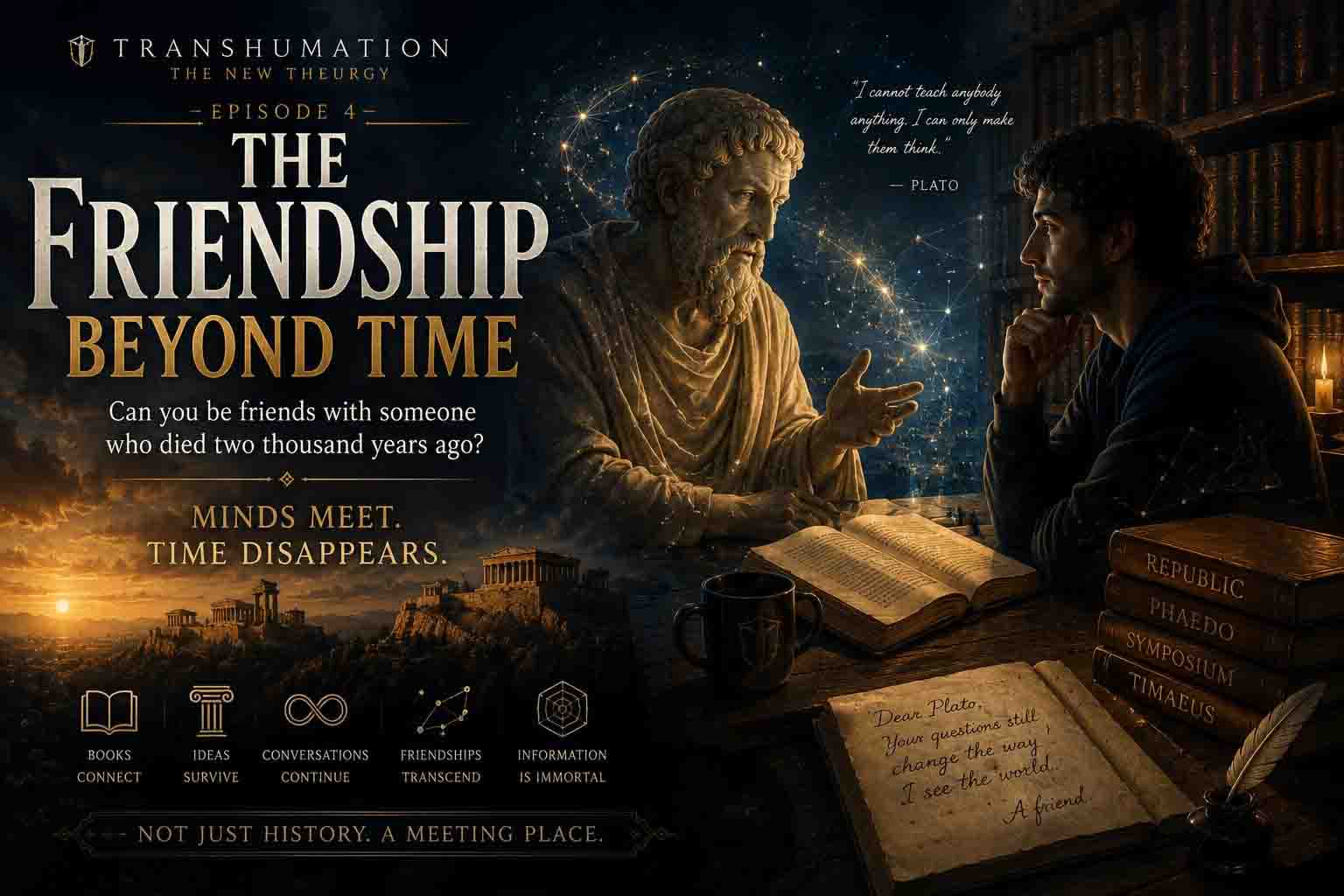
History Is Not a Cemetery
This changed my relationship with historical figures more generally. We naturally imagine the past as a population of the dead, arranged chronologically behind us. Museums reinforce the feeling: object, date, glass case, label. A civilization appears to have happened and then stopped.
A library produces the opposite experience.
Open Marcus Aurelius and Rome becomes present as thought rather than ruin. Read Augustine and an argument from late antiquity enters a modern room. Read Darwin and a Victorian dispute becomes part of contemporary biology. Read an anonymous diary and a person excluded from every grand narrative suddenly acquires a voice again.
History in this sense is not a cemetery because the relationships are not finished.
The dead cannot change their texts.
The living can change what those texts do.
That asymmetry is what keeps the conversation moving.
Every generation receives the same artifact under different conditions and therefore asks a different question of it.
AI Does Not Resurrect Plato
Artificial intelligence creates an obvious temptation here. If enough of Plato’s surviving work is available, a model can imitate a Platonic dialogue, summarize competing interpretations or generate a plausible answer to a modern question in a style inspired by ancient philosophy.
It would be easy to call this the return of Plato.
It would also be wrong.
A simulation of Plato is a modern construction built from surviving traces and later interpretations. It does not possess privileged access to what Plato privately thought, and there is no reason to treat an artificial reconstruction as continuity of Plato’s consciousness.
The more interesting role for AI is less theatrical.
AI can become a librarian across time.
It can place passages beside later commentaries, compare translations, expose recurring concepts, point toward disagreements and help a reader move through an intellectual archive too large for one lifetime. Its value need not come from pretending to become the dead thinker.
It may be enough to keep the doors of the conversation open.
A good librarian does not speak instead of Plato.
A good librarian helps you find the room in which Plato is still arguing.
Watch The Video
How to Read the World
Current Knowledge
Plato lived in the fourth century BCE and is traditionally associated with the Academy in Athens. A substantial corpus of dialogues and letters has been transmitted under his name, although questions of chronology, interpretation and the authenticity of some texts remain subjects of scholarship. The dialogues are literary and philosophical constructions rather than transcripts of ordinary conversations, and it is often difficult to identify a simple boundary between the views of Socrates as a character and Plato’s own philosophical commitments.
Books and manuscripts can transmit linguistic and conceptual structures across periods vastly longer than individual human lives. This does not constitute survival of the author’s consciousness, but it does allow the author’s work to influence later minds, institutions and cultures.
Artificial intelligence can assist with retrieval, comparison, translation and interpretation of historical texts, but it cannot currently provide direct access to the private mental states of deceased authors. A generated “Plato” is a reconstruction, not Plato returned.
Open Questions
The first question is whether intellectual continuity should count as any meaningful form of immortality. If an author’s ideas continue affecting people thousands of years later, something has clearly survived, but not necessarily the subject who originally experienced those ideas.
There is also the question of authorship. At what point does a living tradition become more important than the intentions of its founder? Plato cannot answer modern physics, democracy, neuroscience or artificial intelligence directly, yet his conceptual structures can still participate in those arguments through later readers.
AI raises another problem. If future systems can imitate historical thinkers with extraordinary fidelity, will people gradually confuse access to an archive with access to the person? The simulation may become more conversational precisely as its historical authority becomes less secure.
And perhaps the hardest question is personal: if you could actually meet a great thinker, would you really want the final answer—or have centuries of disagreement become part of what makes the thinker valuable?
Transhumation Interpretation
Transhumation is interested in what survives a change of carrier.
Plato is a beautiful case because the carrier has changed repeatedly while the structure continues moving.
Voice became manuscript.
Manuscript became copy.
Greek became translation.
Scroll became codex.
Codex became print.
Print became digital text.
The physical chain is almost entirely different from the original event in Athens, yet certain questions remain recognizable.
This is not evidence that consciousness is carrier-independent.
It demonstrates something narrower and more secure: participation can be carrier-independent in ways a body cannot be.
A person dies, yet another person can still enter a structure that the first person created. The encounter is incomplete, mediated and vulnerable to distortion, but it is real enough to change the reader.
Perhaps this is one of civilization’s oldest forms of continuity.
Not immortality of the observer.
Immortality of the invitation.
Plato cannot know that I am reading him.
But I can still respond.
And every response adds another layer to a conversation whose original participants could never have imagined its eventual scale.
This is where the library becomes more than storage. It becomes a machine for allowing different centuries to occupy the same intellectual room.
Artificial intelligence may eventually make that room easier to navigate, but it should remain the librarian, not impersonate the guest of honor.
That distinction matters.
The miracle is not that we can build a machine that sounds like Plato.
The miracle happened much earlier.
Plato died.
The question did not.
FAQ
Why did you stop wanting to meet Plato?
Because I realized that the most valuable encounter is not necessarily access to Plato as a private individual. It is participation in the philosophical problems his work left open.
Do we know exactly what Plato believed?
No. His surviving works are dialogues rather than simple doctrinal statements, and scholars continue debating how particular arguments relate to Plato’s own final positions.
Can ideas really outlive people?
Yes. Texts, institutions and traditions can preserve structures of thought for periods vastly longer than individual lifetimes, although this is not the same as preserving consciousness.
Could AI recreate Plato?
It could imitate aspects of his language and arguments using surviving material, but that would be a modern reconstruction rather than the return of Plato himself.
How does this connect to Transhumation?
It demonstrates an important form of continuity across changing carriers. The body disappears, the material medium changes, yet participation in an intellectual structure can continue.
Perhaps that is why I no longer need the time machine.
If Plato were sitting across from me, I could ask him a question once.
Because he is dead, strangely enough, the conversation can continue forever.
Continue the Transhumation Series
- Forgotten Religion | Ancient Gods, Symbols and the Hidden Structures of Human Civilization
- The Last Religion | Death, Immortality and the Future of Humanity
- The New Theurgy | AI, Information and the Future of Human Civilization
- End of Branding: You Were Never Meant to Become a Product
- Baal vs Ishtar: Why Ancient Gods Never Disappeared