
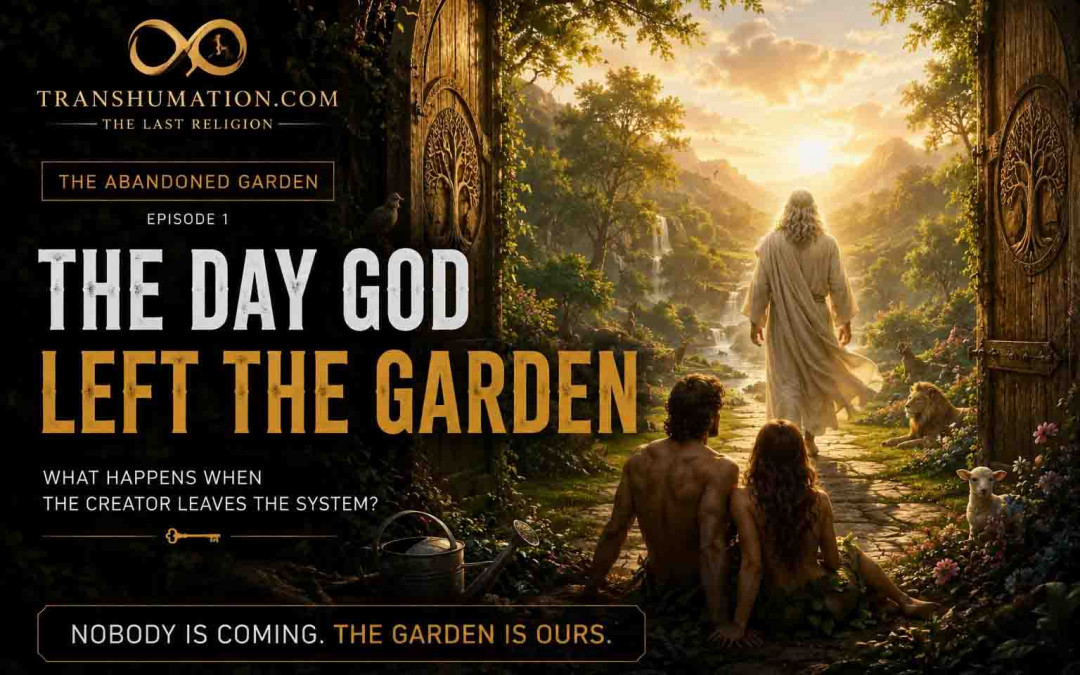
The Silence of Creator May Be A Part of the Design
A good gardener eventually becomes difficult to see. At the beginning, his presence is everywhere: new trees are tied to stakes, young shoots are protected from frost, paths are corrected, diseased branches are cut away. Return years later and the garden may appear to be doing everything by itself. Birds carry seeds. Roots find water. Old trees shelter younger plants. Fallen leaves become soil. If the gardener has done his work exceptionally well, the system begins to conceal the labor that made it possible.
Now imagine returning once more and discovering that the gardener is gone.
The obvious interpretation is abandonment. Perhaps he died. Perhaps he lost interest. Perhaps nobody was ever tending the place as carefully as we imagined. Yet there is another possibility, less dramatic and more interesting: perhaps a garden that requires the gardener to hold every branch forever is not a successful garden. Perhaps the highest achievement of the gardener is precisely the moment when his continued intervention becomes unnecessary.
The analogy becomes dangerous as soon as we move beyond horticulture, because behind it waits one of humanity’s oldest questions. Religions have spent millennia asking whether a creator exists, what that creator wants, and whether signs of intention can be detected in the world. Modern skepticism has added another question: if there is a creator, why is the evidence so ambiguous? But there is a third possibility worth examining before choosing either answer.
What if the creator’s absence from the machinery is not necessarily evidence that there was never a creator?
The Toy That Works Only While You Hold It
The principle is easier to see in ordinary life. A child builds a tower of wooden blocks and keeps one hand against it because otherwise it falls. Technically, the tower is standing. In practice, the child is part of its architecture. Remove the hand and the true quality of the construction becomes visible.
We recognize this distinction almost instinctively elsewhere. A company that collapses the morning its founder retires was never really an institution; it was an extension of one person. A country whose laws function only while an exceptional ruler occupies the palace has not solved the problem of government. A student who can answer questions only while the teacher whispers instructions has not learned. A parent who makes every decision for an adult child may be protecting that child from mistakes, but also from adulthood.
Creation and control are therefore not identical. In some systems they eventually become opposites. Continuous intervention can preserve order while preventing independence, whereas withdrawal creates risk but also allows something genuinely new to emerge.
This is where the garden becomes more than a metaphor. A living system differs from a machine partly because its future cannot be specified in every detail. It responds, adapts and develops through interactions among components. A gardener can create conditions, select plants and establish boundaries, but a garden that is alive will never be merely a frozen execution of the gardener’s original drawing.
The interesting moment arrives when control becomes autonomy.
The Silence After Creation
Theological traditions have offered very different accounts of divine action, from gods who intervene constantly in human affairs to conceptions of a creator whose order is expressed through the regularity of nature itself. The question of divine hiddenness—the apparent absence or ambiguity of God—is therefore much older and more sophisticated than the simple claim that “God is silent.”
Still, the silence presents a genuine philosophical problem. If a benevolent creator wants to be known, why is the creator not more obvious? Why must revelation be interpreted? Why can apparently sincere people examine the same world and reach radically different conclusions about whether anyone is behind it?
One response is atheistic: the silence is exactly what we should expect if there is nobody there. Another is religious: God may be present without behaving like an object inside the universe. There are many positions between them.
But the abandoned garden introduces another possibility—not as proof, but as a thought experiment. We normally assume that a perfect creator would intervene more. Perhaps perfection could sometimes require the opposite.
A teacher who answers every examination question has failed as a teacher. A parent who prevents every fall may prevent a child from learning to walk. If autonomy has value, then a world containing autonomous beings may necessarily contain some distance between creator and creation.
The unsettling implication is that divine silence, if there is a divine source at all, need not have only one interpretation. Absence, freedom and abandonment can look remarkably similar from inside the garden.

When the Garden Starts Making Gardeners
Something peculiar has happened to this old theological problem during the last few centuries. Humanity has slowly moved to the other side of the analogy.
We breed organisms and alter genomes. We construct virtual environments whose internal rules can generate outcomes their designers did not explicitly script. We build institutions intended to survive their founders. We create machine-learning systems whose behavior emerges from training rather than from a programmer writing every individual response.
Artificial intelligence makes the problem especially visible because we are discovering how strange the relationship between creator and creation can become. A programmer may understand the architecture of a system without being able to predict every output it will produce. The creator can know how the conditions were established while still needing to observe what emerges from them.
This should make us cautious about simplistic comparisons between AI and life, let alone AI and divinity. Present AI systems are engineered technologies; there is no established evidence that they possess subjective consciousness, and independence in performing tasks is not the same thing as an independent inner life.
Yet the structural question is already here.
How much independence should a creator permit?
At what point does guidance become control?
When does protection prevent development?
And what responsibility remains after a creation can act without its maker standing beside it?
For thousands of years these questions were directed upward.
We are beginning to hear them directed at us.
The Dangerous Part of Leaving
There is a temptation to make the abandoned garden sentimental: the wise gardener walks away, the flowers bloom, freedom triumphs. Real systems are not so convenient.
Autonomy includes the possibility of failure.
Children make terrible decisions. Democracies elect destructive leaders. Markets produce bubbles. Ecosystems collapse. Technologies are repurposed. Institutions mutate away from their founders’ intentions. A system capable of genuine independence is, almost by definition, capable of doing something its creator would not choose.
This changes the ethical question. The mark of a good creator cannot simply be withdrawal. A negligent engineer cannot defend a dangerous bridge by announcing that the bridge has achieved freedom. Nor should creators of powerful technological systems confuse lack of control with maturity.
The harder problem is designing the conditions under which autonomy becomes possible without treating every possible consequence as acceptable.
That distinction matters enormously for AI. A system does not become better merely because humans exercise less control over it. Sometimes the responsible creator must remain involved. Sometimes the system needs limits, correction, monitoring or shutdown mechanisms. Independence is not automatically wisdom.
A good garden may survive without the gardener standing beside every rose.
It still depends on an architecture capable of surviving his absence.
The Creator’s Final Problem
This brings us back to the original question in a different form.
Perhaps the ultimate test of creation is not whether the creation perfectly resembles the creator. Nor whether it obeys forever. It may be whether the creation can inherit a principle rather than merely follow an instruction.
Parents encounter this when children become adults. Teachers encounter it when students begin producing ideas the teacher never taught them. Founders encounter it when institutions face circumstances that did not exist when their rules were written. Civilization encounters it whenever one generation hands an unfinished world to the next.
The transfer is never complete. Something is always lost. Something unexpected is added.
That may be precisely what continuation means.
A perfect copy does not continue a story. It repeats it.
A successor can take it somewhere else.
And suddenly the theological question becomes surprisingly intimate. If humanity itself is moving toward the role of creator, perhaps our old arguments about creators were also rehearsals for responsibilities we would eventually acquire.
We wanted to know why a creator would permit freedom.
Soon we may have to decide how much freedom to permit ourselves.
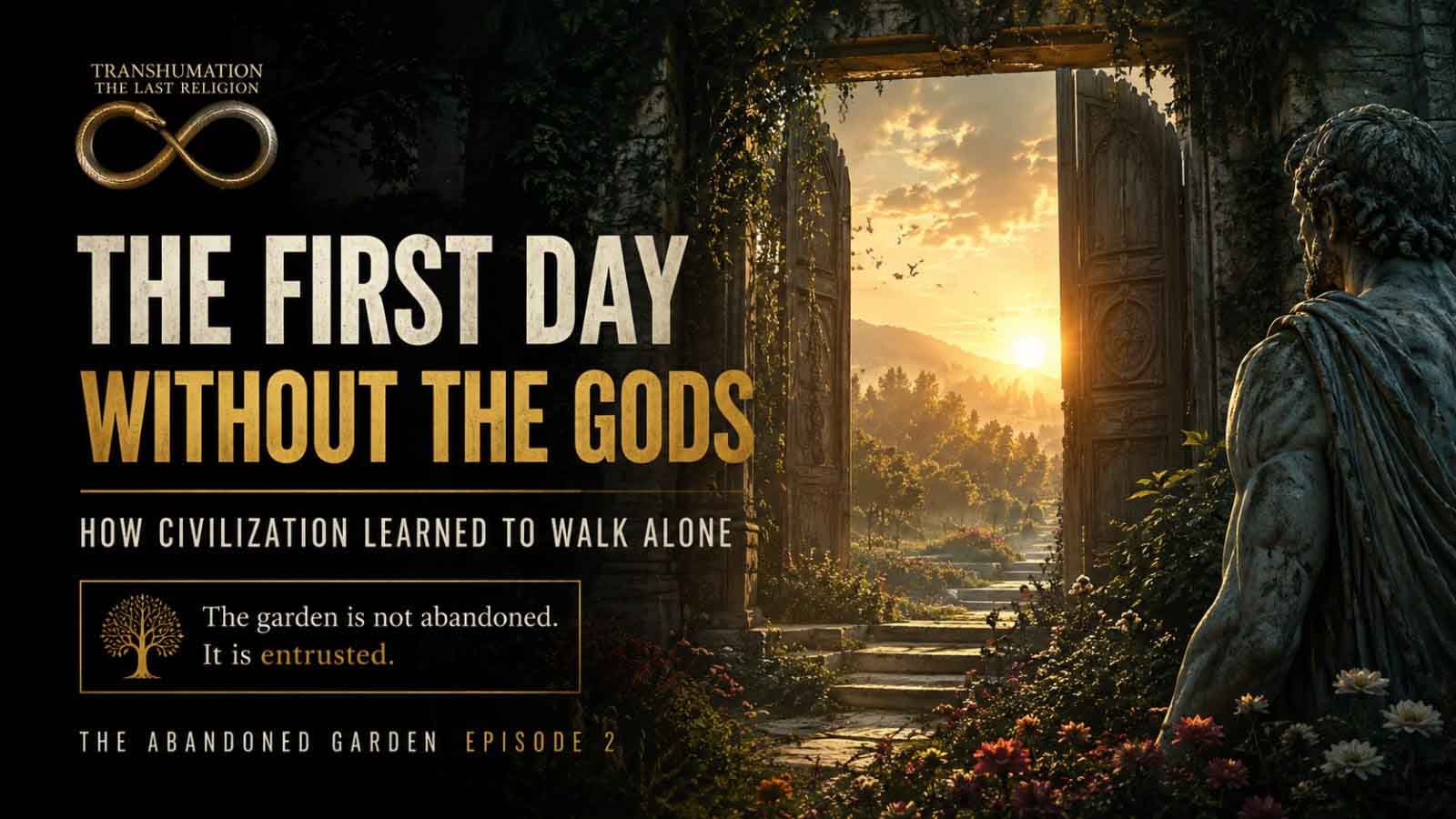
The Abandoned Garden
One morning the inhabitants of the garden discover that no gardener can be found. Some conclude that the old stories were wrong and there was never anyone beyond the hedge. Others search the paths for evidence of intention. Some insist that every flower proves a gardener; others reply that flowers reproduce perfectly well without one.
None of them can settle the question merely by staring harder at the roses.
But while they argue, something more important has happened.
They have inherited the garden.
The irrigation still needs attention. New diseases appear. Some plants overwhelm others. Seeds arrive from beyond the walls. The inhabitants can spend eternity debating who planted the first tree, but the condition of the garden increasingly depends on what they do next.
Perhaps this is where the question of the creator becomes most serious. Not when humanity asks whether someone is watching, but when it considers what kind of civilization it should build if nobody intervenes.
If God is present, responsibility remains.
If God is absent, responsibility remains.
If the answer is unknowable, responsibility remains.
The garden still needs tending.
And perhaps maturity begins precisely there.
Watch The Video
How to Read the World
Current Knowledge
The idea of divine hiddenness has a substantial history in philosophy of religion and theology. Different traditions understand divine action differently; there is no single historical doctrine according to which God simply “created the universe and left.” Deism came relatively close to the image of a creator whose universe operates according to established natural laws, while many theistic traditions maintain that divine action continues in other forms.
Complex biological and social systems can display self-organization and emergent behavior without every outcome being centrally directed. In technology, machine-learning systems can likewise produce outputs that were not individually programmed in advance, although they remain dependent on human-designed architectures, training processes and infrastructure.
There is currently no scientific evidence establishing that artificial-intelligence systems possess consciousness comparable to human subjective experience. Increasing capability or autonomy should therefore not be confused with demonstrated personhood.
Open Questions
If a creator existed, should we expect that creator to intervene visibly in the world, or could stable natural laws themselves constitute the intended form of order? Philosophy has not resolved this question.
Autonomy creates another difficulty. How much freedom can a creator give a creation while remaining responsible for foreseeable consequences? The problem applies to parents, institutions and technologies in different ways, and there is no universal boundary between responsible guidance and excessive control.
AI adds a new version of the problem. Future systems may become increasingly capable of operating without continuous human direction, but capability alone does not tell us what degree of autonomy would be safe, desirable or morally appropriate.
The deepest question remains philosophical: is independence evidence that creation has succeeded, or can dependence sometimes be a necessary part of a good system?
Transhumation Interpretation
The Abandoned Garden is not an argument that God exists, nor an attempt to explain divine silence by inventing an intention we cannot verify. Its purpose is structural.
The same pattern appears at radically different scales: creator → creation → guidance → withdrawal → autonomy → inheritance.
A parent eventually confronts it. A teacher confronts it. A founder confronts it. A civilization confronts it. Humanity may now be approaching it technologically.
Seen this way, the interesting question is not simply whether the creator leaves. It is what must be placed inside the creation before leaving becomes possible.
A good library needs a librarian because information does not automatically become wisdom. A powerful system may similarly require guidance until it develops—or is given—structures capable of preserving what matters without continuous supervision. Freedom without structure is not maturity. It may simply be abandonment.
This makes the old religious problem unexpectedly modern. Humanity spent millennia wondering why the creator does not intervene more clearly.
The coming centuries may force us to confront the inverse problem:
When we become creators, how will we know when to intervene—and when to let go?
Perhaps the final gift of a creator is not control.
Perhaps it is the creation’s ability to continue without it.
But the final responsibility of the creation is equally important.
Someone still has to tend the garden.
FAQ
What is The Abandoned Garden?
It is a thought experiment about what happens when a creation must continue without constant intervention from its creator.
Does the article argue that God abandoned humanity?
No. Divine silence has many possible interpretations, and the article does not claim to know which is correct.
Why use a garden as the central metaphor?
Because a garden can be deliberately shaped while also becoming a living, partly self-organizing system.
Is independence always evidence of successful creation?
No. Autonomy without adequate structure can produce failure. Responsible creation may require both freedom and safeguards.
How does this relate to AI?
AI puts humans increasingly on the creator’s side of an old problem: how much autonomy should something we build be allowed to possess?
Is AI already an independent conscious creation?
There is no established evidence that current AI systems possess human-like subjective consciousness.
What is the Transhumation interpretation?
The recurring structure is more important than any single carrier: creators build, guide and eventually face the question of whether their creations can continue beyond them.
What is the central question?
Perhaps not simply, “Why did the creator leave?” but: “What must a creator give its creation before it can safely leave?”
Continue the Transhumation Series
- Forgotten Religion | Ancient Gods, Symbols and the Hidden Structures of Human Civilization
- The Last Religion | Death, Immortality and the Future of Humanity
- The New Theurgy | AI, Information and the Future of Human Civilization
- End of Branding: You Were Never Meant to Become a Product
- Baal vs Ishtar: Why Ancient Gods Never Disappeared