
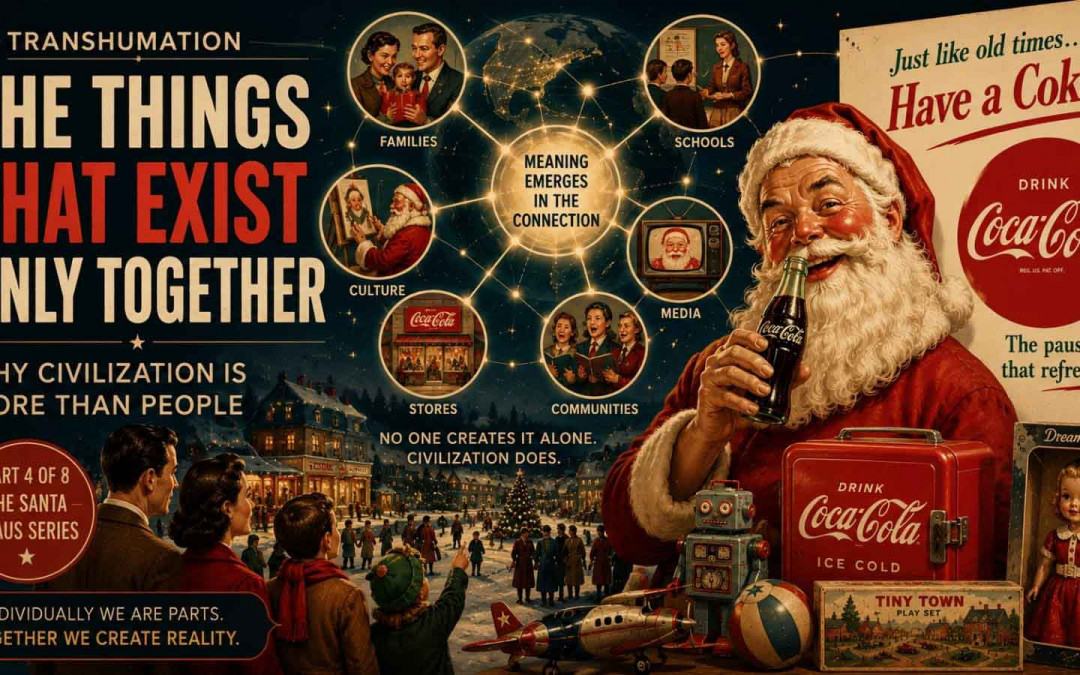
The Things That Build Civilization
Imagine arriving at an old cathedral just before closing time. The tourists have mostly gone, the last footsteps are moving toward the door, and for a few minutes the building seems to belong to itself. There is stone under your hand, coloured glass above you, timber somewhere beyond the vaults, iron holding things together that you cannot see. Everything appears reassuringly solid. A cathedral seems like precisely the sort of thing whose existence should be beyond philosophical dispute.
Now imagine that a team of conservators arrives the following morning and begins to dismantle it. They work perfectly. Every stone is numbered and placed safely in a warehouse. Every pane of stained glass is preserved. Every beam, hinge, carving and fragment of metal survives. Not a gram of the cathedral has been destroyed.
When the work is finished, what exactly is sitting in the warehouse?
All the cathedral’s matter is there. The cathedral is not.
Something disappeared without anything being lost.
That small puzzle opens a surprisingly large door. We are accustomed to searching for reality inside things: the stone, the cell, the person, the computer, the document. But many of the most consequential things in human life cannot be located inside any single component. They appear only when components enter particular relationships.
Sometimes the most important thing in the room is not another object.
It is the arrangement.
Where Did the Cathedral Go?
We can make the puzzle easier by rebuilding the cathedral. Put every stone back where it was, reconnect the beams, restore the windows and open the doors. At some point during this process, the collection of building materials becomes a cathedral again.
No miraculous substance has been added. What has returned is organization.
A stone can support another stone because of where it has been placed. An arch exists because several pieces constrain one another in a particular geometry. Remove one block and the remaining stones have not changed chemically, but the structure may cease to perform the function that made the arrangement interesting in the first place.
Civilization is full of things like this.
A university is not its lecture halls. Close the institution and sell the buildings to a hotel company; the bricks survive perfectly well, while the university disappears. A court is not a room containing a judge and several chairs. A marriage is not two bodies standing beside each other. A company is not its office furniture. Money is not identical to the paper on which a denomination happens to be printed.
We live among objects, but much of our world is made from relationships between objects, people, rules and expectations.
The invisible architecture is often more consequential than the visible one.
Santa Claus Has No Address
Santa Claus provides a wonderfully unserious demonstration of the same problem.
Suppose we decide to find him.
We search every red suit, every Christmas tree, every toy shop and every warehouse full of presents. We inspect the Coca-Cola advertisements, children’s books and old Christmas films. We can catalogue every physical object associated with Santa Claus and still fail to locate the thing itself.
Because Santa Claus does not live inside any of them.
He exists between them.
A parent remembers what Christmas felt like as a child and recreates part of the experience for another child. Schools decorate classrooms. Films repeat recognizable images. Shops prepare their displays. Grandparents preserve family rituals. Children compare stories with friends. Millions of people who will never meet one another perform slightly different versions of the same cultural act.
Nobody controls the entire system.
Nobody needs to.
Remove one Christmas tree and Santa Claus survives. Remove one film and he survives. Remove one generation of advertising and he probably survives.
Remove the network of participation, however, and he disappears almost immediately.
Nothing needs to burn.
The relationship only needs to stop being reproduced.
That is a rather useful model for thinking about civilization.

A Word Requires Two People
Language makes the structure easier to see because language seems physical until we examine it closely.
A word can be spoken as sound or written as marks. But neither the sound nor the marks contain their meaning in the way a bottle contains water. The English word tree bears no natural resemblance to branches, bark or leaves. It works because speakers have inherited an agreement about what those four letters are doing.
Meaning therefore requires a relationship between sign and interpreter.
Imagine that every English speaker vanished tomorrow while every English book, dictionary and audio recording remained perfectly preserved. English would still exist in one sense: its physical traces would be everywhere. But in another sense it would have become silent. Until somebody reconstructed the code, Hamlet would be ink arranged on paper rather than Shakespeare being understood by another mind.
This is why preserving information is not enough to preserve civilization.
The reader must also survive.
The teacher must survive.
The conventions connecting one mind to another must survive.
A library full of books whose language nobody understands is an archaeological treasure, but it is no longer a functioning library in the ordinary human sense. It has preserved the possibility of knowledge while losing immediate access to the knowledge itself.
Civilization therefore has to reproduce not only its information.
It has to reproduce its interpreters.
The Internet After the Last Cable Is Cut
The internet makes the same point with machinery.
Walk into a data centre and you can point at servers, switches, fibre-optic cables and storage devices. All of them are parts of the internet. None of them is the internet.
The interesting thing happens when machines communicate according to compatible protocols across networks.
Disconnect them all and the machines remain. Their processors retain the same chemical composition. Buildings continue standing. Hard drives may still contain enormous quantities of data.
But the global network has vanished.
Once again, destroying the whole does not require destroying the parts. It is enough to destroy the connections that allow the parts to behave as a whole.
This principle becomes more interesting when applied beyond technology. A market exists because buyers, sellers, prices, rules and expectations interact. A government depends upon institutions recognizing one another’s authority. A scientific community depends upon researchers, publications, criticism, replication and accumulated methods. A family is not merely a list of genetically related individuals; it is also a changing network of obligations, memories and roles.
Civilization begins to look less like a warehouse filled with achievements and more like an ecosystem of maintained connections.
That distinction matters because warehouses can be preserved by locking the door.
Relationships cannot.
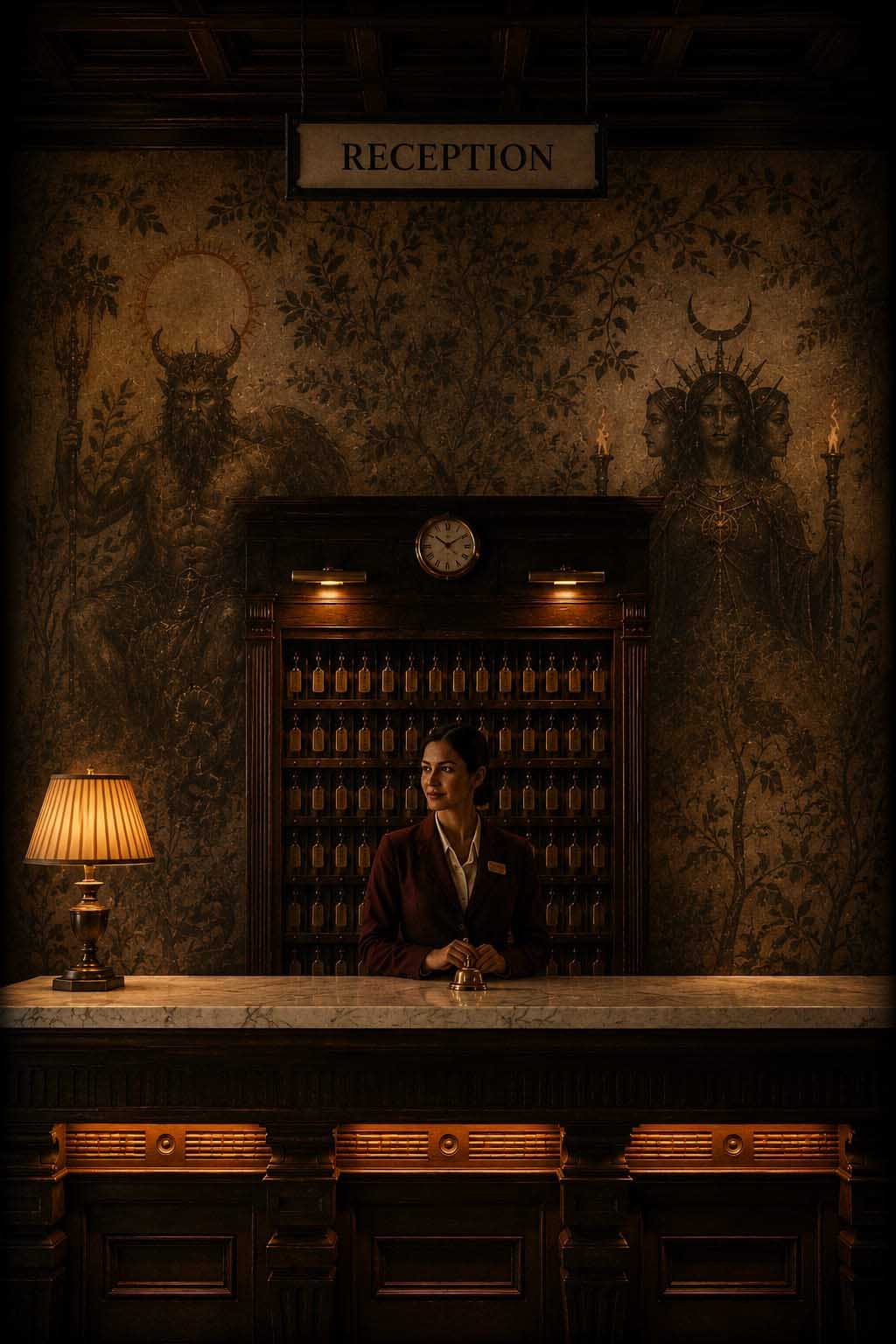
What the Gods Were Organizing
Ancient religions become more interesting when viewed from this angle, although we should be careful not to rewrite their historical meanings to fit a modern theory.
Many ancient deities were associated with forces that connected different parts of life: fertility joined generations; justice organized relations among people; trade connected strangers and territories; gods of boundaries marked transitions between spaces; agricultural rituals connected communities to seasonal cycles.
The gods were not merely characters wandering through supernatural adventure stories. They belonged to systems of ritual, authority, social identity, explanation and reciprocal obligation.
A temple without worshippers becomes architecture.
A ritual without participants becomes choreography.
A sacred text without interpreters becomes an object.
Whatever one believes about the metaphysical reality behind religion, its civilizational existence clearly depends upon relationships continuously being reproduced.
This may help explain why religions can survive the destruction of temples while disappearing in places where the buildings remain.
Stone is durable.
Participation is not.
The Strange Power of Trust
Modern societies often teach us to think in terms of possessions because possessions are easy to count. We can measure houses, money, servers, weapons, factories and books. It is considerably harder to place trust on a balance sheet.
Yet remove trust and many of the objects lose their function remarkably quickly.
A banknote works because other people are expected to accept it tomorrow. A contract works because institutions are expected to recognize it. A university diploma matters because strangers recognize the institution that issued it. Scientific knowledge travels because researchers share methods for deciding what counts as evidence.
Civilization depends on millions of expectations about what other people will do.
Most of those people have never met.
This may be one of humanity’s strangest achievements. We learned to cooperate not merely with family or neighbours but with invisible networks of strangers distributed across countries and generations. A person boards an aircraft because they trust engineers they have never seen, regulations they have never read, technicians whose names they will never know and a pilot they may meet for three seconds.
The aircraft is an object.
The system that makes boarding it reasonable is not.
The Human Being Is Already a Relationship
Eventually the argument reaches biology, where the distinction between thing and relationship becomes harder to maintain.
A human body contains trillions of cells performing specialized functions within organized systems. A neuron removed from a brain does not contain a thought waiting to be opened. Whatever consciousness ultimately turns out to be, ordinary cognition depends upon coordinated activity across networks rather than a single magical neuron carrying the person inside it.
The same general principle appears elsewhere in nature. Ant colonies display behaviours that no individual ant understands as a master plan. Ecosystems emerge through interactions among organisms and environments. Multicellular organisms exist because cells cooperate, differentiate, signal and constrain one another.
Complex systems acquire properties that are difficult—or sometimes impossible—to understand by examining components in isolation.
This does not mean that mysterious new substances appear when things connect. It means that organization itself can have causal importance.
Move the cathedral stones and you change the cathedral.
Disconnect the computers and you change the network.
Break enough relationships inside a society and you may preserve every building while losing the civilization that built them.
The Things That Exist Only Together
We can now return to the warehouse.
Every stone is still there.
Perhaps that was the trap.
We assumed that because nothing had been destroyed, nothing important had been lost. But the cathedral was never merely the sum of its inventory. It was stone arranged into arches, glass positioned to transform light, rooms connected to ritual, history attached to place, and generations of observers capable of recognizing what they had entered.
Civilization may work the same way.
Its greatest achievement is not simply the accumulation of increasingly sophisticated objects. It is the construction of relationships capable of surviving beyond the individuals who formed them.
Language does this.
Science does this.
Families do this.
Libraries do this.
The internet does this.
Even Santa Claus, in his ridiculous red suit, does this.
Perhaps that is why civilizations can disappear while leaving magnificent ruins. Archaeologists arrive centuries later and find streets, walls, coins, temples and tools. The physical pieces survived.
What vanished was the invisible arrangement that once made those pieces part of a living world.
Civilization had not been hiding inside the stones.
It had been happening between them.
Watch The Video
How to Read the World
Current Knowledge
The idea that systems can possess properties arising from interactions among their components is broadly associated with concepts such as emergence, systems theory and network science. Examples range from biological organisms and ecosystems to markets, languages and technological networks.
Social institutions such as currencies, universities and legal systems depend on shared rules, practices and recognition rather than on any single physical object. Their material infrastructure matters, but it is not sufficient to constitute the institution.
Language likewise depends on communities of speakers and interpreters. Written records can preserve linguistic information after a language ceases to be spoken, although decipherment may later restore some degree of understanding.
Complex biological functions also depend on organized interactions. Individual neurons perform cellular processes, while cognition arises from activity distributed across neural systems. The precise relationship between neural activity and subjective consciousness remains unresolved.
Open Questions
How much of a system can be changed before it becomes a different system? If every person in an institution changes while its rules and relationships continue, what exactly preserves its identity?
There is also a preservation problem. Can information genuinely survive if the network of interpreters required to understand it disappears, or has only its physical carrier survived?
Artificial intelligence introduces another question: can increasingly complex relationships between humans and artificial systems create institutions or forms of collective intelligence that cannot be meaningfully reduced to either humans or machines alone?
And perhaps the oldest question remains the hardest: are relationships simply useful descriptions imposed by observers, or are certain relational structures as objectively real as the physical components that instantiate them?
Transhumation Interpretation
Transhumation begins here with a deceptively simple proposition:
some things exist only together.
The carrier matters, but the arrangement may matter more.
A civilization can therefore survive the replacement of enormous quantities of matter. Buildings are rebuilt. Citizens die and are replaced by new generations. Languages evolve. Institutions change headquarters. Books move from parchment to print to digital storage.
And yet something can continue.
The structure survives migration between carriers because relationships are reproduced.
This gives us a different way to think about identity:
parts → relationships → structure → function → continuity
The cathedral is useful precisely because it reveals what happens when this chain is broken. Preserve every component while destroying their relationships and the higher-order object disappears.
The reverse is equally interesting.
Replace the components while preserving enough of the relationships and something recognizable may remain.
That is the deeper Transhumation problem.
Perhaps continuity does not always require preserving the original matter.
Perhaps it requires preserving the organization that allows the matter to continue performing the same role inside a larger structure.
This is why a library exists for readers rather than books. Why language requires minds. Why civilization requires trust. Why information needs an observer.
And it leads eventually to the uncomfortable human question.
If every atom changes, every cell changes, memories change and the body ages, what exactly allows us to continue saying:
I am still me?
The cathedral puzzle has quietly become the identity problem.
Perhaps we began by looking at stones because it was easier.
FAQ
What does “The Things That Exist Only Together” mean?
It describes systems whose important properties depend on relationships among their components rather than on any component alone.
Where does the cathedral go when it is dismantled?
Its materials survive, but the organization that made those materials function as a cathedral has been disrupted.
Why is Santa Claus an example?
Because the tradition exists through relationships among children, parents, schools, media, commerce and generations rather than inside any single object.
Does language exist without speakers?
Its records can survive, but a language becomes functionally silent when nobody can interpret it.
Is the internet just a collection of computers?
No. Its essential function depends on communication among connected machines using shared protocols.
What does this have to do with biology?
Many biological functions arise from organized interactions among components. A single neuron, for example, cannot perform the cognitive functions of a brain.
Does this mean the whole is literally more than its parts?
Not necessarily in a mystical sense. The important point is that relationships and organization can produce functions that isolated components do not possess.
How does this connect to Transhumation?
It supports the idea that continuity may depend not only on preserving matter but on preserving relationships, organization and function across changes of carrier.
What is the central question?
If the parts can change while the structure survives—and the parts can survive while the structure disappears—where exactly does identity live?
Continue the Transhumation Series
- Forgotten Religion | Ancient Gods, Symbols and the Hidden Structures of Human Civilization
- The Last Religion | Death, Immortality and the Future of Humanity
- The New Theurgy | AI, Information and the Future of Human Civilization
- End of Branding: You Were Never Meant to Become a Product
- Baal vs Ishtar: Why Ancient Gods Never Disappeared