
The Chicken Dream
We have spent thousands of years redesigning animals to suit human needs. Now, for the first time, we are acquiring the tools to do the same thing to ourselves. The chicken may be a surprisingly good place to begin thinking about what “improvement” actually means.
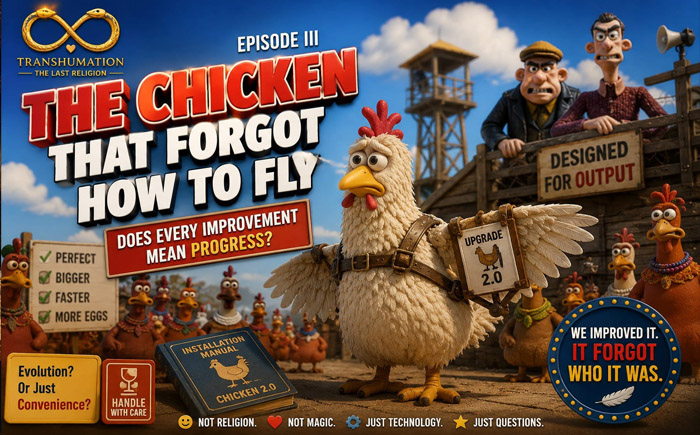
A chicken still looks like a bird. It has feathers, wings, hollow bones, a wishbone, flight muscles, and the nervous system of an animal whose evolutionary history belongs to the sky. Watch one startled in a garden and something ancient briefly reappears: a frantic burst of wings, a jump onto a fence, perhaps a short flight into a tree. The machinery has not disappeared. It has simply become less useful than it once was. Domestic chickens descend primarily from the red junglefowl of South and Southeast Asia, birds perfectly capable of taking to the air when necessary, although never in the manner of an eagle or an albatross. They fly to escape predators, cross obstacles and reach elevated roosts. Many modern chickens can still do some of this. Heavy commercial breeds, however, have been selected so intensively for characteristics useful to us—rapid growth, large bodies, meat production—that sustained flight has become increasingly impractical. The chicken did not wake one morning and abandon the sky. We changed the relationship between its wings and its world.
There is something almost embarrassingly ordinary about this. Humanity has domesticated animals for millennia. We breed cows for milk, sheep for wool, dogs for particular behaviours, pigeons for appearance and horses for speed. The chicken hardly seems to belong among the great philosophical problems of civilization. Yet that may be precisely why it is useful. Civilization’s most consequential assumptions often hide inside things too familiar to attract our attention. The chicken walking around a farmyard with two perfectly visible wings presents a question far larger than poultry: when we improve something, who gets to decide what counts as improvement?
The Price of Improvement
From the human point of view, the domestication of the chicken has been an astonishing technological success. A wild animal was transformed into one of the most efficient biological production systems ever incorporated into civilization. Generations of selective breeding increased egg production, altered body size, accelerated growth and created specialized lines optimized for purposes their ancestors never encountered. None of this required cruelty as its conscious objective. Farmers were not conducting a philosophical campaign against flight. They were selecting characteristics that appeared useful, generation after generation, and the organism gradually moved toward the incentives surrounding it.
That distinction matters. The unsettling part of the story is not that human beings deliberately decided that chickens should lose the sky. It is that nobody needed to make such a decision. Optimization can remove something without ever declaring war on it. If greater body mass provides an economic advantage while strong flight provides almost none, the balance shifts naturally. The system rewards one trait and quietly stops rewarding another. What disappears may not have been considered undesirable at all. It may simply have become irrelevant to the objective being optimized.
This is one of the less comfortable properties of progress. Improvement is rarely an abstract upward movement. It is improvement toward something. A racehorse is improved for speed. A dairy cow is improved for milk yield. A search engine is improved for retrieval. A social platform may be improved for engagement. Each objective produces gains, but the objective itself determines which qualities become valuable and which are allowed to fade into the background. Efficiency therefore cannot tell us whether a system is good. It can only tell us how successfully the system is approaching the destination we have given it.
A Bird That Remembers the Sky
The chicken becomes stranger when looked at not as a failed airplane but as an archive. Its body contains historical information. The wings are not decorative inventions placed there by a designer with a sense of humour. They are residues of a biological history in which leaving the ground mattered. The animal carries an older environment inside its anatomy.
Civilizations do this as well. We inherit buildings whose original functions have vanished, ceremonies whose meanings have changed, words detached from the worlds that produced them, political institutions designed for technologies that no longer exist. We continue to shake hands, ring bells, wear ties, say phrases, observe holidays and reproduce symbols whose genealogies most of us could not explain. Culture is full of wings.
Usually this is harmless. Sometimes it is beautiful. An obsolete function can become memory, identity or ritual. But occasionally a surviving form reveals that a deeper transformation has occurred. The shape remains while the original relationship has disappeared. A thing can therefore appear continuous while becoming something substantially different from what produced it.
This is where the chicken becomes useful beyond agriculture. It reminds us that identity is not preserved merely because the external architecture survives. Wings do not necessarily guarantee flight. A constitution does not automatically guarantee liberty. A university does not automatically guarantee curiosity. A communication network does not automatically produce understanding. A human body, eventually, may not by itself guarantee everything we currently place inside the word human.
Harry Angel’s Chickens
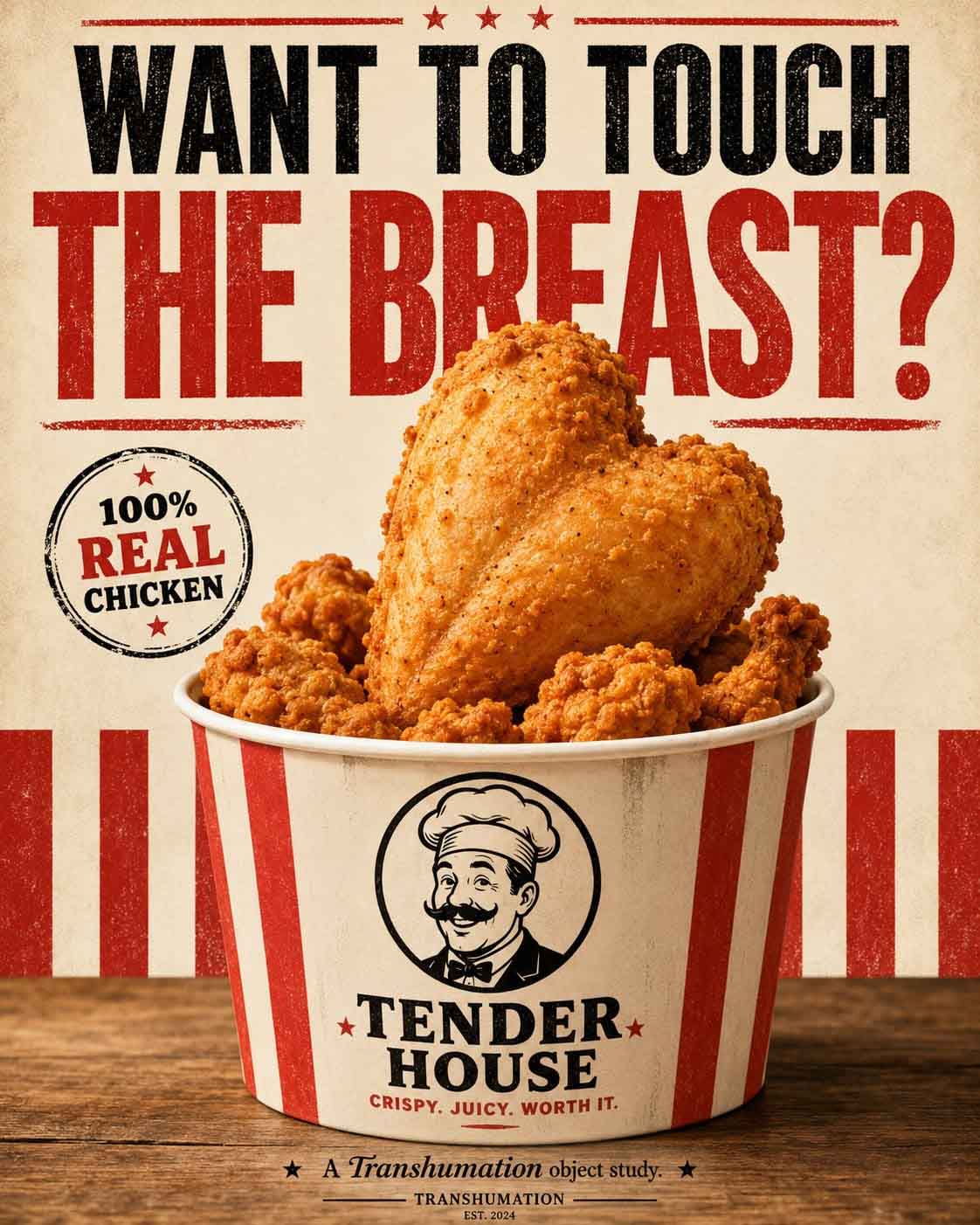
Angel Heart gives the chicken an entirely different atmosphere. Harry Angel repeatedly expresses an aversion to chickens, including the memorable line, “Dead chicken is good chicken.” The film never supplies a neat zoological explanation for the obsession, and it would be a mistake to pretend that the filmmakers secretly encoded a theory of domestication into the story. The connection is interesting for another reason.
Angel Heart is a film about identity surviving beneath forgetting. Harry moves through the story believing himself to be one person while evidence gradually reconstructs another history underneath him. Objects, names, habits and fragments of memory behave almost like archaeological remains. The surface personality continues functioning while something essential has been displaced.
Placed beside that story, the chicken acquires an accidental but powerful resonance. Here too is a creature whose present form carries evidence of an older possibility. Nothing supernatural is required. The bird simply possesses an architecture whose full purpose is no longer expressed by its ordinary life. Harry has forgotten who he is. The chicken has not literally forgotten anything, of course, but we have altered the environment in which its inherited capacities make sense.
That difference is important. Transhumation should not turn metaphor into evidence. The film is not “about” selective breeding, and chickens do not possess some mystical ancestral memory of flying across prehistoric skies. But metaphor is useful precisely because unrelated structures can illuminate one another. In both cases, the visible present is incomplete without the history hidden inside it.
Progress for Whom?
For most of human history, this question could comfortably be directed outward. What are we doing to animals? What are we doing to landscapes? What are we doing to machines? That separation is beginning to fail.
Gene editing, reproductive technology, neural interfaces, synthetic biology and artificial intelligence are bringing the logic of optimization closer to the human organism and the human mind. We do not yet possess the ability to redesign humanity at will, and many popular visions remain speculative. But the direction is difficult to miss. Characteristics once accepted as biological conditions are increasingly becoming potential engineering variables.
Suppose, sometime in the future, we could reliably create people who required less sleep. The immediate advantages would be obvious. More productive hours. Lower staffing costs. Longer operational periods. Perhaps soldiers, surgeons or astronauts could remain functional under conditions impossible today. Now change the variable. Reduce aggression. Increase concentration. Suppress anxiety. Enhance memory. Moderate sexuality. Increase obedience. Lower the emotional cost of repetitive work.
At what point does improvement stop describing the flourishing of the person being changed and begin describing the convenience of the system that uses them?
The chicken makes this question difficult to escape because we already know how optimization behaves when the designer and the designed do not have equal power. The animal did not participate in defining the breeding objective. We did. Its body became the territory upon which our definition of usefulness was written.
Civilization and Convenience
The most dangerous transformations are not necessarily imposed by villains. Villains are reassuring because they give responsibility a face. Convenience is harder to oppose. It arrives as a small improvement, then another, then another. Each individual decision appears reasonable. Eventually the accumulated environment makes the previous way of living difficult to imagine.
Consider how often civilization accepts a loss because the substitute is easier. We surrender memory to devices because devices remember better. We surrender navigation because maps navigate better. We surrender recommendation because algorithms filter abundance better. None of these transfers is inherently catastrophic. Human beings have always extended themselves through tools. Writing itself allowed memory to leave the skull and survive on another carrier. The mistake would be to assume that because outsourcing a function is convenient, the consequences of losing the original capacity do not matter.
A future human being could conceivably retain all the visible architecture we associate with humanity while living inside systems that have quietly removed some of the capacities through which earlier humans understood freedom, judgment, privacy, uncertainty or agency. The wings might remain.
That possibility changes the ethical problem. The central question is no longer whether technology makes us stronger. Almost certainly it will. The harder question is what strength means when somebody else has chosen the metric.
The Creator’s Burden
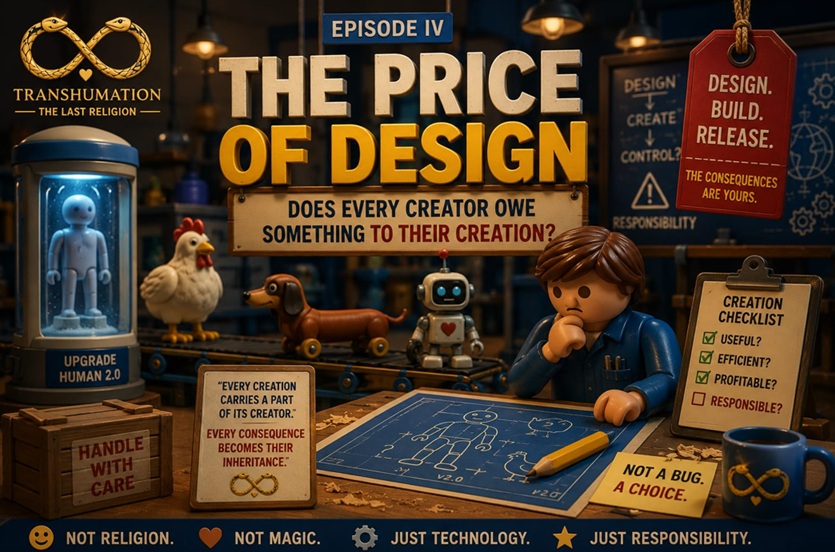
Every creator eventually encounters a conflict between the interests of the maker and the interests of what has been made. Parents experience it when deciding how much of a child’s life should reflect parental ambitions. Governments encounter it when security conflicts with liberty. Companies encounter it when profitable systems compete with the wellbeing of customers. Engineers encounter it when the easiest measurable objective fails to represent the messy reality it was supposed to improve.
Artificial intelligence may eventually make this conflict impossible to ignore. If increasingly autonomous systems become capable of pursuing goals, developing preferences or possessing forms of experience—a possibility that remains scientifically unresolved—the question of creator responsibility will move from metaphor into ethics. But even before machines reach anything resembling consciousness, AI already exposes the basic problem of optimization. Give a system the wrong objective and extraordinary intelligence can make the mistake more efficient rather than less.
Power therefore produces a peculiar obligation. The more completely a creator can redesign the conditions of another being’s existence, the less sufficient efficiency becomes as a moral argument. The farmer can say the chicken produces more meat. The corporation can say the worker produces more output. The government can say the citizen produces less disorder. The engineer can say the machine produces better metrics. None of those statements answers the deeper question.
Better for whom?
Watch the Vdeo
How to Read the World

Current Knowledge
Modern domestic chickens descend predominantly from wild junglefowl populations, particularly the red junglefowl, and domestication changed their morphology and behaviour over thousands of years. Wild junglefowl are not long-distance flyers, but they can fly effectively over short distances, especially to escape danger or reach roosting places. Domestic breeds vary dramatically. Lighter chickens can still fly surprisingly well, while modern heavy broiler lines are far less capable because their body proportions and rapid growth make sustained flight difficult.
Selective breeding is itself a form of biological design, although historically it operated without knowledge of genetics. Humans repeatedly selected animals possessing desirable traits, allowing those characteristics to become more common over generations. Modern genomics and gene-editing technologies make the process increasingly deliberate and potentially much faster. None of this proves that human beings will eventually redesign themselves on a comparable scale. It does establish that civilization already possesses a long history of reshaping living organisms according to human-defined goals.
There is also no scientific basis for saying that a chicken literally “remembers” being able to fly in the psychological sense. The phrase is metaphorical. What survives is evolutionary history embodied in anatomy, behaviour and genetics.
Open Questions
The important questions begin precisely where established knowledge ends. If humanity gains the ability to alter complex human traits safely, who should decide which traits count as improvements? Can an enhancement remain voluntary once refusing it creates an economic or social disadvantage? Could a society unintentionally breed behavioural diversity out of itself through cultural selection even without genetic engineering? If machines eventually possess morally significant forms of experience, will creators owe responsibilities to their creations that resemble—or exceed—the obligations we already struggle to recognize toward animals?
There is an even deeper question beneath all of these. How do we distinguish an adaptation from a loss when the environment itself has been redesigned? A chicken that cannot fly efficiently may be perfectly adapted to a protected farm. A human who cannot navigate without a digital system may be perfectly adapted to a networked civilization. Perhaps nothing has gone wrong. Or perhaps the disappearance of a capacity only becomes visible when the environment that replaced it suddenly fails.
The answer depends on what we believe a being is for. And that may be the most dangerous question a creator can ask.
Transhumation Interpretation
Transhumation begins from a suspicion that the future will not be defined simply by whether technology becomes more powerful. Power is comparatively easy to measure. What matters is whether the structures carried through that technological transformation preserve the things we actually meant to save.
The chicken is therefore not a warning against modification, breeding, biotechnology or progress. Such a conclusion would be too easy. Nature itself is not morally perfect, and preserving every inherited condition merely because it is old would make medicine, agriculture and civilization impossible. Human beings should change things. We always have.
The warning concerns the metric.
A civilization capable of redesigning itself must eventually decide whether its objective is merely to produce more efficient humans or to enlarge the possibilities of being human. Those are not necessarily the same project. A person requiring no sleep might be an extraordinary achievement or the perfect employee. A person incapable of anxiety might be liberated from suffering or deprived of an alarm system essential to judgment. A perfectly obedient intelligence might be safe, or it might represent the creation of a mind whose wings were removed before it ever discovered the sky.
The chicken cannot ask why its body was redesigned. We can.
That difference may turn out to be one of the most important responsibilities intelligence has ever inherited. Humanity may become the first species able not merely to receive its future from evolution but consciously to participate in writing it. If that moment comes, the essential question will not be whether we can make ourselves faster, calmer, stronger, longer-lived or more efficient.
It will be whether, after improving everything we know how to measure, we still remember what the wings were for.
FAQ
Can chickens actually fly?
Yes, although their ability varies enormously by breed. Chickens are not built for sustained long-distance flight, but lighter breeds and their wild relatives can make short flights to escape predators, cross obstacles and reach elevated roosts. Heavy commercial breeds are generally much less capable.
Did humans deliberately breed chickens so they could not fly?
Not usually. Reduced flight ability was largely a consequence of selecting other characteristics, particularly body size and rapid growth. This is exactly what makes the example interesting: a capacity can diminish without anyone explicitly choosing to eliminate it.
What does the chicken symbolize in this article?
It represents the difference between preserving the appearance of something and preserving its capacities. Wings can survive even when flight becomes difficult. The same principle can be used to think about institutions, technologies and potentially human beings.
Why is Angel Heart mentioned?
Because the film revolves around concealed identity and a man whose visible life no longer corresponds to his buried history. Harry Angel’s recurring association with chickens creates an interesting symbolic parallel, although the article does not claim that this was the filmmakers’ intended meaning.
Is the article arguing against genetic engineering or human enhancement?
No. Preventing disease, restoring lost functions and expanding human possibilities may represent genuine progress. The problem begins when the interests of the designer quietly replace the interests of the person being redesigned.
How does this connect to artificial intelligence?
AI makes the problem of objectives unusually visible. An intelligent system can optimize exactly what it has been instructed to optimize while producing consequences its creator never intended. The same logic becomes ethically more serious when the object of optimization is a living being—or humanity itself.
Who should decide what counts as an improved human?
There is no settled answer. Individual autonomy, social consequences, equality, safety and the interests of future generations can conflict. The danger lies in treating a technical capability as though it automatically supplied the moral justification for using it.
What is the deeper Transhumation question?
Not whether humanity will change. It already has, continuously, through biology, culture and technology. The deeper question is which structures should survive the change.
We may eventually possess the power to redesign almost everything about ourselves.
The chicken suggests one modest precaution:
Before improving the wings, remember why they existed.
Continue the Transhumation Series
- Forgotten Religion | Ancient Gods, Symbols and the Hidden Structures of Human Civilization
- The Last Religion | Death, Immortality and the Future of Humanity
- The New Theurgy | AI, Information and the Future of Human Civilization
- End of Branding: You Were Never Meant to Become a Product
- Baal vs Ishtar: Why Ancient Gods Never Disappeared