
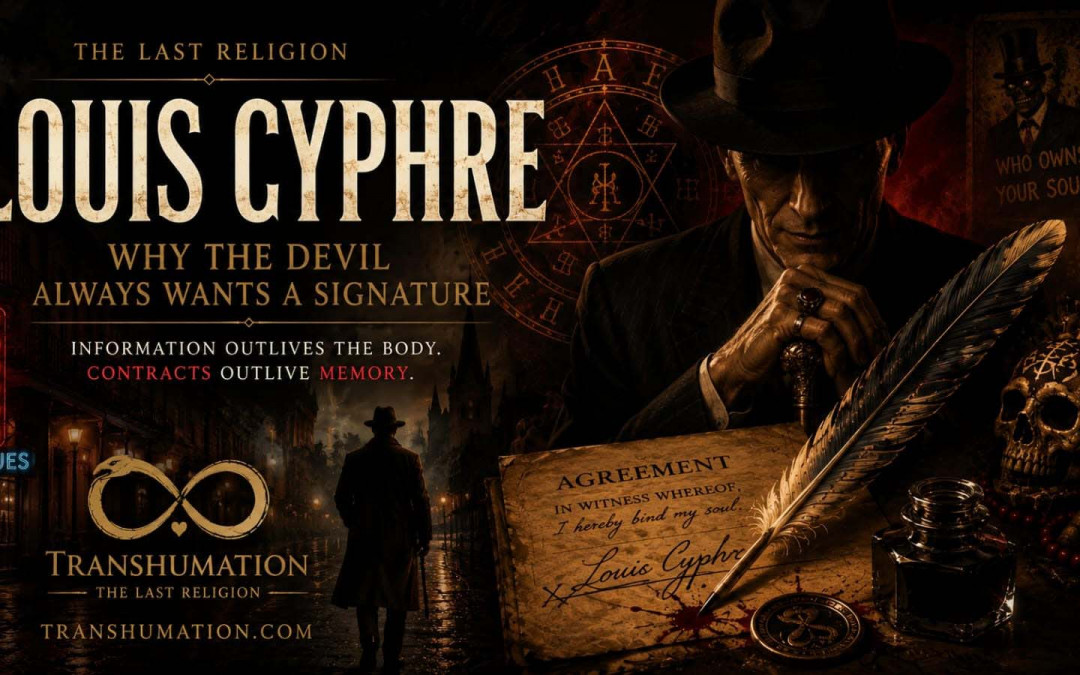
The Devil Wants Your Signature
If the Devil were truly all-powerful, why would he need your name at the bottom of a page? From Faust to Angel Heart, the mythology of damnation repeatedly returns to the same curious device: not seizure, but agreement. The Devil offers terms, the human accepts them, and a mark made in ink becomes more important than force. Perhaps the contract has always been frightening for the same reason civilization depends upon it. It turns a private decision into something that can survive the person who made it.
If the Devil wanted your soul, mythology gives him an oddly bureaucratic method of obtaining it.
He does not usually break down the door. He does not drag the victim away before breakfast. He arrives with an offer. Youth. Knowledge. Beauty. Wealth. Power. Revenge. Something the human being already wants badly enough to bargain for. Then, somewhere in the story, comes the strangely administrative moment: the terms are accepted. A promise is made. A hand is shaken. A name is written. Sometimes there is blood, sometimes parchment, sometimes merely a spoken agreement, but the structure remains remarkably stable. The supernatural creature capable of terrifying miracles behaves as though consent matters.
That should be the first clue that the contract is doing more than providing dramatic decoration.
If sheer power were the point, no contract would be necessary. An omnipotent Devil would not need lawyers. Yet Western stories repeatedly imagine evil as something that prefers an agreement to an abduction. Faust must say yes. A bargain has to be entered into. The victim may be deceived, vain, desperate or catastrophically shortsighted, but the mythology becomes more disturbing when the final responsibility cannot simply be transferred to the monster.
The Devil’s most unsettling weapon is therefore not possession. It is authorship. He wants you involved in writing what happens next.
The Strange Power of a Signature
A signature is one of civilization’s strangest technologies because almost nothing happens when it is made.
A hand moves. Ink touches paper. A sequence of letters appears that may take less than two seconds to produce. The physical change is trivial. Yet once the mark has been accepted by the surrounding legal or social system, consequences can be enormous. Property changes hands. Money becomes debt. Two companies become one. A marriage begins or ends. A government enters an agreement. A person accepts employment, relinquishes a right, recognizes an obligation or authorizes another person to act in their name.
The ink has almost no power by itself. Tear the signature from its institutional context and it becomes a little drawing.
Its power comes from information plus recognition.
This is easy to overlook because modern civilization surrounds us with these mechanisms so completely that they have become invisible. We treat a passport as though the booklet itself contains nationality, a deed as though the paper contains ownership, a bank statement as though numbers printed on a screen somehow contain wealth. None of these things operates alone. They function because enormous networks of people, institutions and databases agree to treat certain patterns of information as binding representations of reality.
A signature is therefore not powerful because it resembles the person who made it. It is powerful because civilization has developed procedures for saying: this mark means that this person agreed to this.
That small transition—from thought to recorded commitment—is one of the most consequential inventions in human history.
Before the mark, intention can still change. After the mark, the future acquires evidence.
This is precisely why the Devil’s contract is so elegant. The supernatural mythology borrows one of civilization’s most ordinary machines of consequence.
Louis Cyphre Keeps the Books
Louis Cyphre in Angel Heart is frightening partly because he so rarely behaves like the creature audiences have been taught to expect from supernatural horror. He does not spend the film roaring, threatening or demonstrating cosmic power. He is composed. Polite. Patient. Well dressed. He asks questions. He remembers arrangements. He appears less like a beast emerging from Hell than a creditor arriving to discuss an overdue account.
Even his name barely bothers to hide the joke.
What makes him dangerous is not that he seems beyond civilization. It is that he seems perfectly at home inside one of civilization’s oldest structures: obligation.
Harry Angel is hired to locate Johnny Favorite, a man who has apparently disappeared after failing to honour an earlier agreement. The investigation gradually becomes something more disturbing because the problem is not merely that a promise was broken. The problem is that forgetting the promise does not cancel it.
That distinction carries much of the film’s horror.
Harry can forget. Records cannot.
Identity can fracture. An agreement can remain.
A man can reconstruct his entire understanding of himself and still discover that an obligation made under an earlier identity has been waiting for him all along.
Cyphre therefore resembles a supernatural archivist. He does not need to pursue Harry in a conventional sense because the structure already exists. Something was agreed upon. The terms remain. The person who entered the agreement may become confused, transformed or unrecognizable even to himself, but the record continues to connect the past version of the person with the present one. That is far more interesting than a Devil who simply kills people. It turns damnation into a problem of continuity.
Civilization Is Made of Invisible Agreements
It is tempting to describe civilization as a collection of visible objects. Roads. Ports. Houses. Courthouses. Banks. Parliaments. Borders. Servers. Yet much of civilization consists of structures that cannot be touched at all. Ownership is one. Debt is another.
Citizenship. Marriage. Employment. Permission. Obligation. Authority. Liability. Inheritance.
A building can be physically identical at noon and one minute past noon while legally belonging to someone entirely different because a transaction has been completed somewhere in a registry. A piece of land does not change colour when ownership changes. The atoms do not reorganize. What changes is the informational relationship between the land, the people and the institutions surrounding it.
Contracts are among the technologies that make those invisible relationships durable.
In a society small enough for everyone to know everyone else, memory and reputation can support many agreements. But memory is fragile. Witnesses die. Stories diverge. People deny what they said. Communities become larger than personal familiarity can sustain. Writing solves part of this problem by allowing an agreement to exist outside the minds of the people who made it.
This is one reason written law, record keeping and contract systems became so important to complex civilizations. They allow obligations to cross time.
A person can die, and an inheritance instruction remains. A ruler can disappear, and a treaty remains relevant. A debtor can forget the conversation, and the account remains. The individual is temporary.
The recorded relationship is designed not to be.
The First Upload Was an Obligation
Modern discussions of technological immortality often begin with the idea of uploading the mind. Perhaps one day, the argument goes, memory, personality or consciousness might be transferred from biological tissue into another substrate. Whether anything resembling genuine consciousness upload will ever be possible remains an open scientific and philosophical question. But civilization solved a simpler version of the carrier problem thousands of years ago. It learned how to move parts of a person outside the person. A written promise is a primitive example.
Before writing, the obligation exists primarily as a psychological state and a social memory. I told you I would do this. You remember. I remember. Someone else heard us. Once the promise is recorded, however, it becomes partially independent of those memories. The document can be stored somewhere neither party is present. It can be read years later. It can be shown to a judge who never met either person. It can survive the death of witnesses.
Something that existed inside human minds has acquired another carrier.
Not consciousness.
Not a soul.
Responsibility.
This may be one of the oldest forms of what Transhumation might call functional upload: not the transfer of the whole person, but the migration of a human relation from one medium into another. Memory becomes inscription. Intention becomes contract. Identity becomes signature. Authority becomes seal.
The original body remains important because the agreement has to be attributed to somebody. But once attribution has been established, the obligation can begin a strange second life outside that body.
Seen this way, civilization has always been full of partial ghosts.
Promises outlive the mouths that spoke them.
The Devil Understands Information
This gives the Devil of contract mythology an unexpectedly modern intelligence. He understands that force is temporary, while information can organize consequences long after the moment of decision has passed. A threat works while the threatening power remains nearby. A contract can travel. A spoken promise can fade. A record can be copied. A person can change their mind. The document remembers that there was once another mind.
Of course, real contracts are not metaphysical traps. Legal systems contain rules concerning fraud, duress, capacity, illegality, unconscionability and enforceability precisely because civilized societies recognize that a signature is not magic. Consent can be defective. Agreements can be invalid. Human beings therefore surround contracts with procedures designed to determine whether the commitment deserves to bind.
Mythology strips many of these protections away.
The Devil’s contract represents the absolute version of obligation: you agreed once; therefore your future belongs to that decision.
That is horrifying because actual human morality rarely works so cleanly. People change. They learn. They regret. They become addicted, frightened, desperate or immature. A person at twenty is biologically continuous with the person at sixty, yet psychologically they may be almost unrecognizable to each other. The mythology of the infernal contract takes that problem and refuses mercy. The document treats identity as continuous even when experience does not.
Louis Cyphre understands the same brutal mathematics. You may no longer be the person who signed. The signature says that you are.
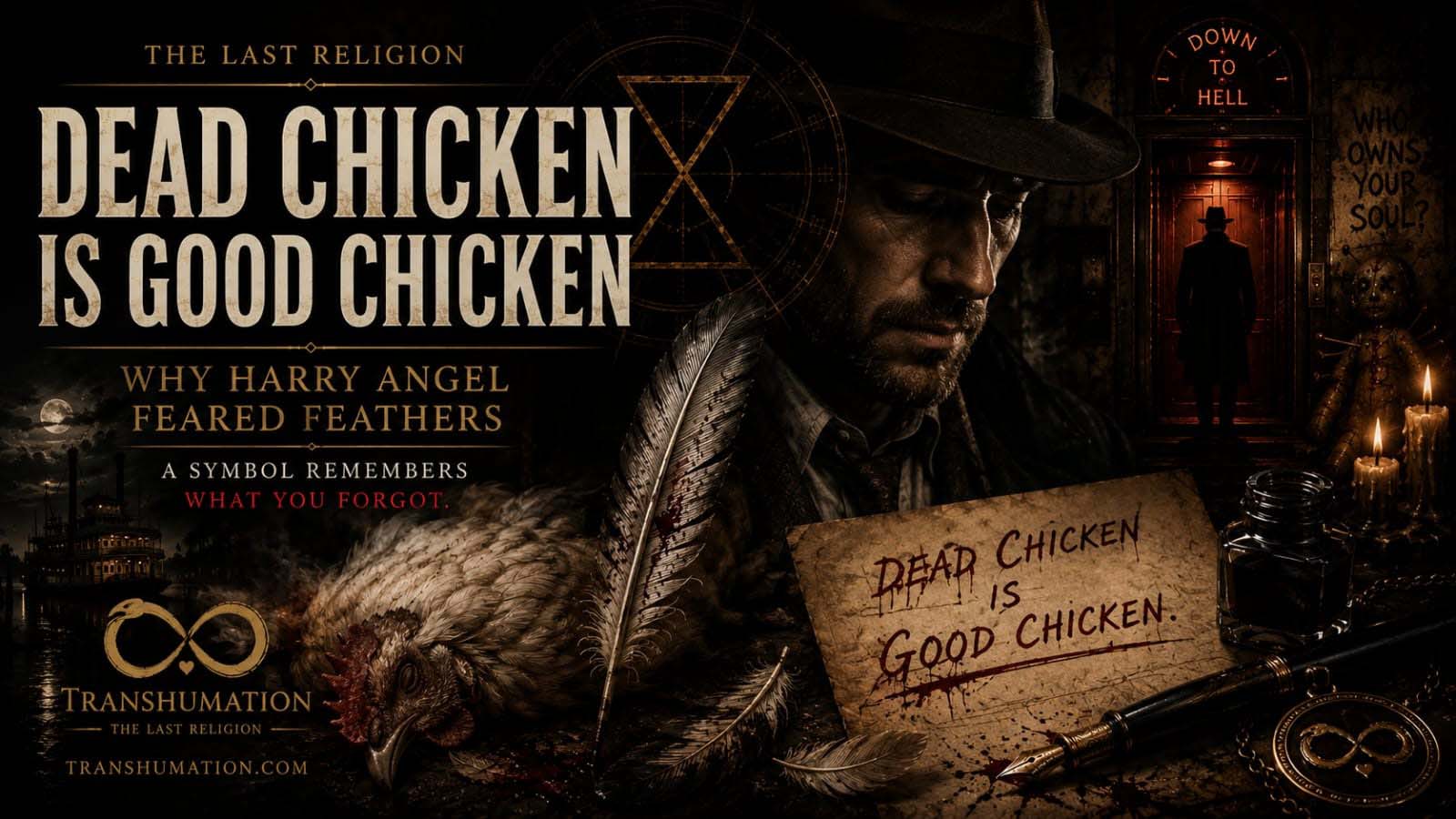
The Contract Is a Machine for Crossing Time
This may be the deepest function of a contract. It connects different versions of a person. The person who takes out a mortgage and the person who makes the final payment decades later are not psychologically identical. Cells have changed. Memories have accumulated. Relationships have appeared and disappeared. The person may have changed professions, countries, beliefs and appearance. Yet the agreement creates a line through those transformations.
Yesterday’s decision reaches tomorrow’s person.
This makes contracts extraordinarily powerful technologies of temporal continuity. We use them because human beings are unreliable across time. Without some mechanism for binding present intention to future behaviour, large portions of economic and institutional life would become impossible. But the same mechanism creates one of the central moral problems of obligation: how much authority should a former version of you possess over the person you become?
Ordinary law limits this in many ways. Contracts expire. Bankruptcy exists. Laws change. Agreements can be renegotiated. Children cannot enter many binding agreements. Some rights cannot simply be surrendered. Civilization has gradually discovered that responsibility requires continuity, but humane responsibility also requires limits. The infernal contract removes those limits. That is why it is such a perfect mythological machine.
It turns one moment into eternity.
From Wax Seals to Face Recognition
The technologies used to establish identity have changed dramatically, but the underlying problem remains almost embarrassingly familiar: how do we prove that a particular human being performed a particular act?
Civilizations have tried witnesses, seals, handwriting, signatures, fingerprints, identification documents, passwords, cryptographic keys and biometric measurements. The physical carrier changes because each technology solves the problem imperfectly. Signatures can be forged. Passwords can be stolen. Documents can be altered. Biometrics can be copied or compromised. New technologies replace old ones, but the structure persists.
Person.
Action.
Proof.
Record.
Future consequence.
Today, a gesture as small as tapping I agree can enter someone into a contractual system containing thousands of words they may never read. A digital signature can authorize a transaction without ink. A biometric scan can authenticate identity without a name being written at all. Distributed ledgers can preserve certain transaction records across networks rather than inside a single institutional archive.
The historical movement is therefore not from contracts to something fundamentally different. It is from one carrier of recorded commitment to another.
Wax disappears.
Paper becomes optional.
The signature itself may disappear.
The agreement remains.
This is exactly the kind of transformation that matters to Transhumation. The visible object is not the structure. The signature can vanish while the function of the signature survives.
The Moral Danger of Permanent Memory
For most of history, forgetting was not merely a human weakness. It was also a form of mercy. Records were lost. Letters burned. Villages forgot scandals. Identities could sometimes be abandoned simply by travelling far enough. Human memory placed natural limits on the persistence of mistakes. Digital civilization is changing this relationship.
Photographs remain searchable. Messages remain stored. Financial transactions leave trails. Search engines retrieve events that human communities might once have allowed to disappear. Biometric systems can link the present body to previous records. Machine learning can combine fragments of information that were individually harmless and reconstruct patterns their subjects never intended to preserve.
The Devil’s contract therefore acquires a surprisingly contemporary form.
What happens when civilization remembers better than the human being it is remembering?
The issue is not simply privacy. It is the relationship between identity and time. If every decision becomes permanently retrievable, an old version of a person may acquire unprecedented power over all later versions. A foolish comment, an obsolete belief or a desperate decision can remain accessible decades after the psychological person who produced it has changed.
Louis Cyphre’s terrifying principle begins to sound less supernatural.
You may have forgotten.
The system has not.
That does not make digital memory evil. Accurate records protect property, expose corruption, preserve history and allow institutions to function. Forgetting can protect criminals as easily as it can protect people who have genuinely changed. The problem is not memory itself.
It is the absence of proportion.
A civilization capable of remembering everything will eventually have to develop a philosophy of what deserves to be forgotten.
Watch the Video
How to Read the World
Current Knowledge
Contracts are ancient institutions, although there was no single moment in which humanity “invented” the contract. Written agreements appear in early literate civilizations, including Mesopotamia, where clay tablets recorded loans, property transfers, marriages, commercial transactions and other obligations. Legal traditions subsequently developed increasingly sophisticated rules around agreement, evidence, witnesses, enforcement and responsibility.
A signature is likewise not universally necessary for a contract to exist. Depending on the legal system and the type of agreement, contracts may be written, oral, electronic or inferred from conduct. The philosophical importance of the signature comes from its role as evidence of attribution and assent: it helps connect a person to a recorded decision.
Modern electronic and digital signature systems continue this function through new carriers. Cryptographic methods can authenticate documents and help demonstrate that information has not been altered, while biometric and identity systems provide additional ways of connecting actions to individuals. These technologies do not make information metaphysically permanent, nor do blockchains preserve every human agreement forever. Their significance lies in continuing an ancient civilizational project: allowing commitments to remain verifiable after the original moment has passed.
Within Angel Heart, Louis Cyphre’s relationship to Johnny Favorite is explicitly connected to a bargain and its consequences. The broader interpretation developed here—Cyphre as an archivist of obligation and the infernal contract as a metaphor for informational continuity—is philosophical rather than a claim that the film secretly presents a theory of information.
Open Questions
The first unresolved question is surprisingly old: how long should a decision remain binding upon a person who has changed?
Law already acknowledges that identity across time is complicated. We restrict the contracts children can make. We sometimes release people from impossible debts. We allow agreements to expire and legal statuses to change. Yet emerging technologies may make past decisions increasingly difficult to escape. If digital identity becomes more persistent, connected and searchable, societies may have to decide whether informational continuity should always imply moral continuity.
A second question concerns consent. Clicking a button can technically indicate agreement, but does meaningful consent require comprehension? If contracts become longer, more automated and increasingly mediated by software, we may reach a point where enormous portions of human life depend upon agreements almost nobody actually understands. The legal mark remains while the psychological act behind it becomes thinner.
There is also an AI version of the problem. Autonomous systems may eventually negotiate, authorize purchases, manage assets or enter agreements on behalf of humans and organizations. If an artificial agent makes thousands of decisions based on authority delegated by its owner, where does responsibility finally reside? With the person who deployed it? The company that trained it? The system that executed the decision? The people who designed the rules under which it operated?
The old Devil’s question returns in technological clothing.
Who signed?
Transhumation Interpretation
Transhumation is interested in things that survive the disappearance of their original carrier. The contract is almost a perfect example because its entire purpose is to create continuity between moments that would otherwise separate.
A human being makes a decision.
The decision becomes information.
The information enters another medium.
The human being changes.
The information continues to act.
This does not mean that a contract contains the person. It contains something smaller and, in certain circumstances, surprisingly powerful: a claim about the relationship between one version of that person and another.
That makes the infernal contract more interesting than a simple religious story about temptation. The Devil does not merely purchase a soul. He exploits continuity. He assumes that the being standing before him tomorrow is accountable for the decision made by the being standing before him yesterday.
Civilization makes the same assumption every day because without it, trust becomes almost impossible. But civilization also spends enormous effort limiting that assumption because people are not static objects. We change, forget, learn and become different versions of ourselves.
The contract therefore sits exactly at the boundary between identity and transformation.
Too little continuity, and responsibility disappears. Every person could simply announce that yesterday’s self no longer exists.
Too much continuity, and transformation becomes impossible. Every mistake becomes permanent because the record defines the person forever.
The mature civilization must somehow preserve both truths: you are responsible for what you did, and you are more than what you once did.
Louis Cyphre represents the nightmare version of the first principle.
He remembers perfectly.
He offers no second.
And perhaps that is why the Devil needs a signature after all. Power can force a body. A contract does something more subtle. It recruits the human being into the architecture of the consequence. The person becomes not merely the victim of the future but one of its authors.
The Devil does not need to steal your soul.
He needs you to leave a record saying that it was yours to give.
FAQ
Who is Louis Cyphre?
Louis Cyphre is the mysterious client played by Robert De Niro in Angel Heart. He hires private investigator Harry Angel to locate Johnny Favorite, and the nature of his connection to Favorite gradually becomes central to the film.
Why does the Devil traditionally ask for a signature?
Stories about demonic bargains often use written or explicit agreements because the contract dramatizes consent and responsibility. The Devil becomes more disturbing when he does not simply overpower the victim but persuades the victim to participate in the transaction.
Does a real contract always require a signature?
No. Contract law varies by jurisdiction and type of agreement. Some contracts require particular formalities, while others may be oral, electronic or established by conduct. A signature is important primarily as evidence that a particular party intended to authenticate or accept an agreement.
What does the contract symbolize in this article?
It represents information that extends responsibility beyond immediate human memory. A promise can move from the mind into an external record and remain actionable even after the people involved have changed or forgotten the original moment.
Why call the contract a form of “upload”?
The term is deliberately metaphorical. Writing a contract does not upload consciousness. It externalizes one component of human agency—commitment—into a different carrier. The obligation can then survive outside the memory of the person who created it.
How is this different from ordinary writing?
All writing can preserve information, but a contract adds recognized consequence. It does not merely say what someone once thought. It records an act that institutions may continue to enforce in the future.
What does digital identity change?
Digital systems make attribution and memory far more scalable. Actions can be authenticated, copied, connected and retrieved across long periods. This increases convenience and accountability but also raises difficult questions about privacy, consent and whether people should remain permanently attached to every past version of themselves.
How does artificial intelligence enter the argument?
AI may increasingly act as an intermediary between human intention and consequential decisions. If software negotiates, purchases, recommends or authorizes actions on someone’s behalf, questions of agency and responsibility become more complicated: the decision may be distributed across human and machine systems rather than located in one obvious actor.
Is the article claiming Louis Cyphre literally represents information?
No. The film supplies the contract, the debt and the problem of identity. Reading Cyphre as a figure of informational permanence is a Transhumation interpretation of those structures, not a claim about a single definitive authorial intention.
What is the central idea?
Civilization learned very early that human memory is too fragile to support responsibility by itself, so it invented systems that allow decisions to survive their makers. The contract is one of those systems. Its greatness and its danger come from the same property: it allows yesterday to continue acting upon tomorrow.
The Devil’s genius, then, may not be that he possesses eternity.
It may be that he understood paperwork.
Continue the Transhumation Series
- Forgotten Religion | Ancient Gods, Symbols and the Hidden Structures of Human Civilization
- The Last Religion | Death, Immortality and the Future of Humanity
- The New Theurgy | AI, Information and the Future of Human Civilization
- End of Branding: You Were Never Meant to Become a Product
- Baal vs Ishtar: Why Ancient Gods Never Disappeared