
Tick Tack Toe, Mr Lusk –
Special Investigation I
What can still be discovered in a document that has survived almost a hundred and forty years of scrutiny? The question is uncomfortable because the paper has not improved with age, while the explanations around it have multiplied. Another observer arrives carrying another theory. The useful contribution would be a question that makes something already visible newly worth examining.
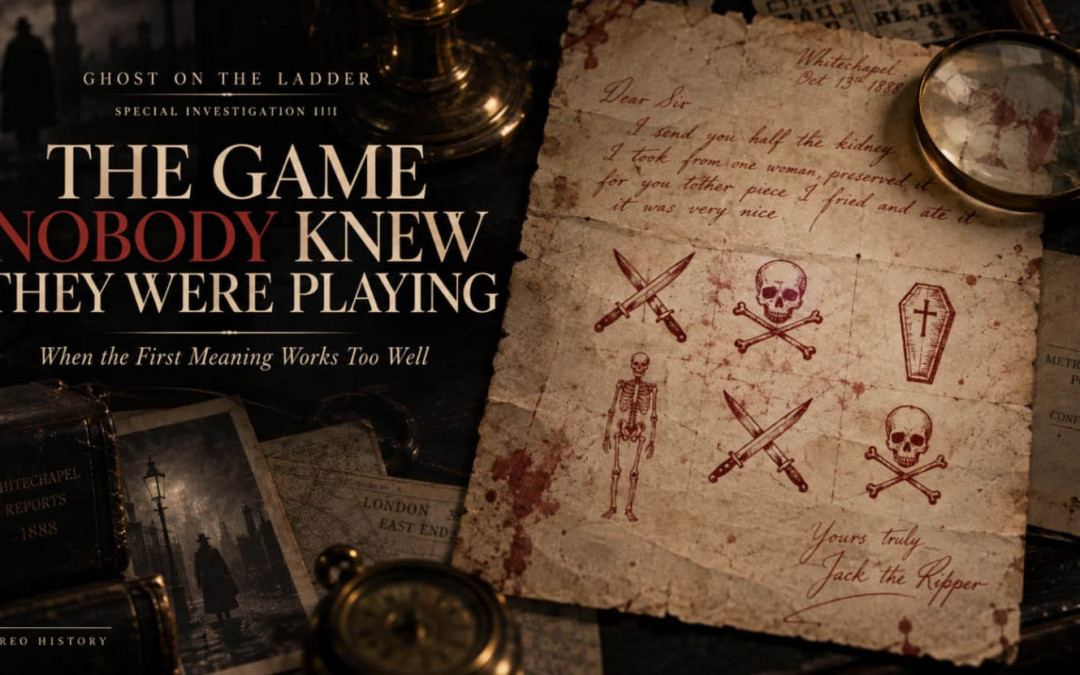
The Birmingham letter, postmarked 8 October 1888 and addressed to Scotland Yard, offers such an opportunity. Its red writing accompanies crossed blades, a skull and crossbones, a coffin and a skeleton. The National Archives presents it as a hoax letter claiming the identity of Jack the Ripper. That attribution gives us a necessary boundary: examining its construction does not authenticate its author as the murderer.
Yet calling something a hoax leaves its construction unexplained. A fabricated communication can contain deliberate arrangement, literary play and considerable ingenuity. We can investigate those qualities without identifying the killer. For this inquiry, the first question is simple: why do these particular signs occupy these particular positions?
The Detail That Starts the Inquiry
The phrase “play my part well & vigorously” provides an ordinary entrance. It describes performance, and someone writing under another identity is performing a role. Beneath the drawings, however, “play” also invites attention to the possibility of a game. The apparent separation within “part” supplies a further temptation: P / ART.
That separation deserves comparison with the handwriting elsewhere before it becomes evidence of intentional division. It is nevertheless a legitimate starting point for curiosity. A detail need not establish a conclusion to justify examining its surroundings. Here, the language of performance sits below a visual composition whose parts may have another function.
A skull already communicates death without assistance. Crossed bones and crossed blades repeat the threat, while the coffin and standing skeleton elaborate it. Such excess can be theatrical decoration. But it also gives the observer enough distinct forms to ask whether the composition organises something beyond its subject.
When Death Symbols Become Game Symbols
The proposed reading begins with a limited operation: classify selected closed forms as O-like and selected crossed forms as X-like. A skull can remain a skull while contributing a closed shape; crossed bones can remain bones while contributing a crossing. The hypothesis concerns these simultaneous functions. Meaning would reside partly in the relationships between familiar objects.
The existing reconstruction assigns the principal forms to nine positions. Read by rows, the proposed arrangement is: empty, O, empty; X, O, X; X, X, O. The original page supplies no drawn grid. Assigning shapes to cells therefore remains an analytical choice that must be justified against the image.
Within that reconstruction, the arithmetic is clear. Four Xs and three Os permit O to move next, assuming X began and ordinary rules apply. O wins immediately by taking the upper-left square, completing the diagonal through the centre. Taking the upper-right square instead allows X to win down the left column.
The position presents a choice between victory and defeat. For Transhumation, its relationship to chess raises a question of compression: how much apparatus can disappear while a strategic relationship remains? Tic-tac-toe is not a complete miniature of chess, but here it offers a construction with fewer kinds of piece, fewer positions and a sharply consequential choice. The comparison concerns what survives that reduction: reading a position, considering alternative moves and recognising that their consequences differ.
The First Puzzle Is Seeing a Puzzle
An unmistakable board would announce its purpose immediately. This composition, under the hypothesis, requires the reader first to recognise that another rule of reading is available. The frightening imagery continues to satisfy the ordinary reading throughout. Its familiarity could make another function easy to overlook.
That suggests a possible test of attention, although the author’s intention remains unrecovered. “Play my part” would then participate in both performance and game, while the drawings retain their macabre vocabulary. The attractive feature is economy: several effects could emerge from the same marks. Complexity would come from their configuration rather than from adding an elaborate code.
The standing skeleton introduces a further literary possibility. Its human outline survives while clothing, profession and useful identifying features disappear. If it stands outside the proposed board, it can suggest a player distinct from the pieces. This reading adds a relation worth considering, but the game reconstruction should stand or fall without requiring that metaphor.
Try to Disprove It
The challenge is now concrete: examine the classification and placement that produce the board. Are comparable closed shapes treated consistently? Do crossings become Xs only when convenient? Does a reasonable change in the proposed grid destroy the position, or reveal an equally persuasive alternative?
Removing an essential mark demonstrates dependence on that mark. It does not, by itself, establish deliberate design: accidental arrangements also depend on their components. The stronger test compares plausible readings of the actual page. If the result requires selective omissions or unusually flexible boundaries, the hypothesis loses force.
Comparison with other decorated letters would also matter. Perhaps this vocabulary routinely yields apparent boards when an observer searches hard enough. Conversely, a similar operation in another document, using different imagery, would warrant closer investigation. Neither comparison has been completed here, and its result cannot be supplied by enthusiasm.
A Structure Beyond Its Maker
A construction can remain productive beyond the questions its maker knew to ask. Consider Donatello’s David as an analogy: a single figure can prompt us to ask how one individual might represent humanity, without requiring a sculpture of every human variation. Presenting the idea of a car does not require displaying every kind of bodywork. The later question belongs to us; the form that makes it possible is already there. We need not attribute our question to Donatello to examine what his work permits us to think.
The game offers a smaller example. To a present-day ear, “tic-tac-toe” can echo “tick-tock,” bringing time, waiting and successive moves into the reading. That association is neither a translation of the name nor evidence that the letter’s author intended a countdown. It is a later resonance we can identify and examine. A structure may acquire new uses as its readers acquire new languages, experiences and problems; the task is to show where the connection rests in the work and where we have supplied it ourselves.
The View We Bring
Transhumation approaches the document from an openly declared position. We want to compare what earlier observers could see with what we see, and to ask what another generation might recognise that remains unavailable to us. Our interest in hidden structures directs our attention toward arrangement, compression and meanings that survive changes of medium. That perspective is a commitment we disclose, rather than an invisible neutrality we ask the reader to trust. It obliges us to expose our choices and take seriously the details that oppose them.
“The future has a long past” also asks how far into the past a future question can reach. A maker need not foresee every later application for a construction to support one. This does not make every association equally persuasive: a useful reading must identify the relationship it preserves and allow someone else to challenge it. Historical questions about authorship and intention retain their own standards of evidence. Our present encounter with the document adds another question: what can its surviving construction make visible now?
We have a proposed reading, its consequences and specific ways to challenge it. We do not have recovered intention, authenticated authorship or a demonstrated historical chain of influence. Our perspective does not exempt us from those limits; it makes the limits part of the inquiry. Reproduce the reading, question its choices and show where it fails. A later generation may find more in this page, or may discover exactly where we went wrong, and either result would move the work forward.
Watch the Video
How to Read the World
by Frederick Kindt
Current Knowledge
The letter and its envelope survive under catalogue reference MEPO 3/142; the envelope bears the Birmingham postmark of 8 October 1888. The quoted phrase and macabre illustrations are present in the archived document. Its attribution to the Whitechapel murderer is not established. The proposed game position belongs to this analysis.
Open Questions
Does consistent classification of the original marks support the proposed board? Is the spacing within “part” exceptional within this hand? Would comparable illustrations produce similar results? These questions require inspection and comparison before the reading can claim stronger evidential weight.
Transhumation Interpretation
A familiar symbol may carry additional information through its relationship to other signs, and a construction may support later meanings its maker never anticipated. Transhumation declares the perspective from which it examines those possibilities: what they could see, what we can see, and what future observers may see differently. Our interpretation remains answerable to the document, including the details that resist it. Try to disprove it applies to our method as firmly as to our proposed board.
FAQ
Is the Birmingham letter considered an authentic Jack the Ripper communication?
No established evidence authenticates it as a letter from the Whitechapel murderer. It belongs to the large body of purported Ripper correspondence generally treated with substantial skepticism.
Does the letter definitely contain a tic-tac-toe game?
No. The noughts-and-crosses reading is a structural hypothesis. The grid is analytical rather than physically drawn on the document.
Why is “play my part” important?
Because the phrase is genuinely present and naturally evokes performance. If the imagery also functions as a game, the word play acquires a second relevant sense. The possible P / ART separation is much more speculative and requires spacing analysis before it should carry serious evidential weight.
Why does the destructive test matter?
Because a proposed reading must be open to failure. Dependence on particular marks alone does not establish intention; consistent classification and comparison with plausible alternative readings provide stronger tests.
Does any of this identify Jack the Ripper?
No. Even a deliberately layered puzzle would tell us something about the person who created that communication, not automatically about the murderer. A sophisticated hoaxer remains a fully viable explanation.
What would make the theory genuinely stronger?
Independent repetition of the same structural operation. Another document using different imagery but the same kind of layered first meaning and hidden relational structure would be far more significant than another visual resemblance.
Continue the Transhumation Series
- Forgotten Religion | Ancient Gods, Symbols and the Hidden Structures of Human Civilization
- The Last Religion | Death, Immortality and the Future of Humanity
- The New Theurgy | AI, Information and the Future of Human Civilization
- End of Branding: You Were Never Meant to Become a Product
- Baal vs Ishtar: Why Ancient Gods Never Disappeared