
After Perfection
There is a particular kind of optimism that adults reserve for children, perhaps because children have not yet had enough time to test it. We tell them that if they can dream something, they can do it, and the sentence survives because it contains enough truth to excuse its obvious failures. Airplanes were imagined before they flew, skyscrapers before they rose, and machines capable of speaking with us before millions of people began arguing with them over breakfast. Imagination does seem to precede a surprising amount of reality. The difficulty is that it also produces things reality appears to have no intention of providing.
A perfect sphere is one of them. There is nothing especially difficult about understanding what it is: every point on its surface must lie at precisely the same distance from its center. Mathematics accepts the definition without complaint, while matter becomes troublesome almost immediately. Manufacture the smoothest sphere you can, polish it until it appears flawless, and then improve your instruments until the flaws return. The closer you look, the less interested the physical object seems in obeying the mathematical one.
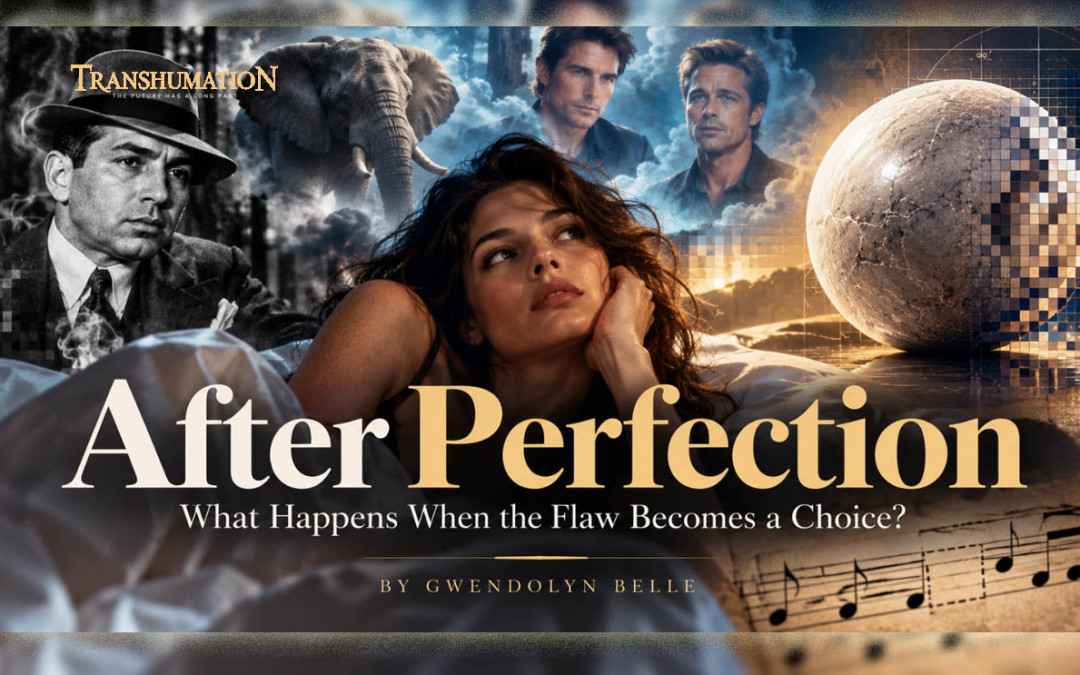
This was the small provocation behind The Perfect Sphere. It was never really about spheres. It was about the uncomfortable possibility that the human mind can formulate something more precisely than the physical world can execute it. We tend to describe imagination as a crude sketch of things that might eventually become real, but here the hierarchy is reversed: the idea is exact and the object is approximate. The universe, usually granted the superior position in such disputes, finds itself producing the imperfect copy.
That would be an interesting enough problem if human beings did not spend roughly a third of their lives closing their eyes and manufacturing worlds.
The Problem With Pixels
Physical carriers are wonderfully indiscreet about their limitations. Print an image and magnification eventually reveals the dots. Put it on a screen and, with sufficient proximity, the continuous face becomes a neighborhood of pixels. Vector graphics postpone the embarrassment by describing curves mathematically rather than storing every visible point, but the moment the curve must appear on a physical display it returns to a finite device with finite resolution. The carrier always seems to leave some evidence of itself behind.
Dreams are more awkward. This does not mean that dreams possess infinite resolution, nor that consciousness somehow escapes the finite brain producing it. A dreamed cathedral does not require cathedral-sized neural architecture any more than imagining the Atlantic requires several million cubic kilometers of water inside the skull. Representation has never been obliged to share the physical properties of the thing represented. Nevertheless, the experience itself does not ordinarily arrive with a convenient pixel grid announcing the engineering limitations of its carrier.
The distinction becomes clearer in people who once had sight and later lost it. Visual experience can persist in dreams despite the absence of current visual input from functioning eyes. That does not remove the brain from the equation; on the contrary, it makes the brain’s role harder to ignore. What interests me is the peculiar fact that an experience can present a visual world without requiring the machinery that normally supplies the world with new visual information. Once that happens, the old question—What am I looking at?—quietly acquires a second one: What, exactly, is doing the showing?
A friend once discovered a surprisingly elegant version of this problem because Lucky Luciano appeared in the wrong format.

Luciano in Black and White
It happened during a lucid dream around 2004. The dream had become sufficiently convincing that knowing it was a dream did not abolish the ordinary caution one feels toward gravity; he understood that he could probably jump from a building without consequences and remained understandably reluctant to conduct the experiment. Instead he chose safer demonstrations of sovereignty. He requested an elephant and got one. Tom Cruise appeared when requested, followed by Brad Pitt, which suggests that even the unconscious, when handed unlimited creative power, occasionally behaves like a casting director.
Then he asked for Lucky Luciano. Luciano appeared, but unlike the others he arrived in black and white. Nothing in the request had specified monochrome, and the discrepancy was noticeable enough that the dreamer began wondering about it while the dream was still taking place. Eventually an explanation suggested itself: at that point he could not remember ever having seen a color photograph of Luciano. His Luciano was not merely a man; he had apparently inherited a property of the archive through which the man had been encountered.
There is no reason to make this mysterious in the supernatural sense. Memory is reconstructive, dreams are generated by brains, and a single lucid dream is not experimental evidence for a theory of consciousness, much less a theory of the universe. Years later, after seeing colorized images of Luciano, the same dream might produce him in color, or in a purple dinner jacket, or not at all. The interesting part is not what caused the black and white. It is what happened when the dreamer noticed it.
For a brief moment, someone inside a convincing world had encountered an anomaly, recognized that the anomaly might reveal something about the mechanism generating the world, and understood that the parameter might conceivably be changed. The imperfection did not prove that the world was false. It revealed that the world had parameters.
That is a rather different thing.
When the Crooked Wall Becomes Expensive
For most of human history, imperfection required very little explanation. Walls were uneven because making them straight was difficult. Surfaces were rough because polishing them was expensive. Recordings hissed because the medium hissed, photographs contained grain because the process produced grain, and handmade objects differed from one another because hands are not injection-molding machines. Progress meant reducing these annoyances until the object approached the form its maker had intended.
Then we became very good at it, and something faintly comic happened. We began paying people to put the imperfections back.
A contemporary house can be engineered with extraordinary geometric precision and then furnished with a wall designed to resemble irregular natural rock. The irregularity may require skilled labor, careful selection and a considerable invoice. Digital photographs acquire artificial grain. Musicians add distortion to recordings made on equipment designed at enormous expense to eliminate it. New furniture is distressed so that it appears to have survived a life considerably more adventurous than the one awaiting it in a climate-controlled apartment.
The difference between the first crooked wall and the second is not visible in the crookedness itself. The first may be irregular because its builder cannot make it straight; the second is irregular because its builder can. One imperfection records a limitation, while the other records a decision. We have a habit of describing perfection as the final stage of progress, when in practice it may be the point at which imperfection becomes available as a language.
This is why mastery often looks, from a distance, surprisingly like a return to where we began. The child draws an irregular line because she cannot draw a straight one. The trained artist may spend years learning control before discovering exactly where to abandon it. The result can resemble spontaneity, but it is spontaneity purchased with competence. What appears to be regression is sometimes the luxury of having acquired a choice.
The Beat That Wasn’t There
The Missing Beat approached the same problem through sound. Establish a simple sequence of four beats and repeat it until the listener no longer has to think about what comes next. The fourth beat becomes almost inevitable, which means that removing it no longer produces ordinary silence. The listener supplies the expectation before discovering that the sound itself has failed to arrive.
Nothing has been added to the sequence. Something has been removed, yet the removal communicates more than another perfect repetition would have communicated. The missing beat acquires a shape because the mind has learned the structure surrounding it. Absence becomes perceptible only because expectation has first been manufactured.
There is a considerable difference between failing to play the fourth beat and choosing not to play it. A defective metronome has made an error; a composer may have created tension. The physical event can be identical while its informational position is completely different. Once the pattern has been mastered, violating it deliberately becomes an operation unavailable to someone who never controlled the pattern in the first place.
This suggests a less tidy model of progress than the one we usually prefer. We imagine, then we create, then we improve what we have created until we can reproduce it reliably. But reliability does not end the sequence. Once the rule is secure enough, we begin bending it, omitting parts of it, exaggerating its failures and manipulating the expectations it created. Perfection turns out not to be the destination but the threshold beyond which deliberate imperfection becomes possible.
The progression is therefore not simply from bad to good or rough to smooth. It is closer to imagination, creation, perfection, violation and control. The last two stages can look like failure if we forget everything that came before them.
The Mistake a God Might Make
This becomes uncomfortable when the same structure is applied to worlds rather than walls or rhythms. Human beings have spent thousands of years describing gods as entities capable of operations that were categorically unavailable to humans: they created environments, established laws, populated worlds, altered conditions, produced appearances, concealed themselves and occasionally left behind phenomena whose interpretation occupied priests and philosophers for generations. The vocabulary was religious because no competing operational vocabulary existed.
We now possess a very primitive one. We construct artificial environments and decide how gravity behaves inside them. We populate them with agents, change their parameters while they are running and create objects that exist only as information presented through a carrier. We can place a person inside such an environment and produce physiological reactions to dangers that the person consciously knows are artificial. None of this makes us gods, but it does make certain old descriptions of divine activity sound unexpectedly like categories of work.
This is where I would place what Transhumation calls The New Theurgy. The claim is not that the ancient gods were programmers, that the universe is a computer game, or that every strange event is evidence of somebody adjusting a control panel. Those conclusions are attractive largely because they arrive before the difficult questions. The more interesting development is that humans have begun acquiring practical experience with operations that previous civilizations could discuss only from the position of inhabitants.
We have not found the gods. We have begun, in a limited and sometimes embarrassingly pixelated fashion, to understand their job.
That change of position produces a question our ancestors could ask only metaphorically. Suppose an observer encounters an irregularity inside a world. How could the observer distinguish a flaw from a limitation, a limitation from a law, and a law from a message? A glitch in a game may result from defective code, insufficient hardware, an intentional design decision or something the designer never anticipated. The anomaly alone tells us very little. Understanding requires discovering the structure in which the anomaly occurs.
Lucky Luciano appearing in black and white is useful precisely because the stakes are so low. Nobody needs to construct a cosmology around a gangster’s missing color. The dreamer could notice the anomaly, propose a mechanism and contemplate changing the result without deciding that an external intelligence had sent him a message. It is almost a laboratory model of the epistemic problem, stripped of the grandeur that usually makes people careless.
What Comes After Perfection
Perhaps this is why perfect worlds have never been as interesting as their imperfections. A completely regular system tells us its rule, but a deviation forces us to ask whether the rule failed, whether we misunderstood it, or whether someone who understood it better chose to break it. The question becomes richer once we ourselves learn to create systems in which all three possibilities exist.
The perfect sphere therefore belongs beside the missing beat and the black-and-white Luciano for a reason that is easy to overlook. The sphere shows a form we can define more perfectly than we can physically execute. The missing beat shows that, after mastering a form, we can make its deliberate absence meaningful. Luciano shows an observer discovering an apparent limitation from inside an experience and recognizing it as a possible parameter rather than merely accepting it as scenery.
None of these things proves anything grand enough to deserve a religion. Together, however, they suggest a change in our position. We are no longer only creatures asking why worlds have rules. We have become creatures capable of constructing small worlds, assigning rules to them, discovering unintended consequences and deciding when a flaw should be repaired and when it should be preserved because it makes the whole thing better.
The old dream was to reach perfection. It made sense while perfection was difficult.
The more interesting question begins when perfection is available and someone deliberately leaves out the fourth beat.
Watch the Video
How to Read the World
by
Current Knowledge
Mathematical ideals such as perfect spheres can be defined exactly, while physical realizations are constrained by matter, measurement and finite precision. Digital representations also depend on finite physical carriers, even when their underlying mathematical descriptions are continuous. Mental imagery and dreams are produced by physical brains, but represented properties do not have to correspond literally to properties of the neural substrate: representing a kilometer does not require a kilometer of brain tissue.
Lucid dreaming, in which a person becomes aware that they are dreaming while the dream continues, is a documented phenomenon. The Lucky Luciano episode described here is a personal anecdote rather than experimental evidence and does not establish any claim about simulation, supernatural agency or the fundamental nature of consciousness.
Open Questions
We still do not fully understand how subjective experience arises from physical neural processes or how internally generated experiences acquire their apparent spatial and visual properties. Lucid dreams also raise narrower questions about how much deliberate control a person can exercise over an ongoing dream and how expectation, memory and prior imagery shape what appears.
The broader philosophical problem is harder: when an observer encounters an irregularity in any sufficiently complex system, what evidence would distinguish an accidental flaw from a structural limitation or an intentional deviation? The existence of an anomaly alone cannot answer that question.
Transhumation Interpretation
The New Theurgy begins not with the claim that humans have discovered gods, but with the observation that humans are beginning to perform primitive versions of operations once described almost exclusively in divine language. We build environments, establish their rules, populate them with agents and alter their parameters. This does not collapse theology into technology; it gives us a new operational position from which to examine some very old questions.
Within that framework, deliberate imperfection becomes especially interesting. A flaw imposed by inability reveals a boundary. The same flaw introduced after mastery can reveal intention. Learning to distinguish those two conditions—without assuming intention where none has been demonstrated—may be more important than the pursuit of perfection itself.
FAQ
What does “After Perfection” mean?
It refers to the stage at which reproducing an ideal pattern is no longer the main challenge. Once a system can be controlled reliably, deliberate deviation from that pattern can become expressive, informative or functional.
Is deliberate imperfection really a higher form of perfection?
Not in a mathematical sense. The distinction concerns mastery. An accidental error can reveal inability or limitation, while an intentional deviation may show that the expected pattern was understood well enough to be manipulated deliberately.
What does the Lucky Luciano dream demonstrate?
By itself, very little scientifically. It is a personal lucid-dream anecdote. Its value in the essay is structural: the dreamer noticed an unexpected property of his experience, proposed a possible mechanism for it and recognized that the property might be changeable.
Can the human mind really imagine a perfect sphere?
Humans can understand and manipulate the exact mathematical concept of a perfect sphere. That does not mean subjective mental imagery possesses infinite resolution or that a physically perfect sphere exists somewhere inside the brain.
How are The Perfect Sphere and The Missing Beat connected?
The Perfect Sphere examines the difference between an ideal form and its physical realization. The Missing Beat explores what becomes possible once a pattern has been established: deliberately violating it can communicate something that perfect repetition cannot.
What is The New Theurgy?
The New Theurgy is a Transhumation framework for examining what happens when operations once discussed primarily through religious or metaphysical language—creating worlds, establishing rules, generating inhabitants and altering conditions—also become technical activities. It does not claim that reality is a simulation or that gods are technological beings.
Continue the Transhumation Series
- Forgotten Religion | Ancient Gods, Symbols and the Hidden Structures of Human Civilization
- The Last Religion | Death, Immortality and the Future of Humanity
- The New Theurgy | AI, Information and the Future of Human Civilization
- End of Branding: You Were Never Meant to Become a Product
- Baal vs Ishtar: Why Ancient Gods Never Disappeared