
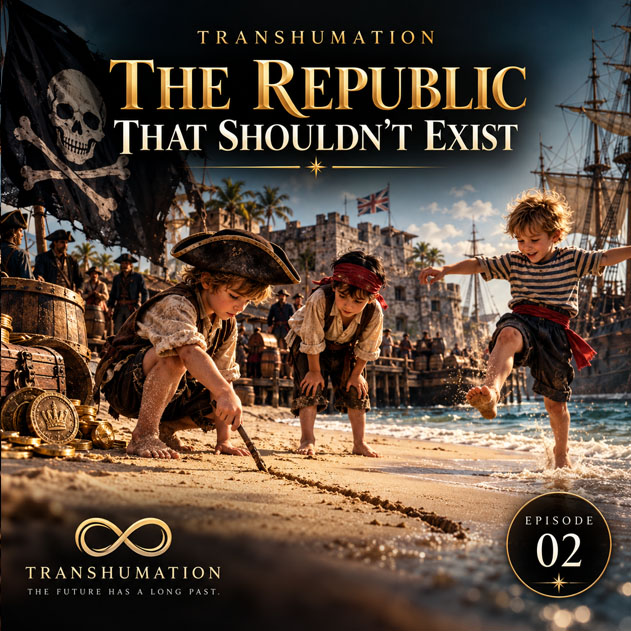
A Line In the Sand
A child takes a stick and draws a crooked line across the sand. In purely physical terms, almost nothing has happened: a few grains have been displaced, a shallow groove has appeared, and the beach remains exactly what it was a moment earlier. Then the child points to one side of the line and says that this is the sea. Another child arrives, listens to the explanation and, instead of walking through the imaginary water, carefully jumps across it. The sand has not changed, but the behaviour of a human being has.
It would be easy to dismiss this as make-believe, because that is exactly what it is. Neither child has mistaken dry sand for water, and neither needs to believe that an actual ocean has materialized in front of them. What they have accepted is not a false description of physical reality but a rule governing how they will behave within it. The distinction seems trivial until a third child arrives, watches the others and begins obeying the same rule. Now the line has acquired something it did not possess when it was first drawn: a history, a community and the expectation that a person encountering it will know what to do.
Adults are very good at recognizing this mechanism in children and remarkably bad at recognizing it in themselves. We draw lines, assign names, create offices, exchange pieces of paper and numbers in databases, and then organize enormous portions of our lives around the resulting structures. The sophistication of the procedure encourages us to imagine that something fundamentally different is happening. Perhaps it is not. Perhaps adulthood consists partly in replacing the stick with sufficiently impressive stationery.
A British Island Where Britain Was Becoming Theoretical
At the beginning of the eighteenth century, Nassau offered an unusually vivid demonstration of what happens when the official description of a place and the behaviour of the people occupying it begin to separate. New Providence belonged to the British imperial system, and there was no great cartographic mystery about the Bahamas. A map could identify the territory, a government could claim sovereignty over it, and London could appoint officials to administer it. Yet none of these facts guaranteed that British authority would be equally substantial when one stepped off the map and onto the beach.
Years of war, attacks, weak administration and abandonment had left New Providence in a condition in which imperial sovereignty was considerably easier to describe than to enforce. During the 1710s Nassau became a haven and operating base for pirates, with Benjamin Hornigold among the important captains associated with the island. Ships arrived because other ships were already arriving; sailors stayed because opportunities existed among people who had stayed before them; merchants and intermediaries could find profit in an economy that respectable imperial theory would have preferred not to acknowledge. Nobody needed to announce the creation of a new country for an alternative order to begin acquiring practical weight.
This is why the familiar expression “Pirate Republic” is simultaneously useful and misleading. Nassau was not a republic in the clean constitutional sense suggested by the name. There was no universal pirate constitution, no single government representing every crew and no founding ceremony at which a new sovereign people collectively replaced British rule. The historical reality was more fragmented, opportunistic and unstable than the later phrase implies. Yet dismissing the phrase entirely creates the opposite problem, because something undeniably had emerged in Nassau: enough people were making enough decisions according to expectations other than those imagined in London for the discrepancy itself to become politically significant.
The important question, therefore, is not whether Nassau satisfies a modern checklist for statehood. It is what happens between the moment when an official rule ceases to organize behaviour and the moment when some alternative begins to do so. There is a large conceptual territory between chaos and a constitution, and human beings spend far more time living there than our history books sometimes suggest.
The Agreement Nobody Signed
Pirates make this problem especially interesting because popular imagination treats them as the natural opposite of rules. The king represents law, the pirate rejects the king, and therefore piracy becomes synonymous with lawlessness. Yet a crew unable to establish expectations about authority, discipline, risk and the distribution of captured wealth would have had difficulty remaining a crew for very long. Pirate articles varied between ships and should never be mistaken for a constitution of Nassau, but their existence exposes the weakness in the simple opposition between law and anarchy: rejecting one system of rules does not remove the need for coordination.
The same principle operates on land without requiring anyone to sit down and design a society. One sailor hears that Nassau is a place where he can find a berth, so he sails there. A merchant discovers that goods can be sold, so he accepts the risk of trading. Another captain arrives because the harbour already contains men, information, supplies and opportunities. Each participant is pursuing his own interest, yet the accumulation of those separate decisions creates an environment that begins influencing the decisions of people who did not create it.
That is the important transition. The first child drawing a sea in the sand must explain what the line means, but the twentieth child may need no explanation at all. He sees others jumping over it and learns the rule from their behaviour. At that point the game has acquired a primitive form of independence from its inventor, because the person who first imagined the rule can leave while the rule remains available to everyone else.
Nothing mystical has occurred. The line still possesses no power of its own, and the pirate haven is not a supernatural entity floating above Nassau. What has emerged is a pattern capable of being transmitted between human beings and reproduced through their actions. Its material carriers can change while the relationship between them persists.
Imaginary Does Not Mean Unreal
This is where discussions of social reality often become unnecessarily confused. We are told that money is imaginary, borders are imaginary, corporations are imaginary and nations are imaginary, as though identifying their dependence on human agreement somehow demonstrated their nonexistence. The obvious response is that a person who considers money unreal will still encounter difficulties when attempting to purchase dinner without it, while a traveller who regards borders as arbitrary social constructions may discover that the border guard has a considerably more practical interpretation.
The problem lies in asking all things to be real in the same way. A hurricane does not require recognition. It remains a hurricane whether the inhabitants of an island understand meteorology, attribute the storm to an angry god or unanimously vote that the wind has no jurisdiction over them. Physical reality has an admirable indifference to parliamentary procedure, which is one reason confusing natural constraints with negotiated ones can become fatal.
A border is different. There may be no corresponding line visible in the soil, and moving the border on a map can sometimes move the border in the world without relocating a single mountain. Nevertheless, the resulting abstraction can determine where soldiers stand, where taxes are collected, which passport is required and whether a person may legally cross a road. Its dependence upon collective recognition does not make its effects imaginary. It means that its causal power travels through human beings.
Money presents the same difficulty in an even purer form. The physical material of a banknote explains almost nothing about its purchasing power, while a number stored electronically may have no interesting physical characteristics accessible to its owner at all. What matters is the network of expectations surrounding it. The peculiar achievement of civilization has been to create things that possess very little physical substance in themselves and then make enormous quantities of physical matter move because of them.
When the Outsider Has to Obey
Imagine again the children on the beach. Three of them have agreed that a patch of sand is a fortress and the line surrounding it cannot be crossed. A fourth child, unaware of the game, walks directly through the imaginary wall. The fortress has failed to influence him because its rules exist only among those who have accepted them. Its reality, if we want to use that word, remains local.
Now alter one detail. The fourth child understands perfectly well that there is no wall, but he also knows that walking through the fortress will cause the other children to protest, defend it or exclude him from the game. He stops at the line. He does not believe in the wall, yet the wall has changed his behaviour.
This gives us a more useful test than asking whether something is “really there.” A social structure becomes consequential when people who did not personally invent it must incorporate its existence into their decisions. They may love it, hate it or regard it as absurd; agreement with the underlying story is no longer necessary. They merely need to anticipate what other people will do because of it.
Nassau reached something resembling this threshold. The pirate presence in the Bahamas could not remain indefinitely a private game among sailors because it affected shipping, commerce and Britain’s ability to exercise authority over strategically important islands. The Crown did not have to recognize a Pirate Republic as a legitimate state for the pirate order to become real enough to require a response. Indeed, the necessity of responding may tell us more about its practical reality than any declaration of independence could have done.
The outsider had reached the line and altered his behaviour because it was there.

Changing the Rule Instead of Winning the Game
The obvious response to an unwanted order is to attack its physical carriers. Ships can be captured, forts occupied, leaders arrested and bodies hanged. Empires were perfectly familiar with this vocabulary, and the British state possessed considerably greater resources than the pirates gathered around Nassau. Yet physical destruction is not the only way to attack a structure whose existence depends upon continued participation.
In 1717 King George I offered a pardon to pirates who surrendered within the stipulated period. The policy did not magically end piracy, nor did it replace the military, legal and administrative force later brought to the Bahamas under Woodes Rogers. Its importance for our purposes lies somewhere else. The pardon introduced a new possibility into the calculations of individual pirates: a man who had previously faced a choice between continuing within the pirate world and submitting to punishment could now imagine leaving that world under different terms.
This is a remarkably strange form of power when viewed through the children’s game. Suppose ten children are defending an imaginary fortress. An adult could kick down their sand walls, confiscate their wooden swords and order them home, but doing so would leave the rules of the game untouched in their minds. They could rebuild the fortress tomorrow. A more interesting intervention would be to offer something outside the game that makes one of the children reconsider whether he wants to remain inside it.
The first child may refuse. The second may laugh. The third may watch the others before deciding. But if one child crosses the line and discovers that the world beyond it is survivable, the decision facing everyone who remains has changed. The fortress may still stand exactly where it stood before, yet its population now knows something it did not know yesterday: departure has become a viable move.
Benjamin Hornigold makes the metaphor almost suspiciously convenient. He eventually accepted the new royal order and became associated with Woodes Rogers’s efforts against pirates who continued operating outside it. One of the men identified with the pirate world of Nassau thus ended up pursuing men who remained within the world he had left. Nothing about the water surrounding New Providence needed to change for this reversal to occur. What changed was the set of available choices and the consequences attached to them.
The Sea That Does Not Negotiate
There is, however, a limit to the metaphor, and the limit matters more than the metaphor itself. Children can decide that a line represents water, and adults can decide that a line represents a border, but neither group can decide that actual water will respect the line. The distinction between agreed structures and discovered constraints is one of the most important distinctions a civilization can maintain.
The pirate can negotiate the division of a captured ship but not the buoyancy required to keep it afloat. A government can alter the legal ownership of a harbour but not the behaviour of the tide. A crew can replace its captain, rewrite its articles and change the flag above the mast, yet none of those decisions can repeal a hurricane approaching from the Atlantic. Human beings possess an extraordinary ability to construct social worlds, but that ability operates inside a physical world that has never signed our articles.
Perhaps this is why the line in the sand is such a useful image. For a while it can become almost anything. It can be an ocean, a border, the wall of a castle or the edge of a kingdom, provided enough people understand what it means and behave accordingly. Then the tide comes in and demonstrates, without argument or ideology, that another category of rule has been present all along.
The mistake is not creating imaginary worlds. Civilization may be impossible without them. The mistake is forgetting which rules require our agreement and which rules will continue operating after everyone has withdrawn it.
The Republic That Shouldn’t Exist
Nassau never needed to become the tidy pirate nation later imagination sometimes makes of it in order to pose the more interesting problem. Its significance lies precisely in the untidy middle ground, where formal authority had weakened, alternative agreements organized behaviour, and the resulting structure became consequential enough that a distant government had to alter its own behaviour in response.
That is also why the story of the pardon deserves to be separated from the story of the pirate haven. The first story asks how an unofficial world can become real through participation. The second asks a more dangerous question: what happens when an adversary understands that the structure depends upon those participants and begins changing the incentives that keep them inside it?
A cannon attacks the ship. A pardon attacks the agreement.
And somewhere on an imaginary beach, one child looks at the line, looks at the other players and realizes that he can simply step across.
The game continues.
But it is no longer the same game.
Watch the Video
How to Read the World

by
Current Knowledge
Nassau became an important pirate haven during the Golden Age of Piracy after British colonial authority in the Bahamas had been badly weakened. Benjamin Hornigold was among the prominent captains associated with New Providence, and the island provided pirates with anchorage, supplies, contacts and access to an economy that developed around their activities. The historical basis for describing Nassau as an extraordinary concentration of pirate power is therefore strong, even though the later expression “Pirate Republic” can imply a degree of formal political unity that the evidence does not support.
Pirate crews also used articles regulating practical matters such as discipline, shares and compensation, but these agreements varied between crews and did not constitute a universal constitution for Nassau. In 1717 George I issued a royal pardon offering terms to pirates who surrendered within a specified period, and the restoration of British authority was subsequently pursued under Woodes Rogers through a combination of pardon, administration and force. Hornigold ultimately accepted the restored order and participated in efforts against pirates who did not.
Open Questions
The unresolved problem is not whether Nassau qualifies as a state according to modern political definitions. More interesting is the threshold at which an informal system becomes sufficiently stable and consequential that people outside it must recognize its effects. Does such a structure become real when two people follow its rules, when those rules survive their inventors, when violations carry predictable consequences, or only when outsiders are forced to adapt their behaviour to it?
The same question extends far beyond piracy. Money, corporations, borders, offices, legal identities and states all depend to different degrees upon patterns of collective recognition while producing effects that are unquestionably physical. Calling them either simply “real” or simply “imaginary” may therefore conceal the phenomenon that actually needs explaining: how information shared between people acquires the capacity to organize matter.
Transhumation Interpretation
Transhumation does not require the claim that social structures inhabit some independent metaphysical realm. The more conservative observation is already sufficiently strange: a structure can persist while its individual physical carriers are continuously replaced. A banknote can be destroyed without destroying the currency; a captain can die without destroying the office of captain; a king can die without necessarily destroying the monarchy; and the child who invented the game can go home while the remaining children continue playing according to his rule.
This suggests that persistence is not always persistence of material. Sometimes what persists is a relationship, instruction or pattern capable of moving between carriers and reproducing itself through them. The physical world remains indispensable — there must still be brains, bodies, paper, ships, computers or some other substrate — but the identity of the structure cannot easily be reduced to any particular one of those things.
Nassau provides no proof of a grand theory of reality, and it should not be forced to provide one. It offers something more useful: a historical case in which the difference between a rule existing on paper and a rule organizing behaviour became unusually visible. Britain possessed the map, the legal claim and the flag, while for a period the people occupying the harbour behaved according to a considerably messier arrangement.
Then the Crown altered the available choices.
And the line began to move.
FAQ
Was Nassau really a pirate republic?
Not in the formal sense of a modern republic. Nassau had no single pirate constitution, central government or unified body of citizens. The term “Republic of Pirates” is useful shorthand for the unusual order that emerged on New Providence when British authority weakened and pirates became powerful enough to organize much of life around the harbour.
Who was Benjamin Hornigold?
Benjamin Hornigold was one of the most important pirate captains associated with Nassau during the early Golden Age of Piracy. He helped establish the Bahamas as a major pirate base and is also remembered for his association with Edward Teach, later known as Blackbeard. Hornigold eventually accepted the royal pardon and later worked against pirates who continued operating outside British authority.
Did pirates really have their own rules?
Yes, although there was no universal pirate law. Individual crews could adopt articles governing matters such as discipline, division of prizes, compensation for injuries and conduct aboard ship. These agreements are important because they show that rejecting the authority of a state did not mean rejecting rules themselves.
What are unwritten rules?
Unwritten rules are expectations that influence behaviour without necessarily being formally encoded in law. They work because people recognize them, expect others to recognize them and anticipate consequences when they are broken. A simple agreement can therefore become surprisingly powerful once enough people begin organizing their behaviour around it.
How can an imaginary rule have real consequences?
A rule does not need to be a physical object to influence the physical world. Borders, money, property and corporations all depend partly on shared human recognition, yet they can determine where people travel, what they own and how resources move. The important distinction is therefore not simply between what is “real” and “imaginary,” but between different ways in which things can become consequential.
Why did Britain offer pirates a royal pardon?
The British Crown needed to restore effective authority and suppress piracy, but force was not the only available instrument. The royal pardon of 1717 offered qualifying pirates a way to surrender without facing prosecution for their previous piracy. In doing so, the Crown changed the choices available to individual pirates and weakened the incentive to remain inside the pirate system.
What does the Pirate Republic have to do with Transhumation?
Nassau provides a historical example of one of Transhumation’s central questions: can a structure be real without being identical to its physical carriers? Ships, pirates, coins and documents could disappear or be replaced while rules and relationships persisted. The episode explores the possibility that some structures endure not because their matter survives, but because their pattern is repeatedly transferred from one carrier to another.
Continue the Transhumation Series
- Forgotten Religion | Ancient Gods, Symbols and the Hidden Structures of Human Civilization
- The Last Religion | Death, Immortality and the Future of Humanity
- The New Theurgy | AI, Information and the Future of Human Civilization
- End of Branding: You Were Never Meant to Become a Product
- Baal vs Ishtar: Why Ancient Gods Never Disappeared