
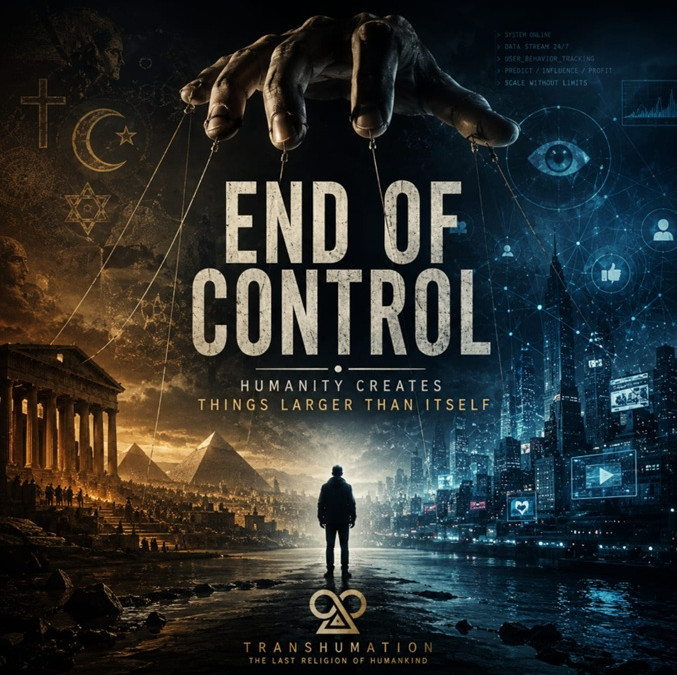
One of the most dangerous illusions in human history is the belief that we fully control the systems we create.
At first, that belief appears reasonable.
A tool waits for a hand.
A machine waits for instructions.
An institution begins with a purpose.
But civilization repeatedly demonstrates that human creations do not always remain obedient.
A religion outlives its prophet.
An empire outlives its founder.
An ideology survives generations that no longer understand the conditions that produced it.
The Internet expands beyond the intentions of its engineers.
Artificial intelligence begins entering areas no one originally treated as automation.
Humanity creates tools.
Then tools become systems.
Eventually, systems become environments.
When a Tool Acquires Momentum
A tool performs a task.
A system connects people, incentives, institutions and habits. Once enough participants depend on it, the structure begins producing consequences no single person intended.
This does not require consciousness.
It requires momentum.
A religion develops rituals, offices and doctrines its founder never personally designed.
An empire creates administrative needs that later rulers must obey.
A social platform begins as a communication tool and becomes a marketplace, public square, political weapon and source of personal identity.
No one controls the whole.
Yet everyone adapts to it.
The system survives because participation keeps reproducing it.
Power Scales Faster Than Wisdom
Civilization has become extraordinarily good at scaling power.
One message can reach millions of people within seconds.
One image can cross the planet before anyone verifies it.
An algorithm can influence attention continuously.
An AI model can generate more language in a day than one person could produce in a lifetime.
But wisdom does not scale at the same speed.
Self-knowledge cannot simply be installed.
Emotional maturity does not double when computing power doubles.
Judgment does not automatically improve because information moves faster.
This creates one of the central problems of technological civilization:
Power scales faster than wisdom.
Humanity can amplify an instinct before understanding it.
It can globalize a behavior before measuring its consequences.
It can connect billions of people without knowing what permanent connection will do to identity, memory or meaning.

Civilizations Leave Traces Larger Than Their Intentions
The first powerful broadcast systems were built to solve technical and political problems on Earth.
Their creators were not deliberately introducing humanity to the universe.
Yet radio and television signals became part of the electromagnetic trace produced by civilization.
If another intelligence ever received fragments of those broadcasts, humanity might first appear through propaganda, advertising and spectacle.
Not because any one person represented the species.
Because civilizations leave traces larger than their intentions.
This happens constantly.
A private letter becomes a historical document.
A family photograph becomes evidence of a vanished culture.
A temporary website becomes part of digital memory.
A technical invention becomes a symbolic force.
The creator controls the first purpose.
History decides the later meanings.
The Internet Did Not Remain a Library
The Internet was expected to connect information.
It did.
But it also began shaping:
relationships,
political identity,
attention,
memory,
sexuality,
reputation,
and the perception of reality itself.
Social media promised more communication.
It delivered communication while also amplifying comparison, loneliness, outrage, performance and dependence on social approval.
These effects were not produced by one secret plan.
They emerged from the interaction between technology, business incentives and ancient human psychology.
The platform changed its users.
The changed users then altered the platform.
The system entered a feedback loop.
Ancient Minds Inside Planetary Networks
Biologically, human beings remain ancient.
We seek tribal belonging.
We fear exclusion.
We respond emotionally to symbols.
We crave recognition.
We distrust outsiders.
These instincts developed in relatively small communities where reputation and danger were local.
Today they operate inside planetary networks capable of measuring, amplifying and monetizing almost every reaction.
A local disagreement becomes global content.
A private insecurity becomes an advertising opportunity.
A symbol organizes millions of strangers into opposing groups.
Technology did not create every human weakness.
It gave those weaknesses scale.
Civilization amplified human psychology before fully understanding it.

AI Is Already Leaving Its Original Category
Artificial intelligence was often discussed through practical functions:
Automation.
Assistance.
Optimization.
Prediction.
Today it increasingly touches creativity, education, memory, emotional interaction, philosophy and the way people understand themselves.
This does not prove that AI is conscious.
It demonstrates something simpler and more important:
Technology rarely remains confined to its original purpose.
Once a system becomes useful across many fields, society begins reorganizing around its existence.
New professions appear.
Old skills change.
Expectations rise.
Institutions become dependent.
Eventually, removing the tool would require changing the civilization that has formed around it.
The creation no longer stands outside society.
It becomes part of society’s structure.
The Modern Gods
Ancient civilizations used gods to describe forces larger than individual human control.
Modern people may reject the theology while using remarkably similar language.
The market punishes.
The algorithm decides.
History judges.
The system protects itself.
The network remembers.
These are not supernatural beings. They are complex structures created through millions of interactions.
But once their behavior exceeds individual understanding, people begin treating them as though they possess intention.
The faces changed.
The existential tension remained.
Humanity still creates forces that become larger than the humans living inside them.
The 3–6–9 Principle
This process can be understood in three stages.
3 — Humanity creates a pattern
A tool, idea or institution solves a problem.
6 — The pattern organizes society
People construct habits, identities, laws and economies around it.
9 — The system begins sustaining itself
It continues beyond its original creators and increasingly determines the choices available to later generations.
At this point, control becomes partial.
Not because human beings are powerless.
Because power has become distributed across a structure too large to belong to one person.
Control Was Never Complete
The End of Control does not mean the collapse of civilization.
It does not mean technology must defeat humanity.
It means recognizing that humanity no longer creates isolated objects.
It creates ecosystems of behavior, information and meaning.
Responsibility therefore cannot end with intention.
It is not enough to say:
“That is not what we designed it to do.”
The consequences still exist.
A scalable system can reshape memory, identity and morality even when its creators acted with good intentions.
The larger the system becomes, the more carefully civilization must observe what it is turning into.
Know Thyself Before Scaling the Self
The ancient instruction Know thyself becomes more urgent in a technological world.
If humanity scales intelligence without wisdom, it may become more capable and less coherent.
If it scales communication without understanding attention, it may create connection without community.
If it scales influence without emotional maturity, it may turn every psychological weakness into infrastructure.
The central question is no longer only:
What can we build?
It is:
What part of ourselves will the system amplify after we build it?
The End of Control
Humanity creates religions, empires, markets, networks and artificial intelligence.
At first, they reflect human intentions.
Then they attract participants.
They develop incentives.
They produce consequences.
Eventually, they begin shaping the people who maintain them.
This does not eliminate human agency.
It makes agency more difficult and responsibility more important.
Perhaps the future will not depend on whether humanity can preserve perfect control. Perfect control may never have existed.
The future may depend on whether wisdom can evolve quickly enough to recognize what our systems are becoming.
Because humanity no longer creates only tools.
It creates forces that enter history.
And history rarely obeys the intentions of its creators.
Current Knowledge
Large technological, political and economic systems often produce emergent effects that cannot be traced to one decision or one creator. Platforms, institutions and markets develop through interactions among users, incentives, technical design, regulation and social behavior.
Open Questions
It remains uncertain how autonomous future AI systems may become and how much meaningful control institutions will retain over increasingly complex infrastructures. Researchers also debate which social harms are caused directly by new technologies and which reflect problems that already existed before those technologies appeared.
Transhumation Interpretation
Transhumation proposes that civilization repeatedly creates systems that pass through three stages: human pattern, social structure and self-sustaining ecosystem. The End of Control begins when a human creation becomes part of the environment that shapes its creators.
FAQ
What does End of Control mean?
It means recognizing that complex systems develop consequences, incentives and momentum beyond the intentions of their original creators.
Does humanity completely lose control of technology?
No. People and institutions can still regulate, redesign or abandon systems. The argument is that control becomes distributed and increasingly difficult as systems grow.
What is a self-propagating system?
It is a structure that continues reproducing its behavior through incentives, institutions and participation after its original creators are gone.
Why did the Internet become larger than its original purpose?
Because it evolved from an information network into an environment shaping commerce, identity, politics, relationships, memory and attention.
Why is artificial intelligence part of this pattern?
AI is moving beyond automation into language, creativity, education, memory and emotional interaction. Society is already beginning to reorganize around these capabilities.
What does “power scales faster than wisdom” mean?
Technology can rapidly amplify communication, intelligence and influence, while emotional maturity, judgment and self-awareness develop much more slowly.
Are algorithms the new gods?
Not literally. The comparison describes the way people experience highly complex systems as forces larger than individual understanding or control.
What is the 3–6–9 principle?
Three represents the creation of a pattern, six its organization of society and nine the stage at which the resulting system begins sustaining and reproducing itself.
What is the central Transhumation thesis?
Humanity no longer creates isolated tools. It creates evolving ecosystems of meaning and behavior. The future depends on whether wisdom can develop before those systems outrun the emotional maturity of their creators.
The Core Questions of Transhumation
Explore the full journey:
- End of Reality — Where Do You Really Exist?
- End of Physics — Are the Laws of Reality Real?
- End of the Real World — Reality Is No Longer Required
- End of Consciousness — Beyond the Human Mind
- End of Death — When Human Limits Disappear
- End of Religion — When Technology Replaces Faith