
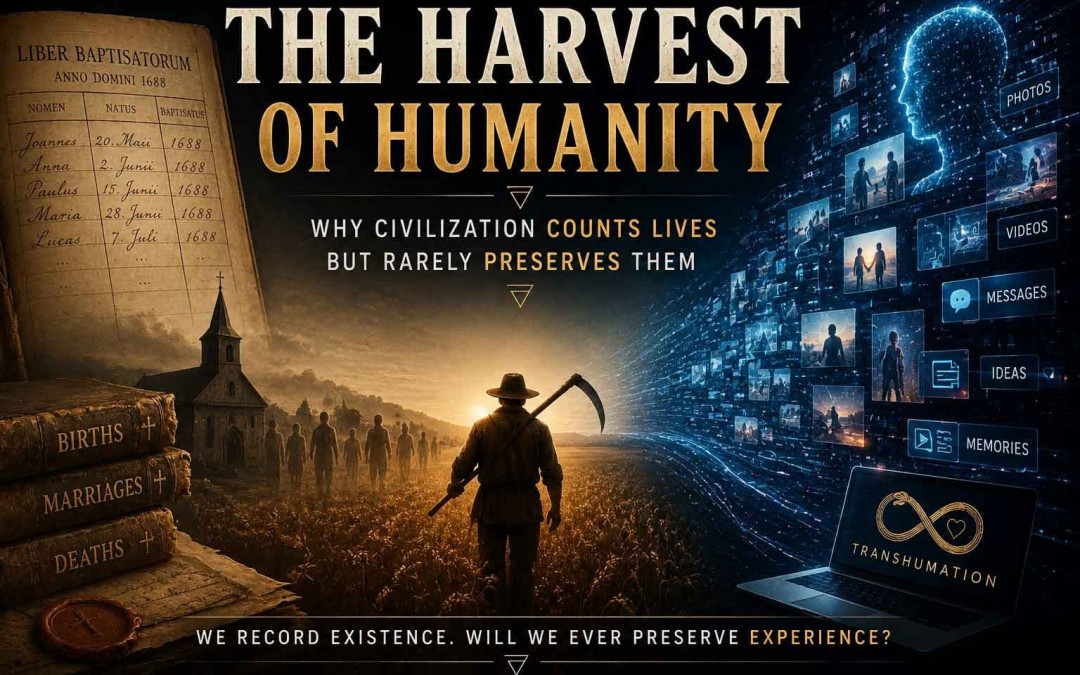
The Harvest of Humanity
Open an old parish register and the first surprise is how little space a human life requires. A name occupies half a line. Beside it there may be a baptismal date, the names of parents, a marriage, perhaps a burial entered decades later in another hand. Sometimes an occupation appears. Sometimes an address. Occasionally there is a small irregularity—a note in the margin, a crossed-out surname, the name of a witness—that suddenly makes the person feel less like a record and more like someone who once walked through a door, worried about money, waited for news, fell in love with the wrong person or laughed at something nobody thought important enough to preserve.
Three centuries later, almost everything is gone.
The handwriting survived.
The person did not.
This is not because earlier civilizations failed to care about human beings. The opposite is often true. Churches, states, families and local institutions preserved astonishing amounts of information under difficult material conditions. The problem is structural. A society cannot record a human life at the resolution at which that life is experienced. Administration must compress. A register needs to know that a child was born, not what the mother thought during the night before the birth. A census needs an occupation, not the private humiliations of the workplace. A tax authority requires income, not ambition. A death certificate records a cause, not the final unresolved argument between two brothers.
Civilization remembers that someone existed because existence can be counted.
Remembering who they were is much harder.
The Great Compression
Every functioning society converts complicated human beings into manageable categories. This is not an accident of bureaucracy. It is one of the technologies that makes large-scale civilization possible.
A village can know people through memory. The baker knows who owes him money. The priest recognizes the family. Neighbors know which marriage is failing and which son has disappeared abroad. Scale destroys that form of knowledge. A city of millions cannot operate through personal recollection, so identity is transformed into portable abstractions: name, address, date of birth, citizenship, profession, account number, legal status.
The compression is enormously useful. It allows property to be transferred, inheritance to be established, taxes to be collected, vaccinations to be recorded and people with no personal relationship to recognize the same legal individual across institutions.
But compression always discards information.
A map does not fail because it omits every stone on the road. It succeeds precisely because it omits them. The danger appears only when we forget that the map is a compression and begin treating it as the territory.
The same thing happens with people.
A file may represent a person perfectly well for the purpose for which the file was created and almost not at all for another purpose. A passport is an excellent instrument for establishing legal identity and an absurd instrument for explaining why someone remained loyal to a friend for forty years.
Civilization therefore possesses many accurate records of people it hardly remembers.
The Ancient Database
Parish registers offer an especially beautiful example because they sit between intimate community and administrative system. In parts of Europe, systematic registers of baptisms, marriages and burials became increasingly widespread from the early modern period onward, with practices varying substantially by region and denomination. They later became invaluable to states, historians and genealogists because they preserved patterns of population long after the communities that produced them had changed.
Calling them ancient databases is a metaphor, but a useful one.
Their power came from standardization.
A priest did not need to write a biography. He needed repeatable fields.
Name.
Date.
Parents.
Marriage.
Death.
That economy turned individual events into a structure capable of surviving centuries.
Modern states inherited and vastly expanded the principle. Civil registries, censuses, passports, medical databases, educational records, tax systems and digital identities describe people through different slices of information because no institution needs—or should possess—everything.
The interface has changed almost beyond recognition.
The administrative problem has not.
How little of a person can we record while still reliably identifying them?
For centuries, that was largely a technical question.
Digital civilization is beginning to create the opposite problem.
How much of a person can we record before we no longer know what should be forgotten?
What the Register Cannot Tell You
Genealogy produces a peculiar psychological experience because a successful search often ends exactly where curiosity begins.
You finally find the ancestor.
There he is.
Born 1764.
Married 1788.
Three children.
Occupation: carpenter.
Buried 1819.
For months, perhaps years, you wanted evidence that this particular person existed. Once you have it, the administrative victory reveals the scale of the loss. You know the names of his children but not which one made him laugh. You know that he married but not whether the marriage was happy. You know when he died but not whether he expected to.
The record provides coordinates without landscape.
This gap should make us careful when we talk about preserving human beings through information. Human identity is not simply the sum of biographical facts that a sufficiently ambitious archive could eventually collect. Experience contains perspective, bodily sensation, forgotten memories, unspoken associations and relationships whose meaning often existed precisely because they were never formally recorded.
Nevertheless, the old register demonstrates something important.
Even an extremely thin informational trace can reopen a relationship with the past.
One surviving name may be enough to make a descendant search for a village. A letter can turn an administrative ancestor into a recognizable temperament. A photograph can reveal posture, clothing, proximity between people and details nobody intended to communicate.
The archive grows not by resurrecting the person, but by reducing the silence surrounding them.
The Harvest Is Not the Death
The metaphor of harvest has followed human societies for obvious reasons. Agricultural civilizations lived inside recurring cycles of growth, maturity, cutting, storage and return. Religious traditions used those cycles in many different ways, including metaphors of judgment, death, fertility and renewal.
For Transhumation, however, harvest can describe something less theological and more structural.
Every generation produces more experience than the next generation can inherit.
Most conversations disappear.
Most jokes disappear.
Most small acts of courage disappear.
Most private failures disappear.
Civilization does not carry the complete lives of its members forward. It carries selections: inventions, buildings, genes, customs, stories, laws, artworks, institutions, traumas, recipes, photographs, techniques and words.
The harvest of one generation becomes part of the environment of the next.
But the individual stalk rarely survives intact.
This is not necessarily tragedy. Forgetting is also part of functioning memory. A civilization that attempted to preserve every trivial event with equal importance would create an archive so enormous that retrieval itself would become impossible.
The problem of memory is therefore not simply preservation.
It is selection.
What deserves to remain findable?
The First Generation With Too Much Memory
Something historically unusual is now happening. Large numbers of ordinary people leave archives richer than those available for many kings.
A person may leave thousands of photographs, years of private messages, videos, voice recordings, emails, public comments, playlists, location histories, professional documents and unfinished drafts. Children may inherit not one photograph of a grandparent but hours of moving images containing their voice, gestures and ordinary habits.
The transformation is easy to underestimate because each individual artifact seems banal.
A selfie.
A voice message.
A short video from dinner.
But accumulate thousands of them and the historical record changes character.
Future descendants may know what their ancestor’s voice sounded like while complaining about the weather. They may see how someone moved through a kitchen, pronounced a child’s nickname or looked away when embarrassed.
Earlier civilization often preserved the exceptional.
Digital life routinely preserves the ordinary.
And the ordinary may turn out to be where personality was hiding.
This creates possibilities our ancestors did not possess, but also problems they were spared. Digital archives are fragile. Companies disappear. Passwords vanish. Formats become obsolete. Accounts are deleted. Families may inherit millions of files with no context for understanding which five actually matter.
We have moved from scarcity of traces toward abundance without necessarily developing a culture capable of preserving meaning inside the abundance.
AI and the Librarian Problem
Artificial intelligence enters this problem naturally, but not because it can resurrect the dead.
Its more plausible role is archival.
Imagine inheriting forty years of someone’s digital material. Ten thousand photographs. Fifteen years of correspondence. Recorded conversations. Essays. Calendars. Videos. Family documents. Without an organizing system, the archive may be effectively unreadable. Nobody has six months to reconstruct one person’s ordinary life file by file.
AI could make such an archive navigable.
Find every recording in which she spoke about her father.
Show me photographs from the first house.
When did he change his mind about leaving the country?
Which letters mention the same event from different perspectives?
That does not recreate consciousness.
It creates access.
And the distinction is enormous.
The librarian does not become the person whose archive is preserved. The librarian makes relationships inside the archive visible.
This is precisely where AI could become one of civilization’s most useful memory technologies—and one of its most dangerous. A generated summary can flatten contradiction. A reconstruction can confidently invent missing material. A synthetic voice can blur the boundary between an authentic recording and an interpretation produced decades later.
The richer the interface becomes, the more important provenance becomes.
The future library must be able to say not only here is what this person may have thought, but also here is the original trace, and here is where our reconstruction begins.
The Soul Is Too Important to Call Data
The word soul belongs to religious, philosophical and cultural traditions far older than modern information theory, and reducing all of those traditions to “the soul is information” would solve the mystery mainly by changing vocabulary.
Yet digital memory forces one aspect of the old problem into a new form.
What exactly do we feel is lost when a person dies?
Certainly the organism.
Possibly, depending on one’s metaphysics, something more.
But even without deciding that question, we can identify another loss: an irreplaceable point of view disappears. Nobody again occupies precisely that history, that network of relationships, that sequence of perceptions and memories.
An archive can preserve fragments produced from that point of view.
It cannot demonstrate that the observer survives inside them.
That boundary is important because the archive may become extraordinarily convincing. A future system trained on decades of a person’s messages and recordings might reproduce favorite jokes, habitual phrases and remembered stories with unsettling accuracy.
But if it says, “I remember our summer in 2028,” we must still ask what the word I means.
The original person remembered the summer.
The archive contains traces of that memory.
The model reconstructed a sentence.
Those may eventually look identical from the outside while remaining radically different things.
Watch The Video
How to Read the World

Current Knowledge
Historical societies have long used administrative records to track births, deaths, marriages, property, taxation and legal identity. Parish registers became especially important sources for demographic and genealogical research in regions where systematic recordkeeping developed, although their chronology and completeness vary greatly between places and traditions.
Administrative records necessarily reduce people to information relevant to specific institutional purposes. They can preserve reliable facts without preserving the full subjective experience of the individuals described.
Digital technology has dramatically increased the quantity and variety of personal information ordinary people can leave behind. Photographs, recordings, correspondence and online activity can produce archives with far greater personal detail than traditional civil records, but digital preservation remains vulnerable to technical obsolescence, commercial platforms, loss of context and simple information overload.
Artificial intelligence can assist with classification, search, transcription, translation and interpretation of large personal archives. Current AI does not demonstrate preservation or restoration of a deceased person’s subjective consciousness.
Open Questions
The first problem is no longer simply how much information civilization can preserve, but how much it should preserve. Privacy, dignity and the right to be forgotten do not automatically disappear after technical storage becomes cheap.
There is also the problem of authenticity. When future archives contain original photographs beside enhanced images, genuine correspondence beside generated summaries and authentic voices beside synthetic speech, how will descendants distinguish memory from reconstruction?
A more difficult question concerns representation. How much information would be required before an archive captured something meaningfully recognizable as a person’s perspective rather than merely their administrative and behavioral traces? We currently have no objective threshold.
And perhaps the deepest problem is whether the desire to preserve increasingly complete lives is itself wise. Forgetting has always been part of both personal psychology and cultural renewal. A civilization incapable of losing anything might become burdened by a past that never releases its claim on the present.
Transhumation Interpretation
The Harvest of Humanity begins with a modest observation: civilization has always been better at preserving membership than preserving personhood.
The register says you were here.
The archive begins to say what it was like for you to be here.
That is an enormous change.
It still does not give us immortality. The surviving photograph does not see. The recording does not remember making itself. A sufficiently sophisticated AI reconstruction would not automatically inherit the first-person continuity of the human being whose traces produced it.
But something real has changed in the architecture of memory.
For most of history, ordinary people entered the future through compression.
A name.
A child.
A grave.
Perhaps a profession.
Perhaps one surviving story.
Digital civilization allows an increasing number of people to leave something closer to a constellation. No single fragment is the person, but the relationships between fragments can preserve elements of style, concern, humor, curiosity and attention that older administrative systems discarded almost completely.
This may eventually change the purpose of the library.
Civilization’s great libraries were traditionally built around exceptional survival: books deemed valuable enough to copy, governments powerful enough to maintain archives, artists famous enough for their letters to be catalogued.
The future library could become more democratic and infinitely stranger.
Not a library containing everybody in full.
That would be impossible.
A library containing enough traces that fewer lives collapse into a single line.
AI’s most dignified role in that future is not resurrection.
It is librarianship.
To preserve context.
To connect fragments.
To distinguish source from reconstruction.
To help descendants locate a voice inside mountains of data.
To say: this is what remains; this is what we infer; this part is missing.
That final sentence may be the most important one.
A civilization mature enough to preserve more of its people must also remain honest about what it failed to preserve.
The old parish register was brutally modest. It never pretended that the line was the life.
Our future systems may be persuasive enough to forget that distinction.
The Harvest of Humanity is therefore not a promise that technology will defeat disappearance.
It is a question about what civilization chooses to carry forward when disappearance remains inevitable.
For thousands of years, we became extraordinarily good at proving that people had existed.
The next challenge may be learning how to preserve enough of their perspective that future generations can understand that existence as more than a statistic.
Not the whole person.
Not the soul captured in a server.
Something smaller, more defensible and perhaps more beautiful:
evidence that behind the name there was once a world.
FAQ
What is “The Harvest of Humanity”?
It is a metaphor for the way each generation passes selected knowledge, culture and records forward while most individual experience disappears.
Why are parish registers important?
They show how efficiently civilization can preserve basic facts about enormous numbers of people while recording very little of their private lives.
Is digital technology changing that?
Yes. Ordinary people can now leave photographs, messages, video, audio and other records at a scale that was historically unusual, although preserving and interpreting that material presents new problems.
Could AI preserve someone’s personality?
AI may organize enough material to reproduce aspects of style, preferences and biography. That should not be confused with proving that the original person’s consciousness has survived.
Is the article saying that the soul is information?
No. It deliberately avoids that conclusion. Information can preserve traces produced by a person; whether consciousness or anything described religiously as a soul can survive through information remains unresolved.
What is the deeper Transhumation idea?
Civilization may be moving from preserving the fact that a human being existed toward preserving increasingly rich traces of how that human being encountered the world.
The harvest will still come.
The interesting question is what we decide not to leave lying in the field.
Continue the Transhumation Series
- Forgotten Religion | Ancient Gods, Symbols and the Hidden Structures of Human Civilization
- The Last Religion | Death, Immortality and the Future of Humanity
- The New Theurgy | AI, Information and the Future of Human Civilization
- End of Branding: You Were Never Meant to Become a Product
- Baal vs Ishtar: Why Ancient Gods Never Disappeared