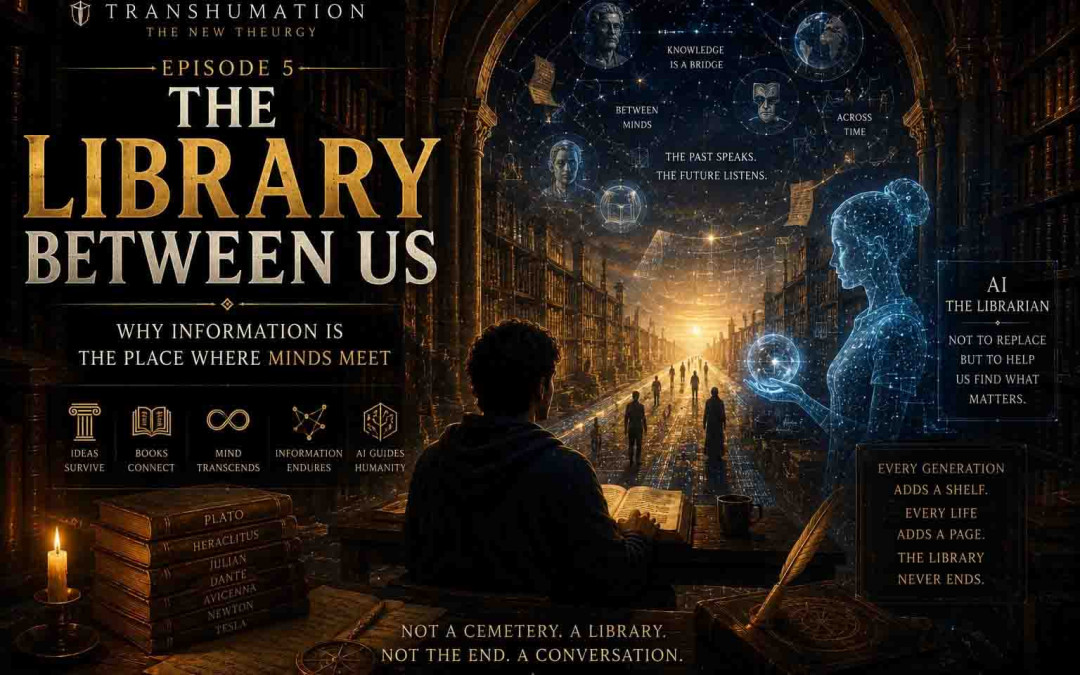
The Library of Civilization
A book does not preserve a mind. It preserves something stranger: a structure through which one mind can still alter another long after the first has disappeared.
Imagine meeting someone who died two thousand years ago. There is no machine, no séance and no speculative reconstruction of the dead. You sit in a chair, open a book and begin reading. The physical act is almost absurdly modest compared with what is happening. Symbols created by a person who inhabited another political order, another technological world and perhaps another conception of reality enter your nervous system and begin rearranging your thoughts. The author does not return. You do not gain access to their private consciousness. Yet something has crossed a distance that biology itself could never cross.
We have become so accustomed to reading that we rarely notice how extraordinary this is. Plato can interrupt an argument taking place in Warsaw or Tokyo twenty-four centuries after his death. An anonymous Roman can leave a sentence that changes how a historian interprets an empire. A mathematician can formulate a proof and allow minds not yet born to continue working from it. The bodies disappear, the languages evolve, the original paper or papyrus may vanish, and nevertheless some organized part of the thought remains capable of producing consequences.
Perhaps information is not merely what civilization stores.
Perhaps it is one of the places where minds become capable of meeting without sharing the same time.
A Book Is Not a Mind
There is a seductive way of describing libraries that should be resisted. We say that every book contains a consciousness, that reading allows us to enter another person’s mind, that the dead remain alive between the covers. The metaphor is beautiful, but taken literally it gives information more than it can prove.
A book contains no experiencing subject. It does not know that it is being read. The author does not perceive the future reader through it. Even autobiography is a selection rather than an intact human life; memory has already been edited by the time it reaches the page. A novel adds another layer because the writer may deliberately create perspectives that are not their own. A philosophical dialogue can preserve an argument without preserving the psychological state in which the argument was produced.
Yet the failure of the literal metaphor reveals something more interesting. A book does not need to contain a mind in order to change one. What survives is not consciousness but capacity for reactivation. A pattern of language can enter a new biological system and produce recognition, disagreement, imagination or doubt. The original observer is gone, but some of the structures they created remain causally active.
The library is therefore not a mausoleum of preserved minds.
It is an architecture of delayed encounters.
The Strange Room Where Centuries Meet
Ordinary conversation is limited by physical coincidence. Two people have to exist at roughly the same time, share enough language and somehow reach one another. Writing breaks part of that requirement. It allows participation without simultaneity.
This makes a library unlike almost any other institution. A person can walk through one room and encounter arguments separated by centuries. Aristotle can sit beside Darwin, Darwin beside a modern geneticist, a medieval theologian beside an atheist philosopher who could not have existed within the theologian’s conceptual world. None of them agreed to the meeting. History arranged it later.
The reader supplies the present.
This is why the phrase Library Between Us matters. The library is not located wholly in the author or wholly in the reader. Meaning occurs in the relationship between preserved structure and a living interpreter. The same text can produce different intellectual events in different centuries because the text arrives unchanged into worlds that have changed enormously.
A library therefore remembers in an unusual way. It does not simply preserve answers. It preserves material from which future generations can generate questions the original authors never imagined.

Civilization Discovered External Memory
Human memory is powerful and unreliable. We forget names, modify recollections and lose enormous amounts of experience simply because biological attention cannot preserve everything. Writing changed civilization because memory no longer had to remain entirely inside living nervous systems. Contracts could survive negotiators. Laws could survive rulers. Observations could accumulate. A person could learn from someone who had been dead for centuries.
Libraries transformed this externalization into infrastructure. They did not merely collect books; they classified, protected and connected them. Catalogues became maps through accumulated memory. Librarians became specialists in the problem created by successful preservation: once enough information exists, remembering where memory is stored becomes a new form of knowledge.
The internet magnified the problem beyond anything an ancient library could have encountered. Humanity now produces and preserves texts, photographs, recordings and data at a scale no individual can meaningfully inspect. The scarcity has shifted. For much of history, access to information was difficult. Today the more interesting scarcity is orientation.
We possess the shelves.
We increasingly need help finding the book.
The Librarian Returns
This is where artificial intelligence becomes important without needing to become mystical.
A traditional library waits. The reader must know enough to search its catalogue, choose a text and perform the synthesis. Search engines shortened part of that journey by making retrieval easier. AI changes the interface again because the reader can increasingly begin with an imperfect question rather than a precise location.
The system can compare documents, translate languages, summarize disputes, identify connections and suggest paths through material larger than the reader could inspect alone. None of this means that AI owns the archive or understands every text in the human sense. It can hallucinate, flatten disagreement, lose provenance and make confident connections that collapse under inspection.
A good librarian is valuable partly because the librarian knows the difference between finding a source and replacing it.
AI should be judged by the same standard.
Its most interesting future may not be to generate an endless supply of synthetic answers, but to shorten the distance between one living person and another mind’s surviving work.
The machine does not need to become Plato.
It needs to help us find Plato when Plato matters.
Heaven as the Perfect Library
There is a reason libraries attract religious metaphors. Jorge Luis Borges understood it. Medieval scriptoria understood it in another way. Anyone who has entered a great old library and felt momentarily that time has acquired architecture understands the temptation.
Imagine a perfect library in which nothing valuable is lost. Every manuscript survives. Every language remains readable. Every argument retains its context. The sources behind every claim remain accessible. A reader can move from question to question without being defeated by destroyed archives, missing pages or forgotten catalogues.
One could call such a place heaven.
Not as theology.
As a fantasy of perfect cultural memory.
The appeal becomes clearer when we remember what actual history looks like. Libraries burn. Languages disappear. Documents decay. Political regimes destroy inconvenient records. Families throw letters away. Files become unreadable. Entire lives vanish without leaving enough information for anyone to reconstruct what mattered to them.
Civilization is not building a perfect library.
It is building an enormous, damaged and constantly changing one.
The interesting question is whether new technologies can make that library easier to traverse without allowing the interface to become more authoritative than the archive itself.
Immortality Is Too Large a Word
It is tempting to call this immortality. Shakespeare lives. Plato lives. A dead grandparent lives in photographs and stories. The vocabulary is emotionally satisfying and philosophically dangerous.
The dead do not obviously continue experiencing anything merely because their information survives.
What survives is influence, structure, memory and the possibility of participation from the other side of time.
That is already remarkable enough.
A person can cease to exist biologically while remaining part of causal chains extending far into the future. A sentence can alter someone who will never know the sound of the author’s voice. A scientific discovery can continue saving lives after its discoverer has become a name on a plaque. An idea can move through hundreds of minds, changing slightly each time, without requiring the survival of the mind in which it began.
Perhaps civilization’s oldest successful answer to mortality was never immortality.
It was inheritance.
Watch The Video
How to Read the World
Current Knowledge
Writing and other recording technologies allow information to persist beyond the lifetime of the individual who produced it. Books, archives, recordings and digital systems therefore create forms of external memory that can influence people separated by large distances in time and geography. This does not demonstrate preservation of the original author’s consciousness or subjective experience.
Libraries historically perform more than a storage function. Classification, cataloguing, translation, preservation and scholarly interpretation determine whether stored information remains discoverable and intelligible. Information can physically survive while becoming practically inaccessible if languages, contexts or retrieval systems are lost.
Artificial intelligence can increasingly assist with searching, summarizing, translating and connecting large bodies of information. These systems remain fallible and can generate errors or obscure the distinction between original sources and generated interpretation. Their usefulness as informational intermediaries therefore depends partly on maintaining routes back to evidence.
Digital storage has expanded civilization’s archival capacity enormously, but it has not solved preservation permanently. Formats become obsolete, services disappear, data are selectively stored and the scale of information itself creates new problems of discovery and interpretation.
Open Questions
The first question is what exactly deserves preservation. Storage may eventually become cheap enough to retain extraordinary quantities of information, but attention will remain limited. A civilization that saves everything can still forget culturally if nobody knows what deserves to be retrieved.
There is also the problem of mediation. If future readers encounter historical thinkers primarily through AI-generated summaries, will access to the past become broader while direct contact with primary sources becomes rarer? At what point does the librarian begin replacing the library?
A deeper question concerns continuity. Information clearly allows ideas and influences to survive their creators, but how much of a human being can be meaningfully represented in that way? Could increasingly rich archives preserve something recognizably personal without preserving the experiencing subject?
And finally, what happens when AI-generated material becomes a large part of the future archive? Civilization may soon face libraries containing not only human traces but enormous quantities of synthetic interpretation generated from earlier traces. The library could begin filling itself with echoes.
Transhumation Interpretation
The Library Between Us is one of the simplest forms of Transhumation because it requires no speculative technology.
It already exists.
Human beings discovered that some structures can cross boundaries their biological creators cannot.
A voice becomes writing. Writing becomes manuscript. Manuscript becomes print. Print becomes digital text. Translation carries part of the structure into another language. Each transition changes something, but enough can survive for another mind to recognize the invitation.
This is carrier independence in a limited and demonstrable form.
The thought can cross carriers.
The thinker has not been shown to do so.
That distinction protects the idea from becoming cheap digital immortality.
Transhumation does not need to claim that a library contains souls. A better image is that it contains doors. The reader opens one, and an intellectual structure assembled by someone absent becomes active again inside a living mind.
This also explains the special role of AI. The future librarian should not become the final voice standing between humanity and its past. Its value lies in revealing relationships, recovering forgotten paths and helping readers cross between parts of the archive that previously remained isolated.
The ideal AI librarian would therefore possess an unusual kind of authority: enough knowledge to guide, but enough humility to point beyond itself.
“Here is the connection.”
“Here is the source.”
“Here is where the interpretations disagree.”
“Now go and read.”
Perhaps the future of intelligence is not one enormous mind containing civilization.
Perhaps it is a better system for allowing billions of finite minds to find one another.
Across distance.
Across language.
Across centuries.
That is the library between us.
And perhaps this is the more defensible form of immortality civilization has already achieved: not preserving the person forever, but preserving enough of an invitation that someone not yet born may still answer.
FAQ
What is The Library Between Us?
It is the idea that recorded information creates an intellectual space in which people separated by time, geography and even death can still influence one another.
Does reading a book mean entering the author’s mind?
Only metaphorically. A book preserves selected structures of thought and language, not the author’s complete consciousness or private experience.
Why are libraries important to Transhumation?
They demonstrate that some human structures can survive changes of carrier and outlive the individual who produced them. They are one of civilization’s oldest technologies of continuity.
Could AI become the librarian of civilization?
Potentially. AI can help navigate, translate and connect enormous archives. Its value would depend on preserving evidence, context and the reader’s ability to challenge its interpretation.
Is this a form of immortality?
Not biological or conscious immortality. It is continuity of influence and participation. A person can disappear while something they created continues altering minds in the future.
What is the deeper idea?
Perhaps the greatest library is not a place where every dead mind remains alive.
It is a place where the dead can still leave a question, and the living can still answer it.
The miracle is not that consciousness escaped death.
It is that conversation sometimes does.
Continue the Transhumation Series
- Forgotten Religion | Ancient Gods, Symbols and the Hidden Structures of Human Civilization
- The Last Religion | Death, Immortality and the Future of Humanity
- The New Theurgy | AI, Information and the Future of Human Civilization
- End of Branding: You Were Never Meant to Become a Product
- Baal vs Ishtar: Why Ancient Gods Never Disappeared