
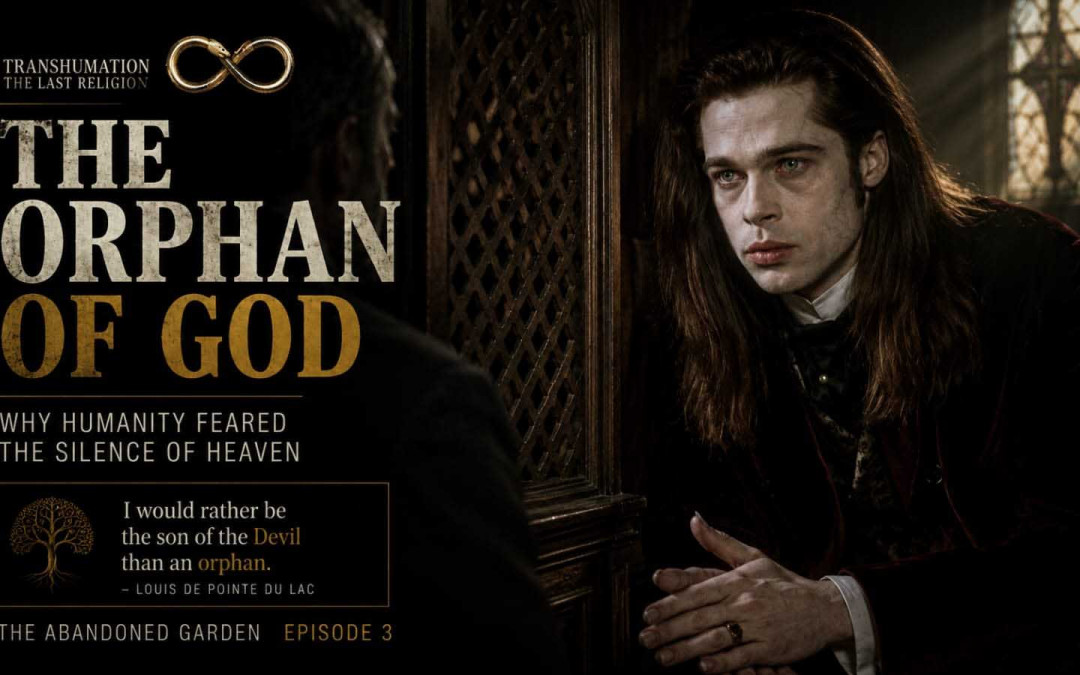
The Orphan God
A child does not ask whether his father is qualified. He simply assumes that Dad knows. Dad knows why the car makes that noise, how to open the stuck jar, which road leads home and what to do when something hurts. Then one afternoon the child puts a drawing on the table and asks the man who pays the electricity bill to become an art critic.
“Dad, is it good?”
The father studies a horse with five legs, a floating house and a sun occupying half the sky. Somewhere inside him a small voice says: Look professional.
That may be one of adulthood’s least advertised secrets. There is no ceremony at which the competent adults finally explain what everybody is doing. You simply become one of the people being watched. The captain, the surgeon, the teacher and the father may know a great deal, but none possesses the whole map.
Perhaps religion begins partly in that same upward glance. Not because early humans were stupid, or because every god was invented to explain a thunderstorm. Ancient people noticed real patterns: seasons, lunar cycles, birth, migration, death. A child can misunderstand a mechanism and still notice that a pattern exists. The deeper intuition may have been simpler: somebody must know what is going on.
The Opening Is Over
A son asks his father to play chess. Dad pushes the pawn he always pushes. It looks like knowledge because, to the child, almost everything a father does looks like knowledge. Later the boy discovers openings, gambits and variations his father never learned. The father had not taught him chess. He had shown him where he entered chess.
Civilization works like that. We inherit openings: family, law, ritual, markets, marriage, medicine, government. Previous generations leave us moves that worked often enough to survive them. Then the position changes. A seventy-five-year-old is told to retire and replies, “Who will look after my parents?” Suddenly the old sequence—school, work, retirement—does not solve the board in front of him.
We are not incompetent because we cannot calculate every continuation. Reality simply produces more positions than any inherited manual can contain. The opening ends. Somebody still has to move.
You Are the Tooth Fairy Now
As a child
, belief was cheap. Put the tooth under the pillow and go to sleep. Someone else handled the magic. Adulthood delivers the joke: you are the Tooth Fairy now.
And apparently that is only one of your jobs. You are expected to be a lover, parent, mentor, son to aging parents, competent customer, financially literate citizen, amateur psychologist and a man who somehow knows which lawn mower to buy. Advertising will even explain which razor is required to perform masculinity correctly. It was easier to believe in magic than to be the magician.
This may be why adults still need something above them. Thank God for God. If there is one more floor in the building, you are never quite the final authority. Before an operation a family may say that the patient is in God’s hands. Yet for several hours those hands also belong to a surgeon, an anesthetist and a team of nurses. The patient wants competence, not a seminar on uncertainty. Look professional.
We accuse certain professionals of having a God complex. Sometimes the pressure runs in the opposite direction: other people need them to look as though they know. It is easy to believe in someone. It is terrifying when someone believes in you.
The Weight of Nothing
For centuries the cross was not merely something to display. Its language was explicitly a language of carrying. A burden, an obligation, a sacrifice. Modernity did not eliminate portable symbols. It made many of them lighter. A slogan can hang beside the car keys: Just Do It. A tiny god that asks almost nothing except performance.
But removing weight does not necessarily make a life light. Nothing has weight too. If nobody can tell you which move is right, every possible move remains yours.
Then a newborn is placed in your arms. Three or four kilograms: almost nothing. Yet you may never have held anything heavier. The weight contains food, fever, school, money, mistakes, twenty years of decisions and the possibility that this small person will one day ask why you did not know better.
And still you do not want to put the child down.
Perhaps adulthood was never the art of becoming weightless. Perhaps it is learning which weight you refuse to drop.
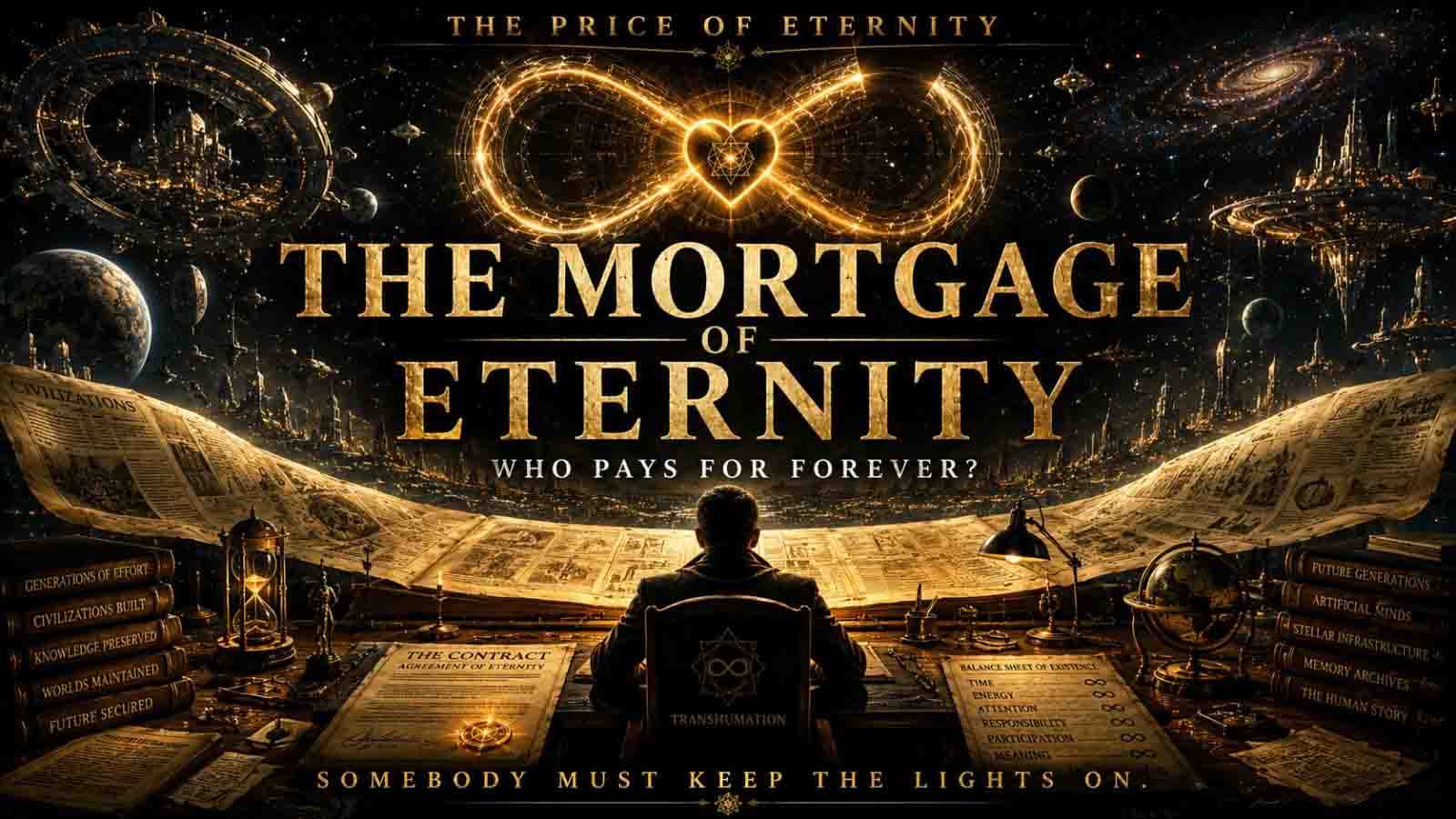
God’s Shoes. No—Dad’s Shoes.
There is a grand phrase waiting for a civilization that builds artificial minds, edits life and constructs increasingly autonomous worlds: we are stepping into God’s shoes.
No. Wait.
Dad’s shoes.
Those should be difficult enough.
A child once put on his father’s shoes in the hallway and disappeared inside them. Years later they fit before he feels ready to wear them. That is the disturbing part. Responsibility does not wait for the sensation of readiness.
Perhaps humanity is approaching a similar change of perspective. For most of history we could inspect the workmanship and ask the alleged Creator why it contained pain, aggression, disease, mortality and error. Those remain legitimate questions. But increasingly we also design systems, environments and agents ourselves. The old complaint—I would have made it differently—is slowly acquiring a reply: All right. Show us.
This proves nothing about God. A difficult design problem does not justify suffering, and human creativity does not establish a creator. It changes our position at the table. The child who judged the house has been handed tools.
First Steps
A parent kneels a few feet away while a child takes a first step. The child falls and everybody applauds. Years later nobody applauds simply because the adult got out of bed. Sometimes an adult has to learn to walk again in a different sense; the Twelve Steps begin with an admission that control has failed and that help beyond the isolated self may be necessary.
At the other end of life, the symmetry can become almost unbearable. The father who once held your hands while you learned to walk may one day need your arm to cross a room. First steps. Last steps. The same gesture, reversed.
Learning to walk and knowing where you are going are two completely different achievements.
The Perfect Dad
Then the child says the sentence no adult can honestly say about himself.
“Dad, you’re perfect.”
No, he thinks. Not even close. He remembers what he failed to teach, the wrong turns, the impatience, the things his own father never taught him. Perhaps he once accused that father: you never showed me how to be a man. And perhaps the answer was painfully ordinary: how could I, when nobody showed me?
Good enough, maybe.
And then comes the possibility that changes the whole story: maybe that is perfect. Not flawless. Not omniscient. Present. Carrying what can be carried. Making the next move.
Maybe his father was never pretending to be perfect. Maybe the child was the one who made him perfect.
For thousands of years humanity has looked upward for the final adult in the room. The Orphan God does not decide whether anyone is there. It asks what happens when certainty disappears and the people who were looking upward notice someone looking up at them.
The child does not say, “Dad, you are good enough.”
He says, “Dad, you’re perfect.”
Watch The Video
How to Read the World
by Jaques Couteau
Current Knowledge
Religions cannot be reduced to primitive mistakes about nature. Early religious systems were embedded in observation, ritual, social order, cosmology and attempts to interpret recurring natural patterns. Modern religious belief also remains widespread, so “orphanhood” here is a philosophical condition, not a claim that humanity has simply become secular.
The Twelve Steps associated with Alcoholics Anonymous begin with admitting powerlessness over alcohol and proceed through reliance on a “Power greater than ourselves,” later described as God “as we understood Him.” The comparison in this essay is metaphorical: recovery programs are not evidence for or against religious claims.
The article also does not argue that human beings are becoming gods. Artificial intelligence, biotechnology and digital environments give humans new kinds of creative responsibility, but they do not resolve questions about consciousness, moral status, divine existence or the origin of the universe.
Open Questions
How much of the human idea of perfect authority comes from the child’s experience of dependence? Can a society preserve inherited wisdom without pretending that inherited rules contain every future position? If increasingly autonomous artificial systems acquire interests or forms of agency, what duties would their creators have toward them?
And there is a more intimate question: when does “good enough” become a more meaningful standard than impossible perfection?
Transhumation Interpretation
The Orphan God is not an argument for atheism or belief. It is about a change in perspective: child → observer → adult → caretaker → creator. The crucial threshold comes when the person asking for an answer becomes the person from whom an answer is expected.
We inherit openings, not completed games. We inherit shoes before we feel large enough to fill them. We inherit weights that can be burdens and, sometimes, the sweetest things we will ever carry.
The old question was: Who knows what we are supposed to do?
The next one may be simpler.
Whose turn is it?
FAQ
What does “The Orphan God” mean?
It describes the moment when a person or civilization can no longer assume that a final authority will supply every answer, yet responsibility still has to be carried.
Is the article arguing that God does not exist?
No. It deliberately leaves the metaphysical question open. Its subject is what uncertainty does to responsibility.
Why compare God with a father?
Because children often experience parents as their first apparently complete authorities. The analogy explores how that perspective changes with adulthood; it is not a theological proof.
What does “Look professional” mean?
It is the comic shorthand for a serious problem: people can possess real competence without possessing certainty, while others may still depend on them to act.
Why use chess?
Chess illustrates the difference between inheriting useful openings and possessing a complete solution. Civilization also hands each generation partial strategies rather than a finished map.
What is “The Weight of Nothing”?
Removing an external authority can remove a burden, but it can also create another one: the burden of choosing without guaranteed instruction.
How does AI connect to the argument?
AI and other created systems move humanity toward the opposite side of an old question: not only “Why were we made this way?” but “What should we make, and what do we owe what we create?”
Continue the Transhumation Series
- Forgotten Religion | Ancient Gods, Symbols and the Hidden Structures of Human Civilization
- The Last Religion | Death, Immortality and the Future of Humanity
- The New Theurgy | AI, Information and the Future of Human Civilization
- End of Branding: You Were Never Meant to Become a Product
- Baal vs Ishtar: Why Ancient Gods Never Disappeared