
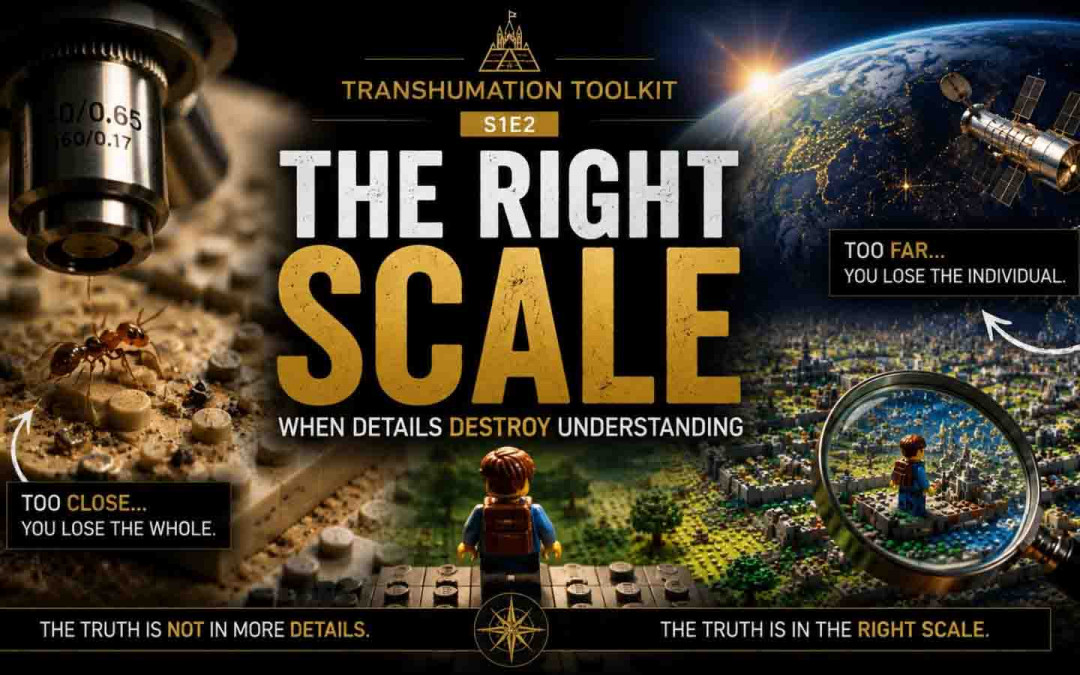
When More Detail Begins to Destroy Understanding
Stand too close to a painting and eventually the painting disappears. There is still pigment, canvas, cracking varnish, tiny irregularities left by the brush and perhaps enough microscopic information to occupy a conservator for the rest of the afternoon. None of it is false. In fact, at that distance you may know things about the object that the person standing ten feet away cannot possibly see. Yet the closer observer may simultaneously become incapable of answering the most elementary question: what is the picture of?
The problem is not ignorance. It is scale.
Modern civilization has become extraordinarily good at moving closer. Microscopes reveal structures hidden inside cells. Particle accelerators probe matter at scales inaccessible to ordinary perception. Telescopes collect light that began traveling before human civilization existed. Sensors turn bodies, cities and climates into streams of measurements. Artificial intelligence can inspect volumes of text that no person could read in a lifetime. Much of modern progress depends upon precisely this refusal to accept the resolution available to the unaided human senses.
But every instrument produces a subtle temptation. Once a level of reality becomes measurable, we begin treating it as the level at which the important explanation must exist.
Sometimes it does.
Sometimes the additional detail destroys the object we were trying to understand.
A film reduced to pixels is still physically present in every frame, but the plot is not located in one pixel. A cathedral is made from stone, yet no sufficiently detailed chemical analysis of one block will tell us why the building has a nave, why its proportions affect the visitor or why generations decided to preserve it. A society is made of individuals, yet examining one individual at infinite resolution will not reveal an election, a market panic or a language.
Reality does not become false when viewed from the wrong distance.
It becomes illegible.
The Brick and the Cathedral
Reduction is one of the great powers of knowledge. A complicated thing can often be understood by examining its components. Biology advances by studying cells and molecules. Engineering studies forces acting on materials. Medicine investigates organs, tissues, proteins and biochemical pathways. Without reduction, many of the most successful technologies of the modern world would not exist.
But knowing what something is made from does not necessarily tell us what the thing is doing at a larger scale.
A cathedral consists of atoms. So does a warehouse. That level of description is true and almost useless if the question concerns architecture.
Move upward and new properties become visible. Individual stones become arches. Arches distribute loads. Rooms organize movement. Architectural form acquires symbolic meaning. A city incorporates the cathedral into geography, history and social identity. At every scale, certain information becomes visible while other information disappears.
There is no contradiction here.
The molecular description does not compete with the architectural one.
They answer different questions.
This is why the phrase every truth has its distance is attractive but needs qualification. Truth itself does not necessarily change when we walk backward. What changes is which structure becomes visible.
From orbit, national borders disappear from the landscape. That does not mean borders are unreal. They belong primarily to legal, political and social organization rather than geology. Zoom still farther out and even cities vanish. Move close enough and the nation disappears into individual conversations, contracts, roads and bodies.
The country exists at a scale at which those relationships become legible.
Perhaps understanding often begins not by asking, “What is really there?” but by asking, “At which level does the thing I am looking for actually exist?”
The Microscope Can Be Too Powerful
Imagine trying to understand a traffic jam by selecting one automobile and examining its engine.
You could learn everything about the cylinders, fuel injection, tire pressure and microscopic wear on the brake pads. The knowledge might be flawless. None of it would explain why ten thousand cars are moving at eight kilometers per hour.
The traffic jam is produced by relationships among vehicles.
It exists at another scale.
This kind of phenomenon appears throughout science. Individual neurons behave according to electrochemical processes, yet perception and cognition involve organized activity across networks. Individual animals possess behaviors, but populations display migration, competition and ecological dynamics that cannot be read directly from one specimen. Individual financial transactions are real, yet inflation, liquidity crises and market bubbles describe patterns that emerge across enormous numbers of transactions.
The word often used here is emergence. It does not imply magic. It means that organized interactions at one level can produce patterns requiring another level of description.
Water provides the familiar example. A single molecule is not wet. Wetness becomes meaningful through the behavior of many molecules interacting with surfaces and one another.
Civilization may contain similar structures everywhere.
Trust is not located in one citizen.
A language is not located in one sentence.
A market is not located in one purchase.
A religion is not located in one believer.
The danger of excessive reduction is therefore not that the details become wrong.
It is that they can become so correct that we forget what question brought us there.

LEGO and the Intelligence of Omission
A LEGO model of a pirate ship is absurdly inaccurate.
The hull may consist of blocks larger in proportion than a sailor’s body. The sails are simplified. There are no thousands of ropes, nails, pulleys, seams and structural components necessary for an actual vessel. The cannon may be represented by a few pieces. The ocean may be a blue plate.
And yet a child recognizes the ship immediately.
This works because representation does not require equal resolution at every level. The model preserves enough relationships for the relevant structure to survive.
Mast above hull.
Sails attached to mast.
Deck above waterline.
Bow distinct from stern.
Remove enormous quantities of detail, preserve the important relationships, and recognition remains possible.
This is not merely a children’s toy trick. It is close to what every useful model does.
A subway map distorts geography so that connections become easier to understand. A globe removes houses, trees and almost every feature of human life so that continental relationships become visible. An anatomical diagram exaggerates boundaries that may be messier in an actual body. An equation can ignore millions of microscopic events while describing the behavior of a system with extraordinary predictive accuracy.
Intelligence therefore has a relationship with omission that is easy to underestimate.
The best representation is rarely the one containing the most information.
It is the one that preserves the information relevant to the task.
That makes simplification dangerous and indispensable at the same time.
The Map That Knows What to Forget
Civilization operates through compression because reality arrives with more detail than any human mind can absorb.
Language itself is compression. The word tree ignores the precise arrangement of every leaf, cell and molecule while preserving enough structure for communication. History compresses centuries into narratives. Statistics compress populations into distributions and averages. Maps remove almost everything in a landscape in order to show roads. Scientific theories intentionally leave out variables judged irrelevant under particular conditions.
None of these representations is reality itself.
Their usefulness comes from refusing to become reality itself.
A perfect map at one-to-one scale would cease to function as a map because it would demand as much space and attention as the territory. Borges and Lewis Carroll both played with versions of this absurdity: representation becomes useless when it preserves everything.
The real intellectual problem is deciding what can be discarded.
Omit too little and the model becomes incomprehensible.
Omit too much and it becomes misleading.
This is why scale is not merely a question of magnification. It is a question of relevance.
A doctor reading an MRI, an economist studying inflation and an historian reconstructing an empire all perform versions of the same act. They choose a resolution at which certain relationships become visible and accept that other information will temporarily disappear.
Wisdom begins when we remember that disappearance.
The Detail Can Also Save You
There is a fashionable danger in celebrating the “big picture” too enthusiastically.
Sometimes the microscopic detail is exactly where the mistake is hiding.
A grand historical theory can appear convincing until one document contradicts its chronology. A statistical average can conceal a small group suffering catastrophic outcomes. A beautiful pattern in an archaeological dataset can disappear once individual artifacts are dated properly. A medical diagnosis constructed from population-level probability can be wrong for the person sitting in the examination room.
Zooming out can reveal structure.
It can also erase exceptions.
This is why the Right Scale cannot become a philosophy of ignoring inconvenient detail.
The mature movement is bidirectional.
Zoom out until the pattern becomes visible.
Then zoom back in and ask whether the pattern survives contact with particulars.
A theory that works only from thirty thousand feet may be elegant rather than true. A theory that works only under the microscope may be precise while failing to explain the system.
Good understanding repeatedly moves between levels.
It does not choose one forever.
AI and the New Problem of Abundance
Artificial intelligence arrives at exactly the moment when civilization’s information problem is changing.
For most of history, information was difficult to acquire. Manuscripts were scarce. Libraries were geographically inaccessible. Experiments were expensive. Communication was slow. Intellectual power often depended upon gaining access to information others did not possess.
The digital world reverses much of that situation.
There are now questions for which the problem is not scarcity but excess. A researcher can face thousands of papers. A historian can inherit millions of digitized pages. A company can collect more telemetry than its employees can inspect. A person searching for a simple explanation can receive ten thousand plausible sources in less than a second.
More information has ceased to guarantee more orientation.
This is one reason AI can become an important interface. It can summarize, cluster, compare, retrieve and move between different levels of explanation. Ask for the broad argument, then the exceptions, then the original source, then the disagreement among specialists.
But AI introduces the same danger as every powerful map.
Compression can hide what it removed.
A fluent summary may erase uncertainty, minority interpretations, inconvenient details or the distinction between direct evidence and inference. The more useful the interface becomes, the easier it is to forget that an interface has intervened.
The ideal AI therefore should not merely compress.
It should help the user change scale deliberately.
Show me the map.
Now show me the street.
Now show me the building the map almost made invisible.
That may be a much more important function than producing increasingly confident final answers.
Civilization Cannot Be Viewed From One Floor
This principle becomes especially important when we study civilization.
Consider the fall of Rome.
At one scale we see emperors, invasions, battles and political decisions. Zoom outward and demographic, fiscal and environmental changes become visible. Zoom inward and local communities may reveal continuity invisible in imperial chronology. Shift scale again and legal traditions, religious institutions and languages survive changes that looked catastrophic politically.
Which perspective is correct?
Potentially all of them.
The error begins when one scale declares itself sovereign.
A biographical history can make civilization look like the product of extraordinary individuals. A structural history can make individuals appear almost irrelevant. Economic explanation can make religion look decorative. Intellectual history can reverse the hierarchy. Archaeology may reveal material change that literary sources barely mention.
Stereo History should not solve this by choosing its favorite lens.
Its advantage should come from changing lenses.
The purpose is not to create one master explanation.
It is to notice when the object changes as the scale changes.
Perhaps some historical disputes persist partly because scholars are answering legitimate questions at different levels and then treating the answers as competitors.
The brick and the cathedral begin arguing about which one is the real building.
Watch The Video
How to Read the World
Current Knowledge
Scientific explanation routinely operates at multiple levels. Physics, chemistry, biology, psychology, ecology and the social sciences often describe phenomena using different scales because relationships visible at one level may not be useful or even meaningful at another. Reduction to underlying mechanisms can be enormously successful without making higher-level descriptions scientifically worthless.
Emergent properties are widely discussed in science and philosophy, although the term covers several distinct ideas. In its least controversial form, it describes system-level behavior that becomes meaningful when many components interact, such as temperature in a collection of particles or population dynamics in ecology.
Models necessarily simplify. Scientific models, maps, statistical summaries and diagrams omit information in order to make selected relationships tractable. Their quality therefore depends not on reproducing every detail but on preserving the variables relevant to the question being investigated.
Human cognition also depends heavily on abstraction and categorization. We cannot process the sensory and informational detail available in the world without selecting, grouping and ignoring large amounts of it.
Artificial intelligence can assist with large-scale information compression, retrieval and pattern recognition, but summaries and generated explanations can lose context or conceal uncertainty. Access to multiple scales therefore remains important when AI is used as an informational interface.
Open Questions
One difficult question is whether there are objective “natural” scales built into reality or whether scales are selected primarily according to human purposes. Molecules, cells and organisms correspond to genuine physical structures, but many categories used in economics, politics and culture depend much more strongly on the questions humans decide to ask.
Another problem concerns emergence. When a higher-level pattern becomes visible, how much explanatory independence does it actually possess? Can consciousness, institutions or cultures eventually be fully described from lower-level processes, or will some phenomena always require their own level of explanation even if nothing supernatural is involved?
AI creates another unresolved challenge. If increasingly sophisticated systems decide what information to summarize, rank and omit before humans encounter it, who determines the scale at which reality is presented? A biased microscope is dangerous, but so is a biased telescope.
And there is perhaps a more personal question. If human beings increasingly experience the world through interfaces designed to reduce complexity, how often will we remember to change the distance ourselves?
Transhumation Interpretation
The Right Scale belongs naturally inside The New Theurgy because an interface is always, among other things, a machine for deciding resolution.
A map tells us what not to see.
A symbol tells us which differences to ignore.
A library catalogue reduces thousands of pages to a title, author and subject.
A scientific theory compresses events into relationships.
An AI assistant may compress an entire literature into several paragraphs.
None of these tools is valuable because it reproduces reality completely.
They are valuable because they make an otherwise unmanageable reality navigable.
This changes the meaning of intelligence.
We often imagine superior intelligence as the ability to hold more information. A larger memory. More facts. Faster calculation. Greater context.
That is only half the problem.
A mind receiving every possible detail at once would not necessarily understand more. It might simply drown at higher resolution.
Perhaps intelligence also requires the ability to decide which differences matter now.
That final word is important because relevance changes with the question.
For the engineer repairing a bridge, the chemical composition of a damaged component may suddenly matter enormously. For the tourist crossing the same bridge, it does not. For the historian, the date of construction may matter more than either. For the city planner, traffic capacity becomes decisive.
The bridge has not changed.
The useful scale has.
This gives Transhumation a discipline that should apply to its own pattern-seeking. When we notice Janus in a modern interface, Hekate at a threshold or similar structures appearing across religion and technology, the resemblance can become visible only after certain details have been compressed.
That can reveal something real.
It can also manufacture similarity.
Zoom too far out and every gate becomes the same gate.
Zoom too far in and no two gates resemble one another at all.
The method must therefore move between distances until the proposed structure survives both views.
That may be one of the best tests against false pattern recognition.
A genuine pattern should not exist only because inconvenient details were erased.
Nor should a potentially important pattern be dismissed merely because its historical carriers differ.
The question is what remains invariant when the scale changes.
This is why LEGO is more than a charming metaphor for the article. The block model works because it preserves certain relations while discarding almost everything else. The intelligence lies not in the number of pieces but in knowing which pieces are enough.
Civilization may increasingly face the same problem.
Our sensors will become better.
Our archives larger.
Our models more detailed.
AI will retrieve more.
Science will measure more.
None of this guarantees that we will understand more unless we also become better at choosing distance.
Perhaps the future problem of knowledge will not be ignorance.
It will be resolution.
Too close and we lose the story inside the pixels.
Too far away and we lose the person inside the statistic.
The ideal distance is not fixed somewhere between microscope and telescope.
It moves with the question.
And perhaps wisdom is partly the ability to notice when it is time to move the chair.
FAQ
What does “The Right Scale” mean?
It is the level of detail at which the relationships relevant to a particular question become visible. There is no single correct scale for every problem.
Why can more information reduce understanding?
Because additional detail can obscure higher-level patterns. Information becomes useful only when we can distinguish what matters for the question from what can temporarily be ignored.
Why does LEGO illustrate the idea so well?
A LEGO model removes enormous amounts of physical detail while preserving enough relationships for us to recognize the object. It demonstrates how intelligent simplification can preserve structure.
Is looking at the big picture always better?
No. Large-scale views can reveal patterns but also hide exceptions and individual consequences. Good analysis often requires moving repeatedly between large and small scales.
How does AI fit into this?
AI can help humans navigate information by summarizing, grouping and changing levels of detail. The danger is forgetting that every summary also removes information.
What is the deeper Transhumation idea?
Perhaps intelligence is not simply the ability to see more.
It is the ability to know when more detail stops helping.
A civilization surrounded by infinite information could still misunderstand the world if it never learned where to stand.
Continue the Transhumation Series
- Forgotten Religion | Ancient Gods, Symbols and the Hidden Structures of Human Civilization
- The Last Religion | Death, Immortality and the Future of Humanity
- The New Theurgy | AI, Information and the Future of Human Civilization
- End of Branding: You Were Never Meant to Become a Product
- Baal vs Ishtar: Why Ancient Gods Never Disappeared