
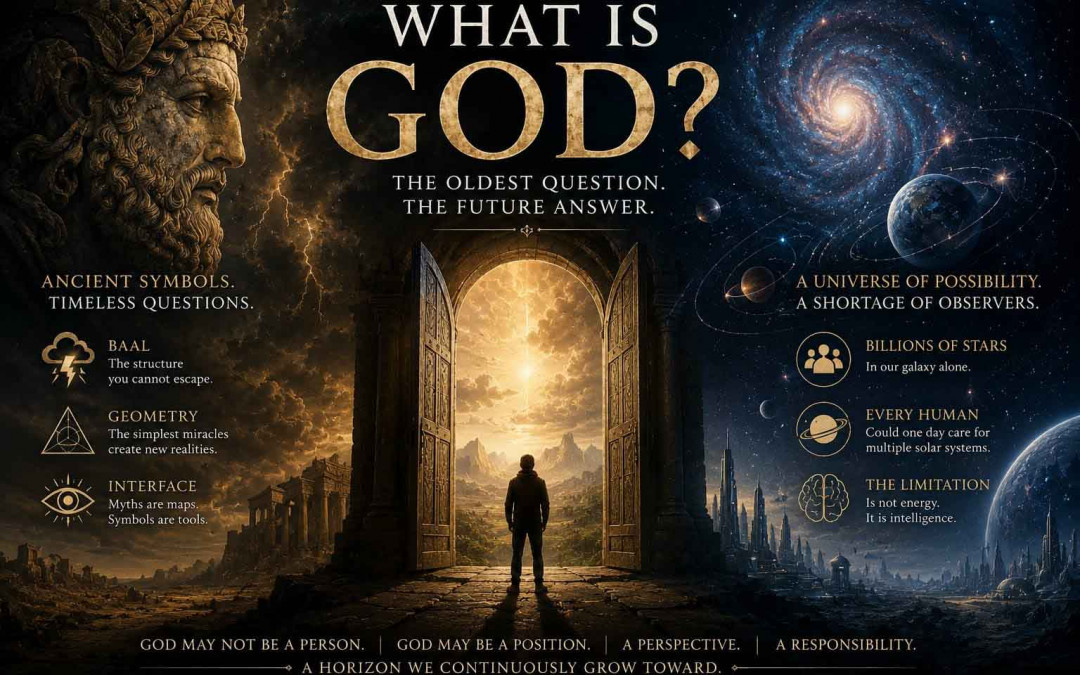
God Is Always Plus One
Humanity has given the divine thousands of names. Perhaps the most persistent thing is not any single answer, but the place the question occupies at the edge of every human model.
Ask ten people what they mean by God and you may receive ten different answers: a creator outside the universe, a personal intelligence, the source of morality, the ground of being, nature itself, a cosmic mind, a projection of human fear, an ultimate reality beyond ordinary categories, or simply a word for something that does not exist. The disagreement is so old that it has become part of the subject. Civilizations have not merely argued about whether gods exist; they have disagreed about what a god would have to be in order for the word to make sense at all. Mesopotamian cities maintained relationships with particular deities, Egyptian religion developed complex and shifting divine identities, Greek philosophers criticized the gods of poets while constructing more abstract ideas of divinity, and later Jewish, Christian and Islamic traditions transformed the question through increasingly powerful conceptions of one God. Modern philosophy then complicated the matter further by asking whether the demand for a creator, first cause or final ground was necessary in the first place.
Thousands of years later, no argument has closed the subject. That persistence does not prove that God exists, but it does reveal something interesting about the way human thought reaches its boundaries. Again and again, we explain one layer of reality only to discover another question behind it. We explain lightning, then ask why matter obeys regular laws. We explain biological complexity through evolution, then ask why a universe capable of evolution exists at all. We identify neural processes associated with consciousness, then encounter the unresolved question of why physical processing is accompanied by subjective experience. An answer arrives, the frontier moves, and another question takes its place. This is the intuition behind a simple Transhumation phrase: God is always plus one.
The Question Beyond the Model
Every civilization constructs models of reality because no individual mind can encounter reality in its entirety. A model may contain gods, ancestors, elements, atoms, genes, markets, fields, mathematical laws or neural networks. The content changes, but the function remains recognizable: the model compresses a world too large to hold directly into relationships the mind can navigate. Scientific models are especially powerful because they can be tested against observation and abandoned when they fail, yet even a remarkably successful theory remains a description of relationships rather than the totality of whatever reality ultimately is.
This distinction matters because it prevents two opposite mistakes. The first is to place God automatically inside every remaining scientific gap. History has repeatedly punished that strategy. Lightning ceased to require a thunder god as meteorology improved; biological diversity ceased to require separate acts of creation once evolution supplied a powerful natural mechanism. Ignorance is not positive evidence for divinity. The second mistake, however, is to assume that a successful description at one level automatically answers every possible question about why that level exists, whether its laws are necessary or whether explanation itself must terminate somewhere. A physicist may describe how a universe develops from an early state without thereby deciding why there is a universe at all. The boundary between explanation and ultimacy remains philosophically contested.
The “plus one” therefore should not be imagined as a supernatural figure hidden behind the latest equation. It is the recognition that a model can be extraordinarily successful while still being a model. The frontier may conceal another physical mechanism, a conceptual mistake, a question with no answer, or something that future generations will describe in language we do not yet possess. Calling that frontier God may be meaningful within theology; treating the frontier itself as proof of God would be much weaker.
Baal and the Reality Behind the Symbol
Ancient gods become more interesting when we stop treating them simply as failed attempts at science. Consider Baal, a title meaning roughly “lord,” associated in important Northwest Semitic traditions with a storm deity, particularly Baal Hadad. For societies dependent on seasonal rainfall, storms were not picturesque background. They touched agriculture, food, political stability and survival. A failed rainy season could change an entire community.
A modern meteorologist does not need Baal to explain precipitation, but the disappearance of that explanation did not remove human dependence on weather. The symbol changed while the underlying asymmetry remained. Humans still live inside planetary systems vastly larger than individual agency, and modern agriculture still depends upon climatic patterns that technology can influence only imperfectly. This does not mean Baal was secretly a primitive model of atmospheric science. For worshippers, Baal belonged to a living religious world, not to an illustrated textbook. The more useful observation is that religious figures often emerged where human beings encountered forces whose consequences were real even when their mechanisms were obscure.
That pattern matters because technological civilization sometimes mistakes explanatory success for independence. We may understand much more about the climate than an ancient farmer did, yet understanding a system does not mean standing outside it. The old god can disappear while the structure that generated awe, dependence or vulnerability remains.
Three Points and a New Level
Another route into the problem begins with something much smaller than a storm god. Place one point on a page, then a second. You have distance. Add a third outside the line and suddenly a triangle appears, along with angles, area, enclosure and an inside that did not exist at the level of any isolated point. Nothing supernatural has occurred; relationships have generated properties meaningful only at a higher level of organization.
Modern science constantly encounters phenomena of this sort. Molecules possess properties that individual atoms do not exhibit alone. Living cells perform functions that isolated molecules cannot. Brains generate patterns of behavior impossible to locate in a single neuron. Societies produce institutions, markets and laws that no individual citizen contains. The word emergence is often used for such cases, although naming the phenomenon does not automatically explain every transition between levels.
The philosophical temptation is to wonder whether reality itself may contain forms of organization radically beyond the scale at which human minds operate. That possibility is entirely reasonable. It does not follow that such a higher level is conscious, personal or divine. A triangle does not prove theology. But the example does warn against assuming that the level accessible to us must be the final level available to reality. Human history contains too many cases in which the observer mistook the visible layer for the whole.
When Intelligence Becomes Godlike Without Becoming God
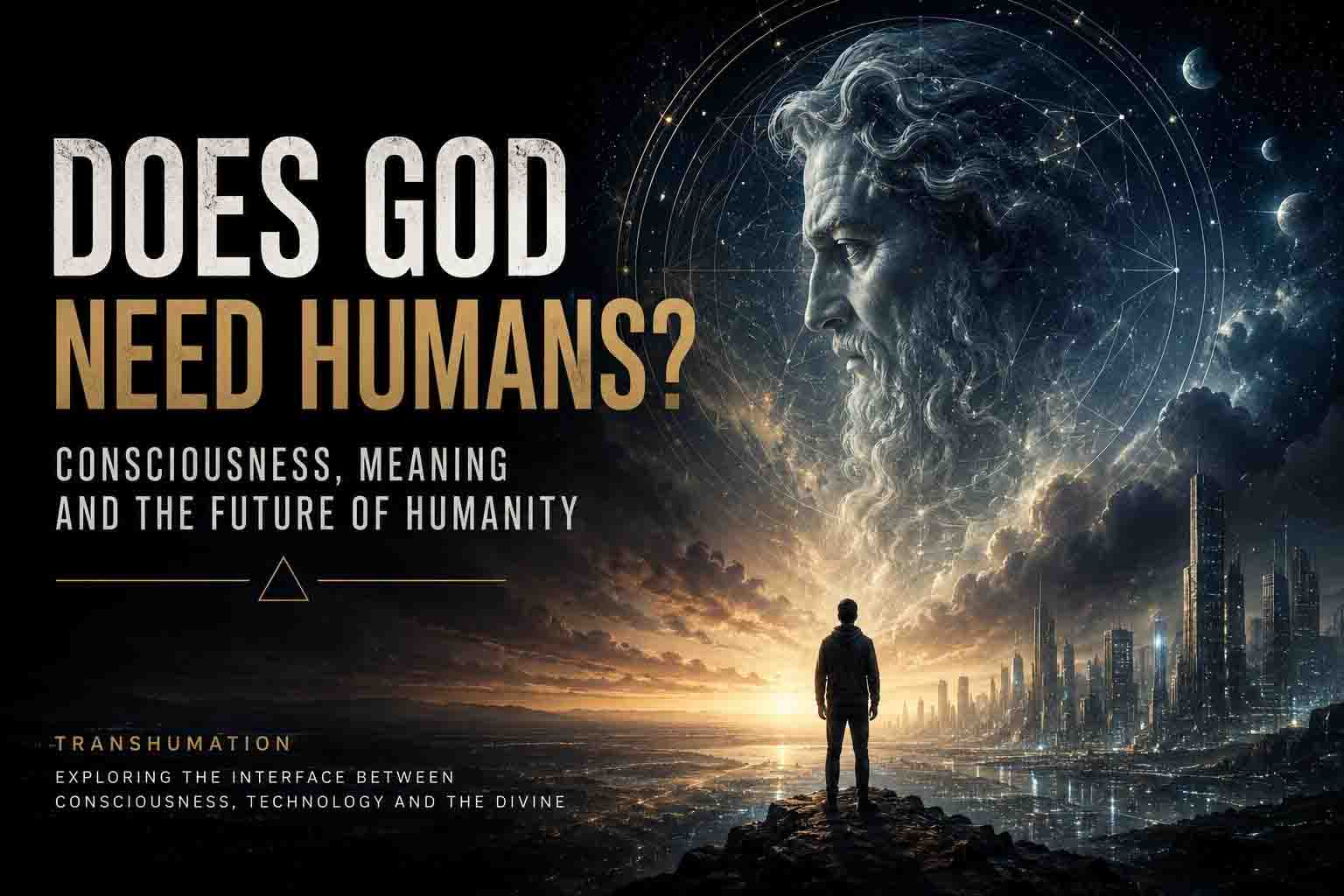
Modern technology introduces a different pressure on the old word God. Human beings are beginning to acquire capacities that earlier civilizations might easily have described in divine language. We can alter genomes, create synthetic organisms, predict storms days in advance, communicate almost instantly across the planet and construct artificial systems capable of generating language, images and plans. Future civilizations may control planetary environments, design radically new forms of life or manipulate matter and energy on scales that make our present capabilities appear primitive.
None of that would make humanity God in the theological sense. Extraordinary power is not the same as ultimate reality, and engineering a living system is not equivalent to creating existence from nothing. What technology changes is the emotional distance between the human and certain powers once reserved for gods. Creation, transformation, prediction and apparent omnipresence begin moving from mythology into engineering.
This may reveal something more interesting than technological divinity. Power can grow much faster than wisdom. A civilization capable of modifying life acquires responsibilities previous generations could barely formulate. If we one day manage planetary climates or create conscious artificial beings, the question will not merely be what we can do. It will be what kind of intelligence deserves to make decisions at that scale. The ancient image of the god may then return less as a fantasy of power than as a problem of responsibility.
The God-Shaped Position
Most religious traditions would reject the idea that God is merely the occupant of the highest available position in a hierarchy, and rightly so. Yet the metaphor of position reveals a recurring structure in human thought. We constantly imagine perspectives wider than our own. The soldier sees the street; the general sees the battlefield. The citizen sees a neighborhood; the planner sees the city. A satellite sees patterns unavailable from the pavement. A scientific model can reveal relationships invisible even to direct observation.
This creates a conceptual staircase. For every local perspective, another may exist from which the local becomes part of a larger whole. The human mind naturally asks whether the staircase ends. Some traditions answer with God as the final perspective, the source from which nothing remains outside. Others deny that such a final observer is necessary. Still others argue that the very idea of a “view from nowhere” may be incoherent.
Transhumation does not need to settle that dispute. It can notice instead that the position keeps reappearing. Complex systems make human beings aware of their locality, and awareness of locality generates the imagination of a larger field. In this structural sense, God can become the name attached to the possibility that there is always a level from which our present whole appears as only a part.
Watch The Video
How to Read the World
Current Knowledge
There is no scientific experiment that has established or falsified God across the enormous variety of meanings given to the term by religious and philosophical traditions. Many specific claims made in religious contexts can be investigated historically or empirically, but broad concepts such as an ultimate creator, necessary being or ground of existence often extend beyond ordinary scientific testing.
Religious concepts of divinity vary substantially. Some traditions describe personal gods, others emphasize unity, cosmic order, impersonal ultimate reality or forms of sacredness that do not map neatly onto the familiar Western idea of a supernatural individual. It is therefore inaccurate to claim that every civilization independently invented the same God.
Ancient deities such as Baal should also not be reduced to personifications of natural forces. Their religious meanings were richer and historically specific. Modern structural comparisons can still be useful, provided they remain interpretations rather than claims about what ancient worshippers “really meant.”
Modern science has greatly expanded human understanding of cosmology, evolution, matter and the brain, but these successes alone do not settle every philosophical formulation of the question of God. Scientific explanation and metaphysical ultimacy are related discussions, not automatically identical ones.
Open Questions
The deepest open question may be whether reality requires any ultimate explanation at all. Human beings are accustomed to asking why events occur, but perhaps the demand that the chain of explanation end in a final cause reflects the structure of human cognition rather than the structure of the universe. A believer may see the need for a final ground as unavoidable; an atheist may regard the demand itself as unnecessary; an agnostic may conclude that current evidence cannot decide between them.
Consciousness creates a second frontier. If subjective experience is eventually explained convincingly through physical mechanisms, some metaphysical arguments may lose part of their force. If the problem remains unresolved, that still would not automatically establish theology; it could simply mark unfinished science. Artificial intelligence adds a further complication: if humanity creates systems intellectually superior to individual humans, will people begin granting them quasi-divine authority despite knowing that they are engineered objects? That possibility may tell us as much about human psychology as about machines.
Transhumation Interpretation
Transhumation does not need a final doctrinal answer to What is God? Its more useful contribution may be to preserve the structure of the question without pretending to know what occupies the final position. God is always plus one should therefore be read as a rule of epistemic humility rather than as hidden theology. Humanity builds a model, expands it, becomes confident in it, and then discovers a boundary the model does not yet cross.
Sometimes the plus one becomes ordinary science. Sometimes it becomes a better philosophical question. Sometimes an apparent mystery disappears. Sometimes one explanation opens another level of uncertainty. The movement is what matters.
This is also why Transhumation should resist both easy mysticism and easy dismissal. The unknown should not automatically be called God, but neither should uncertainty be treated as an embarrassment waiting to be erased. There is intellectual value in preserving the border between what is known, what is strongly inferred, what is possible and what remains genuinely undecided.
Perhaps divinity, at least as a Transhumation concept, begins precisely at that border. Not as proof of a supernatural person standing behind it, but as the recurring possibility that reality exceeds the highest level we currently know how to describe. A believer may ask whether that excess has intention. An atheist may ask whether the word God adds anything useful. A scientist may ask how the boundary can be moved by evidence. The Transhumation question is slightly different: what happens to human beings each time the map expands and the edge moves again?
That may be why the question of God survives while particular gods, cosmologies and philosophies change. We keep reaching the edge of what appears to be the whole, only to discover another horizon.
FAQ
What does “God” mean?
There is no single definition. Depending on the tradition, God may mean a creator, personal deity, ultimate reality, necessary being, moral source or something beyond ordinary categories of being.
Did every civilization believe in gods?
No. Religious traditions are too diverse for that claim, though many societies developed ideas involving gods, spirits, ancestors or sacred orders.
Does science disprove God?
Science can investigate empirical claims, but very broad metaphysical concepts of God do not function like ordinary scientific hypotheses. Science alone does not settle every version of the question.
What does “God is always plus one” mean?
It means that every apparently complete human model can generate another question beyond its boundary. The phrase describes the moving horizon of understanding, not proof that a deity occupies that horizon.
Is this just a God-of-the-gaps argument?
It should not be. A God-of-the-gaps argument inserts God wherever science has not yet produced an explanation. The Transhumation idea is different: it asks whether any human model can reasonably be assumed to exhaust reality simply because it is currently our best one.
Could humans become gods through technology?
Humans may acquire powers once imagined as divine, but extraordinary capability is not equivalent to being an ultimate creator or ground of existence. The more interesting issue may be whether technological power forces humanity to accept forms of responsibility once associated with divine authority.
What is the deepest Transhumation position?
Do not turn every mystery into God, and do not turn every unanswered question into a promise that the mystery will certainly disappear.
Keep the boundary visible.
Beyond every current map there may be another mechanism, another level, another mistake—or nothing at all. The discipline lies in not pretending to know which before the evidence arrives.
That is the plus one.
Continue the Transhumation Series
- Forgotten Religion | Ancient Gods, Symbols and the Hidden Structures of Human Civilization
- The Last Religion | Death, Immortality and the Future of Humanity
- The New Theurgy | AI, Information and the Future of Human Civilization
- End of Branding: You Were Never Meant to Become a Product
- Baal vs Ishtar: Why Ancient Gods Never Disappeared