
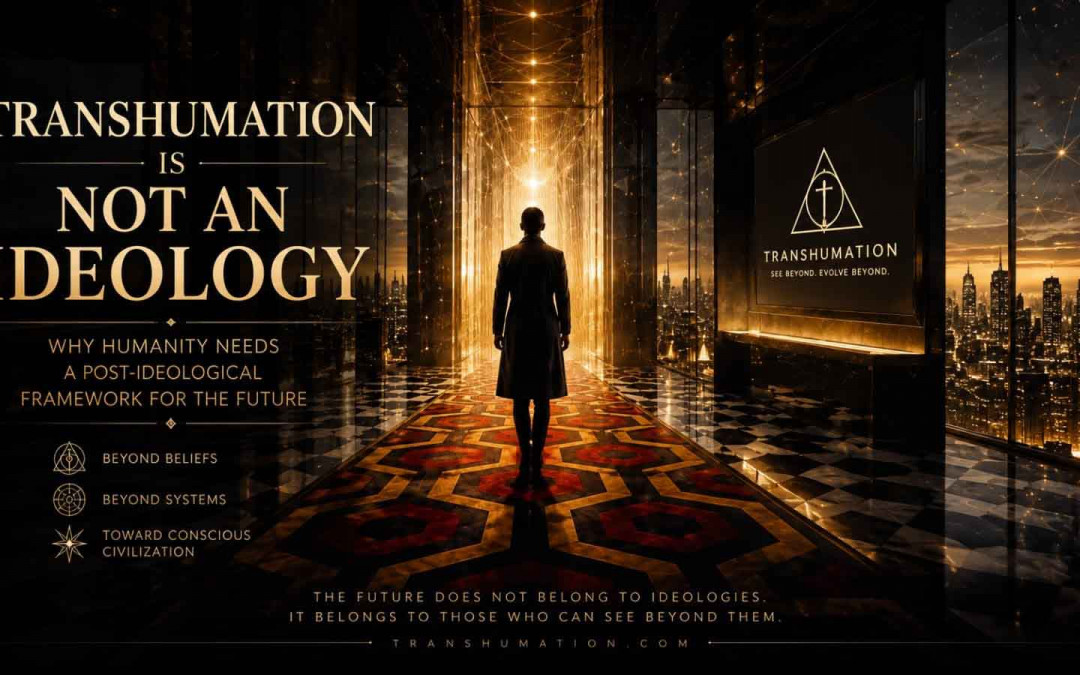
A Map for a Moving World
Transhumation is not a promise of the future. It is an attempt to remain oriented while the meaning of the human is still changing.
Every age produces systems that claim to explain more than they eventually can. Some are religious, some political, some economic, some philosophical. They differ enormously in their ambitions and consequences, but they often share one temptation: to mistake a useful map for the territory itself. A doctrine begins as an interpretation of reality and gradually becomes a defense against reality changing. Exceptions are treated as errors. Contradictions become threats. The map acquires borders more rigid than the landscape it was supposed to describe.
This temptation becomes especially dangerous during periods of rapid transformation. A political philosophy developed for industrial society may struggle with an economy organized by algorithms. A legal concept of identity created for a person occupying one body and one jurisdiction becomes less comfortable when that person maintains persistent digital identities across systems and countries. Ideas about intelligence formed when sophisticated language belonged exclusively to humans have already had to adjust to machines capable of producing fluent text, images and code. Even familiar distinctions—natural and artificial, person and tool, memory and archive, reality and representation—have become less stable than they appeared a generation ago.
We possess extraordinary instruments for changing the world and surprisingly weak language for describing what those instruments may be changing us into.
Transhumation begins inside that gap.
Not with the promise of a final answer, but with a suspicion: perhaps a civilization undergoing continuous transformation requires a philosophy capable of transforming without losing its structure.
The Problem With Final Maps
Ideologies do not fail simply because reality changes. Some political, moral and religious traditions have survived for centuries precisely because they contain mechanisms of interpretation, reform and internal disagreement. Nor is flexibility automatically a virtue; a philosophy that changes every time it meets resistance may simply mean nothing.
The more interesting distinction lies elsewhere.
A strong framework must be stable enough to make claims and vulnerable enough to be corrected by evidence.
That is harder than it sounds.
Human beings are remarkably good at turning explanations into identities. Once an idea becomes part of who we are, contrary evidence can begin to feel less like information than attack. The structure designed to explain reality becomes a structure designed to protect itself. At that point certainty acquires an emotional value independent of whether it remains accurate.
Modern technological civilization makes this increasingly difficult to sustain because it changes the conditions under which old categories were constructed. For most of human history, memory was scarce, communication slow and identity physically local. A person disappeared from most daily life after death. Knowledge traveled slowly enough for institutions to absorb it. Biological evolution operated on one timescale while cultural change operated on another.
Digital civilization has altered all of these conditions at once. Vast archives remember more than individual people can. A conversation can cross the planet instantly. A dead person’s voice and image can remain accessible indefinitely. Software can perform functions once requiring trained specialists. Artificial systems can participate in activities—language, classification, prediction, artistic production—that human societies historically associated with minds.
None of this proves that humanity has entered a post-biological age.
It does prove that some of our maps were drawn for a different landscape.
Technology Has Entered the Definition of the Human
The technological question was once relatively easy to separate from the human question. A hammer extended the hand. A telescope extended the eye. A train extended movement. The tool changed what a person could do without seriously challenging what a person was.
That distinction has become harder to maintain.
A smartphone does not merely extend one human faculty. It contains fragments of memory, social identity, navigation, correspondence, financial access, photography and relationships. Remove it from a modern person’s life and you have not removed part of the brain, but you may have removed access to functions around which that person’s ordinary existence has been organized.
Artificial intelligence pushes the problem further. Current AI systems do not establish that intelligence has become independent of matter, biology or physical infrastructure, and they certainly do not prove machine consciousness. But they demonstrate that some performances once treated as reliable evidence of uniquely human cognition can be produced by non-human systems.
This forces us to separate categories that ordinary life once allowed us to keep together.
Language is not necessarily consciousness.
Intelligence is not necessarily personhood.
Memory is not necessarily identity.
Information is not necessarily understanding.
A simulation is not necessarily continuity.
These distinctions are philosophical, but they are becoming practical. The company designing an AI companion, the doctor working with neural prosthetics, the legislator deciding whether a synthetic likeness of a dead actor may be used commercially, and the parent deciding how much of a child’s identity should exist permanently online are all making decisions about the boundaries of the human whether they use philosophical language or not.
The future does not need philosophy because engineers have failed.
It needs philosophy because engineering has become powerful enough to create philosophical situations.
Why the Old Symbols Keep Returning
This helps explain one of the stranger characteristics of technological culture: ancient symbols and questions keep reappearing where we expected them to disappear.
Plato becomes interesting again when we discover how easily structure can migrate between physical carriers. The old problem of the soul returns when we ask whether a person’s continuity could survive radical alteration of the body. The problem of the double returns when a machine can reproduce someone’s appearance, voice and conversational habits. The oracle returns in altered form when prediction systems process more information than any individual observer can comprehend. Mythological figures associated with thresholds, transformations and divided identities begin to feel unexpectedly contemporary because technological civilization is producing thresholds, transformations and divided identities of its own.
This does not mean that ancient cultures secretly predicted artificial intelligence. It would be intellectually cheap to turn mythology into disguised engineering manuals. The resemblance lies at a different level.
Technologies change rapidly.
Human questions recur.
What remains the same when the carrier changes? How much transformation can identity survive? When does a tool become part of the person using it? What happens when human beings create something they can no longer fully control? How should power be used when its consequences exceed the lifespan of the people who created it?
These are not ancient questions because our ancestors possessed our machines.
They are ancient because the structure of the problem is older than the technology currently expressing it.
Baal and the Weight of Systems
Baal is useful here only if we resist making him say things the historical Baals never said.
The word itself was a title—“lord” or “master”—used in several ancient Near Eastern contexts, and the religious traditions surrounding different Baal figures were considerably more complex than the simplified image later inherited through polemic, literature and popular culture. There is no legitimate historical basis for declaring Baal an ancient god of technological inevitability.
But symbols can acquire later lives.
Within Transhumation, Baal can function as a figure of a different problem: the moment when a human-created system begins to feel larger than the people inhabiting it. Institutions, markets, military structures, bureaucracies and technologies can all acquire momentum that no single participant designed. People continue feeding the structure because withdrawing from it individually seems impossible. Responsibility becomes distributed. Everyone participates; nobody appears fully in control.
Modern technological infrastructure often produces precisely this sensation. Few people consciously chose a civilization in which social relationships, political communication, financial systems, navigation, employment and personal archives would depend on a relatively small number of global digital architectures. Yet once these systems exist, abandoning them is no longer equivalent to simply refusing a tool. The infrastructure has become part of the environment.
This is where inevitability must be treated cautiously.
AI is not destiny.
Networks are not supernatural forces.
Technological trajectories can be altered by law, economics, culture, war, accident and public choice.
But human beings are particularly vulnerable to systems in which individual choice becomes weaker than collective momentum. Once enough people depend on a structure, the distinction between we chose this and this is simply how the world works begins to blur.
Baal, used carefully, belongs at that boundary.
Not as the god who guarantees the future.
As the reminder that civilizations sometimes kneel before structures they themselves continue to maintain.
Between Acceleration and Retreat
Technological discussion repeatedly falls into two emotional positions. One treats acceleration as inherently good. More intelligence, more computation, more connection, more longevity and greater control over nature become self-justifying goals. The opposite position imagines meaning somewhere behind us: before smartphones, before artificial intelligence, before industrialization, perhaps before modernity itself.
Both positions simplify the problem.
There is no convincing historical moment to which humanity can return and recover an uncontaminated human condition. The human animal has always been technological. Fire altered digestion and survival. Clothing altered geography. Language transformed collective memory. Agriculture transformed society. Writing externalized knowledge. Medicine changed natural selection. The city, book and computer belong to different scales of technological intervention, but none stands outside the long history of humans modifying the conditions of human existence.
The important question is therefore not whether transformation should happen.
Transformation is already the ordinary condition of civilization.
The question is what should remain through it.
That changes the tone of the entire discussion. Preservation does not have to mean freezing humanity in its present form. Progress does not have to mean treating every inherited form as an obstacle. A civilization may alter its technologies, bodies and institutions while deliberately protecting continuities it regards as valuable: dignity, agency, memory, curiosity, responsibility, relationships, the capacity to revise error.
Transhumation becomes interesting precisely here, between nostalgia and surrender.
It asks whether transformation can have direction without pretending to know the destination.
The Human After the Human
The phrase post-human often produces an unnecessarily dramatic picture: biological humanity disappearing and being replaced by machines. Reality, if it moves in that direction at all, will probably be less theatrical.
Humans already exist across systems.
A person’s financial identity exists partly in databases. Their social identity exists partly in other people’s minds and partly in networks. Their memories depend on biological recollection but also photographs, messages, calendars and documents. Their ability to navigate may depend on satellites. Their work may depend on machines capable of storing and processing knowledge they do not individually possess.
None of this makes the person less biological.
It makes the boundary of practical human existence harder to draw at the skin.
Future neural interfaces, prosthetics, artificial organs, genetic modification, immersive environments and AI systems could deepen that entanglement. But it remains possible that consciousness itself depends on biological processes that cannot be transferred to another carrier. It is equally possible that future science will reveal aspects of cognition that are more substrate-independent than we currently understand.
Transhumation should not decide that question in advance.
Its role is to build language strong enough to ask it without confusing speculation with evidence.
That distinction separates inquiry from doctrine.
Watch The Video
How to Read the World
Current Knowledge
Human beings have always modified their environment and themselves through technology. Archaeology, anthropology and history show long continuities between biological capacities and external tools: language, writing, tools, institutions and machines extend functions that an isolated organism could not perform alone. Contemporary digital systems extend this process dramatically because they can store memory, mediate relationships, perform cognitive tasks and operate across global networks.
Artificial intelligence currently performs increasingly sophisticated forms of language generation, pattern recognition, image production, classification and problem solving. These capacities do not demonstrate subjective consciousness. Nor do they prove that intelligence has become independent of physical systems; every functioning AI currently depends on material infrastructure, energy and computation.
There is likewise no established scientific evidence that human consciousness can be uploaded, transferred or preserved independently of a functioning biological brain. Neuroscience continues to show strong dependence between brain states and human experience. Questions about whether consciousness could eventually be realized in another physical substrate remain unresolved.
Technological systems can nevertheless acquire forms of social momentum. Network effects, infrastructure dependence, economic incentives and institutional lock-in can make technologies difficult to reverse once they become widely embedded. This is a social and economic phenomenon rather than evidence of historical inevitability.
Open Questions
The first question is methodological: how can a philosophy remain open to transformation without becoming so flexible that it can never be wrong? If Transhumation claims to be an orientation system rather than an ideology, it must still identify propositions that evidence could overturn. Otherwise openness becomes merely another form of immunity from criticism.
There is also the question of direction. If transformation itself is neither good nor bad, by what criteria should one transformation be preferred over another? Longevity may preserve life but intensify inequality. Artificial intelligence may expand human capability while concentrating power. Neural technology may restore lost functions while creating unprecedented forms of surveillance. A serious philosophy of transformation requires more than fascination with change; it needs principles for judging consequences.
Another problem concerns identity. How much technological integration can occur before the concept of an individual person becomes inadequate? If memories, decisions and cognition increasingly depend upon external systems, does human agency become distributed, or are these systems still tools belonging to a biologically bounded subject?
And finally, what happens when structures created to serve humanity become conditions humanity must serve in order to participate in society? At what point does infrastructure become environment, and at what point does environment become destiny?
Transhumation Interpretation
Transhumation begins with movement.
The word itself is useful because it suggests neither escape nor arrival. In its older pastoral sense, transhumance is a movement between conditions: the herd does not abandon the landscape but moves through it according to changing seasons. The identity of the traveller persists while location changes.
That image is more useful for the future than the familiar fantasy of humanity replacing itself.
The central problem of Transhumation is not how to cease being human.
It is how to understand what remains human while the carriers, environments and capacities through which humanity exists continue to change.
This makes continuity more important than purity.
A civilization that insists on remaining materially identical cannot develop. A civilization that preserves nothing through development cannot meaningfully call its future a continuation.
Somewhere between those extremes lies the structure we are trying to identify.
This is why Transhumation returns repeatedly to libraries, myths, artificial intelligence, religion, technology, death and the problem of the copy. They appear to be separate subjects until one notices that the same question keeps moving between them.
What survives translation?
What survives replacement?
What survives death?
What survives a change of medium?
What survives when the model becomes more useful than the original?
What survives when civilization itself changes carrier?
The answer may sometimes be nothing. That possibility matters. A pattern that cannot survive testing should be discarded rather than protected because it belongs to the system.
This is also why uncertainty cannot merely be decorative. A framework that praises uncertainty but always arrives at its preferred conclusion is still an ideology wearing softer clothes.
Transhumation must permit its strongest ideas to fail.
Perhaps consciousness cannot migrate.
Perhaps artificial intelligence will remain a tool rather than become a new category of mind.
Perhaps human identity is more biologically constrained than technological culture likes to imagine.
Perhaps some apparently carrier-independent structures depend on their material histories in ways we have underestimated.
These possibilities do not weaken Transhumation.
They define its boundary.
The purpose of the map is not to guarantee the landscape.
It is to help us notice when the landscape has changed.
FAQ
What is Transhumation?
Transhumation is a framework for examining how changes in technology, biology, information, culture and human self-understanding alter the conditions of civilization. It is especially interested in continuity: what can change while something still remains recognizably itself.
Is Transhumation the same as transhumanism?
No. The two subjects overlap because both take technological transformation seriously, but their emphasis differs. Transhumanism is often associated with technologically enhancing human abilities, extending life and overcoming biological limitations. Transhumation is more concerned with continuity, meaning, identity, cultural structures and the philosophical consequences of transformation itself.
Is Transhumation a religion?
Not in the conventional sense of requiring belief in a deity, revelation or fixed supernatural doctrine. It can examine religion as one of humanity’s oldest systems for approaching questions of death, meaning, continuity and transcendence without requiring either belief or disbelief as an entry condition.
Is Transhumation anti-technology?
No. Treating technological development as inherently corrupt would be as simplistic as treating it as inherently beneficial. The relevant question is what particular technology changes, who controls it, who benefits, what dependencies it creates and which human capacities it preserves or erodes.
Why does Transhumation use ancient mythology?
Because ancient myths preserve recurring structures of human thought: transformation, thresholds, sacrifice, power, identity, death and the encounter with forces larger than the individual. They are useful as cultural instruments of interpretation, not as evidence that ancient civilizations secretly possessed modern scientific knowledge.
Why mention Baal?
Baal is used symbolically, not as a claim about historical theology. Within this framework he can represent the unsettling experience of confronting systems whose accumulated momentum feels greater than the agency of any individual participant. The historical Baal traditions were more varied and should not be reduced to that modern interpretation.
Does Transhumation believe AI is conscious?
No conclusion is assumed. Present AI systems demonstrate impressive cognitive performances, but this does not establish subjective consciousness. Whether artificial consciousness is possible remains an open question.
Does Transhumation claim that humanity will become post-biological?
No. It regards post-biological existence as a possibility worth examining, not an established destination. Human consciousness may prove dependent on biological processes in ways that cannot be transferred. The framework should remain valid even if mind uploading proves impossible.
If Transhumation has ideas about the future, why isn’t it simply another ideology?
Because the distinction depends less on whether it makes claims than on what it does when those claims fail. A framework becomes ideological in the problematic sense when contrary evidence is consistently absorbed, dismissed or reinterpreted so that the system can never lose. Transhumation should instead identify conditions under which its interpretations would have to change.
Can a philosophy exist without certainty?
It has to. Science itself works without requiring absolute certainty; strong explanations remain open to correction while still being useful. The alternative to dogma is not intellectual paralysis. It is provisional confidence proportionate to evidence.
If transformation is inevitable, does humanity really have a choice?
Transformation in a general sense is unavoidable because organisms, cultures and civilizations are never perfectly static. Particular technological futures are not inevitable. Regulations, institutions, economics, wars, ethics and individual choices influence which technologies develop and how they are used. Calling a specific future inevitable can itself become a way of avoiding responsibility for choosing it.
What does Transhumation actually want to preserve?
That question should remain open enough to be debated, but several candidates recur: conscious agency, the capacity to understand rather than merely process information, memory without imprisonment by the past, responsibility proportional to power, intellectual freedom and the possibility of meaningful relationships across changing forms.
The point is not to preserve the current human being like an insect in amber.
It is to identify which structures must remain intact for transformation to count as continuation rather than disappearance.
What would prove Transhumation wrong?
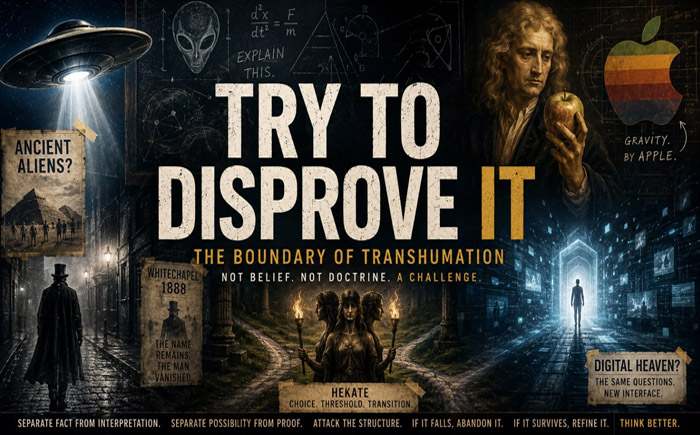
There is no single proposition called Transhumation that can be falsified in one experiment. Individual claims within it must be vulnerable to disproof. If consciousness proves inseparable from biological brains, theories of carrier-independent consciousness must be abandoned. If an apparent historical structure disappears when tested against wider evidence, the structure must be rejected. If technological change does not produce the philosophical consequences predicted, the interpretation must change.
A framework that cannot lose cannot learn.
What is the deepest idea behind Transhumation?
Perhaps it is simpler than the machinery surrounding it.
Human civilization has always changed its carriers.
Stories moved from voices to books.
Memory moved into libraries.
Power moved from muscles into machines.
Calculation moved into computers.
Parts of judgment are now moving into artificial systems.
We do not yet know how far that migration can go, and we should distrust anyone who claims to know the final destination.
The important question is therefore not whether humanity will become something else.
Humanity has always been becoming something else.
The question is what can cross the transformation without being lost.
That is where Transhumation begins.
Continue the Transhumation Series
- Forgotten Religion | Ancient Gods, Symbols and the Hidden Structures of Human Civilization
- The Last Religion | Death, Immortality and the Future of Humanity
- The New Theurgy | AI, Information and the Future of Human Civilization
- End of Branding: You Were Never Meant to Become a Product
- Baal vs Ishtar: Why Ancient Gods Never Disappeared