
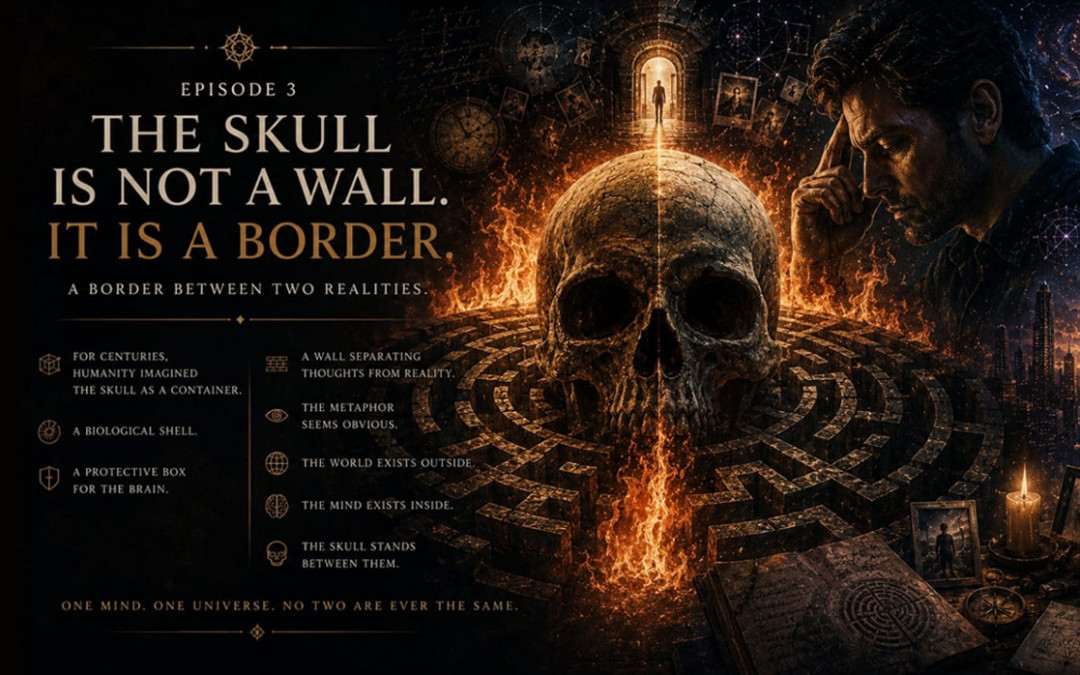
The Skull Is Not a Wall
We imagine consciousness hidden behind bone, looking out at reality through two small windows. The stranger possibility is that human existence has never belonged entirely to either side.
A skull in a museum case looks like a container after its contents have disappeared. The architecture encourages the metaphor. There are walls of bone, openings for the eyes, a chamber where the brain once lived. From the outside it is easy to imagine a simple geography: the world was out here, the person was in there, and the skull marked the line between them.
It is such an intuitive picture that we rarely notice how misleading it is.
A living human being is not a spectator sitting somewhere behind the forehead while reality enters through the eyes like a film projected onto an internal screen. Perception is a continuous exchange involving senses, nervous system, memory, attention, expectation and action. The world affects the organism; the organism interprets the world; interpretation changes what the organism notices next. Even the apparently simple act of seeing a face is already shaped by an enormous history of learned distinctions, emotional associations and biological mechanisms.
The skull therefore makes a better border than a wall.
Not because consciousness literally lives on one side and reality on the other, but because the image captures something important about being human. We exist at a frontier where physical events become experienced events, where wavelengths become colours, pressure waves become voices, and arrangements of matter become things that matter.
The frontier is not somewhere far away.
We carry it with us.
Two Worlds, but Not Two Universes
Human beings appear to inhabit two domains at once. The first is stubbornly external. Mountains remain where they are regardless of our opinions. Gravity does not negotiate. Other people possess intentions we cannot control. The universe existed before any particular human observer and, barring rather ambitious metaphysics, will continue after that observer is gone.
The second domain is private.
A hotel room can be physically identical for two guests and psychologically different in every important respect. For one it is merely a place to sleep. For another it is the room where a marriage ended. A melody can be an arrangement of frequencies to one listener and an involuntary return to childhood for another. An old coat may be worthless according to every economic measure and impossible to discard because someone who is dead once wore it.
Nothing supernatural is required for this distinction. The internal world does not need to float independently of biology. Memory, emotion and imagination depend upon living brains. Yet reducing them to physical description alone leaves out the level on which human beings actually encounter them.
A wedding photograph can be measured in centimeters.
Its significance cannot.
A sentence has an acoustic waveform.
Its insult does not.
Human existence unfolds precisely in this mismatch between measurable event and experienced meaning.
That is the first border.
Where a Star Becomes a Memory
Consider something as ordinary as looking at the night sky. Light leaves a star, crosses an enormous distance and eventually reaches the retina. Photoreceptors respond. Neural signals travel through a nervous system. Visual information is processed through multiple interacting regions of the brain.
But the person does not experience retinal chemistry.
They experience a star.
Perhaps they remember being shown the constellation by their father. Perhaps they think about distance. Perhaps they feel nothing. Perhaps the same point of light becomes evidence in an astronomical calculation.
The physics entering the organism is shared.
What emerges as experience is not.
This is where phrases such as “the universe becomes aware of itself” become tempting. They are beautiful, but they should remain philosophical rather than scientific claims. We do not know that the universe as a whole becomes self-aware through us, nor do we possess a final explanation of how physical processes produce subjective experience.
The mystery is narrower and more defensible.
Some arrangements of matter appear capable of having a point of view.
That fact alone is extraordinary enough.
A stone reflects light. An eye receives it. A living nervous system organizes it into a world containing distance, beauty, recognition and memory.
Science can trace much of the mechanism.
The existence of experience remains the strange part.
The Frontier Nobody Had to Discover
Civilizations celebrate frontiers because frontiers offer visible drama. Ships cross oceans. Expeditions reach poles. Rockets leave Earth. Telescopes look deeper into space. The frontier between world and experience has none of this spectacle because every human being crosses it continuously from birth.
Perhaps that familiarity is why we underestimate it.
We have learned to estimate the age of the universe, identify the chemical composition of stars and detect planets around distant suns. At the same time, there is still no universally accepted explanation of why brain activity is accompanied by a subjective world at all.
Why is there something it is like to see blue?
Why does injury become pain rather than merely altered information processing?
Why does a sequence of sounds become music?
Why does remembering someone who died produce an experience fundamentally different from merely retrieving a fact about them?
These are not arguments against neuroscience. They are among the reasons neuroscience matters.
The better we understand the mechanisms, the more precisely we can state what remains unexplained.
The most interesting frontier is often not the place where knowledge ends completely.
It is the place where knowledge becomes sharp enough to show us the shape of our ignorance.
The Ancient Skull
This is why an archaeological skull can become such an unsettling object.
Science may recover an astonishing biography from bone. Teeth can preserve chemical signatures of childhood geography. Skeletal changes can reveal disease and injury. DNA may establish ancestry. Diet can sometimes be reconstructed. Age and biological sex can be estimated. The physical remains become a document.
And still, almost everything that constituted the world for that person is gone.
Perhaps the individual disliked winter. Perhaps there was a particular person they searched for whenever they entered a gathering. Perhaps one hill on the horizon meant home. Perhaps they feared an animal whose bones lie in another display case twenty meters away. Perhaps they had a recurring dream.
We can recover the carrier far more easily than the viewpoint.
This is not because consciousness must have been an immaterial substance that escaped the skull. It may have depended entirely on biological processes that ended with death. The tragedy remains.
The bone can survive for ten thousand years.
The perspective may disappear in minutes.
An ancient skull is therefore not simply evidence that a member of our species once existed. It is evidence that the universe was once encountered from a position that can no longer be reconstructed.
The object remains.
The point of view is missing.
Dreams and the Reality Machine
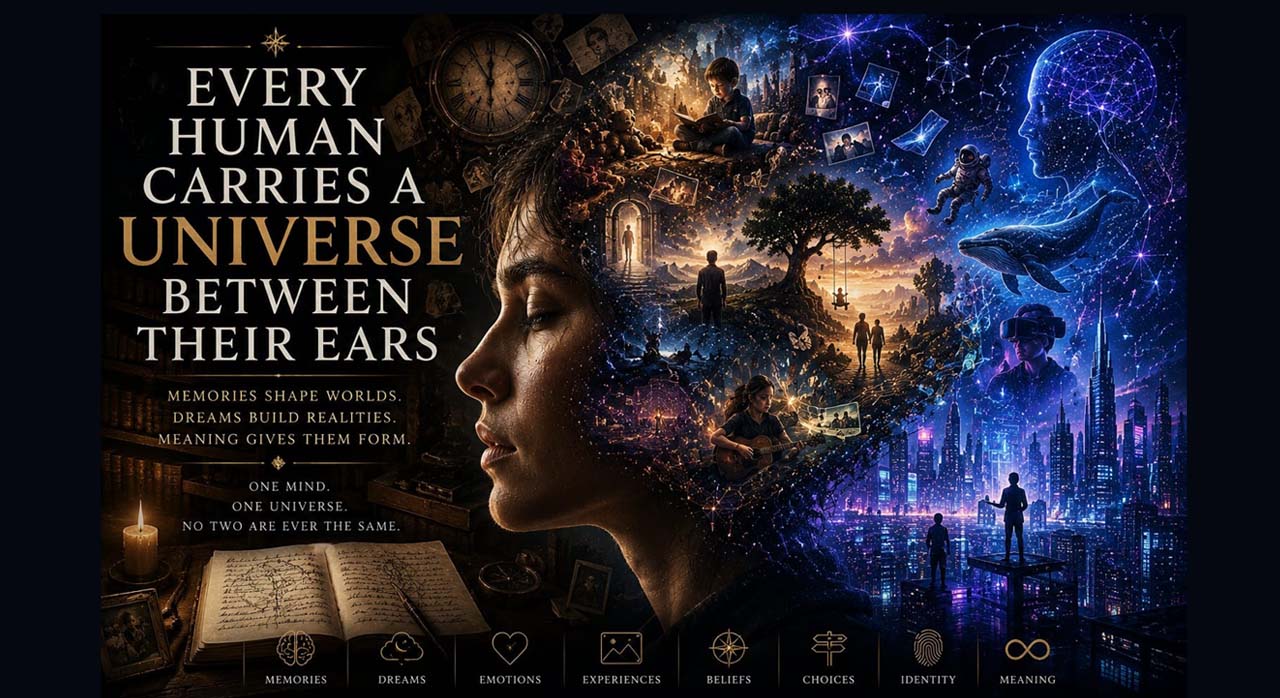
Dreaming makes the border temporarily easier to see.
At night, sensory contact with the immediate environment is radically altered, yet experience continues. A person can walk through a city assembled from several real places, speak to someone dead for decades, accept impossible architecture and experience fear intense enough to wake with a racing heart.
Nothing here establishes a second external universe.
The dream is generated by a living brain.
But that is precisely why it matters.
Dreams demonstrate how much of experienced reality depends upon construction rather than direct correspondence with the immediate environment. The mind does not need a physical tiger in the bedroom to produce terror. It does not need a deceased parent physically present to produce the experience of seeing them.
Long before virtual reality, the biological nervous system was capable of producing convincing environments.
Long before cinema, it generated scenes.
Long before artificial avatars, it populated worlds with people who were not there.
Technology did not invent mediated reality.
It discovered that consciousness was already remarkably good at it.
The Mirror Was Never the World
A mirror is another useful object because it appears simple while quietly producing philosophical trouble. It shows a room that seems to continue behind the glass. The second room is geometrically persuasive, visually accessible and impossible to enter. Everyone understands that the reflection is not another physical room, yet the image still behaves sufficiently like one to guide action.
Conscious experience is not literally a mirror. Perception does not passively reproduce reality, and the brain is not a sheet of reflective glass. But the analogy reveals something useful: representation can be both dependent upon reality and different from it.
The brain builds models.
Those models must remain constrained by the external world or the organism pays the price. A person who persistently misjudges the location of a staircase discovers very quickly that reality has veto power.
But usefulness does not require perfect duplication.
A subway map is deliberately unlike a city. Its distortion makes it useful. A word is unlike the object it names. A memory is unlike the event it preserves.
Human cognition depends on models that simplify, emphasize and interpret.
We do not merely live in the world.
We live through interfaces to it.
The Future May Be an Interface Problem
This becomes more important as technology enters the border.
Virtual reality can modify the sensory environment without moving the body very far. Neural prostheses can translate between biological activity and external devices. Artificial intelligence increasingly mediates the information through which humans understand events. Recommendation systems influence what becomes visible before conscious choice even begins.
The old distinction between “real world” and “digital world” therefore becomes less useful.
A digitally mediated event can change a career, destroy a reputation, begin a relationship or influence an election. Its mediation does not make its consequences unreal.
The deeper question is what happens when more of the interface between world and mind is designed.
Who decides what is shown?
What is filtered?
What is remembered?
What becomes invisible?
If consciousness has always depended on interpretation, technologies capable of shaping interpretation occupy an extraordinarily powerful position.
The future may not require humans to leave reality for another world.
It may require us to understand who controls the border through which the world becomes experience.
Watch The Video
How to Read the World
Current Knowledge
Human perception is not regarded by neuroscience as a passive recording of external reality. Sensory systems transform physical inputs into neural signals, while attention, memory, expectation and prior learning contribute to how those signals are organized into conscious perception. The experienced world is therefore constructed in an important sense, but it remains constrained by external physical conditions.
Dreaming is associated with activity in the sleeping brain and can occur during several stages of sleep, although vivid narrative dreams are particularly associated with REM sleep. Dreams demonstrate that the brain can generate complex experiences with reduced dependence on immediate sensory input. They do not demonstrate that consciousness can exist independently of the brain.
Human memory is reconstructive rather than a perfect recording. Recollection can change over time and incorporate later information. This means that the internal world is not simply a passive archive of past events but an active reconstruction shaped by present context.
Current science strongly associates human consciousness with functioning biological brains. Brain injury, anesthesia, drugs, disease and electrical stimulation can alter conscious experience. There is presently no demonstrated example of human consciousness existing independently of biological processes.
At the same time, there is no universally accepted theory explaining why particular forms of neural activity are accompanied by subjective experience. Neuroscience can increasingly characterize mechanisms and correlations while the philosophical problem of why experience exists remains contested.
Open Questions
The most difficult question is not whether brains process information. They plainly do. It is whether a complete description of that processing would also constitute a complete explanation of subjective experience. Some theories expect the explanatory gap eventually to close through neuroscience; others argue that the problem reveals something deeper about our concepts of mind and matter.
Another unresolved question concerns the boundary of the individual. If sensory information is increasingly mediated by external technologies, memories are supported by digital systems and decisions are influenced by artificial agents, does the practical boundary of the self remain identical to the biological boundary of the body?
The question becomes sharper with future neural interfaces. If artificial devices someday replace or supplement increasingly large parts of perception and cognition, when does a tool become part of the cognitive system rather than something merely used by it?
There is also the social problem of the interface. If most human knowledge arrives through systems that select and rank information before we encounter it, how much of our experienced reality is being shaped by structures we do not consciously perceive?
And beneath all of these questions remains the old one: if the external world and the experienced world are not identical, what exactly constitutes the border between them?
Transhumation Interpretation
The skull is useful to Transhumation not because bone has metaphysical properties.
It is useful because it gives physical form to an abstract problem.
Carrier and experience.
World and model.
Signal and meaning.
Outside and inside.
Transhumation repeatedly returns to the possibility that structures can survive changes of carrier. Language survives different voices. Music survives different instruments. Geometry survives different drawings. Stories survive different books.
Consciousness is where that principle becomes uncertain.
The fact that perception transforms external events into internal experience does not prove that experience can be detached from biology. The fact that dreams generate convincing worlds does not prove that consciousness can migrate into virtual environments. The fact that memories can be externalized into books or databases does not mean the observer has been externalized with them.
That boundary must remain visible.
But another conclusion follows.
Humans have never encountered reality without an interface.
The eye is an interface.
Language is an interface.
Memory is an interface.
Culture is an interface.
A book is an interface between a dead author’s structure of thought and a reader who reconstructs part of it centuries later.
Artificial intelligence may become another such interface, perhaps the most powerful we have built: a system standing between enormous portions of civilization’s stored information and the individual consciousness attempting to understand them.
This makes the old image of the skull unexpectedly contemporary.
The important border may no longer end at bone.
It may extend into screens, archives, networks, prostheses and models.
The question of the future is therefore not simply whether machines can become conscious.
It is also what happens when machines increasingly occupy the territory between consciousness and the world.
A wall invites us to ask what lies on the other side.
A border forces a different question.
What crosses it?
And what changes during the crossing?
FAQ
What does “the skull is not a wall” mean?
It is a metaphor. The skull physically protects the brain, but human experience is not best understood as a mind sealed inside a box observing an independent world. Perception involves continuous exchange between organism and environment.
Do humans really live in two realities?
Not literally in two independent universes. The useful distinction is between external physical reality and subjective experienced reality. The second depends on biological processes but includes memories, emotions and meanings that cannot be reduced to a description of the surrounding environment alone.
Are dreams another reality?
Dreams are genuine experiences generated by a sleeping brain, but there is no evidence that ordinary dreams occur in a separate external world. Their importance lies in showing how convincingly the brain can construct an experiential environment.
Does consciousness create reality?
Not in the sense that thought arbitrarily creates external physical events. Consciousness participates in constructing experienced reality by interpreting sensory information through memory, attention and expectation. External reality continues to constrain that interpretation.
Why compare consciousness to a mirror?
The comparison concerns representation rather than literal mechanism. A mirror produces an image dependent upon the world without becoming the world itself. Conscious experience likewise depends on external reality while presenting it through an internal model.
Is the brain simply a computer processing information?
That analogy can be useful for some functions but is incomplete. Brains are biological systems with properties that differ substantially from conventional computers, and there is no consensus that computational description alone explains consciousness.
Why does the ancient skull matter?
Because it reveals an asymmetry between physical preservation and subjective preservation. Bone can survive for thousands of years, allowing science to reconstruct parts of a person’s biological history, while the first-person world that once accompanied that organism may be entirely inaccessible.
Could technology preserve that internal world?
Technology can already preserve increasingly rich traces: photographs, recordings, writing, behavioral data and memories described by the person. Future systems may preserve far more. None of this currently demonstrates preservation of the original subjective observer.
Could a brain-computer interface move the border outward?
Functionally, perhaps. If external systems become tightly integrated with perception, memory or decision-making, the practical boundaries of cognition may become increasingly difficult to identify with the skull alone. Whether subjective consciousness itself would extend into those systems is a separate and unresolved question.
If perception is constructed, how do we know there is an external world?
The fact that perception involves construction does not imply that the world is imaginary. Shared measurements, prediction, experimental repeatability and the resistance of reality to individual expectation provide powerful reasons to infer an external world independent of any single observer.
What happens when algorithms begin controlling the interface?
Then the philosophical problem becomes political. If algorithms influence what information becomes visible, which memories are resurfaced, whose speech is amplified and what possibilities are recommended, they participate in shaping the environment from which individual experience is constructed.
Where does the self actually end?
There is no simple answer. Biologically, the organism has relatively clear boundaries. Functionally, human cognition has always depended on tools, language, other people and cultural systems. Future technologies may make the mismatch between biological and cognitive boundaries increasingly obvious.
Why does this matter to Transhumation?
Because Transhumation is interested in what survives when carriers and interfaces change. The skull represents the oldest version of that problem. A biological organism receives the world, transforms it into experience and acts back upon the world. Technology is now inserting new layers into that process.
The important question may therefore not be whether humanity eventually escapes the skull.
It may be whether the skull was ever the true boundary in the first place.
Perhaps consciousness has always existed at a crossing: between event and interpretation, matter and meaning, world and model.
The future merely makes the crossing visible.
Continue the Transhumation Series
- Forgotten Religion | Ancient Gods, Symbols and the Hidden Structures of Human Civilization
- The Last Religion | Death, Immortality and the Future of Humanity
- The New Theurgy | AI, Information and the Future of Human Civilization
- End of Branding: You Were Never Meant to Become a Product
- Baal vs Ishtar: Why Ancient Gods Never Disappeared