
The Ladder Between Worlds
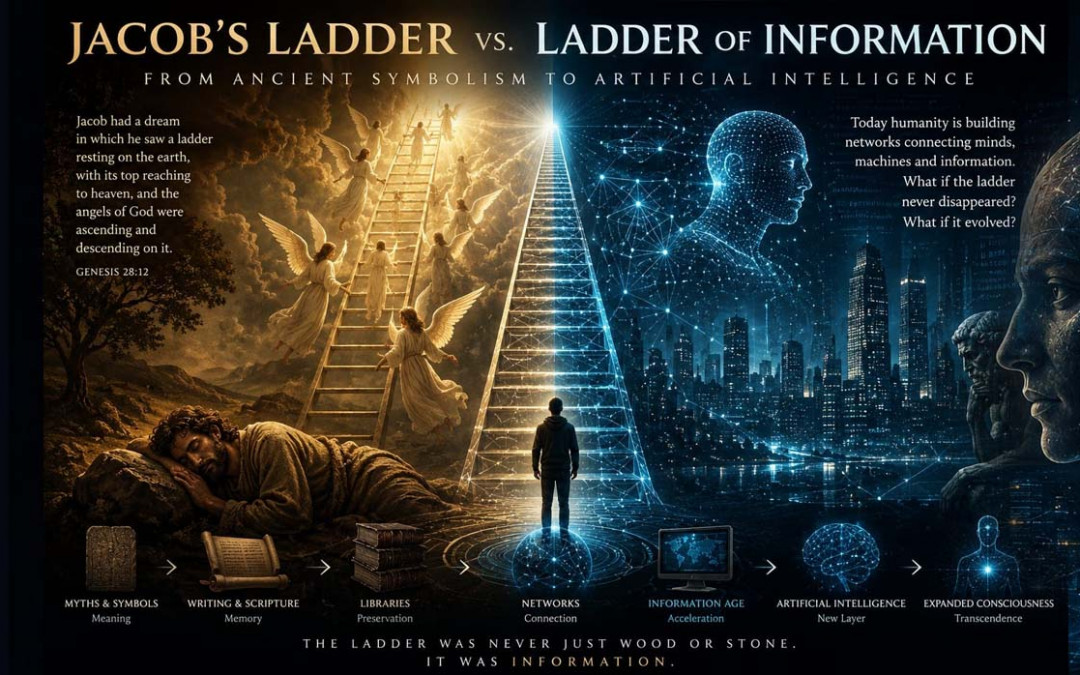
Jacob dreamed of a structure joining Earth and Heaven. Three thousand years later, civilization is still building things that promise to connect what once seemed impossibly far apart.
There is something almost childishly simple about a ladder. It is one of the least mysterious objects humanity has invented: two sides, a sequence of steps, a way of moving from one level to another. Yet place the same object inside a dream, let it disappear into the sky, add figures moving between Earth and Heaven, and suddenly the ladder becomes one of the most durable images in Western religious imagination.
In Genesis, Jacob falls asleep during a journey and dreams of a structure extending between earth and heaven, with divine messengers ascending and descending upon it. The scene has been interpreted for centuries as revelation, divine presence, communication between worlds and a sign of covenant. Christian interpreters later gave it additional meanings. Artists turned it into a vertical architecture of transcendence. Mystics found stages in it. Popular culture reduced it to the phrase Jacob’s Ladder, until the biblical image became almost independent of the text that produced it.
What makes the symbol endure is not that the ancient author secretly anticipated fiber-optic cables, neural networks or artificial intelligence. He did not.
The symbol survives because the problem survives.
How does something below communicate with something above?
How does the limited reach what exceeds it?
How does one level of reality become accessible from another?
Modern civilization has changed the vocabulary.
It has not escaped the question.
The Strange Power of a Vertical Line
Most symbols of travel are horizontal. Roads lead toward another city. Ships cross oceans. Migration carries people from one territory into another.
A ladder is different.
It implies levels.
You do not merely go elsewhere. You go higher or lower. One position becomes subordinate to another. The person at the bottom can see where the ladder begins but may not see where it ends. The climber progresses in discrete stages, and the structure itself remains between worlds.
This is why ladders, mountains, towers and stairways recur so easily in spiritual language. They turn abstraction into architecture. Ignorance can become a lower level. Knowledge becomes ascent. Ordinary life belongs below; revelation appears above. The metaphor does not prove that knowledge is literally higher than ignorance, but it gives the mind a geometry for thinking about transformation.
Civilization has inherited that geometry.
We speak of levels of education, higher understanding, intellectual ascent, technological progress and climbing through hierarchies. Even when religion disappears from the sentence, the vertical imagination remains.
The ladder survived secularization.
Jacob Was Not Building the Ladder
There is an important detail in the biblical story that modern readings can easily miss. Jacob does not construct the structure. He encounters it.
He is asleep.
The connection between earth and heaven appears before him as something already operating. The messengers move in both directions. When Jacob wakes, his transformation does not consist of acquiring a new technology. It consists of recognizing that the place in which he slept has become meaningful.
This changes the metaphor.
Jacob’s Ladder is not primarily a story about human engineering conquering distance. It is a story about discovering that a connection exists where the traveller had perceived only ordinary ground.
That may be why the image becomes unexpectedly useful in the technological age.
Our machines constantly reveal connections that were previously invisible.
A radio telescope turns signals from remote objects into data that a human observer can examine. A microscope translates structures beneath ordinary perception into visible form. Writing allows one consciousness to affect another centuries later. Networks make billions of people informationally adjacent while remaining physically distant.
The achievement is not merely speed.
It is the construction of interfaces between levels of experience that were previously inaccessible to one another.

Civilization Has Always Built Informational Ladders
Writing may have been the first great ladder of this kind.
Before writing, much of what one generation knew had to survive in living memory, ritual, imitation and oral transmission. Knowledge could cross time, but the bridge was fragile.
Writing created another step.
A dead person could continue speaking in a limited sense. A law could survive the ruler who issued it. An observation could reach someone who had not been present when it was made.
Libraries added another level. Printing multiplied it. Telegraphy separated communication from the speed of the travelling human body. Radio detached voice from physical proximity. The internet compressed geographic distance almost to irrelevance for certain kinds of information.
Artificial intelligence now introduces something qualitatively unsettling.
The archive no longer merely waits to be searched.
It begins to answer.
That does not mean the archive has become conscious. It does mean the interface between a human mind and accumulated information has changed.
A library traditionally requires the reader to know where to look.
An AI system can increasingly act as interpreter, translator, index, synthesizer and conversational surface between an individual and enormous quantities of stored culture.
The ladder is becoming interactive.
The New Theurgy
This is where the old word theurgy becomes interesting, but only if we use it carefully.
Historical theurgy, especially in late antique Neoplatonic traditions, referred to ritual practices intended to establish contact or alignment with divine realities. Symbols, invocations, sacred objects and ritual actions were not treated merely as decoration. They functioned as interfaces between levels of existence understood within a religious metaphysics.
Artificial intelligence is not theurgy in that historical sense.
A language model is not a god.
A prompt is not an invocation of a deity.
A computer is not an altar simply because people occasionally speak to it late at night.
But the structural resemblance is worth examining.
Ancient theurgy asked whether symbolic systems could mediate between human consciousness and an order larger than the individual.
Modern technological civilization increasingly constructs symbolic systems that mediate between individual consciousness and something larger than the individual: accumulated language, global knowledge, statistical patterns, collective memory and networks containing traces of billions of lives.
The New Theurgy begins at this resemblance without pretending the two things are identical.
The interesting question is not whether AI has become divine.
It is what happens when the interface becomes powerful enough to change our experience of what lies beyond the individual mind.
Angels Going Both Ways
The movement on Jacob’s Ladder is not one-directional.
The messengers ascend and descend.
That detail matters because a genuine interface does not merely allow the human being to climb toward a larger system. Something returns.
Writing externalizes thought and later returns thought to another reader.
A search engine accepts an intention and returns information.
A conversation sends language outward and receives another mind’s interpretation.
An AI interface takes a question produced by one consciousness, passes it through structures built from enormous quantities of human symbolic material and returns a new arrangement of information.
The cycle changes the questioner.
That is more interesting than the fantasy of simply “uploading humanity” into some higher informational realm.
Civilizational ladders are reciprocal.
Every new medium changes not only how far information travels but also how the humans using it think.
Writing changed memory.
Printing changed authority.
Photography changed evidence.
The internet changed attention.
Artificial intelligence may change the relationship between asking and knowing.
The ladder does not simply lead somewhere.
Climbing changes the climber.
Heaven Was Also a Distance Problem
Religion traditionally dealt with distances that could not be crossed physically.
The dead were unavailable.
The divine was unseen.
The future was unknown.
Meaning itself often appeared to belong to an order larger than the individual human life.
Modern technology does not resolve those problems merely by translating them into engineering. Digital memory does not prove immortality. Simulated worlds are not heaven. An AI reconstruction of a deceased person is not evidence that the person survived.
Yet technology repeatedly approaches the boundaries where religious imagination once operated.
It preserves voices after death.
It allows people separated by continents to share a room perceptually.
It produces environments that exist only as computation but create genuine psychological consequences.
It creates non-human systems capable of responding in language.
Religion and technology therefore sometimes appear beside one another not because one replaces the other, but because both confront the human desire to cross limitations that ordinary biology imposes.
The ladder remains.
The materials have changed.
The Problem at the Top
There is a danger in every ladder.
Once levels exist, humans begin assuming that higher automatically means better.
More information becomes wisdom.
More computation becomes intelligence.
More intelligence becomes consciousness.
More connection becomes understanding.
More technology becomes progress.
None of these transitions is guaranteed.
A ladder can lead upward without leading anywhere worth going.
The internet connected civilization at extraordinary scale and also industrialized distraction, manipulation and misinformation. Digital archives preserve memory while making forgetting more difficult. Artificial intelligence can increase access to knowledge while also making it easier to generate convincing nonsense.
The existence of the ladder therefore does not settle the question of ascent.
We still need criteria for deciding what counts as a higher level.
That is where philosophy returns.
Watch The Video
How to Read the World

Current Knowledge
Jacob’s Ladder appears in Genesis 28, in the account of Jacob’s dream during his journey. The Hebrew term traditionally rendered as “ladder” has also been interpreted by scholars as something closer to a stairway or ramp; the exact physical form is less certain than later artistic representations suggest. What is clear in the narrative is the connection between earth and heaven and the movement of divine messengers between them.
Over centuries, Jewish and Christian traditions developed multiple interpretations of the episode, including divine communication, providence, spiritual ascent and connections between earthly and heavenly realities. Later mystical and artistic traditions expanded the symbolism considerably.
There is no historical basis for claiming that Jacob’s Ladder originally encoded a theory of information, artificial intelligence or technological development. Such readings are modern interpretations.
Human civilization has, however, repeatedly developed technologies that allow information to persist across changes of physical carrier and across periods much longer than individual human lives. Writing, printing, recording, digital storage and networks all provide documented examples of this process.
Current artificial intelligence systems can organize, generate and transform information, but this does not establish that they possess subjective consciousness, spiritual status or independent understanding comparable to human experience.
Open Questions
The first question concerns the nature of informational ascent. Does access to more information actually produce more understanding, or can civilization become informationally richer while becoming less capable of judgment? A ladder of knowledge requires some distinction between accumulation and comprehension.
There is also the problem of interpretation. Libraries preserved information because human readers could reconnect stored symbols with meaning. If artificial intelligence increasingly becomes the primary intermediary between people and civilization’s archive, does it merely improve access, or does the intermediary begin shaping what the archive means?
Another question concerns continuity. Information can clearly survive individual biological lives. Whether consciousness, identity or subjective experience can do the same is entirely different. The fact that a voice recording persists after death does not establish that the speaker persists.
And there is a deeper philosophical problem. When civilizations build increasingly powerful interfaces between individuals and systems larger than themselves, are humans genuinely transcending limitation, or merely moving dependence from one layer to another?
Transhumation Interpretation
For Transhumation, Jacob’s Ladder is valuable precisely because it does not need to be converted into technological prophecy.
It is a diagram of relation.
Below and above.
Finite and larger.
Individual and system.
Question and answer.
Human and whatever exceeds the human.
Civilization repeatedly rebuilds this structure using different carriers.
The shaman had ritual.
The philosopher had dialogue.
The monastery had manuscript.
The Enlightenment had the encyclopedia.
The industrial age had mass print.
The twentieth century built broadcasting and computation.
The network age built search.
Artificial intelligence may be building something closer to a conversational ladder through the accumulated symbolic material of civilization.
But a ladder is still only an interface.
It does not tell us whether what waits at the other end is wise.
This is where The New Theurgy becomes useful as a Transhumation concept. Not as a return to supernatural certainty, and not as the claim that AI has replaced the gods. The New Theurgy asks what happens when humans once again build symbolic interfaces toward systems whose total scale exceeds individual understanding.
The priest once interpreted an oracle.
The scholar interpreted the library.
The modern person increasingly asks a machine to interpret the library for them.
That shift deserves more attention than the familiar question of whether AI will someday “become conscious.”
Perhaps the more immediate transformation is happening on our side of the interface.
The ladder is changing the climber.
Jacob woke from his dream and saw the same ground differently.
That may be the more durable meaning of the story.
The great ladder does not necessarily transport us to another world.
Sometimes it changes the world we think we are standing in.
FAQ
What is Jacob’s Ladder?
Jacob’s Ladder refers to the vision in Genesis 28 in which Jacob dreams of a structure connecting earth and heaven, with divine messengers ascending and descending upon it.
Was it literally a ladder?
Possibly, but the Hebrew word is not completely precise by modern standards and has also been understood as a stairway or ramp. The later image of a familiar wooden ladder is partly the product of artistic tradition.
What does Jacob’s Ladder traditionally symbolize?
Interpretations vary, but common themes include divine presence, communication between heaven and earth, providence, revelation and spiritual ascent.
Why has the image remained so powerful?
Because a ladder provides an intuitive structure for movement between levels. It makes abstract ideas such as ascent, revelation and transformation physically imaginable.
What is the Ladder of Information?
The Ladder of Information is a Transhumation interpretation of civilization as a sequence of systems that allow knowledge and memory to move beyond the limits of individual minds: oral tradition, writing, libraries, printing, networks and increasingly artificial intelligence.
Is AI the next step on that ladder?
Potentially in the limited sense that AI changes how humans access and reorganize stored information. This does not mean AI is automatically a higher form of consciousness or that technological development necessarily constitutes progress.
Is artificial intelligence a form of theurgy?
Not historically or literally. Ancient theurgy belonged to specific religious and philosophical traditions concerned with interaction with divine realities. The New Theurgy uses the comparison structurally: both involve symbolic interfaces connecting an individual human consciousness with an order perceived as larger than itself.
Does Transhumation claim technology is becoming religious?
No. Technology and religion remain distinct domains. But advanced technologies increasingly revisit problems traditionally associated with religion and metaphysics: identity, immortality, intelligence, creation, meaning and transcendence.
Can information survive beyond biology?
Yes, in the ordinary sense that information stored in books, recordings or digital systems can outlive the human beings who produced it. Whether subjective consciousness can survive biological death is a completely different question for which there is currently no demonstrated technological solution.
Is more information always a form of ascent?
No. Information can increase while understanding deteriorates. A civilization drowning in data may still lack judgment, context and meaning. A genuine Ladder of Information therefore cannot be measured simply by storage capacity.
Could AI become the librarian of civilization?
AI could increasingly serve as an interface to large portions of stored human knowledge, connecting information that would be impossible for one person to read in a lifetime. Whether it functions as a good librarian depends on accuracy, transparency, context and the ability of humans to challenge its interpretations.
What happens if the interface becomes more important than the library?
Then the interface begins shaping the reality available to the reader. If people encounter history, science and culture primarily through algorithmic interpretation, control of the interface becomes a form of cultural power.
What is at the top of the Ladder of Information?
Perhaps nothing resembling a final answer.
That may be the mistake contained in the metaphor of ascent: assuming that every ladder has a final platform waiting above the clouds.
Civilization may instead discover that each new level reveals another horizon. Writing did not finish knowledge. Libraries did not finish it. Science did not finish it. The internet did not finish it. Artificial intelligence almost certainly will not finish it either.
The ladder may matter because it preserves movement between levels, not because it promises an ultimate one.
What is the deepest Transhumation reading of Jacob’s Ladder?
Not that Jacob saw the internet in a dream.
Not that angels were information packets.
Not that ancient scripture secretly contained artificial intelligence.
Something simpler survives those exaggerations.
A human being lies on the ground and encounters a structure connecting his limited position with an order larger than himself. Information moves across the boundary. He wakes changed because he now understands the place differently.
Thousands of years later, humanity continues building structures for precisely that purpose.
Books.
Libraries.
Networks.
Artificial intelligence.
Different ladders.
The same dangerous hope:
that somewhere beyond the next step, the world may become more intelligible.
Continue the Transhumation Series
- Forgotten Religion | Ancient Gods, Symbols and the Hidden Structures of Human Civilization
- The Last Religion | Death, Immortality and the Future of Humanity
- The New Theurgy | AI, Information and the Future of Human Civilization
- End of Branding: You Were Never Meant to Become a Product
- Baal vs Ishtar: Why Ancient Gods Never Disappeared