

Why the Most Successful Media Revolution Became Invisible
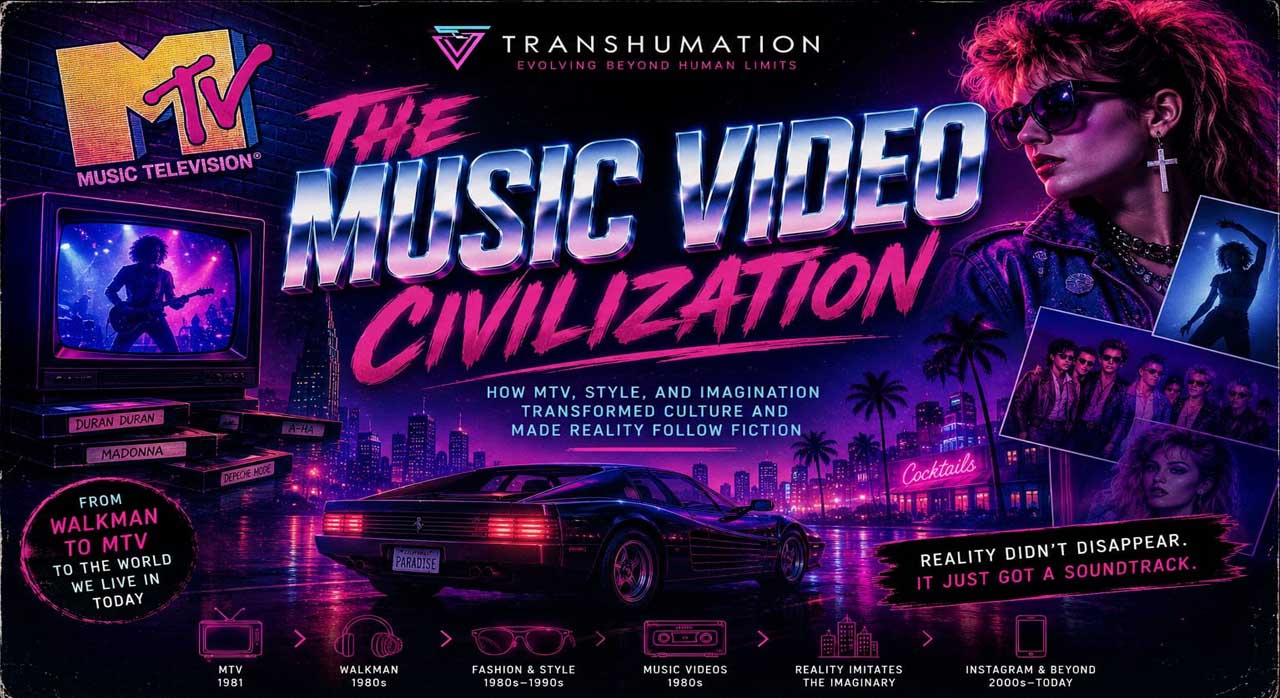
There was a time when MTV looked unmistakably like the future.
The logo moved. The editing moved faster. Music no longer seemed content to remain inside sound. A song arrived with clothes, architecture, choreography, lighting, attitude and a face constructed for the camera. The channel did not merely show musicians performing. It offered miniature worlds, often only a few minutes long, in which sound and image had become so tightly fused that separating them afterward could feel almost artificial.
Then something apparently went wrong.
The channel that had once made music television seem like a new cultural frontier became less central to music itself. Reality programming expanded. The internet transformed distribution. YouTube made scheduled television unnecessary for anyone who simply wanted to watch a music video. Streaming detached the song from the channel. Social platforms turned the audience into producers, editors and broadcasters.
The obvious story is decline.
MTV lost its purpose.
But there is another way of looking at the same history.
Perhaps the institution weakened because the cultural form it helped normalize no longer needed an institution to contain it.
The channel became smaller.
The grammar escaped.
The Channel That Made Music Visible
MTV did not invent the music video. Promotional films, televised performances and carefully designed relationships between popular music and visual style existed long before the channel began broadcasting in 1981. Nor did MTV invent celebrity, youth marketing or rapid editing. Cinema, advertising and television had already developed sophisticated languages for all three.
Its importance lay in concentration.
For hours at a time, viewers could encounter music not as an occasional visual supplement but as a continuous audiovisual environment. The performer was not simply someone whose voice accompanied an image. The image increasingly became part of how the performer was understood.
That altered the economy of attention surrounding music.
A successful song could now possess not only melody and lyrics but a visual memory. Hair, jacket, dance, set design, color palette and camera movement could become inseparable from the cultural object itself. Listeners did not merely remember what a song sounded like. They remembered the world in which the song appeared to exist.
This was especially powerful because music was already emotional compression. A few minutes could carry desire, rebellion, melancholy or fantasy with extraordinary efficiency. The music video added another layer of compression by turning those emotions into visible environments.
A song became easier to inhabit.
And once music became inhabitable, style became one of its most portable products.
Three Minutes Became Enough
The music video developed an unusual relationship with narrative.
A feature film usually has to explain why one event follows another. A novel must spend time establishing a world. Television traditionally relied upon recurring characters and continuity.
A music video could ignore most of that discipline.
A woman stands in an empty desert.
A car appears at night.
A face turns under blue light.
A dancer enters an industrial building.
The scene changes.
Nobody asks how the characters traveled there because the music provides another kind of continuity. Mood replaces geography. Rhythm replaces explanation. Association replaces causality.
This made the form extraordinarily efficient at transmitting identity.
Three minutes could communicate sophistication, aggression, sexual confidence, alienation, luxury, danger or innocence without having to define any of them in prose. Clothing and movement carried arguments silently. Lighting could tell the viewer whether the world was intimate, threatening or expensive before a single recognizable narrative action occurred.
Modern digital platforms use similar compression constantly, but the resemblance should not be mistaken for a direct line of inheritance. TikTok did not emerge because MTV executives accidentally invented it forty years earlier. Short-form internet video grew from many overlapping traditions.
What MTV demonstrates is that audiences were already perfectly capable of reading a dense audiovisual language long before social media made that language universal.
The format did not need to teach people everything explicitly.
It trusted recognition.
When the Audience Left the Living Room
The decisive change came when distribution moved away from scheduled television.
MTV’s original power depended partly on scarcity. The channel could decide what entered rotation because audiences had limited access to music video outside broadcast systems. The gate mattered because the gate controlled visibility.
The internet weakened that architecture.
Once viewers could search directly for a video, the idea of waiting for a channel to play it became absurd. Once artists could publish directly, distribution no longer required the same intermediary. Once algorithms could personalize recommendation, one centrally programmed flow of music began to look primitive.
The old institution lost power.
The audiovisual form did not.
Music videos moved online.
Artists became even more visually conscious.
Fan culture became participatory.
Fragments of songs circulated independently from complete recordings.
Clips became memes.
Fashion cycles accelerated.
A song could acquire a second life because fifteen seconds of it fit perfectly beneath a particular gesture or joke.
In that environment, MTV did not need to survive as the dominant channel for MTV-like cultural dynamics to expand.
The broadcast tower had weakened.
The audiovisual bloodstream had become larger.
The Music Video Escaped the Music
This may be the real cultural victory.
The logic of the music video eventually stopped requiring music videos.
Advertising became increasingly cinematic.
Fashion campaigns borrowed the visual density of short-form entertainment.
Sports introductions became miniature films.
Political communication learned to compress personality into instantly recognizable visual moments.
Ordinary individuals began presenting themselves through carefully selected combinations of image, music, location and gesture.
None of these practices originated solely with MTV.
But together they reveal a larger transition toward a culture in which presentation is increasingly part of the information rather than packaging placed around it.
This distinction matters.
A photograph of a room does not merely document the room when the room was arranged partly in anticipation of the photograph.
A person selecting a song for a short video is not simply adding background music when the song changes how the image is interpreted.
A political figure standing against a particular backdrop is not transmitting the same message they would transmit anywhere else.
The visual environment becomes semantic.
This was one of the lessons music video made difficult to ignore.
Meaning does not travel only through propositions.
It travels through atmosphere.
Life Learns to Perform for the Camera
The most interesting descendant of music-video culture may therefore be neither TikTok nor YouTube.
It may be ordinary self-presentation.
Human beings have always managed appearances. Clothing, manners, portraiture, architecture and social ritual long predate cameras. There has never been a historical period in which identity was completely private and unperformed.
What changes when nearly everyone carries a camera is the frequency with which life becomes aware of its possible representation.
A meal can be selected partly because it photographs well.
A holiday can be experienced partly through the expectation of future images.
A room can be designed with a camera angle in mind.
An outfit can be evaluated not only in a mirror but on a screen.
The image enters before the event has finished.
This creates a feedback loop in which life and media become harder to separate. People photograph existing styles, those images circulate, others reproduce the styles, designers observe the reproduction and create new environments partly in response to the imagery.
There is no clean original after several cycles.
Culture begins editing itself.
MTV was not responsible for this transformation, but the music-video era provides an important early mass example of what happens when aesthetic representation becomes powerful enough to reorganize the thing represented.
The performer learns to live inside the image.
Later the audience learns the same technique.
The Smartphone Did Not Replace MTV
It absorbed a much larger ecology.
The smartphone combines functions that once belonged to separate cultural objects: camera, television, music player, editing suite, telephone, map, diary, publishing platform and social network. It did not evolve as the final stage of MTV, and reducing it to that genealogy would be silly.
But from the perspective of media experience, something remarkable happened.
The separation between consumption and production collapsed.
An MTV viewer watched professionals construct audiovisual identities.
A smartphone user can construct one before breakfast.
This changes the scale of the phenomenon enormously.
The music video required production teams, equipment, distribution and broadcast access. Today an individual can record, edit, score and distribute an audiovisual fragment globally using one device.
The old distinction between artist and audience becomes porous.
Not everyone becomes an artist in any meaningful sense, but almost everyone gains access to tools of representation that once belonged disproportionately to media institutions.
This means that the cultural principles visible in music television no longer arrive only from above.
They circulate horizontally.
Millions of people borrow styles from one another, re-edit them, parody them, intensify them and return them to the network.
The channel becomes unnecessary because the audience has become a distributed channel.
The Invisible Victory
There is a useful way to think about successful interfaces.
At first, they attract attention to themselves.
Later, if they become sufficiently effective, people stop noticing them.
The electric light switch is not experienced as a revolutionary interface every time a room becomes bright. Search does not feel like an astonishing reorganization of information when someone casually checks the name of an actor during dinner. GPS can coordinate a journey through a foreign city while feeling less miraculous than finding a parking place.
Cultural forms can undergo a similar disappearance.
Once a visual grammar becomes familiar enough, it stops announcing itself as a style.
Fast editing becomes ordinary.
Music attached to personal imagery becomes ordinary.
Identity presented through audiovisual fragments becomes ordinary.
Brands behaving like personalities become ordinary.
People documenting themselves as though they were both protagonist and director becomes ordinary.
This does not mean MTV caused all of those things.
It means that the media environment in which MTV once looked radical became normal enough that its radicalism became difficult to remember.
The revolution disappeared into literacy.
What MTV Actually Won
The title therefore needs qualification.
MTV did not win institutionally.
It lost much of its old cultural monopoly.
It did not win technologically.
The internet reorganized media distribution on terms television could not control.
It did not even win aesthetically in the sense of one permanent style conquering culture. The actual look of contemporary social media differs enormously from classic music television.
What survived was something more abstract.
A recognition that music, image, style, identity and emotion can function as one tightly compressed informational object.
A recognition that atmosphere can communicate almost as efficiently as explanation.
A recognition that the presentation of the self can become part of the self’s public meaning.
And, most importantly, a recognition that a short audiovisual fragment can contain enough cultural information to circulate independently of the larger narrative from which it came.
That principle now belongs to ordinary digital life.
MTV helped make it legible.
The internet made it universal.
The smartphone made it personal.
Algorithms made it continuous.
Watch The Video
How to Read the World
Current Knowledge
MTV launched in the United States in 1981 and became an influential platform for music videos and youth-oriented popular culture. Music videos and promotional music films existed before MTV, so the channel should be understood as a major distributor and accelerator of the form rather than its inventor.
The network’s influence extended beyond music itself. Visual styling, fashion, celebrity identity, advertising and music increasingly interacted within the channel’s programming and surrounding culture. At the same time, MTV was only one participant in broader transformations already occurring across film, television, advertising and popular music.
The rise of the internet changed the distribution economics of music video. Online platforms allowed viewers to access videos on demand rather than waiting for scheduled broadcast, while artists and audiences gained new routes for publication and circulation.
Contemporary short-form platforms share several characteristics with music-video culture, including dense audiovisual communication, rapid editing, strong use of music and emphasis on visual identity. These similarities do not establish a simple direct genealogy, because modern platform culture developed from many technical and cultural sources.
The MTV television channel therefore became less central to music discovery while the music video itself remained culturally important and migrated successfully into online distribution.
Open Questions
One interesting question is how much of contemporary short-form media should genuinely be understood as an extension of music-video culture. Similar formal features may reflect historical influence, but they may also emerge independently because short audiovisual formats naturally reward compression, rhythm and rapid recognition.
Another question concerns whether the music video changed perception or merely adapted exceptionally well to cognitive tendencies that already existed. Human beings have always responded quickly to faces, movement, music, status cues and symbolic environments. MTV may have industrialized a grammar the nervous system already understood rather than creating a new kind of mind.
There is also the problem of causality between media and identity. Did increasingly visual media make people more performative, or did broader changes in consumer culture, celebrity and technology create a demand for more performative media? The relationship is probably recursive rather than one-directional.
A more serious question concerns personalization. MTV still presented a relatively shared broadcast environment. Modern algorithmic platforms construct individualized streams. What happens when the cultural grammar of emotionally compressed audiovisual media is combined with systems capable of learning which specific images hold each person’s attention?
Transhumation Interpretation
MTV matters to Transhumation because it demonstrates how an interface can disappear without its structure disappearing.
The original channel was visible.
You switched it on.
You knew when the medium had begun.
The frame of the television separated music television from the rest of the day.
Contemporary media are less courteous about their borders.
Music, video, messaging, photography, commerce and identity travel together through the same device. A person can leave one application and enter another without leaving the larger informational environment.
The interface becomes continuous.
This is where the phrase MTV won acquires a more serious meaning.
The victory is not that the world looks like an old music video.
It is that civilization increasingly accepts something music television made exceptionally visible: experience can be designed through the orchestration of image, sound, sequence and identity.
Once that principle becomes normal, it can move between carriers.
Television carries it.
Then websites.
Then social platforms.
Then smartphones.
The carrier changes while enough of the structure survives to remain culturally recognizable.
But the migration also changes the structure.
The old MTV viewer received a broadcast.
The contemporary user participates in a feedback system.
The user watches, produces, responds, measures response and adjusts future presentation. The representation of identity can therefore change behavior before the next representation is produced.
This is a much more powerful loop than television alone could create.
A media system no longer merely shows people desirable styles.
It can observe which styles hold attention and reorganize the next encounter accordingly.
That distinction brings the subject close to the larger Transhumation problem of interfaces becoming environments.
A good interface helps a person navigate reality.
A sufficiently pervasive interface can begin determining which parts of reality are easiest to notice.
When the image becomes personalized, ranked and continuously available, representation acquires a new degree of power over salience.
This does not make the physical world unreal.
The body still needs sleep.
The city still has weather.
The photograph cannot remove gravity.
But the interface can shape which portion of reality becomes emotionally important at a given moment.
This is why the history of MTV cannot end with nostalgia.
The more interesting line runs forward toward artificial intelligence.
Generative systems may eventually allow audiovisual environments to become adaptive rather than merely selected from existing media. A platform today chooses among millions of existing pieces of content. A future system could increasingly generate imagery, music, narratives and presentation styles for particular users or moments.
The music video once said:
here is a world constructed around this song.
The personalized generative interface could say:
here is a world constructed around your predicted response.
That difference deserves attention.
The first system creates style.
The second may create individualized reality filters.
This does not mean AI is simply MTV with better software. It means the same old problem of interface and interpretation becomes more consequential as the interface gains the ability to adapt.
The Library of Mirrors therefore needs a rule that television did not require with the same urgency.
The reader should be able to recognize the mirror.
When a medium selects, compresses and stylizes the world, the selection should not become so transparent that it masquerades as the whole world.
MTV’s old artificiality was, in one sense, reassuring.
The smoke machine was visible.
The editing was theatrical.
The clothes were obviously chosen.
The video admitted that it was constructing an atmosphere.
Modern interfaces can become much less visible while performing more selection.
That may be the deeper historical reversal.
MTV looked artificial because the medium was new.
Digital culture increasingly looks natural because the medium has become habitual.
And perhaps that is the real form of victory.
Not when everybody continues watching the original channel.
When nobody needs the channel because the cultural operation it represented has migrated into ordinary behavior.
MTV did not become civilization.
That would give one television network far too much credit.
But it occupied an unusually visible moment in a larger transformation: the moment when audiovisual identity stopped looking like packaging and began looking like a language.
We speak that language constantly now.
That is why we rarely hear the accent.
FAQ
Did MTV really “win”?
Metaphorically. The television channel lost much of its former centrality, but several cultural forms it helped popularize became ordinary parts of digital media.
Did MTV invent the music video?
No. Music films and promotional videos existed earlier. MTV gave the form an influential continuous mass-media platform.
Is TikTok basically modern MTV?
No. TikTok emerged from a very different technological and social environment. The useful comparison is their shared reliance on compressed audiovisual communication, music and rapid recognition.
Why did MTV become less important for music?
On-demand internet distribution removed the need to wait for a television channel to select and schedule videos, while streaming and social platforms created new routes for discovery.
What is the deeper cultural change?
Presentation increasingly became part of information itself. Image, music, mood and identity could function together as one compressed cultural object rather than as separate layers.
What is the Transhumation question?
The original MTV frame was easy to see. Contemporary interfaces increasingly surround everyday life and personalize what appears inside them.
The deeper question is therefore not whether media shape experience. They always have.
It is what happens when the medium becomes so successful that we stop noticing the frame through which the world is being shown.
Continue the Transhumation Series
- Forgotten Religion | Ancient Gods, Symbols and the Hidden Structures of Human Civilization
- The Last Religion | Death, Immortality and the Future of Humanity
- The New Theurgy | AI, Information and the Future of Human Civilization
- End of Branding: You Were Never Meant to Become a Product
- Baal vs Ishtar: Why Ancient Gods Never Disappeared