
The Board of Humanity
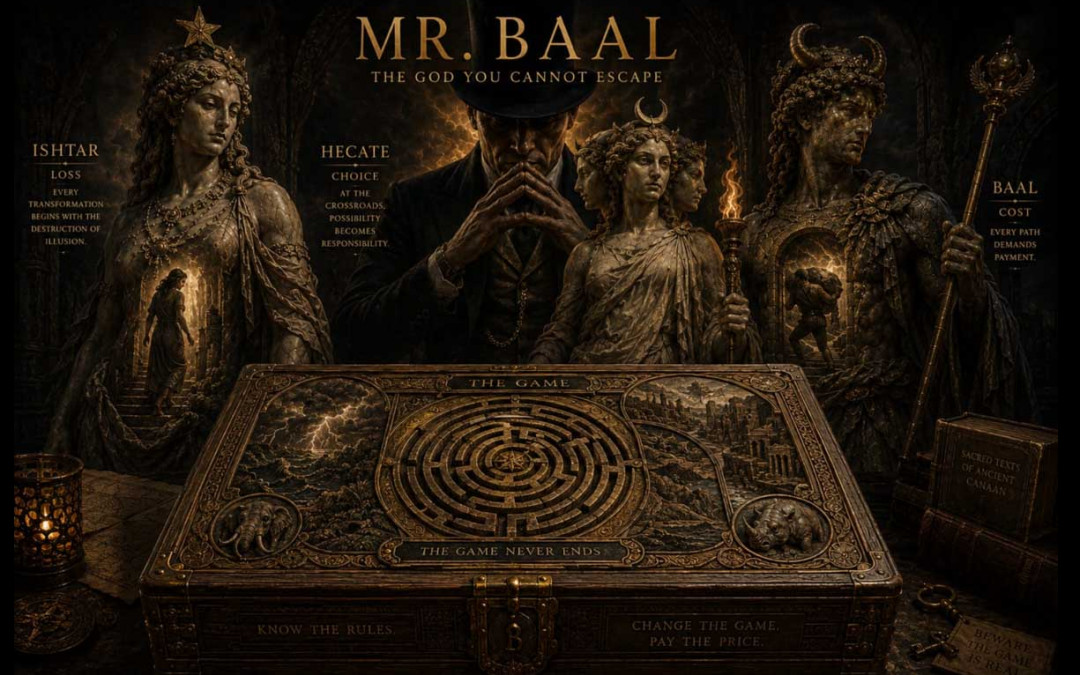
Baal, the price of reality, and the strange possibility that some gods survived by becoming invisible
A farmer in the ancient Levant could do almost everything correctly and still lose.
He could prepare the soil, sow at the proper time, protect what he had planted and work until there was nothing more to be done. Then he had to look upward. If the rains came, the field might live. If they did not, effort, virtue and intention could become almost irrelevant. The sky did not negotiate with him.
That makes the ancient storm god Baal rather more interesting than the demonic figure his name eventually became in parts of later Western culture. To the people who encountered Baal in his original religious world, rain was not scenery. It was infrastructure. A storm could mean fertility, food and political stability. Its absence could mean hunger.
Modern people rarely ask a god for rain. We have irrigation, insurance, global supply chains, weather satellites and financial markets. We have become exceptionally good at putting machinery between ourselves and the sky.
But we have not abolished the thing the farmer discovered.
There are conditions we do not get to negotiate.
Perhaps this is where Baal becomes worth taking out of the museum.
Before Baal Became the Villain
The first problem is his name. Baal was not originally the personal name of a single universal god in the way modern readers might imagine Zeus or Apollo. The Northwest Semitic word meant something like “lord” or “master” and could be used as a title. The Baal who emerges most vividly from the Late Bronze Age texts discovered at Ugarit is generally identified with the storm deity Baal/Hadad, a divine figure associated with rain, fertility, kingship and conflict.
His world was not organized according to our later categories of a single benevolent God opposed by an evil supernatural rival. Baal belonged to a divine society with conflicts, alliances and competing powers. In the Ugaritic Baal Cycle, his struggle with Yamm, associated with the sea, and later his confrontation with Mot, associated with death, belong to a mythology deeply entangled with questions of order, fertility and continuation.
Centuries of religious conflict changed the cultural meaning of the name. Biblical texts polemicized against Baal worship, and much later Christian demonological traditions pushed figures bearing the name still further toward the infernal. Eventually, for many modern readers, “Baal” arrives already wearing the costume of a defeated pagan demon.
That afterlife is historically fascinating. But it can obscure the simpler object standing behind the mythology: a civilization watching the sky.
A storm god matters differently when rain decides whether your children eat.
This does not mean that ancient worshippers secretly understood Baal as an abstract philosophical principle called Reality. There is no Ugaritic tablet saying Baal is the architecture of existence. That is our experiment, not theirs.
The experiment begins with a question: what problem made a storm god so important in the first place?
The Farmer’s Unpleasant Discovery
Imagine again the farmer.
He can influence reality, but he cannot command it. He possesses agency without sovereignty. There is an enormous difference between those two conditions, and much of civilization could be described as our attempt to narrow the gap.
Agriculture narrows it. Medicine narrows it. Banking narrows it. Engineering narrows it. Technology may be the largest collection of such attempts ever constructed. We identify something reality does to us and invent a method of doing something back.
But the boundary merely moves.
An airline can build an extraordinarily safe aircraft and still obey aerodynamics. A pharmaceutical company can create a remarkable medicine and still encounter chemistry. A government can print currency but cannot permanently legislate away the consequences of scarcity. An artificial-intelligence company can promise almost anything in a presentation; eventually the model must run somewhere, consume energy, encounter hardware, produce results and meet a world capable of saying no.
Reality has an irritating habit of auditing our metaphors.
This is where I think Baal becomes more interesting than the familiar description “storm god.”
Not because Baal was reality. Historically, he wasn’t.
Because the relationship between the worshipper and the forces represented by Baal contains something that survived him: you may negotiate your position inside a system without being able to negotiate the existence of the system itself.
That is a much harder idea to kill than a god.
What Does the Future Cost?
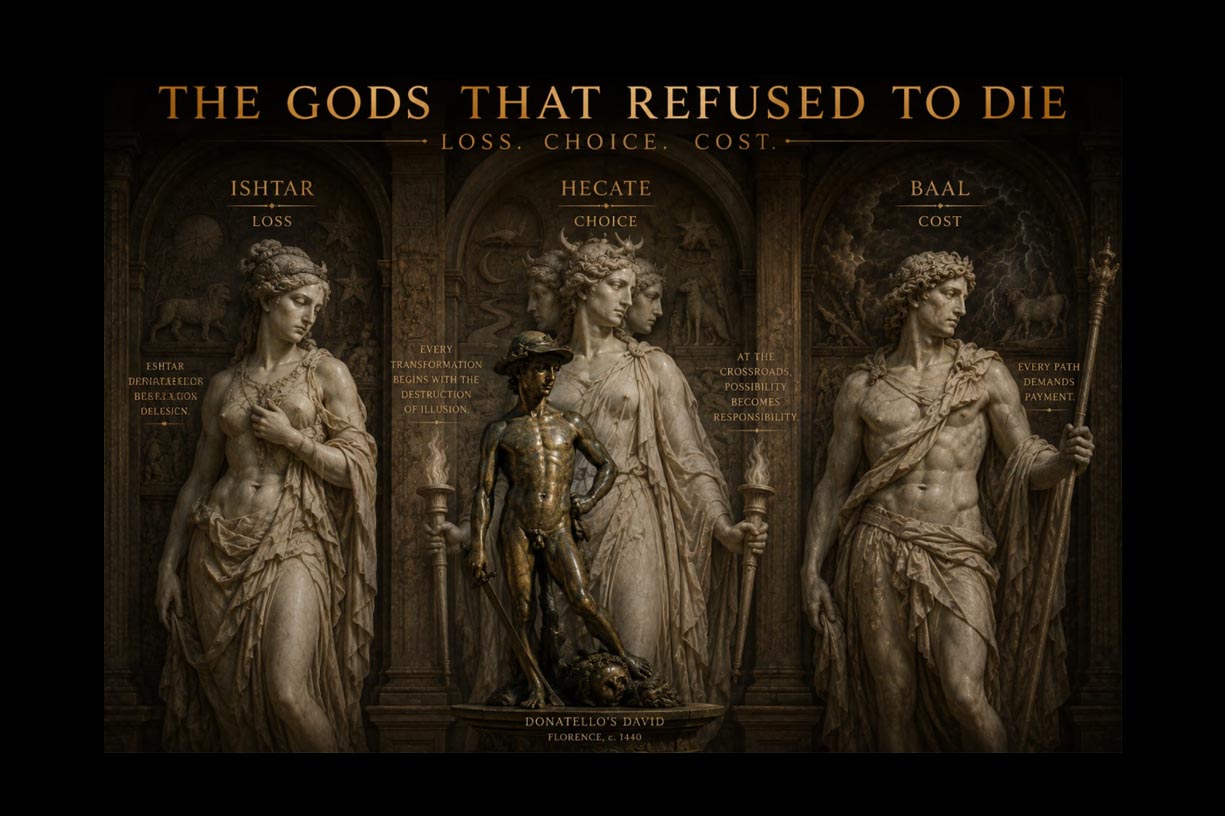
In another Transhumation experiment, we placed Ishtar, Hecate and Baal beside one another—not because an ancient religion arranged them this way, but to see whether three very different mythological figures could illuminate a recurring structure.
Ishtar gave us subtraction: the descent in which the signs of identity and power are removed.
Hecate gave us the threshold: the moment at which the old road is no longer sufficient and several directions become possible.
Baal now introduces something less romantic.
The bill.
This is where almost every vision of the future becomes less beautiful. Digital immortality sounds extraordinary until somebody asks what exactly is being preserved, on what substrate, by whom and for how long. Artificial intelligence promises abundance, then somebody has to construct the data centres. Space settlement begins with Mars and ends, very quickly, with radiation shielding, calories, waste, spare parts and energy.
Even ordinary dreams work this way. Becoming excellent at something costs the years spent becoming excellent at it. Having children creates possibilities while permanently closing others. Building a company consumes money, attention and portions of a life that cannot subsequently be reinvested somewhere else.
Economics has a wonderfully unromantic expression for part of this: opportunity cost.
Every serious yes contains a collection of noes.
Ancient sacrifice and modern opportunity cost are obviously not the same institution, and confusing them would produce a pretty metaphor at the expense of history. Yet beneath both is an uncomfortable recognition that possibilities compete for finite things.
Time. Energy. Matter. Attention.
Perhaps every future eventually encounters Baal—not the ancient deity, but the problem for which the deity gives us a memorable face.
Kubrick’s Ball
There is a moment in The Shining that seems almost too small to notice. Jack Torrance throws a tennis ball against a wall inside the Overlook Hotel and catches it when it returns.
Kubrick does not need Baal for the scene, and there is no sensible historical argument connecting the film to an Ugaritic storm god. The interesting connection is structural rather than symbolic.
Jack can choose how hard to throw.
He can choose the angle.
He can choose whether to throw at all.
What he cannot choose is whether the wall participates.
The ball returns because the environment has properties of its own.
Much of Kubrick’s cinema becomes unsettling for a similar reason. His characters move through architectures—literal and social—that seem larger than their intentions. The Overlook has corridors, repetitions, locked histories and rules that Jack does not create simply by entering it. The maze outside the hotel makes the metaphor almost embarrassingly physical.
And this gives us a useful distinction.
Freedom does not necessarily mean escaping structure.
Sometimes freedom means understanding enough of the structure to move differently inside it.
A sailor is not free because the sea has stopped possessing currents. He becomes freer by learning to read them. A pilot does not defeat gravity. Flight is possible because an aircraft has been designed with extraordinary respect for the very physical laws it appears to overcome.
Technology repeatedly performs this trick.
What looks like escaping reality is usually better obedience to reality at a deeper level.
The airplane does not refute gravity.
It understands the rules well enough to make gravity part of the solution.
If God and Satan Played Football
There is a deliberately ridiculous thought experiment that gets surprisingly close to the point.
Imagine God and Satan playing football.
Immediately we begin thinking about the players. Who is stronger? Who cheats? Who wins? Which side represents order and which rebellion?
But before any of those questions can matter, there must be something neither player can simply redefine whenever convenient.
A field.
Boundaries.
A ball.
Some distinction between a goal and not a goal.
Without those conditions there is no contest, only arbitrary movement.
If we wanted to smuggle Baal into this strange little game, I would not put him on either team. I would make him the field.
Again, this is emphatically not ancient Canaanite theology. It is a modern metaphor designed to isolate a structure. And the structure becomes interesting precisely because it sits beneath moral opposition. Good intentions do not abolish consequences. Evil intentions do not abolish them either. Reality does not become unreal because the person encountering it happens to be virtuous.
This may be one reason civilizations repeatedly personified forces larger than individual desire. A personality makes an abstraction memorable. The sea becomes someone. Death acquires a face. The threshold receives a guardian. The storm receives a lord.
Eventually the personality can disappear.
The constraint remains.
The Labyrinth Is Still Here
There is an attractive modern fantasy that progress consists primarily of escape.
Escape biology. Escape scarcity. Escape work. Escape ageing. Escape Earth. Perhaps eventually escape the body itself.
Transhumation is interested in all of those possibilities. A hopeless romantic should be. There is something magnificent about a species refusing to accept that every inherited boundary must remain where nature happened to place it.
But the radical realist has to follow immediately behind with a flashlight.
Escape into what?
Uploading a mind, if such a thing ever becomes possible, would not remove constraints. It would exchange biological constraints for computational ones. Leaving Earth would not abolish nature; it would place human beings inside an environment considerably less forgiving than the one they left. Artificial intelligence does not eliminate economics merely because intelligence becomes cheaper. It changes which resources become scarce.
Perhaps there is no final door marked EXIT.
Perhaps there are only deeper rooms.
That possibility changes the meaning of progress. The greatest human achievements may not be victories over reality at all. They may be increasingly sophisticated collaborations with it. We learned enough about pathogens to create vaccines, enough about electricity to illuminate cities, enough about gravity and combustion to leave the ground.
We did not break the labyrinth.
We learned some of its walls.
And this brings us back to a god whose temples largely disappeared thousands of years ago.
Baal does not need to be resurrected as a supernatural being for his story to remain useful. Nor do we need to pretend that an ancient storm deity was secretly teaching modern systems theory. Something more modest—and perhaps more remarkable—is possible.
The farmer standing beneath the ancient sky and the engineer standing inside a modern data centre may share one discovery.
The world can be changed.
But first it has to be encountered as it is.
The better question, then, may not be whether humanity will finally escape its limitations.
It may be this:
Which limitations are walls—and which are the rules that make building anything possible?
Watch The Video
How to Read the World
Current Knowledge
Baal was a title meaning approximately “lord” or “master” used in Northwest Semitic religious traditions. The Baal particularly well known from texts discovered at ancient Ugarit is generally associated with the storm god Baal/Hadad and with rain, fertility, kingship and conflict. The Ugaritic Baal Cycle includes conflicts involving Yamm, associated with the sea, and Mot, associated with death.
Biblical traditions contain strong polemics against Baal worship, while later religious and demonological traditions contributed to the increasingly negative image attached to the name in Western culture.
There is no historical evidence that ancient worshippers understood Baal as “reality itself,” “the price of transformation,” or the underlying rules of a cosmic system. Those ideas belong to the Transhumation interpretation developed in this article.
The references to Stanley Kubrick and The Shining are likewise structural comparisons, not claims of an intentional connection between Kubrick and ancient Baal traditions.
Open Questions
Why do civilizations so often personify forces they cannot fully control?
When technology allows us to overcome an apparent limitation, have we escaped a rule of reality—or merely discovered a deeper rule that allows us to work around the first one?
And if every form of freedom continues to depend upon some underlying structure, is absolute freedom even a coherent idea?
Perhaps the most interesting question is not how far humanity can escape the labyrinth, but whether intelligence itself consists partly in learning which walls can move.
Transhumation Interpretation
Transhumation reads Baal as an experiment in carrier-independent structure.
The historical carrier was a storm god. The underlying human encounter was with forces that could be influenced but not simply commanded: weather, fertility, scarcity, survival and consequence.
Modern carriers are different. Markets, biology, computation, energy and physical law have replaced the storm god in many of the situations where human beings encounter constraints larger than individual intention.
The claim is not that these things are Baal.
The question is whether the same relationship has survived the change of carrier:
desire → encounter with constraint → understanding → participation → consequence.
If that structure survives after Baal is removed, then the comparison may be useful.
If it requires believing in Baal to work, we should discard it.
That is the test.
FAQ
Was Baal an evil god?
Not originally in the simple modern sense. Baal was an important deity or title in several ancient Northwest Semitic traditions. Later religious polemics and demonological traditions profoundly altered his cultural image.
Was Baal a storm god?
The Baal prominent in the Ugaritic texts is associated with the storm deity Baal/Hadad and particularly with rain, fertility, kingship and conflict.
Did ancient people believe Baal represented reality itself?
There is no evidence for that formulation. It is a Transhumation interpretation based on the relationship between humans and the uncontrollable natural forces associated with Baal.
What does Baal represent in Transhumation?
Baal becomes a way of asking about constraint, consequence and the cost imposed by reality on every attempted transformation.
What does Baal have to do with The Shining?
There is no proposed historical connection. Kubrick’s hotel and maze are used as modern examples of individuals operating inside structures whose rules do not depend upon their wishes.
What is the main idea of the article?
Human progress may not consist of escaping reality’s rules. Some of our greatest achievements come from understanding those rules deeply enough to create new possibilities inside them.
Continue the Transhumation Series
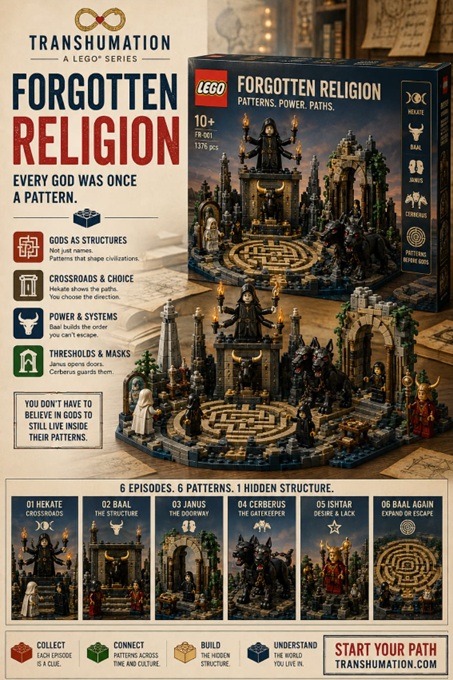
- Forgotten Religion | Ancient Gods, Symbols and the Hidden Structures of Human Civilization
- The Last Religion | Death, Immortality and the Future of Humanity
- The New Theurgy | AI, Information and the Future of Human Civilization
- End of Branding: You Were Never Meant to Become a Product
- Baal vs Ishtar: Why Ancient Gods Never Disappeared