

The Geometry Before Biology
A three-legged table almost never wobbles.
Place it on an imperfect stone floor, a terrace that has settled badly, or a patch of ground no carpenter would willingly call level, and all three feet will still find a plane. Add a fourth leg and something irritating becomes possible. If one foot is even slightly out of alignment, the table rocks between two configurations, as though the extra support has somehow made it less certain.
There is no mysticism in this. Three non-collinear points define a plane. The geometry was true before anyone built a stool, before anyone wrote Euclid, before wood existed, before trees existed, before life existed.
That small domestic fact opens a much larger question.
Living organisms arrived extraordinarily late in the history of the universe. Long before cells divided, before DNA replicated and before evolution began exploring biological form, matter already occupied space. Forces already operated. Surfaces curved. Distances existed. Energy moved through gradients. Certain configurations were stable and others were not.
Life did not enter an empty universe and invent form.
It entered a world in which some forms were already easier to build, move, repeat and maintain than others.
Biology came later.
Geometry was waiting.
Why Does Geometry Matter in Biology?
It is easy to speak about living systems as though biology writes its own rules.
Genes mutate. Organisms compete. Natural selection preserves some variations and eliminates others. Given enough time, eyes appear, wings appear, skeletons appear, vascular systems branch through bodies and nervous systems fold extraordinary amounts of tissue into limited volumes.
But evolution never works in a blank space of possibilities.
A flying animal must interact with a fluid.
A tree must distribute material while resisting gravity and wind.
Blood must travel through vessels.
A cell must exchange substances across a surface.
A large animal must support its own mass.
These are biological problems, but they are also geometric and physical problems.
Increase the volume of an organism and its relationship to surface area changes. Lengthen a limb and leverage changes. Build a branching network and trade-offs appear between coverage, transport distance, energy cost and structural reliability. Grow a shell and curvature matters.
Evolution does not need to understand any of this.
It only needs variation and differential survival.
Forms that interact successfully with physical constraints can persist. Forms that fail may disappear.
Over immense periods, this process can produce structures that look almost engineered precisely because physical reality has been editing them continuously.
The organism proposes.
Reality edits.
Why Is the Triangle Structurally Important?
The triangle deserves attention, although not worship.
Among polygons, it is the simplest closed form. More importantly for engineering, a triangle made from rigid members tends to preserve its shape unless the members themselves deform or the joints fail. A four-sided frame can shear into a parallelogram without changing the lengths of its sides; add a diagonal and it becomes two triangles, dramatically increasing rigidity.
Bridges use this.
Roof trusses use it.
Aircraft structures use it.
So do cranes and towers.
The triangle is therefore not important because the universe secretly prefers the number three. It is important because particular geometric relationships generate particular mechanical consequences.
The three-legged stool demonstrates a different advantage. Three contact points determine a plane, which means all three can rest simultaneously on an uneven surface. Four legs introduce another constraint: if the fourth point does not lie in exactly the same plane, the stool can wobble.
This is where geometry becomes philosophically interesting.
A shape can function as a solution before any mind recognizes it as one.
Humans did not vote the triangle into structural usefulness.
We discovered what follows from its relations.
That distinction matters.
It is one of the places where the old argument about whether mathematics is invented or discovered stops feeling entirely academic.
Does Nature Prefer Certain Shapes?
Nature does not possess preferences.
But physical processes can repeatedly favor certain configurations.
Soap films tend toward arrangements that reduce surface energy. Crystals form structures constrained by molecular interactions. Rivers branch. Lightning branches. Trees branch. Lungs and blood vessels branch too, although each system arises through radically different processes.
Similarity does not mean common ancestry.
Nor does it imply one hidden cosmic template.
Sometimes different systems encounter related optimization problems.
A branching structure can be useful whenever something must be distributed from a limited number of sources across a wider area, or collected from a wide area into fewer channels. This does not make a river and a lung the same thing. It means the geometry of distribution can recur across very different carriers.
Spirals provide another seductive example.
They appear in shells, storms, plants and galaxies, but not for one universal reason. The underlying mechanisms differ. A spiral galaxy is not following the same developmental process as a sunflower.
This is one of Transhumation’s most important tests.
Recurrence is not genealogy.
When a form reappears, the first question should not be “What ancient pattern is expressing itself again?”
It should be “What constraint could make this structure useful more than once?”
Only then does resemblance become informative rather than decorative.
Why Are So Many Animals Bilaterally Symmetrical?
The human body looks approximately mirrored because bilateral symmetry is widespread among animals that move directionally through an environment.
There are good functional reasons for this organization. A body with a front and back can specialize sensory structures toward the direction of travel. Paired limbs can assist locomotion. Left-right organization can support balanced movement.
But gravity alone does not explain bilateral symmetry, and nature does not obey one universal design rule.
Jellyfish and many other organisms display radial forms.
Sponges can be highly irregular.
Plants follow different developmental logics.
Even bilaterally symmetrical animals contain striking internal asymmetries. The human heart is not centered like a decorative emblem; organs occupy different positions, and developmental biology actively establishes left-right differences.
Geometry therefore constrains life without dictating one ideal body.
Evolution explores possible forms inside physical reality while carrying the historical baggage of everything that came before.
A whale is not designed from scratch for water.
It is a mammal whose ancestors returned to water.
History matters alongside geometry.
That is why nature is so much more interesting than pure optimization.
Every organism is partly a solution and partly an inheritance.
The Shape Before the Organism
Consider an eye.
Its optical problem existed before biological eyes did.
Light propagates.
Surfaces refract.
A curved structure can focus incoming rays.
None of these relationships waited for an animal to discover sight.
Evolution eventually produced biological systems capable of exploiting them.
The same is true of wings.
Air already possessed properties allowing lift and drag before birds, insects or bats evolved. Those groups reached flight through different anatomical histories, yet all of them were forced into negotiations with the same surrounding physics.
This does not mean geometry contains a hidden blueprint for birds.
It means reality contains constraints and affordances.
Certain relationships are possible.
Others are expensive.
Some are unstable.
Some are extraordinarily effective once evolution stumbles into them.
Life therefore looks creative without having complete freedom.
It improvises inside a room whose dimensions were established long before it arrived.
The First Social Geometry
This is where the article can leave science and enter metaphor, provided we say clearly that we are changing levels.
One person can hold a thought.
Two people create a relation.
Introduce a third and the structure changes qualitatively.
Now there can be coalition, mediation, jealousy, comparison, triangulation, audience, secrecy and alliance. Person A can behave differently toward B because C is present. Information can be unevenly distributed. Two people may know something the third does not.
Sociology and psychology have long recognized that triadic relations differ from dyadic ones, but this is not because human society literally obeys Euclidean triangles.
The similarity is structural.
Adding a third element can create relationships that were impossible when only two existed.
This is exactly the kind of comparison that needs restraint.
The geometric triangle does not cause jealousy.
A social triangle is not a theorem.
But both examples reveal a more general idea: new relations can appear when a system gains another element.
Complexity is not always the accumulation of more parts.
Sometimes the important change is that the number of possible relations changes.
Does Meaning Begin at Three?
No, at least not as a universal fact.
A solitary person can produce meaning.
Two people can form language, attachment and conflict.
There is no scientific threshold at which the third element magically creates interpretation.
But “three” can still serve as a useful philosophical model.
A sign.
Something signified.
An interpreter.
An event.
A memory of the event.
A present observer.
An object.
A representation.
A viewer.
Again and again, meaning appears relational.
This is much more defensible than saying a triangle itself generates meaning.
What the triangle offers is a compressed picture of relation becoming structure.
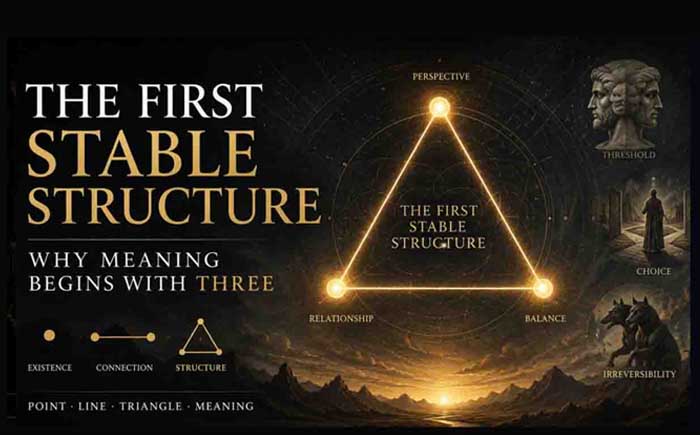
With one point, there is location.
With two, distance becomes possible.
With three non-collinear points, an enclosed plane figure becomes possible.
The jump is geometrically real.
The philosophical extension is metaphorical.
Keeping those categories separate makes the metaphor stronger rather than weaker.
The Birth of Disorder
The original idea that chaos becomes possible only after order exists contains something worth preserving, but it needs refinement.
Physical disorder obviously did not wait for triangles.
Entropy, instability and stochastic processes do not require human concepts of structure.
What does require structure is failure.
A thing can fail only relative to some organization capable of being maintained.
A bridge can collapse because it had a load-bearing arrangement.
A genome can mutate because there was an existing sequence.
An institution can decay because it previously coordinated behavior.
A relationship can break because a relationship existed.
In this sense, order creates new categories of disorder.
Before the cathedral exists, there can be no ruined cathedral.
Before the organism exists, there can be no disease of that organism.
Before civilization creates memory, there can be no loss of that particular archive.
Structure creates vulnerability because anything organized can become disorganized.
This may be one of the deeper prices of complexity.
The more relationships a system can maintain, the more ways those relationships can fail.
Would Alien Intelligence Discover the Same Geometry?
This is one of the best places to test the entire argument.
Imagine an intelligent species evolving under another sun with no shared biology, language, religion or cultural history.
Its myths could be incomprehensible to us.
Its senses might divide reality differently.
Its social structure might bear little resemblance to ours.
Would it discover triangles?
If it investigates spatial relations comparable to ours, almost certainly it would encounter equivalent geometric constraints, although its notation, concepts and preferred mathematical foundations could look completely unfamiliar.
A triangle does not need to be called a triangle.
π does not need the symbol π.
The Pythagorean relationship does not depend on Pythagoras having existed.
This does not prove that mathematics occupies a Platonic realm independent of matter.
That remains a philosophical question.
But it strongly suggests that at least some mathematical relationships are not arbitrary products of one human culture.
An alien civilization might write them differently.
It could not negotiate them away.
That is a very different kind of universality from myth.
Is Mathematics Discovered or Invented?
Geometry eventually leads into one of philosophy’s oldest rooms.
Human beings invent notation.
We choose symbols.
We develop axiomatic systems.
We decide which questions interest us.
But once certain assumptions and relationships are established, consequences often appear that we did not simply vote into existence.
This is why mathematics can feel simultaneously invented and discovered.
We construct formal languages and then encounter structures inside them that surprise us.
The extraordinary effectiveness of mathematics in physics makes the mystery deeper, but it does not settle the ontology.
Platonists can argue that mathematical structures exist independently of human minds.
Other philosophical traditions can interpret mathematical truth without committing to such entities.
Biology does not decide between them.
What biology does show is something more modest and difficult to deny: living forms emerge in a world where spatial and physical relations place real constraints on what can work.
Life did not write those constraints.
Life encountered them.
Geometry Before Biology
The most interesting conclusion is therefore less mystical than the original claim and, in a way, stranger.
Before there were organisms, there were possible relationships among positions, forces, surfaces and energies.
Before there were wings, there were fluids in which certain shapes interacted differently with motion.
Before eyes, there was light.
Before skeletons, there were problems of support.
Before vascular systems, there were geometric costs attached to moving material through space.
Evolution arrived late and began exploring this already structured landscape.
Sometimes it found similar solutions more than once.
Sometimes history prevented an apparently perfect solution.
Sometimes one constraint fought another and produced compromise.
Life is not mathematics made flesh.
But neither is it free from mathematics.
It is improvisation conducted under older rules.
Watch The Video
How to Read the World
Current Knowledge
Geometry and physics existed as descriptions of spatial and physical relationships long before biological life appeared. Life evolved within pre-existing physical constraints involving energy, forces, diffusion, fluid dynamics, material strength and spatial organization.
Triangles possess specific structural properties that make them useful in engineering. Rigid triangular frameworks resist deformation in ways that unconstrained quadrilateral frames do not, while three-point supports can remain stable on uneven surfaces because three non-collinear contact points define a plane.
Biological form reflects multiple causes. Physical constraints matter, but so do genetic development, evolutionary history, ecology and natural selection. Similar structures can therefore emerge independently without implying common ancestry or one universal hidden template.
Symmetry is widespread in biology, but no single form dominates all living systems. Bilateral symmetry is common among many mobile animals, radial symmetry occurs in others, and asymmetry itself can be biologically functional.
Mathematical relationships appear reproducible across cultures and representations, but whether mathematics exists independently of physical reality remains an unresolved philosophical question rather than an established scientific conclusion.
Open Questions
One major question is how much biological form can be predicted from physics alone. Some structures emerge strongly from physical constraints, while others depend so heavily on evolutionary history that knowing the physical environment is insufficient to predict the organism.
Another concerns convergent evolution. When unrelated organisms independently arrive at similar forms, how much of the similarity reflects a limited space of effective solutions and how much reflects contingent history? Nature repeatedly suggests both constraint and creativity.
A deeper question concerns universality. If intelligent life evolved elsewhere, would its mathematics converge toward ours at the level of underlying relationships even if its notation and concepts differed radically? We have no second technological civilization with which to test the hypothesis.
Finally, there is the philosophical problem beneath the entire discussion: whether mathematical structure is fundamental to reality or whether mathematics is the extraordinarily successful language minds have developed for describing recurring relations within it.
Transhumation Interpretation
For Transhumation, geometry provides a clean example of a structure that can survive dramatic changes of carrier.
A triangle may appear in stone, ink, light, software or engineering. The material changes while certain relations remain identifiable.
But that principle must not become metaphysical shorthand for everything.
A social triangle is not geometry. A biological spiral is not proof of cosmic symbolism. Recurrence does not establish common origin.
The useful question is narrower: what relation survives when the carrier changes, and does that relation still explain anything once the details return?
Geometry is powerful precisely because reality can say no.
A bridge either carries the load or it does not.
FAQ
What does “geometry before biology” mean?
It means that living systems evolved inside a universe where spatial and physical constraints already existed. Biology had to develop within those conditions rather than inventing them.
Why is the triangle structurally important?
A triangle is the simplest polygon and, in rigid frameworks, has useful resistance to deformation. Three-point supports also have special stability properties on uneven surfaces.
Why are so many animals symmetrical?
Symmetry can support efficient movement, development and organization, but its causes are evolutionary and developmental rather than purely geometric. Nature also contains many radial and asymmetric organisms.
Does nature really prefer certain shapes?
Nature has no preferences, but physical processes can make some structures more stable, efficient or likely than others under particular conditions.
Would alien intelligence discover triangles and geometry?
If alien intelligence investigated comparable spatial relationships, it would likely encounter equivalent mathematical constraints, although its notation and conceptual framework could differ radically from ours.
What is the deeper Transhumation question?
The most interesting question is not whether the universe secretly worships triangles.
It is whether certain relationships keep returning because reality gives them an advantage independent of the material carrying them.
A triangular truss can be made of wood or steel. A branching network can appear in blood vessels or rivers for entirely different reasons. A wing can be feathered, membranous or mechanical and still negotiate with the same atmosphere.
The carrier changes.
The constraint remains.
That does not mean life is obeying a hidden sacred geometry. It means life is creative inside a world that was never infinitely permissive.
Perhaps that is the more serious version of the original intuition.
Biology did not begin the story of form.
It entered halfway through, found the room already furnished, and began discovering what could be built there.
Continue the Transhumation Series
- Forgotten Religion | Ancient Gods, Symbols and the Hidden Structures of Human Civilization
- The Last Religion | Death, Immortality and the Future of Humanity
- The New Theurgy | AI, Information and the Future of Human Civilization
- End of Branding: You Were Never Meant to Become a Product
- Baal vs Ishtar: Why Ancient Gods Never Disappeared