
The First Stable Structure
A three-legged table has an elegance that four legs sometimes fail to achieve.
Place it on old stone, warped timber or a terrace that has shifted slightly over the years and the three feet will still find a plane. Add a fourth leg and the familiar irritation becomes possible: one foot hangs a fraction above the floor, and the table begins to rock. The extra support has created an extra condition that must be satisfied.
There is nothing mystical about this. Three non-collinear points define a plane. A triangular frame, built from rigid members, also resists deformation in a way that a simple four-sided frame does not. A rectangle can shear toward a parallelogram while keeping its side lengths; add a diagonal and the structure becomes two triangles.
Engineers use the fact constantly.
Architecture uses it.
Bridges use it.
The triangle succeeds not because nature has a secret preference for the number three, but because certain relationships produce certain consequences.
Yet once you notice this, a temptation appears.
One point can be considered alone.
Two points establish a distance.
Three non-collinear points can enclose an area.
Something genuinely changes.
The question is whether this small geometrical transition tells us anything about systems much larger than geometry.
That is where the interesting argument begins.
Why Is a Triangle Structurally Important?
A point does not enclose anything.
Two points define a relation between positions, but they still cannot create an inside and an outside. A third non-collinear point closes the simplest polygon.
The triangle introduces boundary.
That is mathematically ordinary and philosophically suggestive.
An interior now exists relative to an exterior. The three sides constrain one another. Alter one vertex and the relations among all three change. In a rigid framework, the configuration possesses properties that do not belong to any member by itself.
The whole now has something the individual points do not.
That last observation deserves attention because it appears throughout complex systems.
Water has properties not found in an isolated hydrogen atom.
A market has dynamics no individual buyer controls.
A language contains structures no individual word contains.
A social group can develop norms that belong to relationships among members rather than to one person alone.
This is emergence in a broad sense: properties of an organized system are not always useful to describe as merely the sum of isolated parts.
The triangle is therefore interesting not because it secretly explains civilization.
It is interesting because it gives us an unusually clean demonstration of relation becoming structure.
What Changes When a Third Element Enters a System?
Quite a lot can change, although not because three possesses supernatural power.
Consider two people.
A relationship can already be extraordinarily complex. They can love, negotiate, deceive, cooperate, remember, compete and create meaning. Nothing essential about human experience waits for a third person to appear.
Introduce a third, however, and several new relational possibilities become available.
Two can form a coalition against one.
One can mediate between the other two.
One person can know something about a second that the third does not know.
A majority becomes possible.
Exclusion becomes possible in a new form.
A relationship can now be observed by someone who is also part of the wider system.
Sociologists have long treated the movement from dyad to triad as a qualitative change because the number of relationships does not merely rise by one. The character of the group changes.
A pair can dissolve completely if either participant leaves.
A group of three can survive the departure of one member as a pair.
The group can begin to acquire a degree of persistence beyond one particular relationship.
This does not make three the beginning of society.
It shows something more precise:
adding an element can create possibilities that did not exist in the smaller system.

Why Are Triads Different From Pairs?
Because systems are not determined only by how many components they contain.
They are also determined by the number and type of possible relations among those components.
With two people, there is one pairwise relationship.
With three, there are three.
With four, there are six.
With ten, there are forty-five.
The relational space expands much faster than the head count.
This is why small groups can become socially complicated surprisingly quickly. The human mind is not merely tracking individuals. It is tracking who trusts whom, who knows what, who owes whom, who may form a coalition and which relationships changed while we were absent.
The third element therefore matters as an example of a broader principle.
Complexity can grow through relations faster than through objects.
That principle extends well beyond sociology.
A network’s power does not reside solely in its nodes.
A language is not simply a pile of words.
A civilization is not an inventory of citizens.
Once relations begin interacting with other relations, the system acquires another level of behavior.
The triangle makes this visible in its simplest graphical form.
That is why the metaphor has such staying power.
Does Meaning Require Three Elements?
Not in any universal scientific sense.
A person alone can experience meaning. Two people can communicate meaning. There is no empirical law saying significance switches on when the third participant enters the room.
But some influential theories of meaning are strikingly relational.
Charles Sanders Peirce, for example, developed a triadic account of signs involving the sign, what it refers to, and an interpretant — roughly, the effect or understanding through which the sign functions as a sign.
The important lesson is not that Peirce proved the sacred nature of three.
It is that meaning often cannot be located comfortably inside one object.
A word does not contain its entire meaning as though meaning were a chemical hidden within the letters.
There is a sign.
There is what it relates to.
There is a process of interpretation.
Remove context or interpreter and the relation changes.
The same principle appears elsewhere.
A photograph is not merely an arrangement of pixels; it stands in relation to an object, a history and a viewer.
A law is not merely text; it exists inside institutions capable of interpreting and enforcing it.
A symbol is not merely a drawing; it acquires significance within a culture capable of recognizing relationships around it.
Meaning is therefore deeply relational.
Three is not the mandatory number.
But the triangle becomes an elegant visual model of something real: meaning often exists between things rather than inside them.
The First Family Is Not a Geometric Proof
The original intuition about parent, parent and child is powerful, but it needs restraint.
A child can transform a relationship between two adults because the social system gains another person whose interests, dependencies and future persist beyond the original pair. Time enters the relationship differently. Responsibilities branch. Kinship expands.
But this is not the “first family” in any universal anthropological sense, and family structures across human societies have always been more varied than one simple triangle.
Nor does reproduction begin only with three simultaneous individuals.
Biology, kinship and civilization cannot be derived from Euclidean geometry.
Still, the comparison reveals something valuable.
The arrival of a child demonstrates how one additional participant can create obligations extending beyond the original relationship.
The pair’s decisions now shape a third life.
The third person’s future changes the meaning of the present relationship.
The geometry does not cause this.
The structural analogy simply helps us notice it.
That distinction should remain visible.
Good metaphors illuminate structure.
Bad metaphors quietly replace explanation.
The Observer Does Not Appear Automatically
This is another place where the original idea becomes seductive.
Three objects do not create an observer.
Three stones on a beach have no perspective on one another.
Observation requires an observing system capable of registering differences and processing them.
But a third position can create something conceptually important: comparison from outside a pair.
Imagine two rival accounts of an event.
A third person can compare them.
Two competing states can be watched by a third state.
Two variables can be related through a third reference.
Perspective often requires a position from which differences become visible.
That is not consciousness emerging from geometry.
It is geometry giving us a model for perspective.
A camera needs a position.
A witness occupies a position.
A map has a frame.
An experiment depends upon the distinction between the thing being measured and the system used to measure it.
The observer does not emerge from the triangle.
But the triangle reminds us that observation is never simply the object.
There is always a relation between observer, observed and frame.
Why Does Stability Create New Forms of Failure?
This may be the most interesting part of the original argument.
Disorder obviously existed before triangles, organisms or civilizations. Physical instability and entropy did not wait for order to acquire meaning.
But failure does require a structure capable of failing.
Before there is a bridge, there can be no collapsed bridge.
Before a genome, no mutation of that genome.
Before a legal system, no constitutional crisis.
Before a relationship, no betrayal of that relationship.
Structure creates new possibilities for breakdown precisely because organization establishes relations that can be preserved or lost.
This is a useful reversal.
We usually imagine order as the solution to chaos.
But every increase in organization also produces new kinds of vulnerability.
A stone cannot suffer institutional collapse.
A single cell cannot experience a stock-market crash.
A small tribe cannot lose a global telecommunications network.
The complexity that gives civilization its power also multiplies the ways in which that power can fail.
In that sense, the birth of structure does create a new landscape of disorder.
Not because chaos begins later.
Because there is now something specific to lose.
Why Is the Number Three So Important in Human Culture?
Three appears so often that it is easy to suspect a hidden universal law.
Religious triads.
Three wishes.
Three trials.
Beginning, middle and end.
Birth, life and death.
Past, present and future.
Three Fates in Greek tradition.
Triple manifestations of deities in several religious systems.
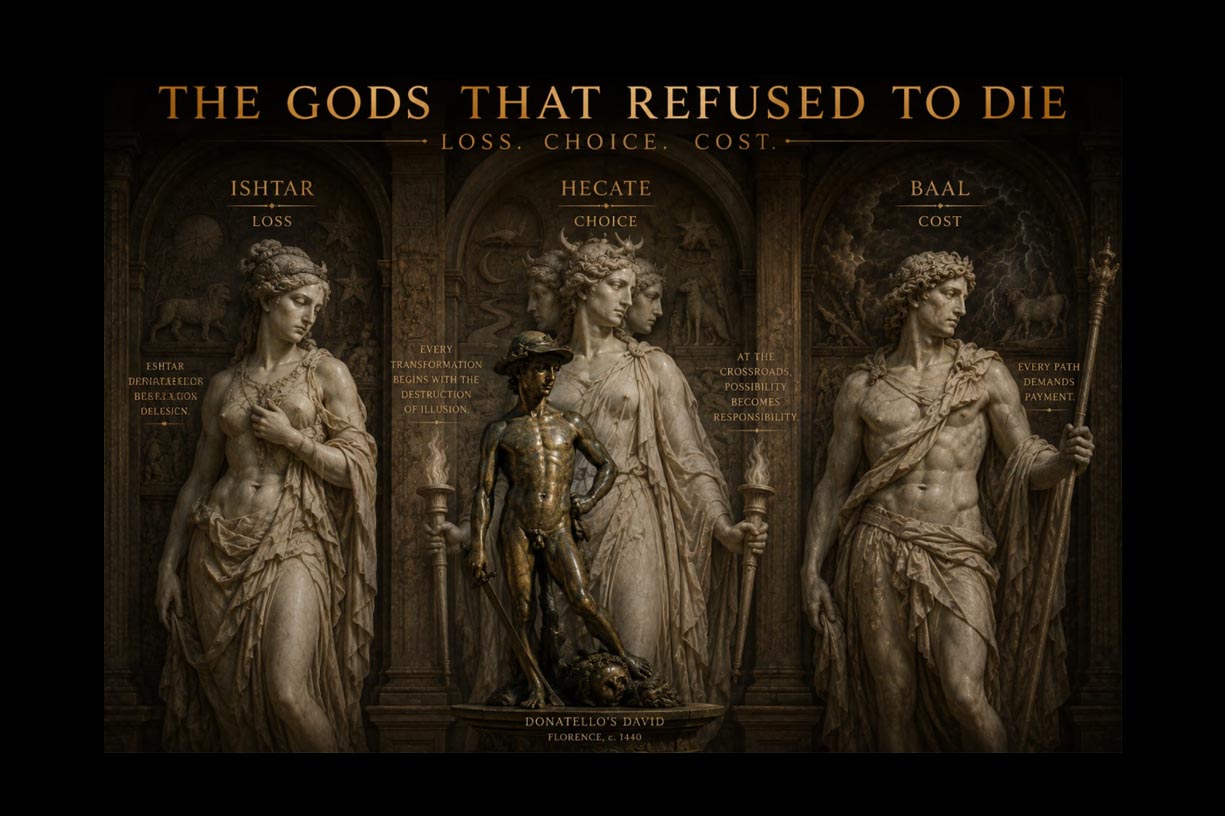
Hekate, in later artistic traditions, appearing in triple form and strongly associated with crossroads and boundaries.
The recurrence is real.
Its explanation is not simple.
Some examples belong to historical transmission.
Others emerge independently.
Some are products of narrative convenience: three provides repetition without monotony. One event establishes a pattern, the second confirms it, and the third can complete or disrupt it.
Some are retrospective. Human beings are excellent at noticing triads once we have decided that three matters.
The mistake would be to gather every occurrence and treat the collection itself as evidence of one hidden source.
Similarity is not genealogy.
A symbol of three in ancient Greece and a triadic structure in another culture may be historically unrelated.
The better question is functional:
What does three allow a story, ritual or conceptual system to do that two does not?
Sometimes the answer may be completion.
Sometimes contrast.
Sometimes mediation.
Sometimes nothing deeper than convention.
That is enough.
We do not need cosmic numerology to make the pattern interesting.
Is Three a Universal Structure or a Human Pattern?
This is exactly where Transhumation’s boundary test should be applied.
Take away the sacred associations.
Take away Hekate.
Take away Christianity.
Take away myths, stories and human preference.
What remains?
Three non-collinear points still define a plane.
A triangle remains the first polygon.
Triangular bracing still has particular mechanical properties.
Three supports still avoid the wobble created by a poorly aligned fourth point.
Those properties survive culture.
Now move into sociology.
Some triadic dynamics are still real, but they depend upon human cognition, institutions and behavior. The analogy has become less universal.
Move again into symbolism.
Now cultural context becomes indispensable.
The word three may acquire sacred significance, narrative rhythm or cosmological meaning, but those meanings are no longer consequences of geometry.
The pattern weakens as we move upward.
That does not mean we should stop.
It means we should know which floor of the building we are standing on.
Geometry gives us fact.
Social structure gives us analogy plus empirical observation.
Symbolism gives us interpretation.
Confusing the three creates mysticism by accident.
Keeping them separate produces something better: a model that knows its own limits.
The Geometry of Meaning
We can now return to the original sequence without pretending it is a law of nature.
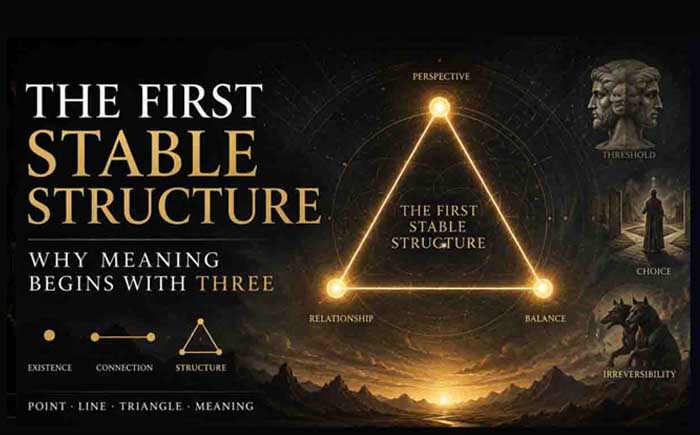
A point can represent existence.
A line can represent relation.
A triangle can represent structure.
These are metaphors.
But they are unusually good metaphors because each step corresponds to a real increase in geometric possibility.
One point cannot define distance by itself.
Two points can.
Two points cannot enclose an area.
Three non-collinear points can.
The symbolic progression therefore has a mathematical skeleton underneath it.
That is what gives it more force than an arbitrary poetic association.
But the final step must still be ours.
Geometry does not manufacture meaning.
A mind encounters geometry and uses its relations to think about something else.
Perhaps that is the deeper lesson.
Meaning does not begin with three.
It begins when a system capable of interpretation discovers that a relation can stand for more than itself.
The triangle becomes meaningful not because three points became conscious.
It becomes meaningful because consciousness discovered that structure can become a model.
Watch The Video
How to Read the World

Current Knowledge
A triangle is the simplest polygon and possesses important structural properties. Rigid triangular frames resist deformation without changing side lengths, which is why triangular bracing appears frequently in engineering and architecture. Three non-collinear points also define a plane, explaining the stability of three-legged supports on uneven surfaces.
The movement from two members to three can produce qualitatively new social dynamics. Triads allow coalitions, mediation, majority relations and forms of exclusion that are impossible in a two-person group. This is a genuine social-structural difference, although it does not imply that all social meaning begins at three.
Meaning itself is not known to require a triadic structure universally. Some theories of signs, including Peircean semiotics, describe meaning through triadic relations, while other theories use different frameworks. These are theories of interpretation rather than evidence for a cosmic numerical law.
The number three appears frequently in narrative, religion and symbolic systems across cultures, but recurrence can result from multiple causes including historical transmission, cognitive preference, narrative structure and independent development. Similarity alone does not establish shared origin.
Geometry, sociology and symbolism can therefore all make legitimate use of triadic structures, but claims valid at one level should not automatically be transferred to another.
Open Questions
One open question is why certain small-number structures appear so naturally in human cognition. Some of the preference may arise from perceptual and memory constraints, some from narrative economy, and some from properties of the systems being described. Separating those influences is difficult.
Another concerns emergence. At what point does adding elements merely increase quantity, and when does it create genuinely new classes of behavior? Triads provide a simple example, but the larger problem runs through network science, biology, language and collective behavior.
There is also a deeper philosophical question about relation itself. Western thought often describes reality through objects possessing properties, yet many modern scientific explanations depend increasingly on interactions, networks and relational structure. It remains contested how fundamental relations are compared with the entities they connect.
Finally, there is the symbolic question: when a geometric pattern reappears in mythology, social organization and modern systems, when are we observing a useful structural analogy and when are we simply projecting a preferred pattern onto unrelated material? The only responsible answer is to restore the details and see whether the comparison survives.
Transhumation Interpretation
For Transhumation, three is interesting not as a sacred number but as a boundary at which some systems acquire new relational possibilities.
Geometry gives the cleanest version. Two points establish relation; three non-collinear points can establish enclosure. Social systems show a looser version: the third participant enables coalition, mediation and a relation to relationships.
The error would be to convert this into a universal law of consciousness.
The better use is methodological. Add another element and ask whether the structure merely became larger or whether an entirely new type of relation became possible.
If nothing genuinely changes, the pattern was decorative.
If a new relational class appears, then the third point has earned its place.
FAQ
Why is a triangle considered the first closed geometric structure?
Because three non-collinear points connected by segments form the simplest polygon and create an enclosed area with an inside and an outside.
Why is a three-legged stool stable?
Three contact points always define a plane, so all three legs can rest simultaneously even on an uneven surface. A fourth leg can wobble if it does not lie in exactly the same plane.
Why are groups of three different from pairs?
A third member introduces possibilities such as coalitions, mediation, majority and exclusion that do not exist in a two-person relationship.
Does meaning literally begin with three?
No. Individuals and pairs can obviously create and experience meaning. “Meaning begins with three” is a philosophical metaphor for the way additional relations can create new system-level possibilities.
Why does the number three appear so often in myths and religions?
There is no single explanation. Historical transmission, narrative rhythm, cultural symbolism and independent recurrence can all contribute. Repetition does not prove one universal hidden meaning.
What is the deeper Transhumation question?
The important question is not whether three is secretly sacred.
It is whether reality sometimes changes qualitatively when one additional relation becomes possible.
A third point closes a shape. A third person can transform a pair into a group. A third position can make comparison possible. None of those facts proves that consciousness, civilization or meaning originated in a triangle.
But together they reveal something worth keeping.
Complexity does not always arrive through enormous numbers.
Sometimes an entire new category of behavior appears when a system gains one more point.
The mystery, then, is not the number three.
It is the moment when more becomes different.
Continue the Transhumation Series
- Forgotten Religion | Ancient Gods, Symbols and the Hidden Structures of Human Civilization
- The Last Religion | Death, Immortality and the Future of Humanity
- The New Theurgy | AI, Information and the Future of Human Civilization
- End of Branding: You Were Never Meant to Become a Product
- Baal vs Ishtar: Why Ancient Gods Never Disappeared