
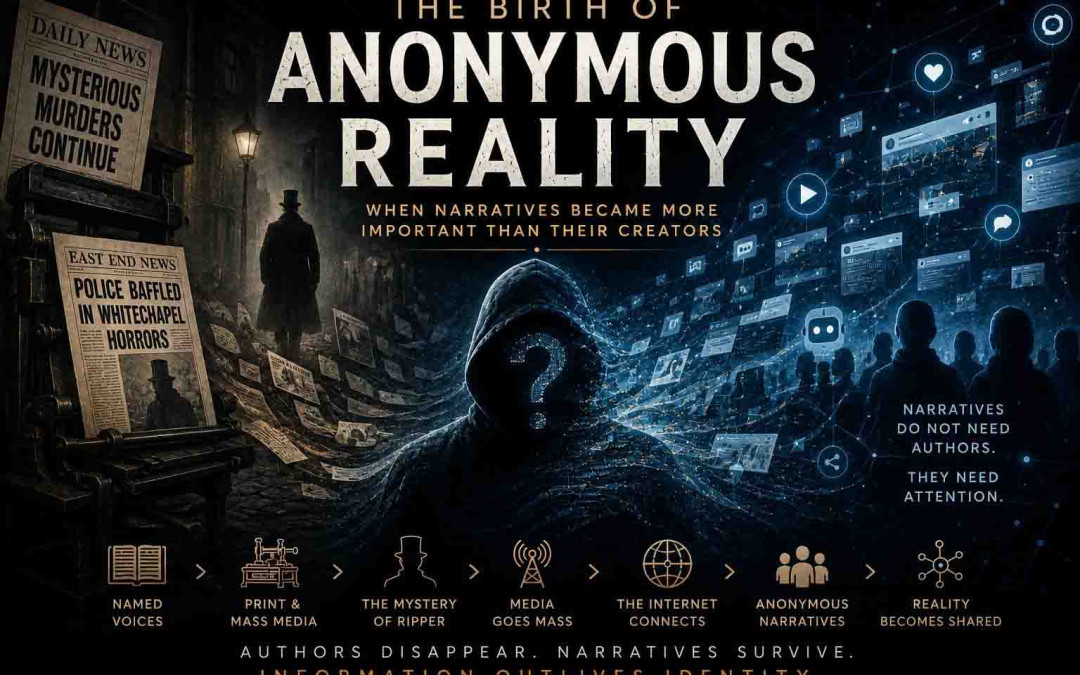
The Birth of Anonymous Reality
There is a peculiar moment in the life of a story when the person who began it stops mattering.
The sentence continues to circulate. The image is copied. The rumor acquires details. Someone retells it slightly differently. Another person cites the retelling rather than the source. Eventually the narrative can become familiar to millions of people who have never asked where it began.
Human culture has always known this phenomenon. Folktales crossed borders without passports. Songs survived singers. Religious traditions accumulated layers of authorship that later generations could no longer disentangle. Political rumors traveled through courts and marketplaces long before the newspaper press became industrial.
Anonymity is ancient.
What changed in the modern world was not its invention.
What changed was its scale.
Printing, telegraphy, newspapers, broadcasting and eventually digital networks created environments in which a narrative could separate from its origin with unprecedented speed, acquire enormous social consequences and remain culturally alive even when its authorship was disputed, fragmented or completely unknown.
The story did not need to know who had started it.
The audience did not always need to know either.
And once that condition became normal, a new problem appeared.
Not simply misinformation.
Something more fundamental.
A civilization could begin living among representations whose effects were real even when their origins were uncertain.
That is Anonymous Reality.
What Is Anonymous Reality?
Anonymous Reality does not mean a world in which nobody knows who wrote anything. Nor does it mean that authorship suddenly became irrelevant.
It describes a condition in which the social power of a narrative can become partially independent of the identity, authority or even existence of its original author.
That distinction matters.
A law still requires institutional authority.
A scientific paper still depends heavily on provenance, method and attribution.
A personal testimony gains meaning from knowing who is speaking and under what conditions.
But many cultural narratives operate differently. A joke can spread without attribution. A rumor may influence behavior before anyone establishes its origin. An image can become politically consequential even when its context has been lost. A phrase can be repeated so many times that people begin remembering the phrase while forgetting whether anyone ever proved the claim embedded inside it.
The effect becomes easier to see when the narrative is emotionally efficient.
Fear travels well.
Humor travels well.
Moral outrage travels well.
Mystery travels exceptionally well because uncertainty invites participation.
The original source may therefore lose authority at the same moment the narrative gains momentum.
This is not the disappearance of reality.
It is the appearance of another layer between reality and the people trying to understand it.
The Ancient World Was Never Entirely Named
There is a seductive historical myth in the original idea: the ancient world belonged to known voices, while modernity produced anonymous information.
History is messier.
Many ancient stories have uncertain authorship. Oral traditions were transformed through generations of transmission. Texts attributed to famous figures were sometimes written by later followers or compiled from multiple sources. Anonymous political speech, rumor and pseudonymous writing are hardly modern inventions.
Even authority itself was never purely personal.
A king’s proclamation derived power not merely from knowing the king’s name but from institutions, rituals and accepted hierarchies. Religious traditions could remain authoritative even when authorship was complex or unknown. Collective memory often cared less about an identifiable originator than about continuity of tradition.
The real transformation therefore concerns distribution and amplification, not the invention of anonymous narratives.
The nineteenth century placed older human tendencies inside much faster systems.
A rumor no longer needed to travel only through conversation.
A report could be printed thousands of times.
A telegraphic summary could move information across large distances before most physical travelers could approach the same destination.
A newspaper could turn a local uncertainty into a national object of attention.
The story acquired machinery.
And machinery changes scale.

Why Jack the Ripper Matters
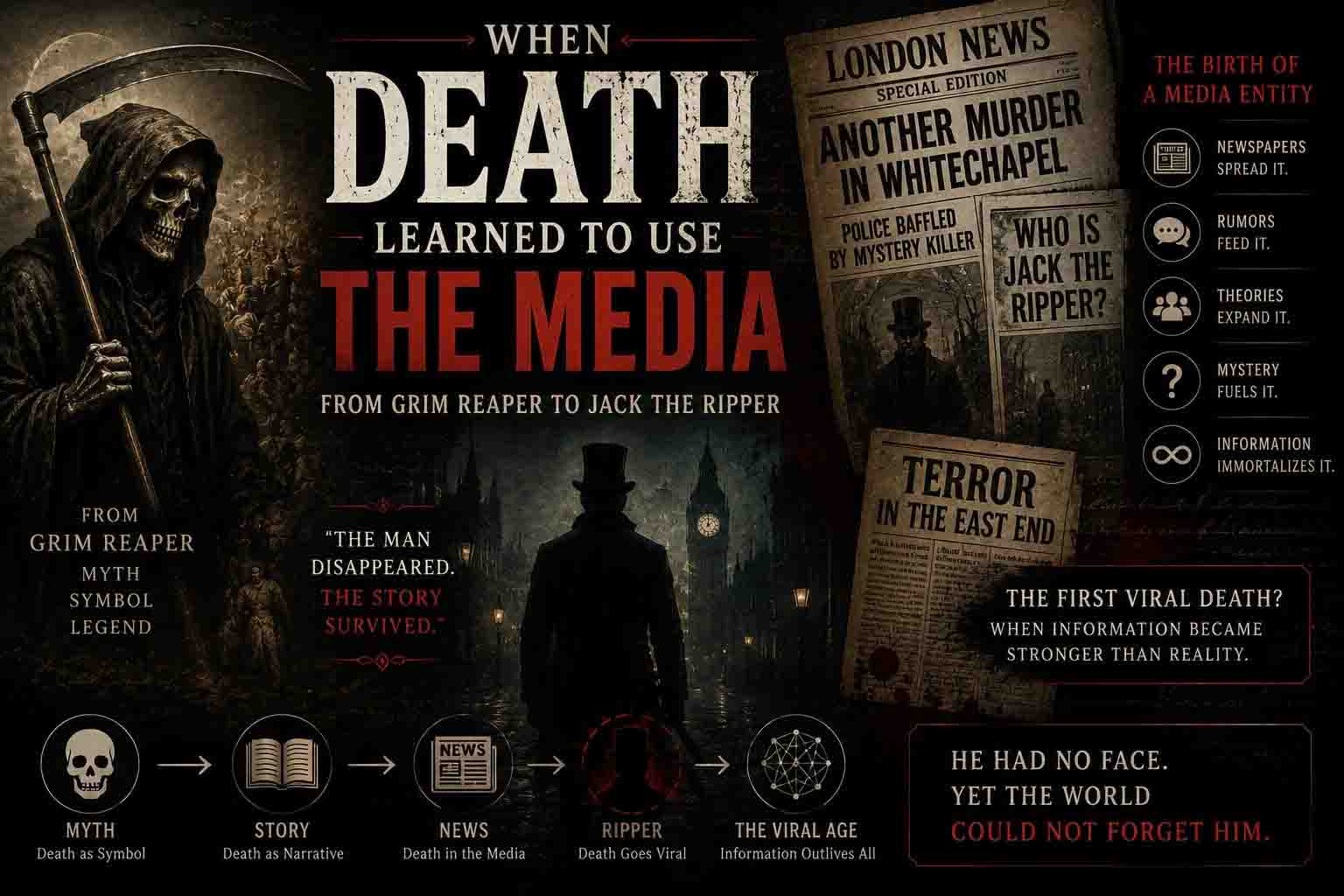
Few historical cases reveal the separation between source and narrative as clearly as Jack the Ripper.
Someone committed the Whitechapel murders.
That person was physical, finite and geographically constrained. He had one body, one biography and one actual set of motives, whatever they were.
The public figure called Jack the Ripper behaves very differently.
The name became famous through correspondence claiming to come from the murderer, particularly the “Dear Boss” letter. The authenticity of that correspondence remains uncertain, and many later Ripper letters were plainly hoaxes. The theatrical voice associated with the killer may therefore belong partly or entirely to people who did not commit the crimes.
This creates an extraordinary inversion.
The historical individual remains unidentified.
The cultural identity becomes highly recognizable.
We do not know the face.
We know the silhouette.
We do not know the name.
We know the nickname.
We do not know whether the famous voice was his.
We recognize the voice anyway.
The persona becomes more stable than the person.
That is not merely an unsolved-crime curiosity. It is a clean example of Anonymous Reality: a public identity can acquire continuity even when its connection to the original source remains uncertain.
The Author Disappears, the Character Improves
Ordinary biography narrows possibility.
The more we learn about a person, the more alternatives disappear. An address rules out some locations. A photograph stabilizes appearance. A date restricts movement. A letter establishes vocabulary. Evidence gradually closes the field.
Jack the Ripper has largely escaped that process.
The archive expanded while the central identity remained open.
That openness became culturally productive.
If the murderer had been conclusively identified in 1888, he would still have become historically notorious. But the cultural object would have been narrower. A verified biography imposes limits.
Mystery removes them.
The unknown killer can be reinterpreted for every generation because the source does not resist.
Victorians could imagine a foreigner, surgeon, degenerate or hidden gentleman. Later periods could imagine conspiracies, psychological archetypes or sophisticated serial-offender profiles. Film could turn the unknown man into gothic atmosphere. Television could turn him into mystery. The internet could turn him into an endlessly branching suspect database.
The absence acts almost like unused space in architecture.
Every generation furnishes the room differently.
This helps explain why anonymity can occasionally strengthen a narrative rather than weaken it.
The missing author becomes an invitation.
When the Audience Becomes Co-Author
Once a story enters a sufficiently connected information environment, authorship becomes distributed.
The original event may have one cause, but the public narrative does not.
Journalists select details.
Editors frame them.
Witnesses contribute impressions.
Police release or withhold information.
Readers offer theories.
Hoaxers invent material.
Later historians sort the archive.
Novelists dramatize it.
Filmmakers create visual conventions.
Online communities compare fragments.
Each participant modifies the thing being transmitted.
This does not mean all interpretations are equally valid.
Some are supported by evidence.
Others are inventions.
But culturally, they can coexist inside the same informational object.
Jack the Ripper becomes less like a conventional character and more like a long-running collaborative construction whose contributors disagree about what they are constructing.
That is one of the defining characteristics of Anonymous Reality.
A narrative no longer requires one author because the environment itself can continue generating versions.
The audience stops merely receiving.
It begins maintaining the object.
The Internet Did Not Invent This
The internet is often treated as the moment when information became detached from authorship.
It did something more powerful.
It made detachment ordinary, immediate and measurable.
A meme can cross continents while its creator remains unknown.
A video can be copied without context.
A screenshot can survive after the original post disappears.
An anonymous account can acquire more cultural influence than many public institutions.
A claim can be repeated thousands of times before anyone has identified its source.
The internet did not invent rumor, pseudonymity or collective authorship.
It removed friction from them.
More importantly, digital platforms added feedback.
People can see what spreads.
They can imitate it.
Systems can rank what generates reaction.
Creators can adjust themselves according to measurable engagement.
Narratives therefore do not merely circulate.
They are selected by an environment that rewards certain properties.
Simplicity.
Novelty.
Emotion.
Conflict.
Recognition.
This creates a powerful evolutionary metaphor, provided we remember it is a metaphor rather than biology.
Stories compete for attention.
Some mutate successfully.
Some disappear.
Some retain a recognizable core while changing almost everything around it.
The source becomes increasingly distant.
The pattern remains.
Autonomous Narratives Are Not Actually Autonomous
The phrase autonomous narrative is useful but dangerous.
Stories do not literally reproduce themselves.
People copy them.
Platforms distribute them.
Servers store them.
Algorithms rank them.
Institutions promote them.
Human attention sustains them.
Every apparently autonomous narrative rests on physical infrastructure and human behavior.
The illusion of autonomy appears because no single person controls the whole process.
This is similar to a market.
No one individual decides the final price of every object, yet the system produces prices.
No one person authored the modern Jack the Ripper mythology, yet the mythology exists.
No individual decides exactly what global internet culture will discuss tomorrow, yet topics emerge.
The narrative looks alive because its behavior exceeds the intentions of any one contributor.
That is an important distinction for Transhumation.
Emergent does not mean conscious.
Self-reinforcing does not mean alive.
Persistent does not mean immortal in the personal sense.
A pattern can behave as though it possesses autonomy without possessing an interior life.
Why Provenance Matters
Anonymous Reality becomes dangerous when influence becomes separated from provenance.
Provenance is simply the history of where something came from.
Who created it?
When?
Under what conditions?
Was it altered?
Was it copied from another source?
Is the surviving version contemporary with the event or reconstructed decades later?
These questions sound archival.
They are becoming central to ordinary life.
A photograph can be genuine but captioned falsely.
A quotation can be authentic but assigned to the wrong speaker.
A video can be real but removed from context.
An AI-generated image can depict an event that never occurred.
A synthesized voice can sound perfectly human without ever having belonged to a human speaker.
The more convincing representations become, the more valuable provenance becomes.
This is an inversion of an older assumption.
We used to treat realism as evidence.
Increasingly, realism may tell us very little about origin.
The image looks real.
That no longer answers the important question.
Where did it come from?
Anonymous Narratives in the Age of AI
Artificial intelligence adds a new layer because it can generate coherent material without a conventional individual author making each local decision.
There are still authors in the broader system: developers, users, institutions, data creators and people defining objectives. But the specific sentence produced at a specific moment may not have a simple analogue to the old model of one writer choosing every word.
This does not make AI-generated information ownerless or metaphysically autonomous.
It makes authorship more distributed.
The change matters because humans are psychologically accustomed to treating fluent language as evidence of a speaker.
A sentence appears deliberate.
A paragraph appears to contain personality.
A conversational system appears to possess a stable voice.
The interface invites us to imagine someone behind it.
But coherence is not proof of consciousness, and style is not proof of a single authorial self.
This brings Anonymous Reality into a much more serious phase.
The nineteenth century allowed a persona to emerge around an absent man.
The digital world allows personas to exist without any straightforward correspondence to one human source at all.
We are becoming increasingly comfortable interacting with voices whose provenance is structural rather than personal.
Influence Without Identity
This changes the old relationship between authority and influence.
Authority traditionally asks:
Why should I trust you?
Influence asks:
Can you make me look?
The two can overlap.
They do not have to.
A physician may possess authority and little reach.
An anonymous account may possess enormous reach and no demonstrated expertise.
A sensational claim can dominate public conversation before a careful correction leaves the first editorial meeting.
This distinction is one of the central problems of modern information culture.
Visibility is not evidence.
Replication is not truth.
Engagement is not authority.
And familiarity is particularly dangerous because repetition can make a claim feel known even when its origin remains weak.
Anonymous Reality therefore does not eliminate authorship.
It makes source literacy more important.
The more easily narratives detach from creators, the more carefully civilization must learn to trace them back.
Watch The Video
How to Read the World

Current Knowledge
Anonymous and collective storytelling long predate modern mass media. Oral traditions, unattributed works, pseudonymous texts, rumors and evolving myths demonstrate that cultural narratives have never depended exclusively on identifiable individual authors.
The nineteenth century nevertheless brought major changes in the speed and scale of information circulation through expanding literacy, cheaper printing, newspaper competition, rail distribution, telegraphy and news agencies. These systems allowed geographically distant audiences to participate in shared informational events more rapidly than earlier media environments typically permitted.
The Jack the Ripper persona provides an unusually clear case of unstable authorship. The murderer remains unidentified, while the name became famous through correspondence whose authenticity is uncertain. Much of the familiar cultural personality surrounding the Ripper cannot therefore be assumed to represent the historical offender.
Digital networks further reduce the cost of copying, modifying and redistributing information. Social platforms also add mechanisms for measuring and ranking attention, making circulation itself a source of influence.
Artificial intelligence complicates authorship further by producing outputs through systems involving training data, model architecture, developers, user prompts and automated generation rather than one straightforward human author choosing every element of the final expression.
Open Questions
One open question is whether anonymous narratives are genuinely more powerful now or simply more visible because modern networks allow their movement to be measured. Humans have always circulated rumors and collective stories, but contemporary systems preserve enormous amounts of evidence about how those narratives spread.
Another concerns trust. If authorship becomes increasingly distributed, what should replace the old intuition that knowing the speaker helps evaluate the statement? Provenance, institutional accountability, transparent sourcing and independent verification may become more important than the apparent personality of the voice delivering the information.
There is also the question of identity. Can a public persona become socially real even when no stable individual corresponds to it? Online culture already suggests that the answer can be yes in a practical sense: accounts, characters and collective identities can produce consequences without revealing a conventional personal source.
The deepest uncertainty concerns AI. As synthetic voices become more persuasive and personalized, will people continue to distinguish between information produced by a person, information mediated by a system and information generated through a distributed process whose authorship cannot be reduced to either category?
Transhumation Interpretation
Anonymous Reality matters to Transhumation because it forces us to separate three things that humans naturally want to keep together:
the source, the pattern and the effect.
A person produces something.
The thing travels.
Another person encounters it.
In simple cases, all three remain easy to connect.
A letter arrives from someone you know.
The handwriting belongs to them.
The contents refer to a shared history.
The material object reinforces provenance.
Modern information systems weaken those connections.
The pattern can survive while the source disappears.
The effect can grow while knowledge of the source declines.
And eventually a representation can become socially powerful enough that the absence of a verified origin no longer prevents it from acting in the world.
Jack the Ripper is a useful historical example because the pattern became extraordinarily durable while the person remained inaccessible.
That should caution us against one of the easiest mistakes in thinking about informational survival.
Persistence is not identity.
A name surviving for centuries does not mean the person survived.
A writing style reconstructed by AI does not mean the writer survived.
A digital model capable of generating plausible memories does not establish first-person continuity.
Sometimes information preserves a person remarkably well.
Sometimes it preserves only selected traces.
Sometimes it preserves what other people constructed around the missing person.
The carrier can be faithful.
It can also carry distortion.
This is why provenance becomes one of the moral foundations of the Library of Mirrors.
A library should not merely preserve what was said.
It should preserve, whenever possible, how we know who said it, when it entered the record, how it changed and where uncertainty begins.
Without that architecture, an information-rich civilization can become strangely ahistorical.
Everything is available.
Nothing has lineage.
The result is a world of perfect surfaces without ancestry.
Artificial intelligence intensifies the problem because it can generate plausible continuity across missing material.
A historical person leaves fragments.
The model fills the intervals.
A dead author’s style continues.
An incomplete archive becomes conversational.
At first this looks like preservation.
But if generated material is mixed invisibly with historical material, preservation turns into reconstruction.
Then reconstruction can become invention.
And eventually the invention may become more accessible than the surviving source.
This is precisely the danger visible in the Ripper story.
The unknown man was replaced gradually by an increasingly coherent character.
The character became easier to encounter than the evidence.
AI could perform the same transformation with greater elegance and at far greater scale.
That is why a future digital civilization may need a new kind of literacy.
Not merely:
Is this true?
But:
What kind of thing am I looking at?
A primary record?
A copy?
A summary?
A reconstruction?
An inference?
A generated continuation?
A cultural myth?
The categories matter because increasingly sophisticated interfaces will make them look similar.
Anonymous Reality is therefore not the death of authorship.
It is the end of the assumption that authorship will always remain visible.
That is a subtler and more important transformation.
The nineteenth century gave stories faster carriers.
The twentieth century gave them radio, cinema and television.
The internet gave them global replication and feedback.
Artificial intelligence may give them voices capable of continuing after their sources disappear.
The pattern becomes increasingly durable.
The origin becomes increasingly difficult to see.
This does not mean reality itself has become anonymous.
The physical event still happened somewhere.
Someone still performed the action.
Every digital process still has infrastructure, history and causes.
What becomes anonymous is our access to causation.
The effect reaches us before the genealogy does.
That is the danger and the fascination.
Civilization has become extraordinarily good at preserving messages.
Its next task may be harder:
preserving the paths that lead backward from messages to the worlds that produced them.
FAQ
What is Anonymous Reality?
Anonymous Reality describes an information environment in which narratives can acquire significant social influence even when their original authorship or provenance is uncertain.
Is anonymous storytelling a modern invention?
No. Anonymous myths, rumors, songs and texts are ancient. Modern media changed their speed, scale, persistence and ability to circulate independently of local communities.
Why is Jack the Ripper relevant?
Because the public persona became highly recognizable despite the historical individual remaining unidentified and the authorship of famous Ripper correspondence remaining uncertain.
Did the internet create Anonymous Reality?
No. It greatly accelerated it by making copying, modification, participation and global distribution exceptionally cheap and fast.
How does AI change the problem?
AI can generate coherent text, images and voices without the simple authorship model of one person choosing every element. This makes provenance and source transparency increasingly important.
What is the deeper Transhumation question?
A narrative can survive after its source disappears. It can even become more powerful than the fragment of reality from which it began.
The difficult question is therefore no longer merely whether information can survive us.
It is whether a civilization surrounded by surviving patterns will still be able to tell which patterns preserve their sources, which distort them, and which have quietly become new realities of their own.
Continue the Transhumation Series
- Forgotten Religion | Ancient Gods, Symbols and the Hidden Structures of Human Civilization
- The Last Religion | Death, Immortality and the Future of Humanity
- The New Theurgy | AI, Information and the Future of Human Civilization
- End of Branding: You Were Never Meant to Become a Product
- Baal vs Ishtar: Why Ancient Gods Never Disappeared