
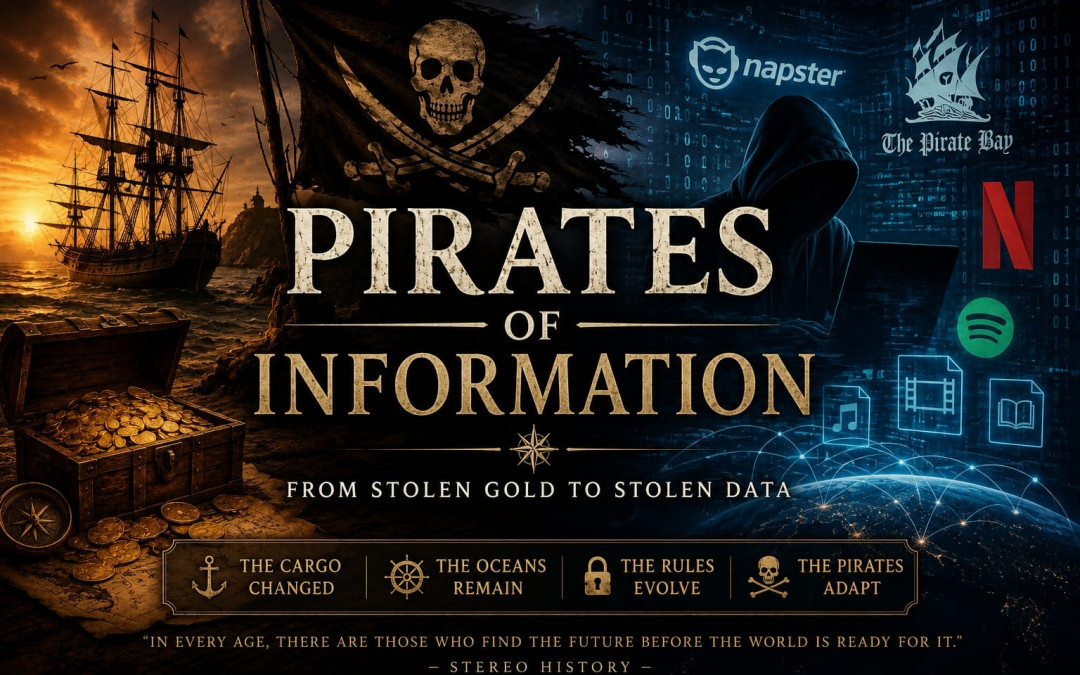
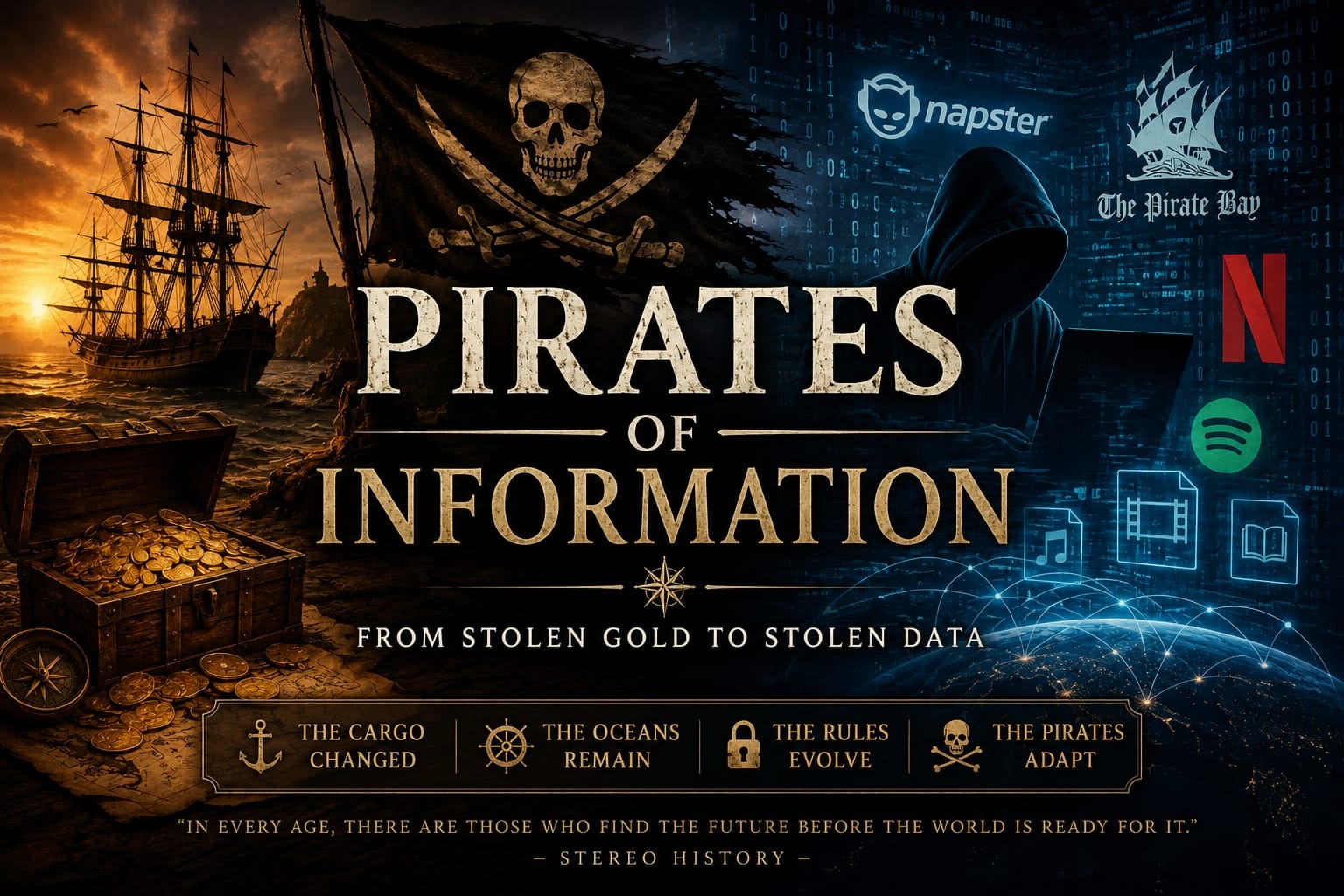
Pirates of Information
An eighteenth-century pirate would have understood the container immediately.
A merchant ship crossing the Atlantic was valuable partly because its wealth had nowhere else to be. Sugar sat in barrels. Silver occupied chests. Silk filled the hold. Spices, tobacco, coin and manufactured goods possessed weight, volume and location. To steal the cargo, one had to reach the ship, board it, overcome resistance and physically remove something that its former owner would no longer possess.
Then imagine showing the same pirate a modern music file.
You copy it.
The original remains.
You send the copy across an ocean without a ship. A second person copies it again. Then a million people do the same. No chest becomes lighter. No harbor receives another vessel. Yet value has moved, ownership claims have been challenged, industries may lose revenue, new audiences appear and a cultural object that once depended on manufactured carriers begins circulating almost independently of them.
The pirate would recognize the conflict.
He might not recognize the economics.
That difference is the beginning of Pirates of Information. The digital age did not simply replace gold with data. It created forms of valuable cargo that behave unlike almost anything pirates once carried away.
The treasure can be copied without being removed.
And once that became possible, some of the oldest ideas about property began to encounter a very strange sea.
The Treasure Was Never Just Gold
Historical piracy followed trade because trade concentrated value.
The pirate did not need a theory of capitalism. He needed to know where desirable goods moved, where protection weakened and where the expected reward exceeded the danger. Oceans created distance from authority, merchant routes created predictability, and imperial systems created enough commercial abundance for parasitic economies to emerge around them.
Modern information systems produce a similar temptation at a structural level. They concentrate things people value and make them movable. Music, films, software, commercial secrets, personal records, financial credentials and intellectual property can all travel through networks at speeds that would make physical smuggling almost comical by comparison.
But the analogy breaks the moment we examine the cargo closely.
Steal a gold coin and the owner no longer has that coin.
Copy a song and the original file can remain perfectly intact.
Steal a password database and the victim may still possess the data, but an unauthorized party now possesses access whose consequences can be devastating.
Leak a confidential document and the central damage may come not from loss of possession but from loss of secrecy.
Digital property therefore forces us to distinguish several things the wooden treasure chest conveniently kept together: possession, exclusivity, access, reproduction and control.
The ocean changed because the cargo acquired new physics.
Is Digital Piracy Really Theft?
This question often produces more heat than clarity because the word theft carries an intuition formed in the physical world.
Traditional theft is subtractive. Something I possess becomes something you possess instead.
Unauthorized digital copying can be non-rival in a narrow material sense. You may reproduce my file without removing my copy. That does not make the act harmless or legally permissible. Copyright law protects rights of reproduction and distribution precisely because creative goods can retain economic value even when copying does not physically deprive the owner of the original.
But the distinction matters intellectually.
The central problem in digital piracy is often not that an object disappeared.
It is that control over replication disappeared.
That is a new kind of vulnerability.
A physical publisher can control a warehouse full of books reasonably well because every additional copy requires paper, printing, transport and inventory. A digital file can escape once and generate millions of near-identical copies at negligible marginal cost.
The loss of exclusivity can therefore be enormous even when the original artifact remains untouched.
This is why the pirate metaphor survived into the internet era so naturally. The legal categories are different, but the emotional structure remains recognizable: someone crosses a boundary established by an owner and moves value through a route the owner did not authorize.
The ship became a server.
The contested object became reproducibility itself.
Napster and the Route Nobody Could Close
Napster arrived in 1999 and exposed the problem in its cleanest cultural form.
Music consumers had spent decades purchasing access to recordings through physical formats: vinyl, cassette, compact disc. The industry organized pricing, distribution and ownership around those containers.
Then a network allowed users to locate music on one another’s computers.
The cultural shock was larger than the software.
A listener no longer needed to think in albums, record stores, manufacturing schedules or shelf space. A desired song could become a searchable object whose relevant location was simply somewhere on the network.
This was not legal liberation from obsolete rules. Rights holders had legitimate claims, and Napster became the subject of major copyright litigation that ultimately destroyed the original service.
Yet the behavior revealed something the industry could not easily unsee.
Consumers valued access differently once the technical possibility changed.
They wanted individual tracks.
Searchability.
Immediate availability.
Large catalogues.
Portability.
The ability to move between artists without moving between physical objects.
Piracy did not invent those desires, and it did not provide the only possible business model. But it revealed the size of the demand before the legal market had fully reorganized around it.
That is the Pirate Principle in a more defensible form.
The pirate does not necessarily invent the future.
Sometimes the pirate demonstrates that a future-shaped behavior is already technologically possible and socially desired.
Did Napster Create Spotify?
No.
And saying yes would make a good story worse.
Spotify emerged from a different technological and commercial environment. Broadband became more widespread. Mobile computing advanced. Licensing structures evolved. Record companies faced changing economics. Cloud infrastructure improved. Consumers became accustomed to accessing media rather than necessarily possessing each individual copy.
Digital piracy was one pressure among several.
But the lineage remains interesting because the legal streaming model eventually satisfied many desires that unauthorized file-sharing had made visible: enormous searchable catalogues, near-instant playback, movement away from physical media and reduced friction between wanting a song and hearing it.
The crucial shift was from ownership of copies to licensed access to libraries.
That transformation would have been difficult to explain using the logic of the record cabinet.
The user did not necessarily want five thousand discs.
The user wanted the functional consequence of having five thousand discs without the room required to store them.
Streaming did not legitimize piracy.
It changed the product.
And sometimes that is how institutions defeat pirates most effectively. They do not merely guard the old harbor more aggressively. They redesign the route.
Why Did The Pirate Bay Matter?
The Pirate Bay made the metaphor explicit.
Founded in Sweden in the early 2000s, it became one of the most recognizable names associated with BitTorrent file sharing. Its nautical language was deliberate: pirate ships, bays, trackers, torrents, flags. The branding openly embraced conflict with existing copyright structures.
Yet the most revealing thing about The Pirate Bay was not the joke in the logo.
It was decentralization.
The old pirate needed the cargo.
The digital pirate often needed only information about where fragments of the cargo could be found and how they could be assembled.
BitTorrent distributed parts of files among many users rather than requiring one central warehouse to deliver every complete copy. The architecture made the old geographical intuition increasingly useless.
Where, exactly, was the contraband?
Partly here.
Partly there.
Partly in instructions describing how machines should find one another.
The port had become a protocol.
This is an important moment in the history of information because it shows what happens when the carrier becomes distributed. Removing one object no longer necessarily removes the pattern.
The law can target institutions, domains, servers and participants.
But the informational structure may migrate.
The hydra metaphor becomes tempting because cutting off one visible point does not guarantee destruction of the network.
Again, none of this determines whether the underlying activity is legitimate.
It reveals something about the architecture.
Information Wants to Move, but It Does Not Want Anything
There is a famous cultural temptation to describe information as though it possesses desire.
Information wants to be free.
Information wants to spread.
Information escapes.
The metaphor is powerful and should remain a metaphor.
Information wants nothing.
People want access.
Companies want control.
Researchers want circulation.
States want intelligence.
Creators want recognition and compensation.
Networks make copying easier.
Protocols lower friction.
Storage becomes cheaper.
The appearance of an irresistible natural force emerges from the interaction of those interests with technologies that make replication unusually inexpensive.
This distinction matters because technological convenience does not settle moral or legal questions.
Something being easy to copy does not establish that everyone has the right to copy it.
At the same time, laws designed for expensive physical reproduction can become increasingly difficult to enforce unchanged once reproduction becomes a basic capability of the medium itself.
The conflict is therefore not simply pirate against owner.
It is often an older institutional model colliding with a new cost structure.
That collision can produce innovation.
It can also produce exploitation.
Usually it produces both.
Why Is Data Valuable?
Calling information “the new gold” is attractive because both can create power.
But data is not simply another precious metal.
Its value is contextual.
A database of yesterday’s weather may be nearly worthless to one company and useful to another. A list of passwords may be extraordinarily valuable to a criminal and catastrophic to the people whose credentials were exposed. Medical records can be valuable because they contain sensitive information. Training data can become valuable when combined with computation and models capable of extracting useful structure.
Data often gains value through aggregation, interpretation and actionability.
A single location coordinate says little.
A year of location history can reveal routines.
One purchase says little.
Thousands can reveal preference.
One sentence may be banal.
A corpus of billions of sentences can become part of the material from which statistical language models learn patterns.
The treasure therefore does not always sit inside the individual datum.
Sometimes the treasure appears only after relationships emerge among many data points.
This makes modern information power structurally different from a chest of coins.
Gold does not become dramatically more gold when placed beside other gold.
Data can become qualitatively more revealing when combined.
The Pirate No Longer Needs to Take the Cargo
This changes the meaning of attack as well.
A pirate once wanted possession.
A modern attacker may want access.
Copy.
Disclosure.
Leverage.
Disruption.
Training material.
Identity.
A database can be compromised without disappearing. A model can be copied. A trade secret can lose most of its economic advantage the moment one unauthorized competitor learns it. A private photograph can become harmful precisely because it is reproduced rather than removed.
The digital pirate therefore demonstrates another principle of the information age:
loss can occur without absence.
That is philosophically strange because human intuitions about property evolved around scarcity.
If I give you my loaf of bread, I have less bread.
If I tell you an idea, we may both have the idea.
Culture has always known this distinction. Digital technology magnified it until entire industries had to be redesigned around it.
The contested commodity increasingly becomes not the physical thing but the right to determine who may instantiate the pattern.
That is a very Transhumation problem.
Nassau and the Digital Bay
Nassau and The Pirate Bay should not be treated as equivalents.
One involved actual Atlantic piracy, physical danger, imperial weakness and stolen goods. The other belonged to a digital copyright conflict inside modern legal and technological systems.
Yet the comparison reveals an interesting structure.
Both depended upon gaps between what a large system wanted to control and what it could efficiently control in practice.
Nassau benefited from weak imperial governance across difficult geography.
Digital piracy benefited from the difficulty of controlling near-costless replication across decentralized networks.
In both cases, the center possessed rules whose enforcement weakened at the edge.
That does not make the edge morally superior.
It makes the boundary analytically valuable.
Rules become easiest to understand where they start failing.
A pirate port can reveal weaknesses in an empire.
A peer-to-peer network can reveal assumptions hidden inside a distribution industry.
The pirate tests the architecture whether civilization likes the test or not.
The Pirate Paradox
This is why the Pirate Principle remains useful despite all the necessary qualifications.
The outsider occasionally discovers a function that the established system eventually adopts in another form.
Free file sharing showed that people valued immediate digital access. Legitimate streaming eventually provided it under different economic arrangements.
Hacker communities have sometimes exposed security weaknesses that institutions later learned to defend.
Unofficial modifications of software have revealed features users wanted before developers incorporated similar functionality.
But retrospective history makes these cases look cleaner than they were.
Most piracy does not produce innovation.
Most rule-breaking reveals nothing valuable.
And an institution adopting a superficially similar feature later does not retroactively legitimize every method by which the earlier behavior occurred.
The interesting pattern is narrower.
The edge can sometimes identify latent demand or latent capability before the center has an incentive to reorganize around it.
That is discovery.
The rest still requires law, infrastructure, investment and scale.
The pirate finds a route.
Civilization decides whether a road should exist there.
Is AI the Next Piracy Debate?
Artificial intelligence has already reopened many of the same questions in a more complicated form.
What does it mean for a model to learn from copyrighted material?
When does statistical learning differ meaningfully from reproduction?
What rights should creators possess when their works contribute to training systems?
What constitutes imitation?
How should provenance work when generated outputs combine patterns learned across enormous corpora?
These are active legal, technical and cultural disputes, and reducing them to “AI steals information” would settle questions that remain genuinely contested.
But the structural resemblance is significant.
Once again, technology has changed what can be done with information faster than institutions have agreed on how every capability should be governed.
Napster changed copying and distribution.
Generative AI changes transformation and synthesis.
The argument is no longer only about whether a file may be reproduced.
It increasingly concerns what may be learned from a corpus, what can be reconstructed from learned structure, and which forms of human cultural production should remain traceable to their sources.
The next pirate ship may therefore carry no stolen file at all.
It may carry a model.
Watch The Video
How to Read the World
Current Knowledge
Historical piracy was primarily concerned with physical goods, ships and commercial routes, while digital piracy generally involves unauthorized reproduction or distribution of copyrighted material. The analogy is therefore metaphorical rather than legally or economically exact.
Napster launched in 1999 as a peer-to-peer music-sharing service and became the subject of major copyright litigation. Its popularity demonstrated substantial consumer demand for searchable, immediate digital access to music, although legitimate streaming services emerged later from a much broader combination of technological, licensing and commercial developments.
The Pirate Bay became an influential index associated with BitTorrent distribution and deliberately adopted pirate imagery as part of its identity. Peer-to-peer architecture differs from traditional centralized distribution because users can exchange portions of files among many participating machines.
Digital information always depends on physical infrastructure. Servers, storage devices, networks, data centers, electricity and user hardware remain necessary even when copying appears almost immaterial from the perspective of the user.
Data can have substantial economic value, but its value depends on context, quality, exclusivity, scale and the ability to use it. It is therefore misleading to describe information simply as a universal replacement for gold or physical wealth.
Open Questions
One unresolved question concerns how institutions should govern goods whose cost of reproduction approaches zero while the cost of creating the original work remains substantial. Copyright law attempts to solve part of this problem, but technological capabilities and cultural expectations continue evolving.
Another concerns the relationship between piracy and innovation. Unauthorized systems can expose unmet demand or inefficient distribution, but distinguishing genuine discovery from simple exploitation is difficult and should not be decided merely by whether a similar legal service appears later.
There is also the question of control. In a physical economy, ownership is strongly associated with possession. In an information economy, value may depend more heavily on access, secrecy, licensing and the ability to control replication. That requires legal and cultural concepts different from those surrounding ordinary physical objects.
Artificial intelligence adds a deeper problem because learning, copying, transformation and generation do not map neatly onto older categories of reproduction. The legal frameworks developing around training data, provenance and generated works may become some of the defining information-policy questions of the coming decades.
Transhumation Interpretation
Pirates of Information belongs to Transhumation because piracy exposes one of the deepest consequences of carrier-independent structure.
A gold coin is stubbornly attached to its material instance.
A melody is not.
Destroy one performance and the melody may survive in another.
Burn one book and the text may survive elsewhere.
Delete one file and enough copies may remain for the pattern to be reconstructed indefinitely.
This does not mean information becomes carrier-free.
Every copy needs matter.
But the importance of one particular piece of matter can decline dramatically.
That changes power.
When value depends upon a unique physical object, control can often be exercised through possession.
When value depends upon a reproducible pattern, control must increasingly be exercised through law, secrecy, authentication, scarcity mechanisms or access systems.
The pirate reveals this change because the pirate attacks whatever the system believes it owns.
In the old world, that meant the cargo.
In the digital world, it may mean the right to reproduce the pattern.
This connects directly with the Compression Revolution and the Carrier and the Pattern.
Civilization becomes more powerful when useful structures can move between carriers.
Language does this.
Printing does this.
Digital files do it with extraordinary fidelity.
AI may extend the principle by making stored cultural patterns increasingly transformable rather than merely copyable.
But every reduction in dependence on a specific carrier produces a governance problem.
If the pattern can move, who has the right to move it?
If it can be copied perfectly, what does ownership mean?
If it can be transformed, when does the new pattern remain dependent enough on the old one to create an obligation?
Technology does not answer those questions.
It merely makes them impossible to avoid.
The Pirate Principle therefore needs an ethical boundary.
The pirate is useful as a detector of structural weakness, not as a moral hero.
A pirate can expose that an industry sells an obsolete container.
A hacker can expose that a security architecture is fragile.
An unofficial user can reveal that a system supports functions its designers overlooked.
But discovery of possibility does not establish legitimate entitlement to exploit it.
That distinction becomes particularly important in AI.
The future may depend upon systems capable of learning from enormous parts of human culture.
The fact that such learning is technically possible does not by itself determine the rights of creators, institutions or users.
The answer will require law, economics, technical design and cultural negotiation.
What Transhumation can contribute is a clearer structural question:
What exactly is being preserved, copied or transformed when the carrier changes?
That question prevents us from using one metaphor for every informational conflict.
A stolen password is not a pirated song.
A leaked medical database is not an unauthorized film copy.
A model trained on public text is not automatically equivalent to either.
The word data hides radically different structures inside one convenient category.
A good Library of Mirrors should do the opposite.
It should distinguish them.
This may be the deeper lesson of the pirate metaphor.
Pirates appear wherever civilization creates something valuable that can move faster than the rules designed to contain it.
The rules eventually respond.
Sometimes the old system adapts.
Sometimes a new market appears.
Sometimes stronger walls are built.
Sometimes society concludes that the old wall was protecting the wrong thing.
The interesting question is never merely who crossed the boundary.
It is what the crossing revealed about the boundary itself.
Gold taught civilization about possession.
Digital files forced it to think about reproduction.
Personal data forced it to think about access and privacy.
Artificial intelligence may force it to think about learning, transformation and provenance.
The treasure changes because the category of value changes.
And perhaps this is where Episode II of the Pirate Principle should end.
Not with a pirate finding the next chest.
With civilization discovering that the next treasure may not fit inside a chest at all.
FAQ
What are “Pirates of Information”?
The phrase describes people or systems that copy, distribute, access or exploit valuable information outside established rules. It is a broad metaphor, not one legal category.
Is digital piracy the same as stealing physical property?
No. Physical theft removes an object from its owner, while unauthorized copying can leave the original intact. Copyright, privacy and data theft therefore involve different legal and economic problems.
Did Napster create Spotify and modern streaming?
No. Napster helped reveal strong demand for frictionless digital music access, but streaming emerged from many factors including broadband, licensing, mobile devices, commercial strategy and technological infrastructure.
Why was The Pirate Bay historically important?
It became a prominent symbol of decentralized digital file sharing and showed how difficult control becomes when information can be reconstructed through distributed networks rather than delivered from one central source.
Why is data so valuable?
Because data can reveal patterns, enable prediction, provide access, preserve secrets or become useful when aggregated and analyzed. Its value depends heavily on context.
What is the deeper Transhumation question?
Physical piracy asks who owns the object.
Information piracy forces a harder question:
what does ownership mean when the valuable thing is a pattern that can leave one carrier, appear on another, multiply without destroying its source, and sometimes become more powerful precisely because it can no longer be kept in one place?
Continue the Transhumation Series
- Forgotten Religion | Ancient Gods, Symbols and the Hidden Structures of Human Civilization
- The Last Religion | Death, Immortality and the Future of Humanity
- The New Theurgy | AI, Information and the Future of Human Civilization
- End of Branding: You Were Never Meant to Become a Product
- Baal vs Ishtar: Why Ancient Gods Never Disappeared