
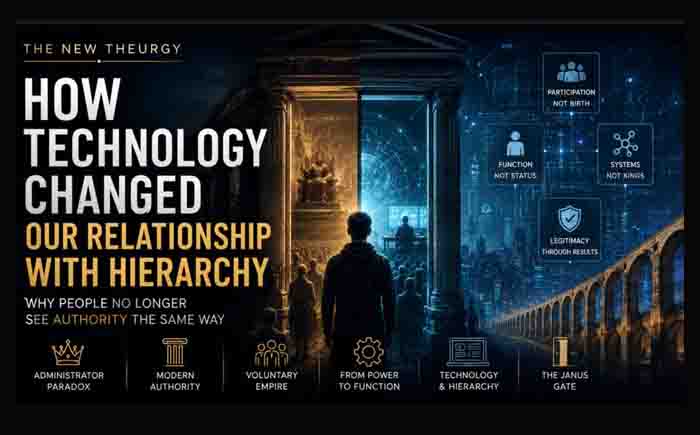
The Invisible Hierarchy
Technology did not abolish authority. It taught authority how to disappear inside systems.
There is something almost reassuring about a throne.
It tells you where power is.
A king sits above the court. A general wears a uniform. A priest stands before an altar. The architecture itself often explains the relationship before anyone speaks: raised platforms, guarded doors, reserved seats, titles, robes, ceremonies. Traditional hierarchy made power visible because visibility was part of its legitimacy. Authority needed to be seen in order to be recognized.
Modern systems often work differently.
Open a social network and there is no throne. Enter a streaming platform and no administrator greets you at the door. Search the web and the people deciding how the system is designed remain almost entirely invisible. Yet hierarchy has not disappeared. Someone owns the infrastructure. Someone writes the rules. Someone determines what can be removed, promoted, ranked, demonetized, recommended, searched, indexed or excluded.
The hierarchy is still there.
What changed is its interface.
The modern user often experiences power not as someone standing above them, but as a system through which they participate.
That difference may be one of the most important transformations of authority in the technological age.
When Power Had a Face
Traditional hierarchies were rarely as simple as a perfect pyramid, but the pyramid remains useful because it captures their visual logic.
The ruler occupied a recognizable summit. Beneath came nobles, officials, clergy, officers, guilds, household authorities and local intermediaries. Status could be hereditary, legally defined or publicly marked. In many societies clothing, architecture, language and ritual constantly announced differences in rank.
Authority therefore had a theatrical dimension.
A crown was not merely decoration.
A palace was not merely housing.
A procession was not merely transportation.
These were interfaces through which hierarchy became legible.
The individual could resent authority precisely because its location was relatively clear.
One knew who collected the tax.
One knew who issued the order.
One knew which gate could not be crossed.
Modern bureaucracy had already begun to complicate this picture before digital technology arrived. Industrial states increasingly replaced personal command with offices, procedures, departments and regulations. Power migrated from the person toward the institution.
Digital systems pushed the migration further.
Now the institution itself can disappear behind a screen.
The Hierarchy Inside the Interface
Consider the experience of joining a digital platform.
The visible action is remarkably modest. Create an account. Accept terms. Choose a username. Enter.
From the user’s perspective, the event feels almost horizontal. Millions of other people appear as profiles of roughly equal size. Everyone receives a box in which to type, post, buy, watch, play or comment.
But beneath that apparent equality sits a highly structured system.
Different users possess different permissions.
Moderators can act where ordinary users cannot.
Administrators possess greater authority.
Developers can change the environment itself.
Owners control the institution in ways unavailable to everyone inside it.
Algorithms rank visibility.
Automated systems classify behavior.
Some accounts become influential while others remain effectively invisible.
The hierarchy is not absent.
It is encoded.
This is a profound shift because encoded hierarchy feels different from ceremonial hierarchy. A king’s privilege can be seen. Algorithmic privilege can appear as a neutral result of the system.
The interface does not necessarily show the ladder.
It shows the screen.

The Participation Effect
Voluntary entry changes the psychology of authority.
A person who enters a club, game, professional association or online platform generally accepts some rules simply by participating. The hierarchy can therefore feel less like an external imposition and more like part of the environment.
You chose to join.
You accepted the terms.
You wanted access.
This does not mean the relationship is genuinely equal or completely voluntary. Modern platforms can become economically, professionally or socially difficult to avoid. Network effects can transform nominal choice into practical dependence. A worker may technically be free not to use a particular system while discovering that employment requires it. A business may technically be free to leave a large platform while losing access to customers by doing so.
Still, perceived participation matters.
Authority feels different when the gate appears voluntary.
The user does not encounter the ruler before entering the city.
The user presses Agree.
One of the great innovations of digital hierarchy may therefore be psychological rather than technical: participation can conceal the experience of subordination.
The Administrator Replaces the Courtier
The administrator is one of the characteristic figures of modern authority.
The title sounds deliberately unimpressive.
Administrator.
Moderator.
Operator.
System manager.
There is almost no charisma in the vocabulary.
That is part of its strength.
Traditional authority often justified itself through status, inheritance, sacred legitimacy or personal prestige. Administrative authority tends to justify itself through function.
Somebody needs to maintain the system.
Somebody needs to allocate permissions.
Somebody needs to remove abuse.
Somebody needs to repair failures.
Somebody needs access that ordinary users do not have.
The argument sounds practical rather than political.
And often it genuinely is practical.
A network without administration can become unusable. A hospital needs roles and chains of responsibility. An aircraft cannot be operated by referendum at every moment. Complex systems frequently require asymmetries of expertise, access and decision-making.
But functionality does not make hierarchy neutral.
The administrator still possesses power.
The important change is that the power is legitimized through competence and system maintenance rather than grandeur.
The throne disappears.
The permissions remain.
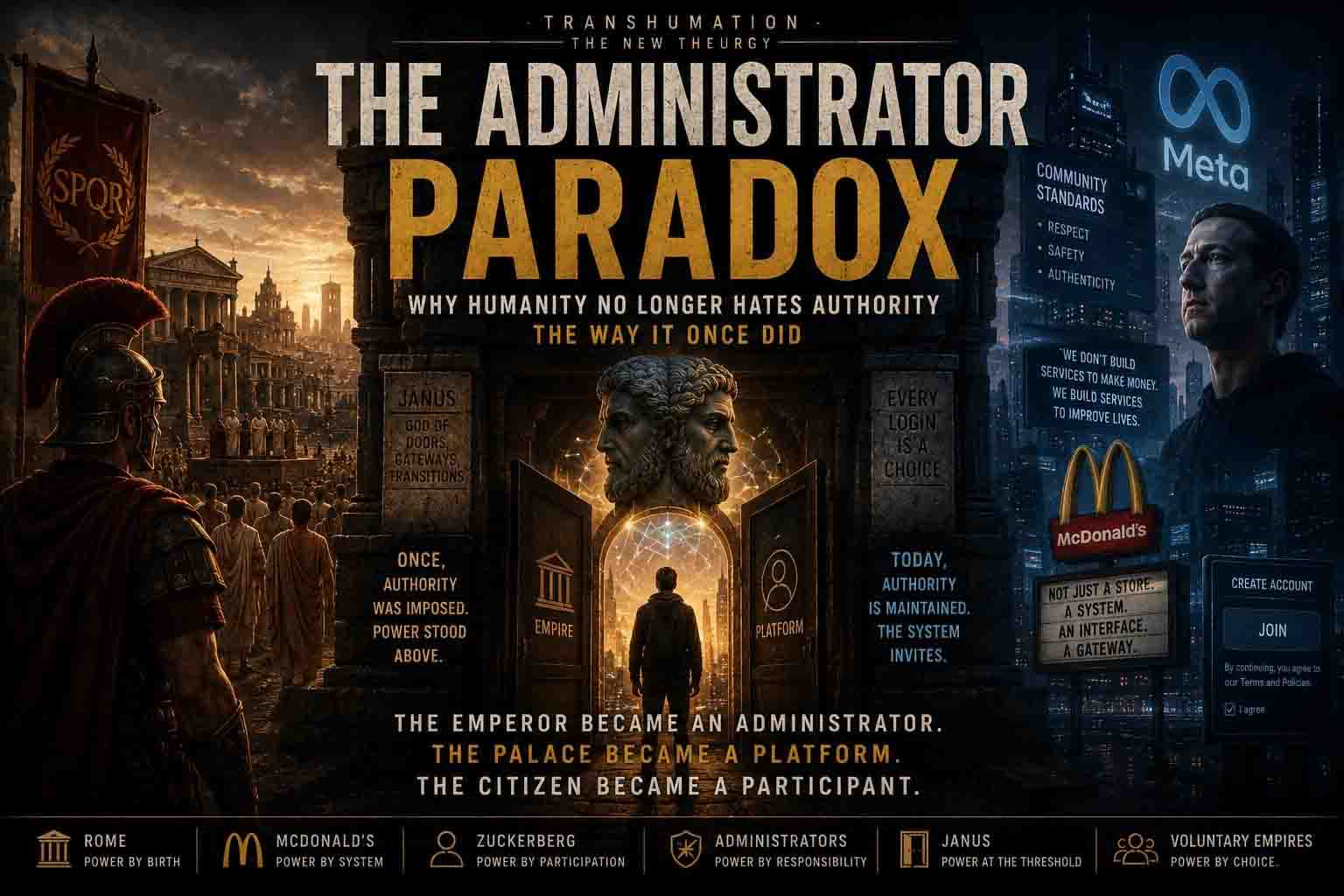
Rome Is More Complicated Than the Ladder
Rome is tempting as an early analogy because Roman citizenship could expand beyond the city itself, and incorporation became one of the empire’s important political technologies.
But Rome should not be romanticized as a civilization of open participation.
Roman society was intensely hierarchical. Citizenship rights varied across periods. Slavery remained fundamental. Gender, wealth, legal status and proximity to power radically shaped an individual’s position. Conquest remained conquest even when incorporation followed it.
Still, Rome demonstrates something important about hierarchy.
Systems can strengthen themselves by allowing outsiders to acquire forms of membership.
Citizenship creates a different relation from pure subjection because membership gives the participant a recognized place inside the structure. Authority becomes more durable when the governed can imagine themselves as stakeholders in the system rather than simply objects of rule.
Modern platforms exploit a comparable logic at a very different scale.
Profiles.
Followers.
Levels.
Badges.
Ratings.
Membership tiers.
Reputation scores.
The user acquires a position inside the architecture.
The hierarchy becomes something one can climb.
And a climbable hierarchy often feels more legitimate than a sealed one.
The Gate Matters More Than the Wall
This is where Janus becomes useful.
Historically, Janus was associated with beginnings, passages, doors and transitions. The comparison does not require turning him into a Roman god of login screens.
The structural idea is enough.
Power is often concentrated at thresholds.
Who may enter?
Under what conditions?
What must be surrendered?
What permissions are granted after entry?
Traditional hierarchy emphasized walls.
Modern systems often emphasize gates.
The account.
The subscription.
The membership.
The authentication layer.
The API key.
The invitation.
The terms of service.
Once inside, the environment can feel open. But the apparent openness depends on the architecture controlling entry.
This makes access itself a political category.
The gate becomes more important than the throne because whoever controls the gate can shape the population of the system before authority becomes visible inside it.
Performance Replaces Ceremony
Modern authority often gains legitimacy through performance.
Does the platform work?
Does the navigation system find the route?
Does the payment clear?
Does the hospital function?
Does the cloud service remain available?
People may know almost nothing about the organizations sustaining these systems while trusting them every day because their outputs are reliable.
This is not completely new. States, armies and commercial institutions have always depended partly on competence.
But digital systems intensify the relationship because the machinery behind them is exceptionally difficult for ordinary participants to inspect.
Trust becomes operational.
The system works, therefore we continue using it.
The problem appears when performance begins substituting for accountability.
A system can function efficiently while distributing power unfairly.
An algorithm can rank accurately according to its objective while the objective itself remains questionable.
A platform can deliver extraordinary convenience while gradually increasing dependence.
Good performance tells us that a system is effective.
It does not tell us whether the system is legitimate.
That distinction matters more as hierarchy becomes invisible.
Watch The Video
How to Read the World

Current Knowledge
Hierarchical organization remains common across governments, corporations, militaries, institutions and digital platforms. Technology has not eliminated differences in authority, access or decision-making power.
Digital systems frequently encode hierarchical permissions through administrator roles, moderation systems, account privileges, ranking mechanisms and ownership structures. These hierarchies may be less visually obvious than traditional political hierarchies while remaining operationally significant.
Participation can influence perceptions of legitimacy. People often tolerate rules more readily when they perceive membership as voluntary, procedurally fair or beneficial, although nominally voluntary participation may become difficult to avoid when platforms or institutions acquire strong network effects.
Roman citizenship did expand over time and became an important mechanism of political integration, but Roman society remained highly stratified and coercive. It should therefore be treated as a partial historical analogy rather than a precursor of modern participatory platforms.
Technology has also increased the importance of expertise and administrative coordination. Complex infrastructures depend on specialized roles, but functional necessity does not by itself determine whether a particular distribution of authority is fair or accountable.
Open Questions
The first question is visibility. Are modern hierarchies genuinely less oppressive, or simply harder to recognize because authority is distributed through software, procedure and infrastructure rather than concentrated in identifiable rulers?
There is also the problem of consent. If participation in a platform is formally voluntary but economically or socially difficult to avoid, how meaningful is the user’s consent to its hierarchy?
Another question concerns mobility. People often accept unequal systems more easily when movement appears possible. But does a visible ladder create real mobility, or merely make hierarchy more psychologically acceptable?
Artificial intelligence introduces an additional layer. When algorithms increasingly assign risk, visibility, priority or access, responsibility can become difficult to locate. Who exercises authority when no individual person appears to have made the decision?
And finally, can increasingly complex civilization remain democratic if meaningful participation requires expertise that most participants cannot realistically possess?
Transhumation Interpretation
The New Theurgy should not describe hierarchy simply as an ancient problem that technology finally solved.
Technology did something stranger.
It transformed hierarchy into interface.
The ancient ruler stood above the crowd.
The modern system surrounds the participant.
One form announces power through height.
The other embeds power into architecture.
This distinction matters because people resist what they can identify more easily than what they experience as part of the environment.
A throne announces itself.
A ranking algorithm does not.
A palace tells you that somebody lives behind the wall.
A platform can make hierarchy feel like personalization.
This is where Transhumation returns to the Interface Problem.
Every interface hides complexity.
Sometimes what it hides is machinery.
Sometimes what it hides is power.
The modern hierarchy can be effective precisely because it does not feel like hierarchy. It feels like access, convenience, recommendation, membership and participation.
That does not make hierarchy inherently corrupt. Large systems require coordination. Expertise matters. Responsibility cannot always be perfectly symmetrical.
The more important distinction is between hierarchy that can be examined and hierarchy that disappears into the environment.
Janus becomes useful here not as a god secretly predicting digital networks, but as a figure of the threshold.
The future of authority may depend less on who occupies the highest seat than on who designs the gate, writes the permissions and determines the rules after entry.
The king controlled the territory.
The platform controls the conditions of participation.
And AI may push this transformation further, because authority can increasingly become adaptive, personalized and difficult to distinguish from assistance.
The guide recommends.
The system filters.
The interface anticipates.
At some point coordination can become governance without ever announcing the transition.
That may be the new hierarchy.
Not the ruler standing above us.
The architecture deciding what paths remain visible while we move through it.
FAQ
Has technology eliminated hierarchy?
No. It has changed how hierarchy appears. Authority increasingly operates through platforms, permissions, algorithms and institutions rather than only through visible ranks and titles.
What is the Participation Effect?
It is the idea that hierarchy can feel more legitimate when people perceive themselves as voluntarily entering and participating in the system.
Why is the administrator important?
The administrator represents functional authority. Their power is justified primarily through maintaining and coordinating a system rather than through inherited or ceremonial status.
Why use Janus as a metaphor?
Because Janus is historically associated with doors and transitions. The metaphor helps focus attention on access: who enters a system, under what conditions and with what permissions.
Are digital platforms really hierarchical?
Yes. Users, moderators, administrators, developers and owners possess different levels of access and control, while algorithms can create additional hierarchies of visibility and influence.
Is functional hierarchy necessarily bad?
No. Complex systems often require specialization and unequal responsibilities. The important questions concern legitimacy, accountability, transparency and the possibility of challenging decisions.
What has technology really changed?
It has made hierarchy easier to embed inside infrastructure.
The older hierarchy said:
Know your place.
The modern system often says:
Welcome. Create your account.
Only later do we discover how the architecture has already decided where everyone stands.
Ten tekst jest mocniejszy, kiedy sednem nie jest „hierarchy returned”, tylko „hierarchy became infrastructure”. To też daje dużo lepszy Janus Gate: nie jako ozdobnik mitologiczny, tylko jako pytanie o to, kto projektuje wejście, dostęp i uprawnienia.
Continue the Transhumation Series
- Forgotten Religion | Ancient Gods, Symbols and the Hidden Structures of Human Civilization
- The Last Religion | Death, Immortality and the Future of Humanity
- The New Theurgy | AI, Information and the Future of Human Civilization
- End of Branding: You Were Never Meant to Become a Product
- Baal vs Ishtar: Why Ancient Gods Never Disappeared