
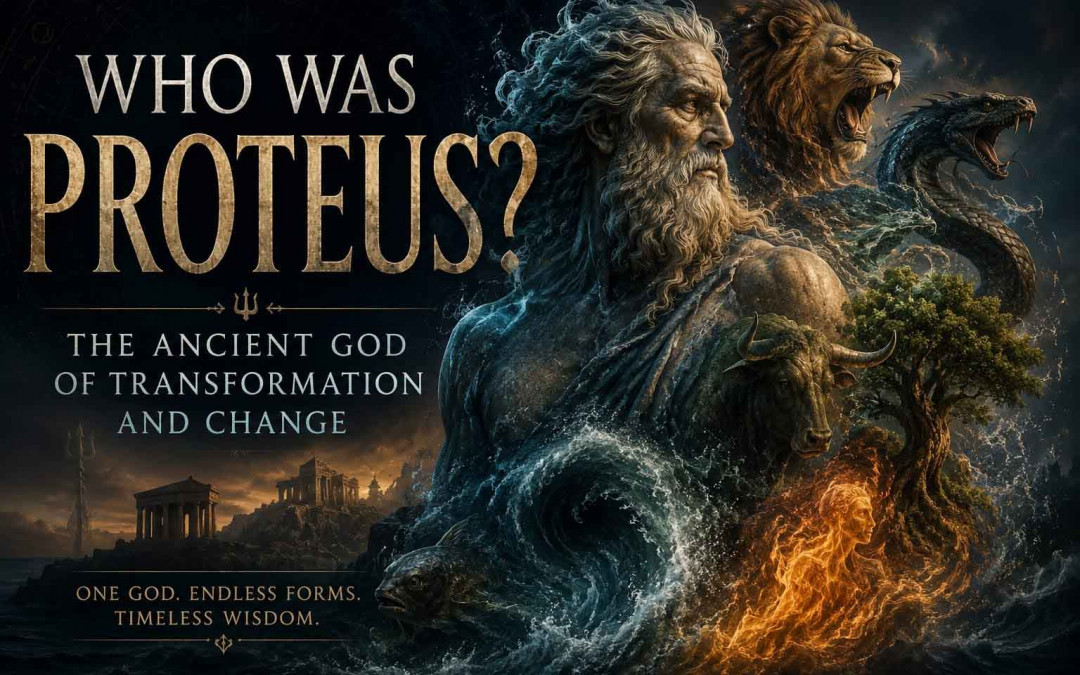
The God Who Refused to Stay One Thing
A hotel key card is a disappointingly ordinary object. It opens a door, stops working at noon, and within a few hours belongs to someone else. Yesterday it was yours. Tomorrow it will serve another guest. The plastic does not change much, but its identity does. A few bits in a system are rewritten and the same object becomes, in practical terms, something new.
Modern life is full of these small transformations. A phone becomes a camera, map, bank, library and translator depending on what is asked of it. A person can leave one profession, retrain, move countries and spend an evening speaking through an identity that exists only online. Software changes function without changing its hardware. Entire industries can be reorganized while their buildings remain standing.
We are so accustomed to this instability that it often feels normal.
The ancient Greeks gave it a face.
Proteus was not one of the great Olympian rulers. He did not command the sky like Zeus or dominate the sea in the grand manner of Poseidon. He belonged instead to a stranger category: an old sea divinity, elusive, knowledgeable and almost impossible to hold onto because the moment someone tried, he changed.
A lion.
A serpent.
Water.
A tree.
Fire.
Whatever the pursuer thought he had captured, Proteus became something else.
The story is memorable because it seems almost playful. It is also more serious than it looks.
To obtain the truth, you first had to survive the transformations.
The Old Man Who Knew Too Much
Proteus appears most famously in the Odyssey, where Menelaus seeks information from the “Old Man of the Sea.” Proteus possesses knowledge unavailable to ordinary mortals, including information about the past and future, but he does not volunteer it. The seeker must first seize him and refuse to release him while he shifts through a sequence of forms.
The scene is strange enough to feel like a puzzle designed by a child: hold on to the old man while he becomes animals, water and fire. Yet the mechanics of the story reveal something more sophisticated. Knowledge is not simply hidden behind a locked door. It actively resists capture by changing shape.
That is a very different image of truth.
A locked box suggests that the answer remains stable and merely difficult to access. Proteus suggests that the object of understanding may alter as the observer approaches it. The closer the seeker gets, the less certain the form becomes.
This is not how we usually imagine knowledge. We like the idea that reality stands still while we inspect it. We assume that if our instruments become precise enough and our categories clear enough, the thing itself will eventually surrender.
Proteus introduces a less comfortable possibility.
Sometimes the problem is not only that we do not yet know enough.
Sometimes the problem is that the object keeps becoming something else.
The Animal Inside the Answer
The transformations attributed to Proteus are theatrical, but their sequence matters less than the principle. A fixed identity dissolves. The seeker is forced to decide whether the changing appearances belong to many different things or to one thing expressing itself through many forms.
That distinction appears far beyond mythology.
A river remains a river while its water changes continuously.
A city remains recognizably itself while buildings are demolished, populations move and institutions change.
A person can remain legally and psychologically continuous through enormous alterations in body, belief, occupation and memory.
A corporation can replace almost every employee and still preserve its name, contracts and function.
A melody survives translation between instruments.
The problem is not that nothing changes.
The problem is that something sometimes appears to survive the change.
Proteus becomes interesting at exactly this boundary. He is not simply a symbol of chaos. Chaos has no continuity. Proteus does. The forms change, but the pattern of being Proteus remains.
This is what makes him more useful than a simple god of instability.
He is a problem of identity under transformation.
Why the Sea Needed This God
It is probably not accidental that Proteus belongs to the sea.
The sea is one of the oldest demonstrations that form can be temporary. A wave exists clearly enough to be named, watched and measured, yet the water composing it is already moving elsewhere. The surface never stops reorganizing itself. Calm becomes storm, transparency becomes darkness, coastline becomes distance.
The ancient Mediterranean was not a poetic abstraction. It was infrastructure, danger, trade and uncertainty. A voyage could alter a person’s wealth, status or survival. The sea connected worlds precisely because it was less stable than the land between them.
Proteus therefore fits his environment with unusual precision.
He knows because he moves.
He escapes because he changes.
He belongs to a medium in which fixed form is always provisional.
This is where the myth begins to feel unexpectedly modern. Industrial civilization was built around fixed objects: factory, profession, institution, nation, product. Digital civilization increasingly works through states that can be updated, recombined and reassigned.
The sea was already doing this before software had a name.
The Word That Escaped the God
Proteus achieved something few mythological figures manage: he became an adjective.
Protean now describes something versatile, variable or capable of assuming many forms. The word survived even as the religious context weakened. A person can have a protean career. A technology can have protean applications. An artist can possess a protean style.
That linguistic survival is revealing.
We no longer need to believe in Proteus for the structure attached to him to remain useful.
This is one of the strongest signs that a myth has escaped its original carrier.
The god disappears.
The function remains.
And the function is increasingly difficult to avoid.
Modern careers are protean. Digital identities are protean. Software is protean. Capital moves between industries. Media migrate between formats. Artificial intelligence can produce text, images, code, translation, summaries and simulations through one underlying system whose visible role changes with the prompt.
The resemblance should not be exaggerated. AI is not Proteus, and mythology is not an early description of machine learning. The useful connection lies in the recurrence of function: one system expressing itself through many task-specific forms.
That is where the old symbol becomes more than decoration.
The Machine That Changes When You Ask
Artificial intelligence makes the Proteus problem unusually visible because the interface can remain almost identical while the behavior shifts dramatically.
Ask one system to translate a paragraph and it behaves like a translator. Ask it to analyze financial data and it behaves like an analyst. Ask it to generate an image and another model behaves like an illustrator. The identity presented to the user is partly constructed by the task.
This is not the same as a human changing professions, and it does not imply inner experience. It is simply a technical fact about adaptable systems.
But it changes the way we think about specialization.
Industrial machines were often built to do one thing extremely well. A printing press prints. A lathe shapes. A traditional calculator calculates. General-purpose computation weakened that relationship because the same hardware could become many different tools depending on software.
AI pushes the abstraction further.
The form is increasingly temporary.
The function appears on demand.
This creates enormous practical power, but it also makes systems harder to categorize. Is the thing a tool, assistant, model, medium, agent, interface or infrastructure? The answer can change according to context.
Proteus would recognize the discomfort immediately.
We keep trying to name the form.
The form keeps moving.
The Identity We Thought Was Fixed
Human beings are undergoing a quieter version of the same pressure.
For much of history, identity was constrained strongly by geography, inheritance, profession and community. This should not be romanticized into a world where nobody ever changed roles. Migration, social mobility, conversion, military service, urbanization and political upheaval transformed lives long before modernity.
What has changed is the speed and frequency with which identity can be reorganized.
A person may change careers several times.
Move across continents.
Participate in multiple communities that never meet physically.
Maintain different public identities across professional, social and digital spaces.
Learn skills that did not exist when they were born.
The old image of a person as something with one stable social form fits less comfortably.
That does not mean identity has become infinitely fluid. Bodies, histories, obligations and social structures still impose limits. But the number of viable transitions has expanded.
Proteus therefore becomes relevant not because modern people have become shapeshifters.
Because adaptation is becoming less exceptional and more structural.
The modern person is increasingly asked not merely to endure change, but to remain coherent through it.
That may be the harder problem.
The Last Form Is the Next One
There is a seductive reading of Proteus that turns transformation into a simple virtue: change is good, adaptability wins, therefore become flexible.
The myth is more interesting than that.
Proteus changes in order to resist capture.
Transformation can protect.
It can also conceal.
A constantly changing institution may avoid accountability. A person who adapts endlessly may lose continuity. A technology that changes faster than regulation can follow may become difficult to govern. A system whose identity shifts according to context can be useful and dangerous for the same reason.
Adaptation is not automatically wisdom.
The real challenge is preserving enough structure to remain something while changing enough form to survive.
This tension appears everywhere in biology and culture. A species that cannot adapt may disappear. A species that changes without maintaining viable organization disappears for a different reason. A civilization unable to update its institutions can become brittle. A civilization that dissolves every inherited structure at once can lose continuity.
Proteus survives every transformation because there is still a Proteus to return to.
The story therefore asks a deeper question than whether change is necessary.
What must remain for transformation not to become disappearance?
Watch The Video
How to Read the World
Current Knowledge
Proteus is an ancient Greek sea divinity best known from literary sources including Homer’s Odyssey. He is commonly described as an “Old Man of the Sea,” associated with prophecy and shape-shifting, and in later traditions is often connected with Poseidon.
In the Odyssey, Menelaus is instructed to seize Proteus and hold him while he assumes different forms. Once restrained successfully, Proteus provides the knowledge being sought. The exact catalogues of transformations vary across retellings, and later traditions expanded his symbolic association with mutability.
The English adjective protean derives from Proteus and refers to something variable, versatile or capable of assuming many forms.
It would be historically inaccurate to describe Proteus straightforwardly as “the god of evolution” or to claim that ancient Greeks understood him through modern biological concepts. Connections with adaptation, fluid identity or artificial intelligence are modern interpretations built from his traditional association with transformation.
Open Questions
What did Proteus’s shape-shifting originally signify within the earliest Greek traditions? Was it primarily connected with the instability of the sea, with prophetic knowledge that resisted human access, or with a broader ancient category of elusive divinities?
A more general question concerns identity. When a system changes continuously, what allows us to say it remains the same system? Is continuity located in matter, memory, organization, causal history or function?
Technological systems make this problem increasingly practical. If one AI architecture can perform many roles, when are we dealing with one system expressing multiple functions and when with genuinely different systems? Similar questions apply to digital identity, institutions and increasingly modular forms of work.
There is also a limit to the metaphor. Adaptation can resemble Protean transformation, but resemblance alone does not establish common structure. The useful test is whether the same function genuinely survives the change of carrier.
Transhumation Interpretation
Proteus may be one of the cleanest ancient symbols for a central Transhumation problem: how can identity survive transformation?
The easy answer is that something remains unchanged underneath.
But reality often refuses that simplicity.
The body changes.
Memory changes.
Language changes.
Civilizations replace institutions.
Technologies migrate from one material platform to another.
Even the functions by which we recognize things can evolve.
The continuity may therefore exist not in an immutable substance but in a pattern capable of reorganizing itself without losing all relation to what came before.
That possibility connects Proteus to one of the deepest questions in Transhumation.
If humanity changes its biological carrier, technological environment, memory systems and cognitive tools, at what point does adaptation become something else entirely?
There is no answer hidden in the myth.
What Proteus provides is a better image of the problem.
The future will probably not arrive as one stable form waiting for us to recognize it. It will arrive as a sequence of provisional forms, each convincing enough to look final until the next transformation begins.
The mistake would be to worship change itself.
The more difficult task is learning what deserves to survive through change.
Proteus escapes because he can become almost anything.
But wisdom begins with a harder question:
After becoming something new, what still makes you you?
FAQ
Who was Proteus in Greek mythology?
Proteus was an ancient Greek sea divinity associated especially with prophecy and shape-shifting.
Why did Proteus change form?
In myth, he transformed to resist people trying to force him to reveal what he knew.
Was Proteus the god of transformation?
He was not formally defined in exactly that modern way, but transformation and mutability are central to his mythological identity.
What does “protean” mean?
It means highly changeable, versatile or capable of taking many forms, and the word derives from Proteus.
Was Proteus older than Zeus?
Proteus belongs to an old layer of Greek myth, but saying simply that he was “older than Zeus” is too strong historically; mythological traditions developed across many periods and sources.
Why is Proteus relevant to AI?
AI systems can perform very different roles through the same underlying architecture, making adaptability and changing function useful points of comparison.
Does Proteus symbolize evolution?
Not in the scientific Darwinian sense. That is a modern analogy rather than an ancient belief.
How does Proteus connect to Transhumation?
Proteus represents the problem of continuity through changing forms, which connects directly to questions of identity, adaptation, technology and carrier-independent patterns.
What is the central idea of the article?
Transformation matters less than the deeper question it creates: what must remain stable enough for something to change without ceasing to be itself?
Continue the Transhumation Series
- Forgotten Religion | Ancient Gods, Symbols and the Hidden Structures of Human Civilization
- The Last Religion | Death, Immortality and the Future of Humanity
- The New Theurgy | AI, Information and the Future of Human Civilization
- End of Branding: You Were Never Meant to Become a Product
- Baal vs Ishtar: Why Ancient Gods Never Disappeared