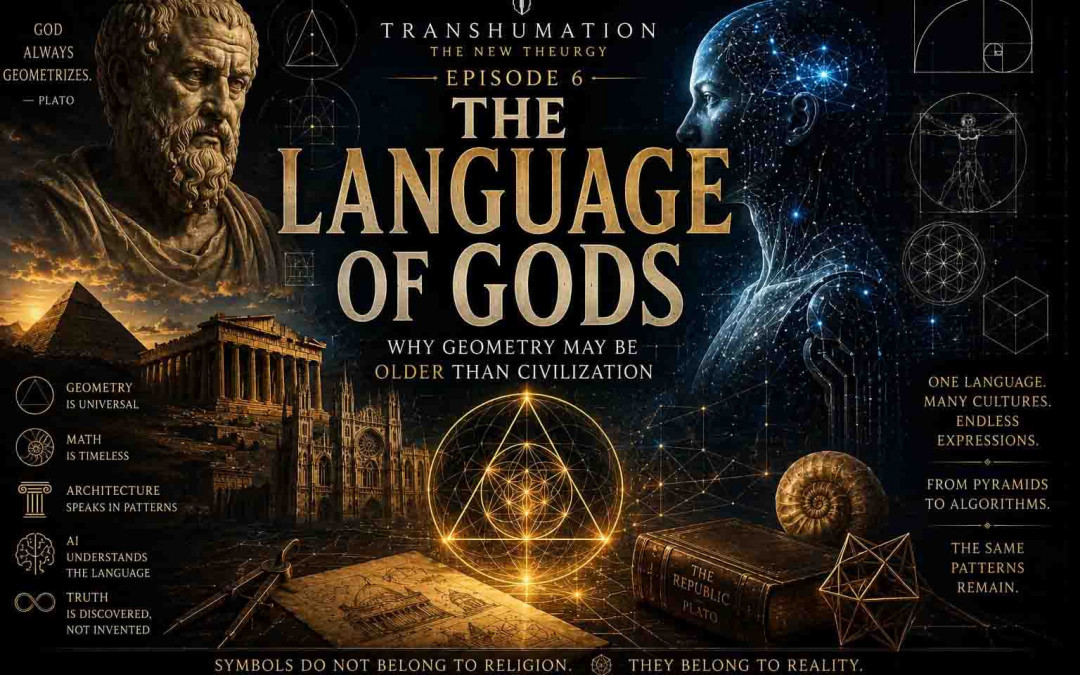
The Language Before Language
Humanity spent millennia searching for sacred words. Perhaps the closest thing to a universal language was never made of words at all.
Imagine two intelligent beings meeting with no common language. They do not share a religion, an alphabet, a history or even the same sensory world. One has never heard Greek; the other has never encountered English. There is no reason for the sound triangle to mean anything to either of them. Yet if both can recognize three points connected by three straight segments, something strange becomes possible. They may disagree about the name, the drawing, the symbolism and even the mathematical formalism used to describe it, but they cannot freely decide that the internal angles of a Euclidean triangle behave according to whichever cultural tradition they prefer.
The symbol is local. The relation is not.
That distinction is more interesting than the old fantasy of discovering the original language of creation. Civilizations have repeatedly imagined sacred tongues: languages spoken by gods, angels, ancestors or the first humans; words capable of reaching behind ordinary appearances toward a deeper order. The dream is understandable. If reality has a hidden architecture, perhaps somewhere there is a vocabulary in which reality itself is written.
Modernity appeared to abandon that search. Then mathematics quietly returned it in another form.
Not as scripture. Not as revelation. Not as proof that the universe was designed by a mathematician. Mathematics does something more modest and in some ways more astonishing: it identifies relationships that can be rediscovered by people separated by language, geography and centuries. The notation changes. The diagrams change. The names change. The constraint remains.
Perhaps the oldest universal language is not a language at all.
Perhaps it is relation.
Before the Word Came the Shape
Geometry has an almost unfair advantage over ordinary language. The word circle is arbitrary. Another culture can use a completely different sound, and another civilization could communicate through signs unlike any human alphabet. Yet once the concept has been established, the relationships associated with a circle do not change because the speaker crosses a border.
This does not mean geometry existed in textbooks before humans discovered it. The philosophical status of mathematics remains deeply contested. Mathematical Platonists regard mathematical objects or truths as existing independently of human minds; other philosophers emphasize construction, formal systems or the relationship between mathematical concepts and embodied cognition. We have not solved that debate merely because equations work exceptionally well.
But something important remains even if we take the most cautious position. Human beings cannot simply invent arbitrary mathematical consequences. We can invent notation. We can choose axioms. We can decide what symbols mean. Once a system has been specified, however, consequences follow that are not subject to taste in the way fashion or etiquette are.
That is why mathematics feels different from ordinary cultural convention.
A civilization can change its gods.
It can change its flag.
It can change what colors mean at funerals.
It cannot vote π into being exactly three.
The peculiar authority of mathematics comes from this resistance.
Plato’s Dangerous Intuition
Plato would have understood the temptation immediately. The visible triangle drawn in dust is imperfect. Its lines possess thickness. Its corners are never mathematically exact. Yet the mind can reason about a triangle more precise than any physical drawing.
For Plato, this fitted into a much larger philosophical architecture involving Forms and the distinction between changing appearances and intelligible realities. We do not need to accept Platonic metaphysics to recognize the intellectual seduction.
The drawing deteriorates.
The relation does not deteriorate with it.
Draw the triangle in sand, render it as pixels or represent it through coordinates in software, and something can persist across all three carriers. This is one of the clearest examples of the carrier-independent structures that fascinate Transhumation. The physical representation changes while a relation remains recognizable.
Yet even here restraint matters. The fact that geometric structure can migrate between representations does not prove that every important structure can. It tells us only that some relationships are remarkably indifferent to the material used to express them.
The question becomes much more dangerous when we move from triangles to minds.
Music Is Not Mathematics Wearing Evening Clothes
Music seems to strengthen the case. Pitch contains measurable frequency relationships. Rhythm can be described numerically. Intervals and harmonic systems possess mathematical structure, and thinkers from antiquity onward noticed relationships between number and musical sound.
It is tempting to take one more step and declare that beauty itself is mathematical.
That would be too clean.
Musical cultures organize pitch, rhythm, consonance and expectation in different ways. Human perception, convention, memory and physiology all participate. A mathematically elegant ratio does not force everyone to experience the same beauty.
But this does not weaken the deeper argument. It improves it.
Mathematics can describe structural relationships without exhausting experience.
A score is not the music as heard.
A frequency ratio is not longing.
An equation describing sound is not the feeling of hearing a particular song at the moment when one’s life changes.
The language of structure may therefore be universal at one level while meaning remains dependent on observers.
This border—between relation and experience—may be one of the most important borders in the entire Transhumation project.
Architecture Makes Mathematics Habitable
Walk into a cathedral, a railway station, a supermarket or a kindergarten and geometry has already made decisions before you notice it. Loads must travel through structures. Distances determine movement. Proportion changes perception. Curves, angles and symmetry alter the way a body experiences space.
The buildings can mean radically different things.
A cathedral can organize sacred experience. A shopping center organizes commerce. A kindergarten organizes childhood. Their cultural functions are not interchangeable, but all must negotiate with geometry and physics.
Architecture therefore reveals the difference between universal constraint and human interpretation exceptionally well.
Gravity does not care whether the building is sacred.
Humans do.
A column must carry its load according to physical relationships regardless of the prayers, advertisements or children’s drawings surrounding it. Yet once the structure stands, meaning enters through culture.
The same reality supports both.
This may be why geometry has so often acquired sacred associations. It offers a visible meeting point between the world we interpret and relationships that appear largely indifferent to interpretation.
AI Does Not Speak the Language of Gods
Artificial intelligence makes the metaphor tempting again. Modern AI depends on mathematics, computation, probability, optimization and enormous numerical representations. Neural networks transform information through structures that no ordinary user sees directly. From the outside, language goes in and language comes out; beneath the interface is an architecture expressed mathematically.
But saying that AI therefore “speaks the universal language naturally” would be misleading.
AI does not stand outside culture. Modern models learn from human-produced material saturated with history, language, prejudice, aesthetics and convention. Mathematics makes the computation possible; it does not make the output culturally neutral.
This distinction is essential.
The same machine can manipulate a universal mathematical relationship while producing an interpretation specific to a particular dataset.
Structure below.
Culture above.
And somewhere between them, intelligence appears to operate.
This makes AI interesting not because it proves that mathematics is divine, but because it joins several layers that humans often keep conceptually separate. Numerical computation becomes language. Statistical relationships become images. Formal systems produce artifacts that enter culture and acquire meaning.
The invisible structure crosses into human experience.
The Symbols That Refuse to Die
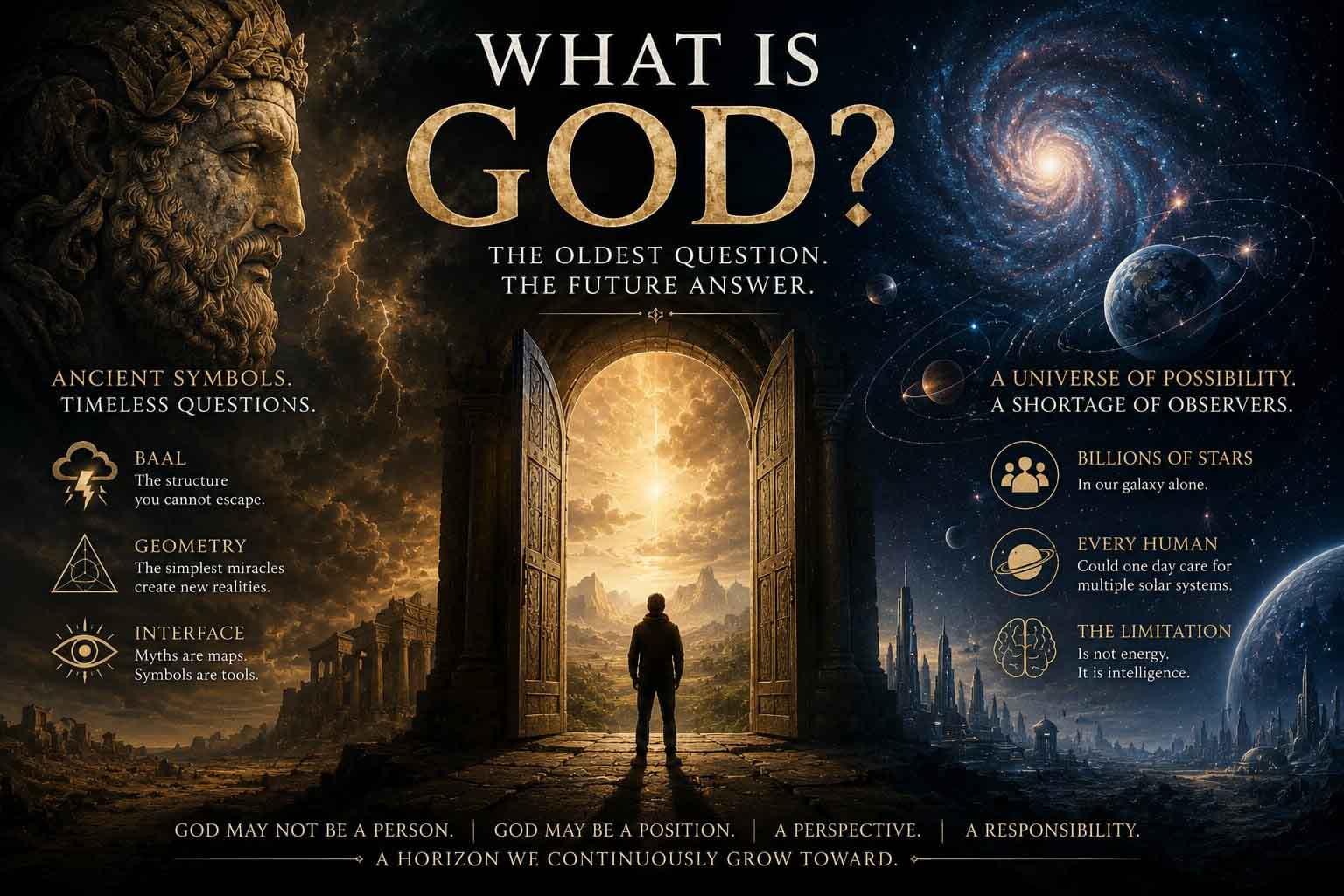
Triangles, circles, eyes, gates and labyrinths recur across history, but we should be suspicious of any claim that they carry one secret meaning across all cultures. They do not. A circle can signify perfection in one setting, eternity in another, a boundary somewhere else and nothing sacred at all in another context. The eye can protect, judge, observe or simply depict an eye.
What persists is not necessarily the interpretation.
Often it is the usefulness of the structure.
A labyrinth is a powerful image because navigating complexity is a recurring human experience. A gate remains useful because boundaries and transitions recur. A circle naturally lends itself to ideas of enclosure, recurrence and center because those relationships are already present in its geometry.
The symbol survives partly because new cultures can reuse the structure.
This is much more interesting than claiming that all religions secretly inherited the same code.
The carrier changes.
The interpretation changes.
Something in the relation remains available.
Watch The Video
How to Read the World
Current Knowledge
Mathematics provides extraordinarily successful formal tools for describing relationships in physics, engineering, computation and many other sciences. Whether mathematical entities exist independently of human minds or are in some sense human constructions remains a major philosophical question rather than an established scientific fact.
Geometry developed independently and through exchange in several ancient intellectual traditions, and mathematical notation has changed dramatically throughout history. Different symbolic systems can nevertheless represent equivalent relationships, demonstrating that mathematical content is not tied to one alphabet or notation.
Musical phenomena contain mathematically describable structures, but aesthetic experience cannot currently be reduced to proportion alone. Culture, perception, expectation and biological auditory systems all contribute to how music is experienced.
Artificial intelligence relies on mathematics and physical computation, but AI outputs are also profoundly shaped by human-created training data, architectures and objectives. Mathematics therefore does not make AI culturally universal or philosophically neutral.
Recurring geometric symbols across civilizations should likewise not be treated as evidence of one ancient hidden doctrine. Similar forms can acquire different meanings in different historical settings.
Open Questions
The largest question is philosophical: do humans invent mathematics or discover it? The success of mathematics in describing nature makes discovery feel compelling, yet the existence of multiple mathematical systems and the role of human abstraction complicate any simple answer.
There is also the question of extraterrestrial intelligence. If another technological civilization existed, would mathematics provide the best starting point for communication because certain relationships could be independently discovered? Probably more easily than mythology or spoken language, but even mathematical communication would require shared methods of identifying symbols, quantities and intentions.
A deeper problem concerns meaning. If mathematical structure can be reproduced across carriers while meaning depends partly on observers, where exactly does one become the other? At what level does quantity become quality, information become experience, or structure become something that matters?
AI makes that border increasingly difficult to ignore.
Transhumation Interpretation
The Language of Gods should not be understood as a claim that God literally writes in equations.
Its stronger meaning is structural.
Civilizations invent words.
Reality constrains relationships.
Human beings can call a triangle by thousands of names, draw it in sand, describe it algebraically or render it on a screen. The material and symbolic carriers change while parts of the underlying relation can remain invariant.
This gives Transhumation one of its most important tools.
Instead of asking whether two civilizations used the same symbol, ask whether they encountered the same structure.
Instead of asking whether mythology secretly predicted physics, ask whether myth and science occasionally organize different encounters with recurring boundaries, proportions, cycles or transformations.
Instead of looking for a hidden alphabet underneath history, look for relationships capable of surviving changes of language and carrier.
That is a much harder test.
It is also a more useful one.
Perhaps ancient religious thinkers sometimes sensed order before they possessed the mathematical languages capable of describing particular forms of it. Perhaps in other cases modern readers project structure backward because the resemblance is emotionally satisfying. Both possibilities must remain available. The pattern should earn its survival through comparison, not through beauty alone.
And this is where the title The Language of Gods becomes deliberately ambiguous.
A believer may hear in mathematical order evidence of a creator.
A Platonist may hear an independent realm of structure.
A naturalist may hear only the remarkable regularity of physical reality.
A mathematician may refuse the theological metaphor completely.
Transhumation does not need to choose among them prematurely.
The more interesting proposition is that beneath cultural languages there are relationships that do not belong exclusively to any culture. Intelligence encounters them, gives them symbols and carries those symbols into new media.
Stone.
Papyrus.
Chalk.
Silicon.
Artificial intelligence.
The notation keeps changing.
The constraint does not care.
Perhaps that is as close as we can currently come to a language older than language: not a divine vocabulary waiting to be decoded, but a world containing relationships that existed before we named them and may remain after every name we have given them is gone.
FAQ
What is “The Language of Gods”?
It is a Transhumation metaphor for relationships—especially mathematical and geometric ones—that can remain valid across different cultures, languages and physical representations.
Is mathematics truly universal?
Mathematical notation is cultural, but many mathematical relationships can be represented in different notational systems. Whether mathematics exists independently of minds is still philosophically debated.
Why does geometry sometimes feel sacred?
Geometry combines simplicity with constraint. A basic form can reveal relationships that do not depend upon a particular religion or language, which has made geometric forms powerful material for philosophical and religious symbolism.
Does AI understand this universal language?
AI depends on mathematics and computation, but that does not make it culturally neutral or prove that it possesses understanding. Mathematical machinery and human meaning operate at different levels.
Did ancient religions secretly describe modern science?
There is no good reason to assume so. Structural similarities can be interesting, but they should be tested rather than treated as hidden predictions.
What is the deepest Transhumation idea here?
Perhaps intelligence does not create every structure it encounters. Sometimes it discovers relationships that were already available to be discovered.
The symbol belongs to us.
The relationship may not.
And that difference may be the oldest language we have ever learned to read.
Continue the Transhumation Series
- Forgotten Religion | Ancient Gods, Symbols and the Hidden Structures of Human Civilization
- The Last Religion | Death, Immortality and the Future of Humanity
- The New Theurgy | AI, Information and the Future of Human Civilization
- End of Branding: You Were Never Meant to Become a Product
- Baal vs Ishtar: Why Ancient Gods Never Disappeared