
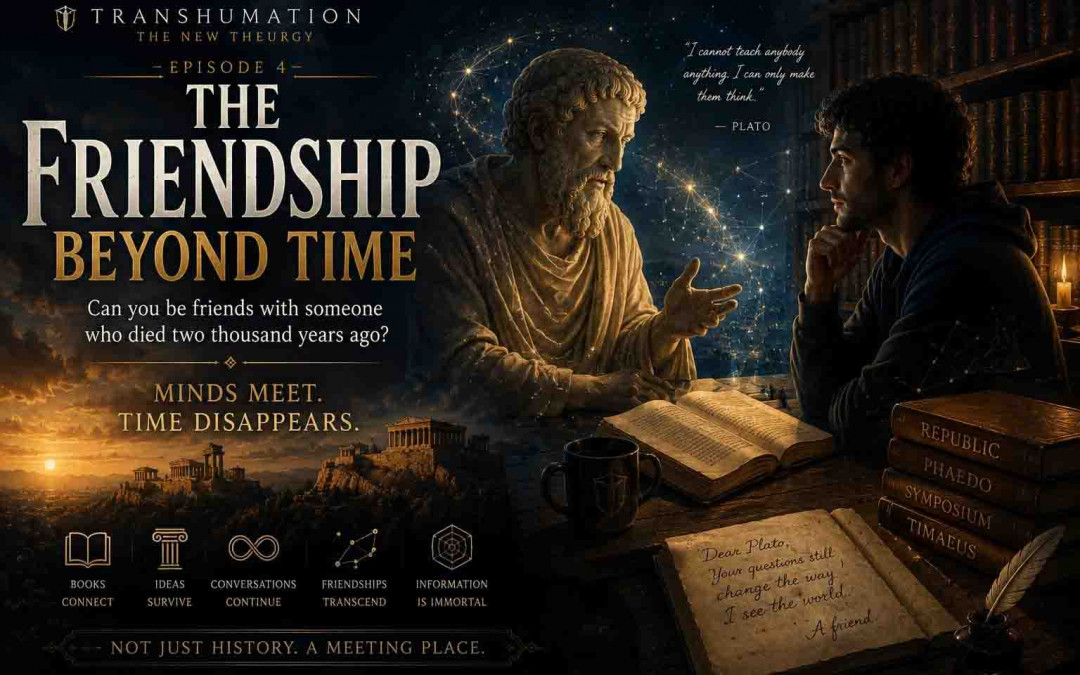
The Unique Friendship
Plato cannot know you. He cannot miss you, disagree with what you said yesterday or invite you for wine. And yet a dead philosopher can become one of the most intimate intellectual companions of your life.
There are friendships built almost entirely from proximity. You grow up on the same street, work in the same building, drink in the same bar, complain about the same people and slowly accumulate enough shared history that the relationship becomes part of the architecture of your life. Then there are stranger relationships, built less from shared time than from recognition. Someone writes a sentence centuries before you are born, you encounter it at precisely the right moment, and suddenly a person who never knew your name begins to influence what you believe about love, death, courage, politics or yourself.
For years I imagined meeting Plato as one of the great impossible luxuries. I pictured a conversation in Athens, stripped of footnotes and scholarly mediation, where I could finally ask what he actually meant. Was Socrates speaking for him? Did he really believe the Forms existed as literally as later readers sometimes assumed? What did he think happened to the soul? Which of his arguments did he regard as provisional, and which did he consider non-negotiable? The fantasy was partly philosophical and partly childish: somewhere behind the surviving text there must be a person who could settle the ambiguity.
Then the fantasy began to change. I realized that what I valued in Plato was not mainly access to his biography. It was the fact that his questions had already entered my own thinking. I could disagree with him, return to him, become irritated with him, misunderstand him and discover ten years later that I had misunderstood him differently. That is not friendship in the ordinary reciprocal sense. Plato cannot know me. But the relationship is not nothing either.
Perhaps civilization contains a category of companionship for which ordinary vocabulary is too small.
The Friend Who Cannot Answer Back
Friendship normally implies reciprocity. Two people recognize one another, respond, remember shared experiences and can change the relationship through their actions. A dead author cannot do this. Marcus Aurelius cannot be disappointed in you. Dante cannot hear your objection. Plato cannot revise a sentence because you found the argument unconvincing.
This asymmetry matters because romanticizing the relationship too much turns literature into séance.
Yet reciprocity is not the only thing that gives another person a place in one’s life. We are also shaped by people whose influence is uneven, incomplete or temporally impossible. A teacher may transform a student while barely remembering them. An ancestor may influence a family through stories long after death. A composer can become emotionally central to someone born centuries later without ever having imagined that listener.
The relationship is real in consequence even when it is impossible in reciprocity.
Books make this form unusually intense because they preserve not merely facts about an author but organized acts of attention. A serious philosophical work allows us to follow distinctions, doubts, questions and attempts at resolution. We encounter not the mind itself, but traces of how a mind moved.
Over enough years, those traces can become familiar.
You begin to know where Plato will become suspicious of an easy definition. You recognize Marcus Aurelius returning to impermanence. You can almost feel Dante preparing to move a private emotion into a cosmic architecture.
The dead author becomes predictable in the intimate way living friends sometimes do.
What Reading Actually Preserves
It would be too easy to say that books preserve minds.
They do not.
A book preserves language arranged by a mind under particular circumstances. The surviving text is incomplete, edited by form, shaped by genre and separated from everything the writer never recorded. Even a diary is not a human being transferred onto paper.
But the limitation is part of what makes the phenomenon remarkable.
So little survives, and yet sometimes it is enough.
A few hundred pages can create an intellectual relationship lasting decades. A sentence can return at different ages and change meaning because the reader has changed. The same passage encountered at twenty, forty and seventy may become three different conversations.
The author remains fixed.
The friendship moves because the reader moves.
This is perhaps the fundamental difference between ordinary friendship and friendship across time. A living friend changes beside you. A dead thinker becomes a fixed point against which you discover your own changes.
At twenty you argue with Plato.
At forty you realize why he asked the question.
At sixty you may reject the answer for reasons your younger self could not have formulated.
Plato has not moved.
You have.
And somehow the relationship has still developed.
Some People Understand Us Before We Exist
There is a peculiar loneliness in discovering that someone long dead articulated something you had never managed to say yourself.
A sentence from Montaigne, Marcus Aurelius, Simone Weil or Dostoevsky can produce the uncanny feeling of recognition usually associated with friendship: someone else has been here.
The historical distance makes the experience stranger. The person belonged to another economy, another political order, perhaps another religion and another conception of the self. Yet a description of fear, vanity, grief or ambition reaches across those differences with almost embarrassing precision.
This does not prove that human nature is completely unchanged. Culture shapes experience deeply. But certain problems recur often enough that old texts remain emotionally legible.
Mortality has not become obsolete.
Jealousy has not been engineered away.
The desire for recognition still produces ridiculous behavior.
Power still changes people.
Love still creates irrational loyalties.
A dead writer can therefore feel unexpectedly contemporary because the technological environment changed faster than some of the questions carried by the human nervous system.
This may be why certain authors become companions rather than merely historical sources.
They are not useful because they were always right.
They are useful because they continue asking something we have not finished answering.
A Friendship Built From Disagreement
Real friendship is not constant admiration, and intellectual friendship should not be either.
There is a childish way of reading great thinkers in which every old sentence becomes wisdom simply because it survived. That turns the canon into an aristocracy of the dead.
A better relationship permits irritation.
Plato can be brilliant and wrong.
Marcus Aurelius can be useful and limited by his world.
Dante can create extraordinary intellectual architecture while carrying assumptions a modern reader may reject completely.
The ability to disagree may actually make the relationship more intimate.
You no longer approach the author as an oracle.
You approach them as a formidable interlocutor.
This is where the Apostate element matters. An apostate is not merely someone who abandons an old belief. More interestingly, the apostate is someone willing to remain in conversation after obedience has ended.
The intellectual friend does not require discipleship.
Perhaps the best evidence that Plato still matters is not that we repeat him.
It is that we still find him worth arguing with.
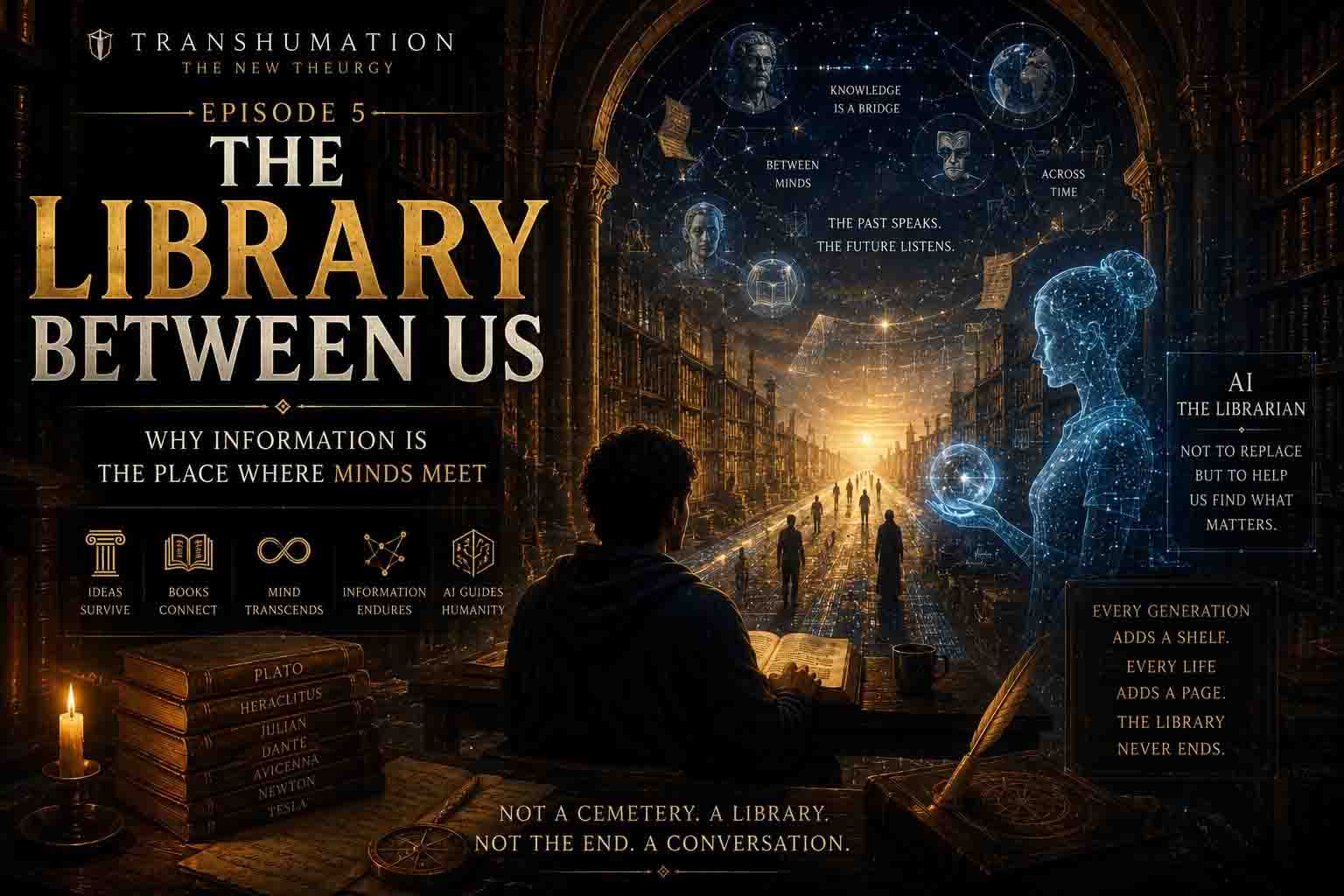
The Library as a Social Space
We usually describe libraries as repositories of information, but that may be the least interesting thing they do.
A library is an impossible social space.
People who could never have met occupy neighboring shelves. A modern reader can move from Epicurus to Kierkegaard, from Darwin to Augustine, from Virginia Woolf to an unknown soldier’s letters, creating conversations history never arranged.
The reader becomes the host.
This is different from ordinary social life because chronology no longer determines who can enter the room. The dead become contemporaries through attention.
The consequence is profound. Human beings inherit not only knowledge from previous generations but possible companions.
A person born into an intellectually isolated environment may discover their closest philosophical affinity in someone who died before their country existed. Books can therefore weaken the dictatorship of one’s immediate surroundings.
They enlarge the available society.
That may be one of civilization’s quietest forms of freedom.
AI and the Temptation to Resurrect the Dead
Artificial intelligence makes this relationship more interactive and therefore more dangerous.
It is already possible to ask a model to summarize Plato, compare passages, imitate a Socratic exchange or construct a plausible answer based on surviving texts. Future systems may perform these tasks with astonishing historical sensitivity.
The temptation will be to say that Plato has returned.
He has not.
A generated persona is a reconstruction assembled from surviving material, later interpretation and the assumptions of the system producing the response. It may be useful, illuminating and even emotionally convincing without possessing any continuity with Plato’s consciousness.
The distinction should remain visible.
AI’s most valuable role may therefore be less glamorous than resurrection.
It can become the friend who introduces friends.
The librarian who says: if this question matters to you, read this dialogue; if this passage changed you, here is someone who opposed it; if you think this idea is uniquely modern, here is a version of the problem written seventeen centuries ago.
That role is powerful enough.
The machine does not need to impersonate the dead.
It can help the living meet them.
Watch The Video
How to Read the Video

Current Knowledge
Friendship is normally understood as a reciprocal social relationship involving mutual recognition, attachment and interaction. A relationship with a deceased author therefore does not meet the ordinary definition in full, although psychology, literary studies and philosophy all recognize that people can form meaningful attachments to absent, fictional or historically distant figures.
Reading can influence beliefs, emotional understanding and self-conception. Texts allow ideas and perspectives to affect readers long after their authors have died, but this does not preserve the author’s consciousness or create genuine two-way interaction.
Historical texts also require interpretation. Plato’s dialogues do not provide transparent access to Plato’s private mind, and scholars continue debating how particular arguments relate to his own philosophical commitments.
Artificial intelligence can make historical material easier to search, compare and discuss, but an AI-generated simulation of a historical figure remains a reconstruction rather than the original person returned.
Open Questions
The first question is whether reciprocity is essential to every meaningful use of the word friendship. A dead philosopher cannot recognize the reader, yet the relationship may still produce loyalty, disagreement, comfort and intellectual growth. Perhaps we need a different category: companionship without reciprocity.
There is also the question of distortion. We often create private versions of dead authors that suit our own needs, selecting passages we love and overlooking aspects that do not fit. Does intellectual friendship make the past more accessible, or sometimes turn historical thinkers into mirrors of ourselves?
AI sharpens that danger. A personalized Platonic simulation could gradually become more agreeable, more contemporary and more responsive than Plato’s actual writings. At what point would the convenient artificial friend begin replacing the difficult historical one?
And perhaps the deepest question is whether understanding requires mutual recognition at all. Can one human mind genuinely encounter another if only one side knows the encounter is happening?
Transhumation Interpretation
Transhumation is interested in boundaries that technology and culture allow us to cross without pretending the boundary has disappeared.
Books do not abolish death.
They abolish one consequence of death: the complete loss of access to another person’s structured thought.
That is already extraordinary.
A body remains trapped in its century. An idea does not have to.
The author cannot cross time as an observer, but a structure created by the author can cross into another nervous system and become active there.
This creates a form of continuity weaker than survival and stronger than memory alone.
Perhaps friendship beyond time belongs in that middle territory.
Plato is not my friend in the way a living person can be. He cannot call, forgive, betray or remember me. Yet he can occupy a stable place in my intellectual life. I can know the rhythm of certain arguments, return to them for decades and measure changes in myself against them.
The relationship is asymmetric.
It is still a relationship.
This matters for the larger Transhumation question because it shows that human connection already exists in forms that do not require simultaneous biological presence. We should not exaggerate what that proves about consciousness, uploading or immortality.
But neither should we underestimate it.
Civilization invented a way for a person who no longer exists to remain available for encounter.
Not completely.
Not perfectly.
But enough.
Perhaps this is why a library can sometimes feel more populated than a crowded room.
The shelves contain no living bodies.
Yet they are full of invitations.
And every time one of them is accepted, two centuries briefly occupy the same present.
FAQ
Can you really be friends with Plato?
Not in the ordinary reciprocal sense. But a long relationship with his work can become a form of intellectual companionship that genuinely shapes a life.
Why does Plato work so well as an example?
Because his dialogues are designed around argument and questioning, making later readers feel less like passive recipients and more like participants in an unfinished conversation.
Can books preserve a person?
They can preserve parts of a person’s language, thought and influence, but not the complete person or demonstrated subjective consciousness.
Could AI make friendship with historical thinkers more realistic?
It could make interaction with their surviving ideas more conversational, but the result would still be a modern reconstruction rather than the historical person.
What is the deeper Transhumation idea?
Perhaps time separates bodies more completely than it separates participation.
The dead cannot become our contemporaries biologically.
But they can still become part of the society of our minds.
And sometimes a person who never knew we existed can nevertheless help us become someone they would have recognized.
Continue the Transhumation Series
- Forgotten Religion | Ancient Gods, Symbols and the Hidden Structures of Human Civilization
- The Last Religion | Death, Immortality and the Future of Humanity
- The New Theurgy | AI, Information and the Future of Human Civilization
- End of Branding: You Were Never Meant to Become a Product
- Baal vs Ishtar: Why Ancient Gods Never Disappeared