
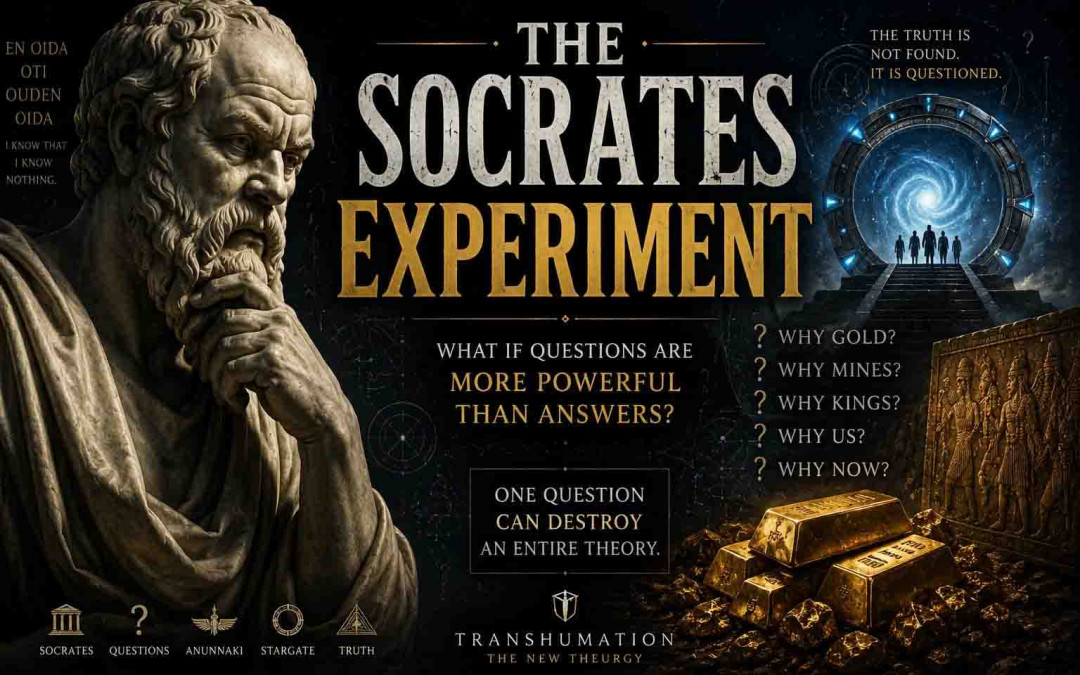
The Socrates Experiment
A theory is most interesting at the moment when one simple question forces it to reveal everything it was quietly assuming.
Imagine an argument that has survived for years because everyone discussing it has been arguing about the wrong part. One side collects coincidences, translations, archaeological anomalies and suggestive images. The other side laughs at the conclusion, attacks the believers and calls the entire subject absurd. Both camps accumulate ammunition. Almost nobody asks the question that would make the structure itself visible.
Socrates would probably have found the situation familiar. We know his method mainly through writers such as Plato and Xenophon, and the historical Socrates is more difficult to reconstruct than the clean classroom version suggests. Yet the pattern associated with him remains extraordinarily powerful: begin not by announcing that another person is wrong, but by asking what must already be true for their claim to work. Then ask what follows from that assumption. Then ask whether the consequences remain consistent with the original belief. A weak theory often does not collapse because an enemy attacks it. It collapses because its own hidden architecture becomes visible.
This is the Socrates Experiment.
Not Can I disprove this?
A harder question:
What would have to be true for this to be true?
The Gold Problem
Take one of the most famous motifs in modern ancient-astronaut mythology: the idea that an extraterrestrial civilization came to Earth in part because it required gold. The story is immediately attractive because gold already possesses enormous symbolic weight. Kings hoarded it, temples displayed it, currencies were tied to it, conquerors crossed oceans for it. Place advanced visitors behind ancient history and gold feels almost inevitable.
But the Socratic question is not whether gold is valuable.
It plainly is.
Gold has useful physical properties. It resists corrosion, conducts electricity effectively and has specialized applications in electronics, aerospace technology and scientific equipment. An advanced technological civilization could conceivably find uses for it that humans have not imagined.
The interesting question begins one step later.
Why would an interstellar civilization need Earth’s gold badly enough to reorganize biological life around extracting it?
The moment we ask that, additional assumptions emerge. We must imagine that the civilization can cross enormous astronomical distances but cannot obtain sufficient gold from asteroids, planetary bodies or other cosmic sources more efficiently. We must imagine that its automation is advanced enough for interstellar travel but primitive enough that biological labor remains attractive. We must imagine that the logistical cost of manipulating a terrestrial species makes sense compared with deploying machines. Perhaps there are answers to all of those objections. But now the theory has work to do.
That is the point.
A serious question does not ridicule the hypothesis.
It makes the hypothesis become expensive.
One Question Can Expose an Entire World
Good theories often contain hidden worlds inside them.
Suppose someone tells you that ancient extraterrestrials ruled humans as kings. The obvious discussion concerns whether there is evidence for extraterrestrials. The Socrates Experiment asks something else: why would a civilization capable of interstellar engineering preserve a political structure resembling a Bronze Age monarchy?
Why a palace?
Why slaves?
Why tribute?
Why dynasties?
Why priests standing between ruler and population?
Perhaps advanced extraterrestrials really would create such institutions. Intelligence does not guarantee political enlightenment. Technological sophistication does not automatically remove domination. Humans themselves provide enough evidence of that.
But another possibility must remain open: perhaps the story looks like an ancient empire because human beings are exceptionally good at projecting familiar power structures into unfamiliar territory.
The alien becomes a king because kings are what we know.
The spacecraft becomes a celestial chariot because chariots are what the storyteller knows.
The god becomes an astronaut because astronauts are what we know.
The costume changes.
The imagination remains local.

Stargate and the Comfortable Universe
Science fiction makes this mechanism easier to see because nobody needs to pretend the fictional world is archaeology.
Consider Stargate SG-1. Its universe is one of television’s great imaginative playgrounds: portals connect planets, ancient technologies appear as magic, civilizations inherit fragments of forgotten knowledge and gods are reinterpreted through technological power. It is entertaining partly because it translates immense cosmic distances into something dramatically manageable.
But television must also produce an episode.
So planets often possess convenient atmospheres, familiar gravity, accessible terrain and humanoid inhabitants who can stand near the actors without months of biological explanation. Alien societies frequently have political structures recognizable to contemporary viewers. Enormous cosmic complexity is compressed into a village, a palace, a military command and a gate.
This is not a flaw peculiar to Stargate. It is what storytelling does.
A narrative must convert the incomprehensible into an interface.
The useful question is what disappears during compression.
We should apply exactly the same suspicion when interpreting stories about the past. A narrative can be emotionally convincing because it uses structures already familiar to us. Familiarity is not evidence.
Sometimes it is evidence about the storyteller.
Ancient Gods and Modern Astronauts
Ancient-astronaut interpretations often begin with a legitimate observation: old religious texts contain beings descending from the sky, luminous phenomena, strange vehicles, transformations, divine weapons and encounters with powers beyond ordinary human capacities.
The mistake comes when ambiguity is converted too quickly into technology.
A fiery object becomes an engine.
A divine weapon becomes a missile.
A celestial being becomes an extraterrestrial.
A heavenly ascent becomes a spacecraft launch.
These translations can be entertaining and occasionally useful as speculative exercises, but resemblance alone cannot establish identity. Religious language operates through metaphor, ritual, cosmology and literary convention. A modern reader raised on rockets and artificial intelligence naturally sees different possibilities from a reader living before industrial technology.
This creates a mirror effect.
Ancient people may have described the unknown through kings, storms and divine animals.
Modern people describe the unknown through aliens, simulations and AI.
Neither fact tells us automatically what the unknown actually was.
It tells us what intellectual furniture was available to the observer.
The Question That Survives the Answer
This is why Socrates remains more useful than the debunker.
A debunker wants a conclusion.
The Socratic method wants the weak joint.
Suppose tomorrow archaeologists discovered indisputable evidence that an extraterrestrial civilization visited Earth in antiquity. The Socrates Experiment would not disappear. It would simply move one level deeper.
Why did they come?
Why interact with humans?
Why leave?
Why those locations?
Why those technologies?
Why those political relationships?
What predictions would follow from the hypothesis?
Which observations would make us abandon it?
A strong idea should generate risks for itself.
If every possible discovery can be reinterpreted as confirmation, we are no longer testing a theory. We are protecting one.
That distinction matters far beyond ancient astronauts.
It applies to politics, religion, technology, conspiracy theories and Transhumation itself.
Watch The Video
How to Read the World
Current Knowledge
The Anunnaki were deities in ancient Mesopotamian religious traditions. There is no accepted archaeological or historical evidence demonstrating that they were extraterrestrial visitors or that humans were genetically engineered by them to mine gold. Modern ancient-astronaut interpretations belong to much later speculative traditions rather than to mainstream Assyriology or archaeology.
Gold does have important technological uses because of its conductivity, corrosion resistance and other physical properties. Therefore the mere statement that a technologically advanced civilization might value gold is not inherently absurd. What requires evidence is the much larger chain of claims connecting extraterrestrial travel, ancient Mesopotamia, human origins and mining activity.
Socratic questioning, especially as represented in Plato’s dialogues, often proceeds by examining definitions and assumptions until contradictions or insufficiently examined beliefs become visible. It should not be reduced to a trick for humiliating an opponent. At its best, the method also exposes weaknesses in the questioner’s own position.
Science fiction regularly adapts contemporary assumptions to imagined futures. This does not make speculative fiction intellectually worthless. On the contrary, it can function as a useful laboratory for examining which parts of an imagined future came from evidence and which came from the culture imagining it.
Open Questions
The most interesting question is not whether humanity projects itself onto the unknown—we clearly do—but whether we can ever completely avoid doing so. Any attempt to imagine non-human intelligence begins with a human nervous system, human language and human categories. Even the concept of intelligence may already contain assumptions developed inside one biological lineage.
There is also a harder methodological problem. How should we investigate genuinely strange historical anomalies without forcing them immediately into either conventional explanation or speculative mythology? Excessive skepticism can discard interesting evidence; excessive pattern recognition can turn every resemblance into confirmation. A useful method must allow surprise while keeping the cost of belief high.
And there is one question ancient-astronaut theories accidentally raise very well: what would an advanced civilization actually value? Matter, energy, information, territory, experience, computation, biological diversity—or categories we currently lack? Asking that seriously may tell us far more about possible futures than assuming cosmic civilizations would simply reproduce the economics of ancient kingdoms.
Transhumation Interpretation
The Socrates Experiment belongs near the center of Transhumation because Transhumation is unusually vulnerable to beautiful ideas.
Patterns are seductive.
Janus appears beside an interface.
Hekate appears at a crossroads.
Ancient gods resemble technological powers.
Carrier-independent structures recur across biology, geometry and information.
AI begins to resemble a librarian.
Once enough of these connections accumulate, a project can begin believing its own elegance.
That is exactly when Socrates should enter the room.
For every strong Transhumation idea, there should be a question capable of damaging it.
If consciousness is a carrier-independent pattern, what observation would show that biology is indispensable?
If history contains recurring structures, how do we distinguish recurrence from selective attention?
If ancient symbols encode durable relationships, how do we know we are not simply projecting modern categories backward?
If AI can become civilization’s librarian, what happens when the librarian systematically misreads the library?
A theory that cannot lose cannot learn.
This may be the real Apostate Principle: apostasy should apply not only to inherited religion or conventional knowledge, but eventually to one’s own favorite ideas.
The goal is not to stand outside civilization announcing that everyone else is wrong.
The goal is to build an idea strong enough to invite the question that might destroy it.
That is why the gold problem matters.
Not because gold disproves the Anunnaki.
Because one innocent question reveals how much invisible machinery a story requires before it can work.
And once you learn to see that machinery, you begin noticing it everywhere.
FAQ
What is the Socrates Experiment?
It is a method of testing an idea by asking which hidden assumptions must be true for the idea to work, and whether those assumptions survive further questioning.
Does the gold question disprove ancient-astronaut theories?
No. Gold has genuine technological value. The question tests the larger chain of assumptions about why an interstellar civilization would need Earth’s gold and why it would use humans to obtain it.
Were the Anunnaki extraterrestrials?
There is no accepted historical or archaeological evidence establishing that interpretation. In ancient Mesopotamian sources, the Anunnaki belong to religious traditions.
Why use Stargate?
Because science fiction makes cultural projection easy to observe. Imagined civilizations often retain political, biological and technological assumptions familiar to the society that invented them.
Can one question really destroy a theory?
Sometimes. More often, a good question reveals the point where additional evidence is required. The theory may survive, change or collapse depending on how well it answers.
What is the deeper Transhumation lesson?
Never ask only whether a pattern is beautiful. Ask what would make it false.
The most dangerous idea is not the obviously ridiculous one.
It is the elegant idea that has quietly arranged the rules so that it can never lose.
Continue the Transhumation Series
- Forgotten Religion | Ancient Gods, Symbols and the Hidden Structures of Human Civilization
- The Last Religion | Death, Immortality and the Future of Humanity
- The New Theurgy | AI, Information and the Future of Human Civilization
- End of Branding: You Were Never Meant to Become a Product
- Baal vs Ishtar: Why Ancient Gods Never Disappeared