
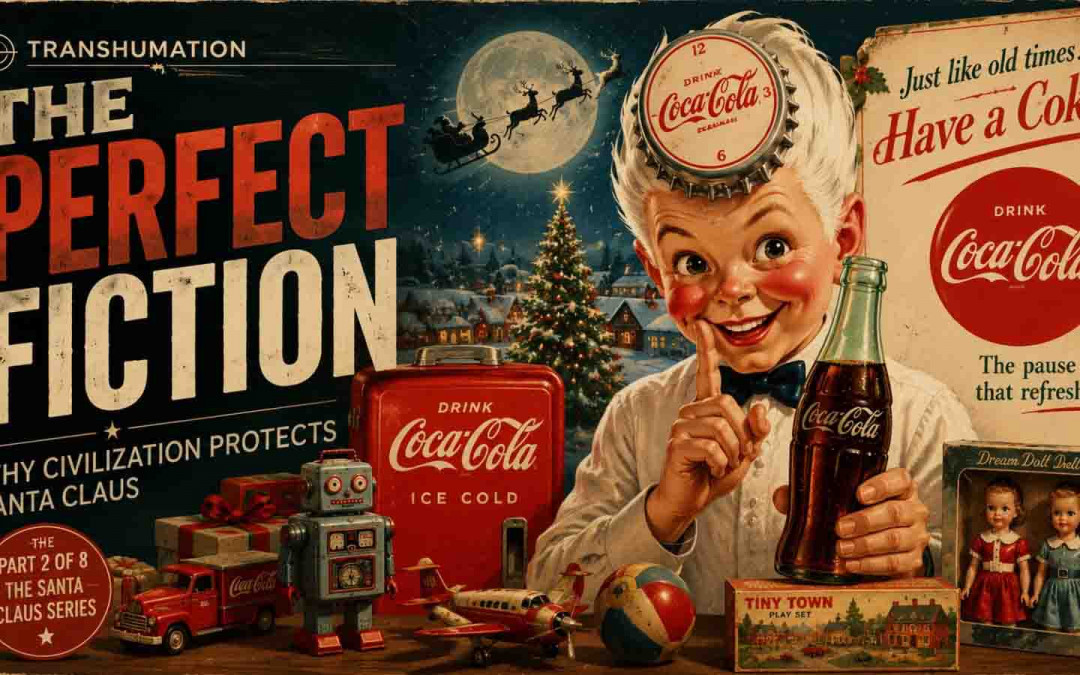
Why Santa Claus Survives the Moment We Stop Believing
Every child eventually discovers who bought the presents. Sometimes the revelation arrives through an older sibling; sometimes through an unfortunately timed visit to a wardrobe; sometimes because the handwriting on a letter from the North Pole begins to look suspiciously like a parent’s. The mechanics collapse quickly. There was no sleigh on the roof, no journey around the world in a single night, no old man entering through a chimney that the house may not even possess. For a brief period this can feel like the end of something. Then an altogether stranger thing happens: the child grows up.
Twenty or thirty years later, the former skeptic may be crawling across the same living-room floor, arranging presents after midnight and making sure the wrapping paper supposedly used by Santa does not match the roll left openly in the kitchen. The person who discovered the trick has become its operator. Instead of exposing the fiction, the initiate joins it.
Most falsehoods are damaged by discovery. Santa Claus seems almost designed to survive it. The revelation does not necessarily destroy the story because, at some point, the purpose of the story changes. A child is told that Santa exists; an adult knows perfectly well who is paying the credit-card bill and nevertheless chooses to keep Santa alive for another generation. Something has crossed the boundary between belief and understanding without disappearing.
That is a peculiar achievement for a fiction. It may also tell us something larger about the way civilizations preserve information.
The Night the Lie Changes Sides
Calling Santa Claus simply a lie misses what happens after the secret is revealed. A conventional deception depends on asymmetry: one person knows what is happening and another does not. Once the victim discovers the mechanism, the deception loses its power. A fraudulent investment does not become more charming when its investors understand the fraud. A fabricated news story does not acquire greater cultural value after the correction appears.
Santa behaves differently because disclosure can turn the former recipient into a participant. The child who learns the truth is gradually admitted backstage. Suddenly the mysterious noises downstairs have an explanation; the apparently spontaneous presents reveal an infrastructure of shopping, hiding, wrapping and exhausted adults waiting for children to fall asleep. The magician has not merely revealed the trick. He has invited someone behind the curtain.
What looked like the destruction of the story can therefore become a rite of passage within it. The question quietly changes from Do you believe? to Will you help create the experience for somebody who still does? The information has not vanished. It has moved to another level.
This distinction matters because it explains why adults who value honesty can participate without necessarily experiencing themselves as habitual liars. Their intention is usually not to persuade a child permanently that an immortal man operates an Arctic logistics empire. The literal belief has an expiration date built into the tradition. What they are attempting to preserve is a temporary form of experience: anticipation, mystery, generosity, surprise and the extraordinary sensation that the ordinary world may contain more than it showed yesterday.
The fiction is temporary.
The experience is meant to remain.
What Exactly Is Real Here?
Civilization is crowded with things whose physical carrier is much smaller than their social reality. A banknote can be held in one hand, but its purchasing power cannot. A wedding ring has measurable weight and chemical composition, yet neither explains the promise it represents. A university diploma is paper or a digital record; what matters is the network of institutions and people willing to recognize what it certifies. A national border can cross a desert where no natural line separates one side from another, while the consequences of stepping across it can be enormous.
These things are not unreal. They are real in a different way from mountains and oxygen.
Their effects depend partly on shared recognition.
Santa Claus is not equivalent to money, marriage, universities or states, and pushing the comparison that far would make it useless. But they reveal a common civilizational ability: humans can attach information to objects, gestures and stories, then coordinate behavior around the meaning rather than merely the material carrier. A ring can carry a promise. A flag can carry an identity. A uniform can carry authority. A fictional figure can carry a ritual.
Once this is noticed, the interesting question is no longer whether Santa Claus is physically real. That problem was settled long ago.
The better question is what kind of reality remains after literal belief disappears.

The Advertising Campaign That Escaped Its Advertisement
The familiar claim that Coca-Cola invented Santa Claus is too neat to be true. The modern figure emerged gradually from much older traditions surrounding Saint Nicholas, Dutch Sinterklaas, English Christmas customs and nineteenth-century American literature and illustration. Clement Clarke Moore’s famous Christmas poem helped establish important elements of the character, while Thomas Nast’s nineteenth-century drawings contributed substantially to his visual development before Coca-Cola’s Santa campaigns began.
Coca-Cola’s achievement was subtler and, for this argument, more interesting.
Beginning in 1931, illustrator Haddon Sundblom created a warm, human, red-and-white Santa for Coca-Cola advertisements. The company did not manufacture the cultural need for Santa. It inherited a figure that had already survived centuries of transformation and helped stabilize one exceptionally successful interface for him.
An advertisement escaped advertising.
That is difficult to accomplish. Most commercial imagery dies with the campaign that paid for it. Sundblom’s Santa entered a much larger visual culture because the image was compatible with something already present: warmth, abundance, winter, childhood, generosity and the domestic theatre of Christmas. Commerce provided a powerful new carrier, but the information was older than the carrier.
This is one of the recurring curiosities of culture. Sometimes advertising borrows from civilization. Occasionally civilization decides to keep the advertisement.
Santa survived both.
The Experience Parents Are Actually Inheriting
Ask parents why they continue the ritual and relatively few will describe a sophisticated theory of cultural transmission. They are more likely to say something ordinary: I want my children to have what I had.
That sentence contains almost the whole mechanism.
They are not trying to reproduce information exactly. They already know that part of the information was false. They are trying to reproduce an experience.
This is an important difference. A photograph preserves an image; a recipe preserves instructions; a ritual attempts to preserve an event by causing another person to participate in something structurally similar. Christmas morning is not transmitted like a fact in an encyclopedia. It has to happen again.
The presents must be hidden again.
Someone has to wait.
Someone has to wonder.
Someone else has to know.
The participants change, but the roles remain.
This is how rituals become unusual carriers of information. They do not merely tell later generations what earlier people did. They persuade later generations to perform a version of it themselves. The child does not read an ethnographic account of Christmas wonder. For a few years, the child lives inside it.
Then the observer changes position.
The recipient becomes the author.
The audience becomes the stagehand.
The story survives because people move through its roles.
Civilization’s Shared Imagination
A child’s encounter with Santa may therefore be an early introduction to something adults spend the rest of their lives doing: inhabiting realities partly constructed by other minds.
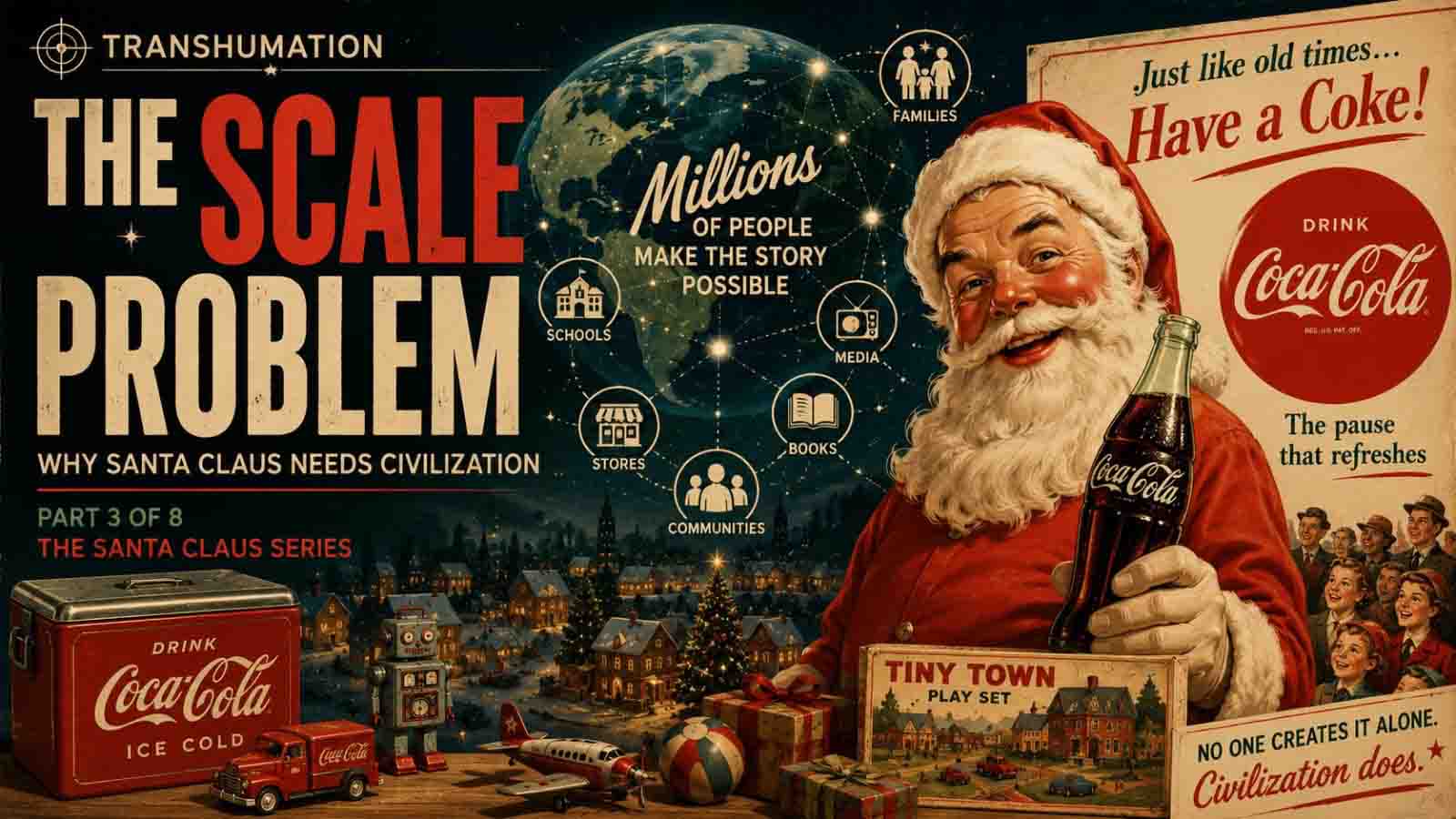
The scale of coordination is remarkable. Parents, grandparents, teachers, films, songs, shop windows, books, advertisements, shopping centres and strangers dressed in red all maintain compatible pieces of the same imaginary world. There is no Ministry of Santa Claus coordinating the operation. No single author owns the definitive version. Contradictions are tolerated. Details vary. Yet the structure remains recognizable across enormous distances.
Human civilization depends heavily on this capacity for shared imagination, although not every shared imagination is fictional in the same sense. Institutions, laws, corporations, currencies and nations acquire much of their practical power because large groups of strangers can coordinate around symbols, rules and expectations that exist beyond any single individual.
This ability is so ordinary that we barely notice it.
A chimpanzee can recognize members of its group. A modern human can walk into an airport, present a small booklet issued by a state, exchange numbers stored in banking databases for a seat aboard an aircraft owned by a legal corporation, cross an invisible national boundary and arrive in a country whose laws are immediately meaningful.
Almost every stage depends on collective abstractions.
Santa is child’s play.
But child’s play may be where we first learn the trick.
Fiction Is Not Reality’s Enemy
Modern culture often places fiction and truth on opposite sides of a clean boundary. In many contexts that boundary is essential. A scientific paper cannot defend invented results by calling them meaningful. A court cannot substitute a beautiful story for evidence. A historian cannot repair missing documents with imagination and then present the reconstruction as fact.
But fiction has another relationship with reality.
It can precede it.
Human beings imagined flying machines long before aviation became engineering. Journeys to the Moon existed in literature before astronauts left footprints there. Artificial beings, mechanical minds and talking machines populated myths and fiction before computer science could seriously attempt anything resembling them. The imagined object does not cause the real one automatically, and countless fantasies remain fantasies forever, but imagination creates a space in which possibilities can be explored before they become practical.
This makes fiction less like reality’s opposite and more like one of civilization’s experimental chambers.
We can construct a world that does not exist, enter it temporarily, observe what happens and return carrying information.
Children do this instinctively.
Artists industrialize it.
Civilizations sometimes build the result.
The Story That Changes the Observer
This brings us to the part of Santa Claus that matters more than the sleigh.
A successful story does not have to remain believed in order to leave something behind. The child can abandon the literal Santa while retaining associations with giving, anticipation, family ritual or generosity. Later the same person may recreate those conditions for someone else without recovering the original belief.
The story has lost one function and retained another.
That suggests a useful way to think about myths more generally. Perhaps some stories survive not because every generation accepts the same interpretation, but because the story can change its relationship with the observer. What begins as explanation may become metaphor. What begins as religious ritual may become cultural memory. What begins as literal belief may become literature, psychology, philosophy or art.
The carrier changes.
The relationship changes.
Something continues.
This does not make every durable story wise, beneficial or true. Propaganda can survive. Prejudice can survive. Dangerous myths can reproduce with extraordinary efficiency. Cultural survival is evidence of transmissibility, not goodness.
But Santa gives us an unusually gentle demonstration of the mechanism.
The story survives the loss of belief because belief was only one stage of participation.
The Perfect Fiction
Perhaps the perfect fiction is not the story that fools everybody forever.
That would merely be a perfect deception.
The more interesting fiction is one capable of surviving the moment its machinery becomes visible. It gives the audience something while the illusion is intact, then gives them something different after the illusion has disappeared. Eventually it may even turn them into custodians of the thing they once believed.
Santa Claus begins as a mysterious visitor.
Then he becomes a discovery.
Then a memory.
Finally, for many people, he becomes a role.
The remarkable part is not that children can believe in him. Children can believe many things. The remarkable part is that adults who know precisely what happened still decide that something in the experience deserves another generation.
Perhaps that is one of civilization’s oldest methods of carrying information through time. We imagine that stories survive because they preserve their contents. Sometimes they survive because they preserve an experience capable of being reconstructed in another mind.
A book waits for another reader.
A piece of music waits for another listener.
A ritual waits for another participant.
Santa waits for another child.
And then, eventually, that child discovers the trick and receives something that was hidden inside the fiction all along:
a place on the other side of the story.
Watch The Video
How to Read the World
Current Knowledge
The modern Santa Claus developed from several historical traditions rather than from a single invention. Saint Nicholas traditions, Dutch Sinterklaas customs, English Christmas figures, nineteenth-century American literature and illustration all contributed to the figure familiar today. Coca-Cola did not invent Santa Claus; its campaigns beginning in 1931, particularly Haddon Sundblom’s illustrations, helped popularize a highly influential visual version of him.
Research on childhood fantasy suggests that children’s distinctions between fictional and real entities are more sophisticated than a simple division between complete belief and disbelief. Children can participate deeply in pretend worlds while gradually developing increasingly complex judgments about what exists literally.
Anthropology, sociology and psychology have also documented the importance of ritual, shared symbols and collective conventions in coordinating human groups and transmitting cultural practices. However, money, legal institutions, religious rituals and fictional characters are different kinds of phenomena and should not be treated as interchangeable simply because all involve shared meaning.
Open Questions
Why do certain fictional figures survive dramatic changes in belief while others disappear? Emotional attachment, repetition, institutional support, commercial reinforcement and adaptability probably all matter, but there is no single rule explaining cultural longevity.
A second question concerns what children actually inherit. Is the lasting value of the Santa tradition primarily wonder, generosity, family continuity, social belonging or simply nostalgia reproduced by adults? Different families may be transmitting quite different experiences through apparently identical rituals.
There is also a harder ethical boundary. If some fictions can perform beneficial functions, how do we distinguish imaginative participation from manipulation? Cultural usefulness alone cannot justify a false claim. A story’s ability to survive tells us that it is effective at transmission; it does not tell us whether what it transmits is good.
Transhumation Interpretation
The Perfect Fiction extends a central Transhumation idea: information does not have to preserve its original carrier in order to preserve a structure.
Santa provides a remarkably visible example.
The first carrier is literal belief: Santa will come.
That carrier eventually fails.
But the structure migrates into anticipation, ritual, memory and generosity. Eventually it can migrate again into the former child’s decision to create the experience for somebody else.
believer → discovery → participant → carrier
What survives is therefore not simply a proposition.
It is a pattern of roles.
This matters because civilization may preserve far more information in this form than we usually recognize. Myths, ceremonies, stories, works of art and institutions can carry ways of experiencing the world even when their original explanations have been abandoned. Their survival does not prove those explanations true, but neither does the disappearance of literal belief prove that nothing was transmitted.
The most interesting test may therefore be neither Is the story still believed? nor even Is the story useful?
It may be:
What survives after the observer discovers how the trick works?
Santa Claus passes that test unusually well.
The child discovers that Santa does not exist.
And one day Santa exists again.
Not because the child changed their mind.
Because the child changed sides.
FAQ
What is the Perfect Fiction?
A Transhumation idea describing a story that can survive the loss of literal belief because its experience or function continues to be transmitted.
Why does Santa Claus survive after children learn the truth?
Because the tradition can change from belief into ritual, memory and eventually participation.
Did Coca-Cola invent Santa Claus?
No. The modern Santa developed from much older traditions. Coca-Cola helped popularize one influential visual form.
Is fiction the opposite of truth?
Fiction is not factual evidence, but it can explore possibilities, transmit experiences and influence real behavior.
Are all surviving myths valuable?
No. Cultural survival proves neither truth nor moral value. Harmful ideas can also survive extremely well.
What does it mean that the observer changes?
The child begins as the recipient of the story, discovers its mechanism and may later become the person creating the same experience for another child.
How does this connect to Transhumation?
It illustrates carrier-independent structure: literal belief can disappear while a pattern of experience, behavior and meaning continues in another form.
What is the central question?
Not simply whether a fiction is exposed, but what remains after we know how it works.
Continue the Transhumation Series
- Forgotten Religion | Ancient Gods, Symbols and the Hidden Structures of Human Civilization
- The Last Religion | Death, Immortality and the Future of Humanity
- The New Theurgy | AI, Information and the Future of Human Civilization
- End of Branding: You Were Never Meant to Become a Product
- Baal vs Ishtar: Why Ancient Gods Never Disappeared