
Symbols Preserve Structure
Imagine being asked to explain a city using only one brick. You could weigh it, photograph it under a microscope, identify its minerals, measure its porosity and reconstruct the temperature at which it was fired. After a year of work you might possess an extraordinary scientific description of the object and still know almost nothing about the city. You would not know where the streets lead, where the river divides the neighborhoods, which buildings dominate the skyline or why thousands of people choose one route rather than another in the morning.
Now imagine the opposite experiment. Someone places a crude model of the city on a table. The buildings are little more than blocks. The river is blue plastic. Three major roads replace thousands of actual streets. Entire districts have been reduced to colored areas and the railway station is represented by something that barely resembles a station at all. Almost every physical detail is wrong.
And yet within thirty seconds you understand something the perfect brick could never reveal.
Where the center is.
What connects to what.
Which side of the river contains the old town.
Where the railway enters.
How the city is organized.
The model contains less information.
It may contain more relevant structure.
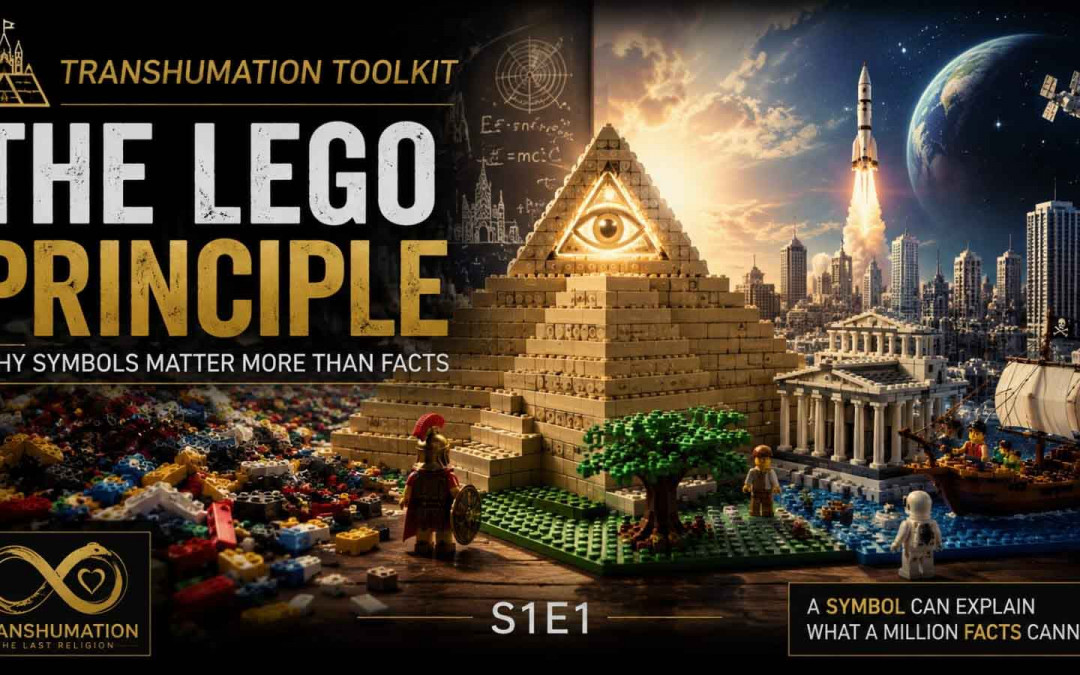
That is the LEGO Principle.
Not that simplicity is truer than detail, nor that symbols are superior to facts, but that understanding often depends upon preserving the correct relationships while allowing enormous quantities of information to disappear.
The Block Is Not the Building
Civilization is full of things that emerge from relatively simple units without being explainable by any one of them in isolation.
Letters become words. Words become laws, novels and prayers. Individual transactions become markets. Citizens become political institutions. Notes become melodies. Instructions become software. Stones become buildings whose architectural meaning cannot be located inside any particular stone.
This does not mean that the components are unimportant. Remove enough stones and the cathedral falls. Corrupt enough instructions and the program stops working. Change enough words and the constitution no longer says what it once said.
But knowing the component is different from knowing the organization.
A child building a castle from toy bricks encounters this distinction almost immediately. The individual brick is astonishingly generic. It can become a wall, a wheelhouse, a spaceship, a dragon or a piece of furniture depending almost entirely on its relationship to other pieces.
The meaning is not sitting inside the brick waiting to be discovered.
It emerges from arrangement.
That is why the same finite construction set can generate an almost absurd variety of recognizable worlds. The vocabulary remains small while the grammar creates complexity.
Civilization works in a similar way more often than we notice.
Symbols Are Machines for Removing Information
We usually describe a symbol as something that represents something else. That is correct but incomplete.
A successful symbol also decides what can safely be ignored.
Consider a map of a subway system. It usually lies about physical geography. Distances are distorted. Curves become straight lines. Stations occupy more space than entire neighborhoods. Rivers are simplified. Streets disappear almost completely.
A bad cartographer attempting perfect physical accuracy could produce a map less useful to the passenger than the deliberately distorted one.
Why?
Because the passenger’s question is not, What is the exact geometry of the city?
The question is, Where do I change trains?
The map preserves the relation relevant to the task and sacrifices much of everything else.
Mathematics does something similar at a far more sophisticated level. Equations can ignore color, history, personality and countless physical details while preserving relationships between quantities. Architectural plans remove almost everything about the experience of inhabiting a building while preserving dimensions and structural relationships needed for construction. Language itself performs continuous compression: saying “dog” ignores almost every property distinguishing one dog from another in order to preserve the category useful for communication.
Human thought would be impossible without this violence against detail.
We understand because we forget selectively.
The danger begins when we forget that something was removed.

Why LEGO Works So Well
A LEGO pirate ship does not resemble a real eighteenth-century vessel at close range. Its hull is geometrically crude. The rigging is almost nonexistent. The proportions are wrong. The interior is simplified beyond absurdity. A naval historian could produce a very long list of inaccuracies before lunch.
A child still recognizes the ship.
This works because the model preserves a small number of relationships with unusually high informational value. There is a hull, a deck, a mast, sails, perhaps cannons and a recognizable bow and stern. Remove thousands of historically correct details and enough architecture remains for the category to survive.
The brilliance is not realism.
It is minimum sufficient structure.
This is much closer to sophisticated modeling than the toy-like appearance suggests. Engineers construct simplified models of systems precisely because replicating every detail would make calculation impossible. Economists exclude most properties of real human beings in order to study selected interactions. Scientists build models that are known to be incomplete but useful within defined conditions.
A model is not a failed copy of reality.
It is an instrument designed to answer a particular question.
The interesting problem is deciding how many bricks can be removed before the ship stops being a ship.
Facts Still Get the Final Vote
This is where the LEGO Principle must protect itself from becoming an excuse for mythology without evidence.
A symbolic pattern can be beautiful.
It can also be wrong.
Suppose someone notices that a gate appears in an ancient religion, in modern software interfaces and in initiation rituals. At a sufficiently abstract level, the comparison becomes compelling: all three involve access, transition and conditions for crossing.
That may reveal a useful carrier-independent structure.
Or it may be an artifact of aggressive compression.
If we zoom out far enough, almost anything can be made to resemble anything else.
A womb is a gate.
A password is a gate.
Death is a gate.
A border checkpoint is a gate.
A university examination is a gate.
A sunrise is a gate.
At some point the symbol becomes so flexible that it can no longer lose.
That is precisely where facts must return.
Historical context matters. Chronology matters. Independent development matters. Differences matter. A Roman doorway, a Hekatean crossroads and a login screen do not become historically connected merely because a modern observer can place all three beneath the category of threshold.
The symbol gives us a hypothesis about structure.
The facts decide how far that hypothesis is allowed to travel.
Without symbols, we drown in particulars.
Without facts, we drown in ourselves.
Myth Is Not a Documentary
This distinction becomes especially important when dealing with myths.
Modern readers often force myths into one of two inadequate categories. Either the story happened literally and must therefore be defended as history, or it did not happen literally and can therefore be discarded as fiction.
But stories can preserve important structures without functioning as documentary reports.
King Arthur offers an obvious example. Scholars have debated possible historical backgrounds for Arthurian traditions for centuries, but the Arthur who became culturally powerful is a literary construction accumulated through many authors and periods. Camelot matters not because archaeological excavation has verified every event, but because the tradition organizes questions about loyalty, legitimacy, betrayal, ideal kingship and the failure of political order.
Batman is even easier. Nobody needs Gotham City to appear in a census before discussing what the character represents culturally. The story can explore justice, trauma, vigilantism, order and the moral limits of power without becoming a report from an actual city.
This does not mean fiction contains a deeper truth automatically.
Bad stories exist.
False myths exist.
Symbols can preserve prejudice as easily as wisdom.
The correct question is therefore not simply, Did this happen? nor simply, What does this symbolize?
It is:
What structure does the story preserve, and does that structure remain useful when tested outside the story?
That is a much more demanding question.
Science Is Full of Deliberate Inaccuracy
Science sometimes appears to stand on the opposite side of symbols, but modern science could barely function without them.
The diagram of an atom in a schoolbook is not an atom. A line on a graph has no physical thickness corresponding to the phenomenon it represents. A gene depicted as a colored rectangle is not literally a colored rectangle sitting on DNA. A physicist writes symbols on paper that compress enormously complex relationships into a few marks.
The scientific difference is not that science avoids representation.
It is that good scientific representations remain accountable to measurement.
Newtonian mechanics is incomplete, but extraordinarily useful within appropriate regimes. A globe is wildly simplified but can correctly preserve certain spatial relationships. A circuit diagram looks nothing like the physical mess inside many real machines and remains invaluable because it preserves the connections that matter electrically.
Science therefore offers a disciplined version of the LEGO Principle.
Remove detail.
Preserve structure.
Test whether the structure still predicts or explains what matters.
Then rebuild the model when it fails.
The symbol earns its authority by surviving contact with reality.
AI and the Infinite Box of Bricks
Artificial intelligence makes this issue especially interesting because contemporary AI systems operate through learned statistical representations rather than simply storing civilization as a conventional encyclopedia of isolated sentences.
But saying that AI “understands patterns rather than facts” would go too far. Modern models are trained on enormous amounts of human-produced data and learn statistical regularities within it. They can reproduce facts, infer relationships, generalize across examples and also generate patterns that are persuasive but false.
That last possibility is crucial.
Pattern recognition is not automatically understanding.
Humans know this from ourselves. We see faces in clouds, conspiracies in coincidence and narratives in random sequences. Intelligence seems to require finding structure, but it also requires the ability to reject structures that do not survive evidence.
AI therefore magnifies both sides of the LEGO Principle.
It can compress.
It can connect.
It can reveal similarities across material too large for an individual to inspect.
It can also build extraordinarily convincing castles from bricks that were never meant to fit together.
The future value of AI may depend partly on whether it becomes good not only at constructing models, but at exposing which bricks support the construction.
The Smallest Model That Still Works
There is a deep elegance in finding the minimum explanation that preserves what matters.
In science, simpler models are often attractive when they explain the same evidence without unnecessary assumptions, although simplicity alone does not establish truth. In design, unnecessary complexity can hide function. In communication, one image can sometimes make a relationship visible that several pages of raw data conceal.
But minimalism has a boundary.
Remove one beam too many and architecture becomes collapse.
Remove one uncomfortable historical fact and interpretation becomes propaganda.
Remove the individual from statistics and policy becomes inhuman.
Remove variation from biology and the average organism begins replacing real organisms that do not match it.
The LEGO Principle is therefore not a celebration of simplicity.
It is a test of structural sufficiency.
How little can remain before the thing we care about disappears?
That question connects directly with personal identity, civilization and Transhumation. If a book changes medium, which properties must survive for us to call it the same book? If an institution replaces its people and buildings, what structure allows continuity? If a person could someday change biological carrier, what would have to remain for the word same to mean anything?
Suddenly the children’s construction set has become a serious philosophical instrument.
Watch The Video
How to Read the World
Current Knowledge
Human cognition depends heavily on abstraction, categorization and compression. We cannot process every available sensory or informational detail simultaneously, so mental representations emphasize selected relationships while ignoring others.
Models in science deliberately simplify reality. Their usefulness depends on whether the simplifications preserve features relevant to prediction, explanation or measurement. A model can therefore be highly useful without being a complete representation of the system it describes.
Symbols likewise do not possess universal meanings independent of context. The same geometric or narrative form can carry different meanings across cultures and historical periods. Structural comparison can be intellectually useful, but resemblance alone does not establish common origin or identical significance.
Modern AI systems learn statistical regularities from training data and can identify or generate complex patterns. They can also hallucinate facts and produce spurious relationships, demonstrating that pattern generation alone is not a guarantee of truth or understanding.
Stories and myths can preserve culturally important themes and relationships even when they are not literal historical accounts. Their symbolic significance must nevertheless be distinguished from claims about what actually occurred.
Open Questions
One difficult question is whether there is a principled way to determine the minimum structure required for identity. In a LEGO model the answer is pragmatic: recognition disappears at some point. For a legal institution, organism or conscious person, the threshold may be far harder to define.
There is also a methodological problem for comparative history. How abstract may we become before structural comparison turns into pattern projection? If two traditions share a gate, a guardian and a transformation, is that enough to speak of a common structure, or have we simply chosen categories broad enough to manufacture similarity?
Artificial intelligence introduces a related question. If AI increasingly supplies humanity with compressed explanations of complex archives, who decides which details are expendable? The quality of future knowledge may depend as much on what informational systems choose to omit as on what they successfully retrieve.
And perhaps the largest philosophical question concerns reality itself. Are some structures genuinely independent of their carriers, or do humans sometimes impose stable patterns on a world that is far less neatly divided than our symbolic systems suggest?
Transhumation Interpretation
The LEGO Principle gives Transhumation both a tool and a warning.
The tool is compression.
Civilization cannot think without it.
A symbol allows one structure to migrate through different carriers. A triangle can be scratched into stone, printed in a book, represented by coordinates or rendered on a screen. A gate can appear physically in architecture and abstractly in software permissions. A story can move across languages while retaining enough of its architecture to remain recognizable.
This is where recurring structures become intellectually interesting.
But the warning is equally important.
The more aggressively we compress, the easier it becomes to find the pattern we hoped to find.
This matters enormously for Transhumation because the project deliberately searches across religion, technology, history, philosophy and biology. At that scale, beautiful similarities are abundant. If every resemblance becomes evidence, the library becomes a hall of mirrors in which our own idea appears on every shelf.
The LEGO Principle therefore needs the Socrates Experiment beside it.
First simplify.
Then attack the simplification.
If the model says that two phenomena share a structure, return to the details and try to break the resemblance. Look for historical differences, different causal mechanisms, contradictory meanings and examples where the proposed pattern should appear but does not.
The structure becomes interesting only after surviving the return of detail.
That may be the mature relationship between symbol and fact.
Facts without structure become an archive nobody can navigate.
Structure without facts becomes mythology nobody can falsify.
The library needs both.
This also changes the claim that civilization is built from information. Information alone is not enough. A pile of bricks is not a cathedral. A hard drive full of documents is not understanding. A genome is not an organism merely because its sequence can be represented as data. A million historical facts do not automatically produce history.
Organization matters.
Relation matters.
Context matters.
Perhaps meaning itself begins when pieces cease to be merely adjacent and become part of a structure.
That is why a child can sometimes understand something important with twenty bricks.
The child does not possess the ship.
The child possesses a model of the relations that make the ship recognizable.
Civilization has been doing versions of the same thing for thousands of years.
Alphabet.
Map.
Equation.
Myth.
Diagram.
Computer model.
Artificial intelligence.
Each is a different box of blocks.
And perhaps intellectual maturity begins when we understand that the goal is neither to collect every brick nor to worship the model we have built.
It is to know which relationships must survive when everything unnecessary is removed — and which fact, if removed, would make the whole construction dishonest.
FAQ
What is the LEGO Principle?
It is the idea that a simplified model can preserve the essential relationships of something even after enormous amounts of detail have been removed.
Is this actually about LEGO?
Only as a metaphor. Toy construction sets make the principle unusually visible because crude blocks can preserve enough structure for a complex object to remain recognizable.
Are symbols more important than facts?
Not absolutely. Symbols organize and compress facts; facts constrain whether the symbolic model remains defensible. One without the other becomes either noise or fantasy.
Why can mythology still be useful if it is not literal history?
Because stories can preserve relationships involving authority, sacrifice, transformation, fear or identity without functioning as documentary records. Their symbolic value does not establish historical fact.
How does AI fit into the LEGO Principle?
AI can identify and compress relationships across enormous quantities of information, but it can also generate convincing false patterns. Its usefulness therefore depends partly on preserving routes from the model back to evidence.
What is the deeper Transhumation idea?
Understanding may depend on discovering the smallest structure that can change carrier without losing what makes the thing recognizable.
But the final test is always the same.
Remove another brick.
If the structure survives, perhaps it was unnecessary.
If the whole thing collapses, you have discovered something that mattered.
Continue the Transhumation Series
- Forgotten Religion | Ancient Gods, Symbols and the Hidden Structures of Human Civilization
- The Last Religion | Death, Immortality and the Future of Humanity
- The New Theurgy | AI, Information and the Future of Human Civilization
- End of Branding: You Were Never Meant to Become a Product
- Baal vs Ishtar: Why Ancient Gods Never Disappeared