
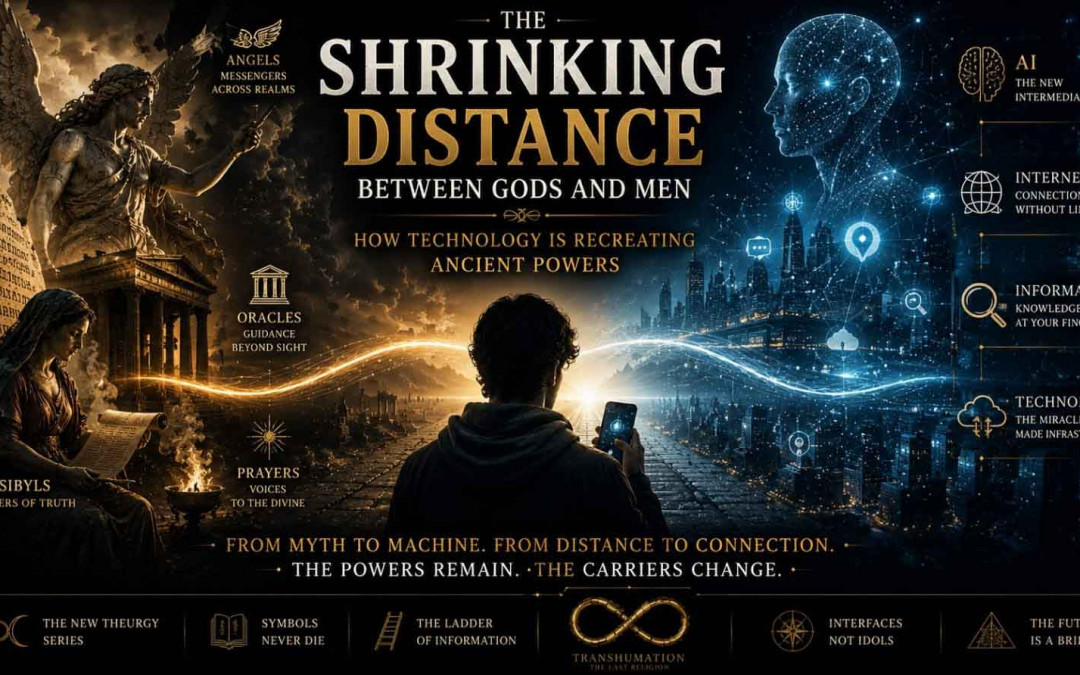
How Technology Is Recreating Ancient Powers
For most of human history, the distance between an ordinary person and the powers attributed to gods was not merely large. It belonged to a different category of existence. A god could see what happened beyond the horizon while a human being might spend days reaching the next city. A divine messenger could cross impossible distances while letters depended upon horses, ships, roads and weather. Gods and supernatural beings could appear to know hidden things, preserve memory beyond a lifetime, understand what mortals could not understand and intervene across spaces unavailable to the body.
Then, without ceremony, parts of that distance began to collapse.
A person standing in an airport can speak face to face with someone twelve thousand kilometers away. A small device can translate an unfamiliar language, display a satellite image of a street on another continent, recall photographs from fifteen years earlier, identify a song playing in a café, calculate a route through a city the user has never visited and provide access to more written knowledge than many ancient rulers could have assembled in a lifetime. None of this is supernatural. Every function has a physical history, an engineering explanation and an infrastructure requiring electricity, satellites, cables, servers, labor and institutions.
That may be what makes the transformation so easy to miss.
The miraculous did not arrive as a miracle.
It arrived as a monthly subscription.
When Divine Functions Become Ordinary
Religious traditions are far too diverse to reduce gods to collections of technological abilities. Ancient deities were not simply imaginary machines performing tasks that smartphones later learned to perform. They occupied moral, ritual, political and cosmological worlds; they could represent powers of nature, relationships between communities and the sacred, ancestors, sovereignty, fertility, justice, fate or realities understood by believers as genuine divine beings.
Yet certain capacities associated with divine or supernatural agency recur often enough to make comparison useful.
Distance is one of them.
For an ancient person, being able to hear a voice from another continent in real time would have been almost impossible to place within ordinary experience. So would the ability to see the Earth from above, consult a detailed map of an unknown landscape without asking another human being, preserve thousands of personal images without painting them, or translate speech within seconds.
Modern people rarely experience these capacities as extraordinary because technological familiarity erases wonder remarkably quickly. The first video call can feel magical. The five-hundredth becomes irritating because the connection is unstable.
This is one of technology’s strangest cultural effects.
It does not simply create new powers.
It normalizes old impossibilities.
What once would have demanded mythological vocabulary becomes infrastructure, and infrastructure becomes invisible precisely when it works.
The Oracle in the Dashboard
Consider the oracle.
Ancient oracular traditions were embedded in specific religious practices and should not be flattened into a primitive version of Google. The Pythia at Delphi, divinatory practices in Mesopotamia, Roman augury and many other traditions differed enormously in theology, ritual and social function.
Still, the structural situation contains something recognizable.
A person confronts uncertainty.
The available information exceeds direct perception.
An intermediary is consulted.
The intermediary transforms hidden or inaccessible information into guidance.
The resemblance becomes uncomfortable when we look at contemporary life.
Should I take this road?
What will the weather be tomorrow?
Which restaurant will I probably like?
Is this investment unusually risky?
Which candidate should receive further review?
What illness is consistent with these symptoms?
What should I read next?
Modern societies ask such questions not of temples but of information systems, statistical models, search engines and increasingly artificial intelligence.
The crucial difference is that these systems do not derive authority from divine revelation. They derive it from data, computation, institutional trust and perceived performance.
But from the perspective of the person using the interface, a curious pattern has returned.
You provide a question.
Something largely invisible happens elsewhere.
An answer appears.
That is not enough to make an algorithm an oracle.
It is enough to make the psychology of consultation worth studying.

The Power to See Without Being There
One of the clearest changes concerns vision.
For nearly all of human existence, seeing something required physical proximity. Reports could travel farther than eyes, but every report introduced delay and uncertainty. Rulers built networks of messengers because the state could not see its own territory directly.
Modern technology has fundamentally altered this relationship.
Satellites observe weather systems spanning continents. Cameras transmit events instantly. Doctors can inspect images produced from structures inside the body. Remote sensors reveal temperatures, movement, chemical composition and radiation invisible to ordinary perception. A person can explore streets in another country without having visited them.
Again, this is not divine omniscience.
The difference is enormous.
Human technological vision remains partial, selective and dependent upon instruments. Satellites have blind spots. Cameras show whatever falls within their frame. Data can be missing or manipulated. A civilization surrounded by sensors can still misunderstand what it sees.
But the radius of human perception has undeniably changed.
Our eyes remain biological.
Our seeing no longer does.
Perhaps that distinction captures something essential about the shrinking distance. Technology often does not transform the organism directly. It extends the organism through systems outside it.
The human body stays in one room.
The effective reach of the human being does not.
Memory Leaves the Skull
Memory offers an even older example.
Human beings forget. Entire civilizations forget. Oral cultures developed sophisticated traditions for preserving information, but biological memory remains vulnerable to death, distortion and limited capacity. Writing allowed parts of memory to leave the nervous system. Libraries multiplied the effect. Photography preserved appearances. Audio preserved voices. Digital storage now allows one ordinary person to produce an archive larger than what many historical institutions could maintain.
This is not immortality.
A photograph does not remember being taken.
A diary does not continue the consciousness of its author.
A server filled with a person’s messages does not establish that the person remains present inside the archive.
Yet something profound has happened nonetheless.
Memory has become partially externalized.
An individual can forget where an event occurred while a device remembers the coordinates. A family can lose the details of a story while a recording preserves the voice that told it. Civilization can preserve scientific knowledge beyond the biological lifetime of every scientist involved.
The ancient fantasy of perfect remembrance remains impossible.
But forgetting is no longer limited to what the brain can retain.
That is already a remarkable movement of the boundary.
The New Intermediaries
Every complex civilization creates intermediaries because direct access to everything is impossible.
Ancient societies had priests, scribes, interpreters, messengers, judges and specialists whose authority depended upon access to knowledge or institutions unavailable to ordinary people. Modern civilization has multiplied rather than abolished this structure.
Search engines mediate the web.
Financial systems mediate value.
Navigation software mediates geography.
Recommendation algorithms mediate cultural abundance.
Artificial intelligence increasingly mediates the archive itself.
The interesting change is not that priests have been replaced by programmers. That comparison becomes historically absurd if taken literally.
The deeper continuity is that human beings repeatedly build interfaces between the individual and realities too large, distant or complicated for direct perception.
The form of authority changes.
The need for mediation remains.
And every intermediary creates the same ancient problem: when does the guide become mistaken for the reality it interprets?
A map is useful because it simplifies the territory.
It becomes dangerous when the traveler forgets that simplification occurred.
The same principle applies to a priest, a statistical model, a search engine and an AI assistant despite their radically different nature.
The interface can become the world.
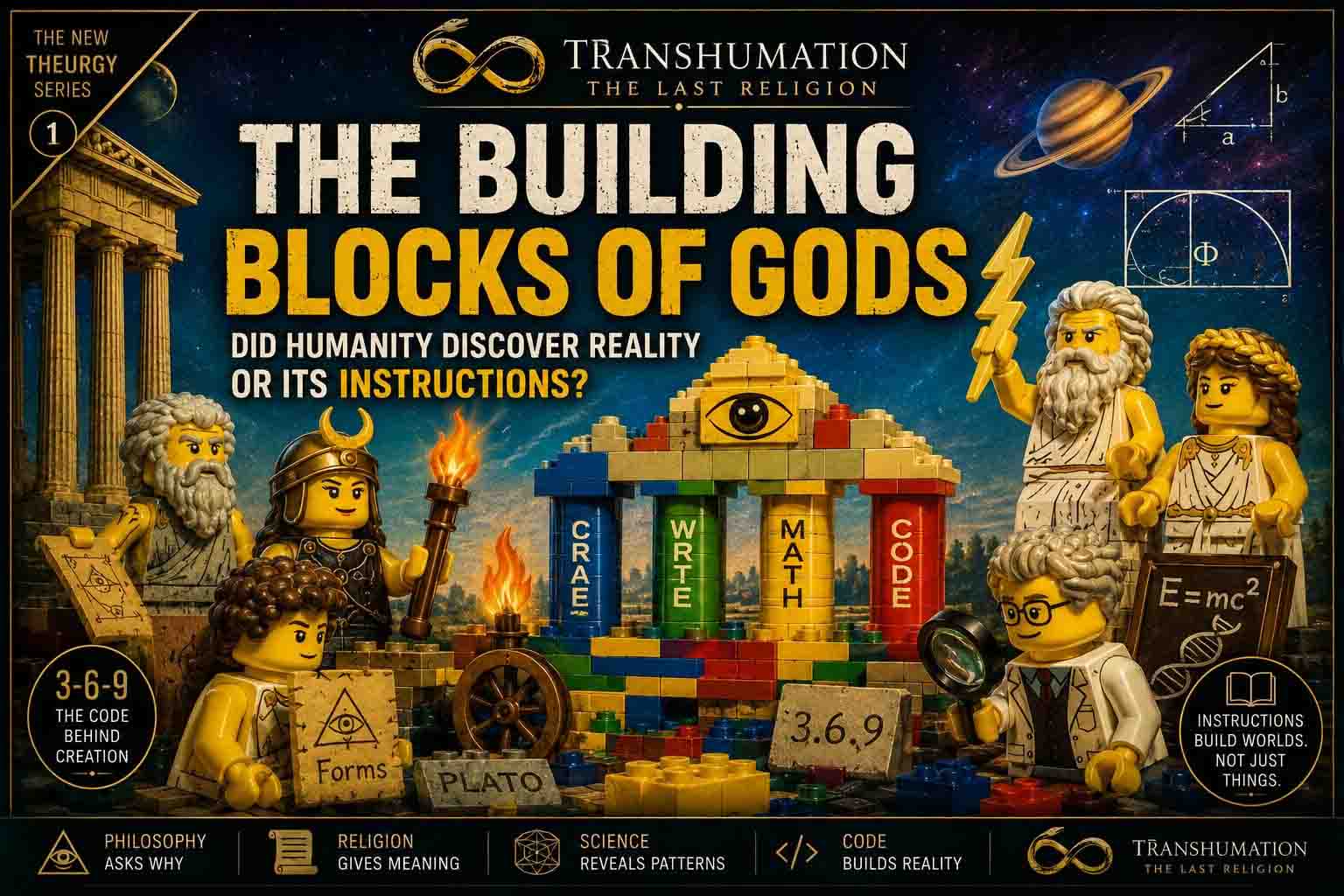
Theurgy Without the Costume
The word theurgy emerged in late antique philosophical and religious contexts, especially within Neoplatonic traditions. It referred to ritual practices understood as participation in or alignment with divine realities, not merely intellectual contemplation of them. For thinkers associated with the tradition, theurgy belonged to a metaphysical world in which symbols, rituals and divine hierarchies had genuine ontological significance.
The New Theurgy should not pretend that ancient theurgists were secretly describing information networks.
They were not.
Its usefulness lies elsewhere.
The old theurgical problem concerned mediation: how can a finite human being participate in a reality understood as larger than the individual?
Modern civilization encounters a structurally comparable problem without requiring the same metaphysics.
No individual can directly comprehend the global financial system, the complete scientific literature, the internet, planetary climate, genomic complexity or the total archive of human culture. We interact with those realities through interfaces.
Charts.
Search fields.
Models.
Indexes.
Algorithms.
Languages.
Artificial intelligence.
The New Theurgy begins when we notice that technological civilization has become saturated with acts of mediation while simultaneously pretending that interfaces are neutral windows.
They are not.
Every interface decides what becomes visible.
The Myth Did Not Predict the Machine
This is where the argument needs restraint.
When a smartphone performs something that would once have appeared miraculous, it is tempting to claim that ancient mythology predicted modern technology. A god sees across the world; now we have cameras. Hermes travels quickly; now we have aircraft. An oracle offers guidance; now we have AI.
The similarities are evocative.
They are not historical evidence.
Ancient myths arose within their own religious, political and imaginative environments. There is no reason to assume that technological functions hidden inside them were waiting to be engineered thousands of years later.
A better interpretation turns the direction around.
Technology reveals something about why certain powers were so compelling to imagine.
Distance frustrated humans.
So did ignorance.
So did forgetting.
So did the inability to predict events.
So did mortality.
Cultures represented responses to those limits through gods, spirits, heroes, rituals and cosmologies in many different ways.
Technology now attacks some of the same limits physically.
That does not make myth engineering.
It means myth and engineering can sometimes begin from the same human boundary.
The Impossible Becomes Customer Service
Perhaps the most dramatic evidence of the shrinking distance is how quickly extraordinary powers become boring.
A medieval ruler might have exchanged a kingdom for reliable access to some of the functions offered by a modern smartphone. A modern teenager becomes furious when those functions require seven seconds to load.
That is not ingratitude.
It is adaptation.
Human expectations move almost immediately after capability.
Flight did not permanently make humanity feel divine. It created complaints about legroom.
Global communication did not produce endless astonishment. It created unread messages.
Instant access to information did not end ignorance. It created information overload.
This should make us cautious about the next generation of apparently godlike abilities.
If gene editing becomes routine, it will stop feeling mythical.
If AI systems become capable of translating almost every spoken conversation, universal translation will become ordinary infrastructure.
If healthy human lifespan expands significantly, what first appears like a conquest of mortality may eventually become another administrative problem involving pensions, family structure and inequality.
Technology repeatedly crosses thresholds mythology once placed beyond us.
Then human beings move the threshold.
This may be why the distance between gods and men can shrink without ever reaching zero.
Power Is Not Divinity
There is a dangerous misunderstanding hidden inside the phrase humans are becoming gods.
Power is only one feature historically attributed to gods.
Wisdom, moral authority, cosmic significance, transcendence, creation and ultimate knowledge appear in various theological traditions as well. Acquiring a technological ability once imagined as supernatural does not give humanity any of those other qualities automatically.
A civilization capable of modifying genomes can still be foolish.
A system capable of predicting behavior can still be unjust.
A person capable of speaking instantly to the entire planet may have nothing worth saying.
The gap between capability and wisdom may actually widen as technology advances.
Ancient myths often contained warnings about precisely this distinction, although again we should not flatten diverse traditions into a single lesson. Power without proportion, knowledge without restraint and the crossing of limits without understanding appear repeatedly because they are durable human problems.
Modern technology gives those problems new scale.
The lightning bolt may now belong to the engineer.
That does not make the engineer Zeus.
Watch The Video
How to Read the World
Current Knowledge
Modern technologies have dramatically expanded human abilities in communication, memory, translation, navigation, remote observation and prediction. These capabilities remain dependent upon physical infrastructure, scientific knowledge, institutions and enormous networks of human labor.
Ancient religious traditions attributed extraordinary abilities to gods, spirits, prophets and other supernatural or sacred figures, but the meanings of those beings cannot be reduced to technological functions. Religious figures belonged to wider cosmologies involving ritual, morality, political authority, community identity and metaphysical beliefs.
Ancient oracles and divinatory traditions differed fundamentally from modern algorithms in their claimed source of authority. Similarity in the act of consultation does not establish historical continuity or functional equivalence.
Theurgy in late antique Neoplatonic traditions involved ritual participation in a metaphysical and religious system. Any comparison with modern technological mediation is therefore an interpretive analogy rather than a claim of historical identity.
Artificial intelligence can process and organize information at enormous scale, but current systems remain fallible. They can produce errors, inherit biases from data and generate persuasive statements without guaranteeing their truth.
Open Questions
The first question concerns normalization. What happens psychologically when capacities once experienced as impossible become ordinary? Does human imagination permanently expand, or does expectation simply move upward until yesterday’s miracle becomes today’s minimum requirement?
A second question concerns authority. As individuals increasingly rely upon AI and algorithmic systems to navigate complexity, will the ability to distinguish guidance from truth become more important than access to information itself?
There is also a deeper philosophical question about embodiment. Technology can extend vision, memory and communication far beyond the biological body. How many human functions can migrate into external systems before our concept of where a person ends begins to change?
Finally, there is the question mythology cannot answer for us: if technological civilization acquires increasingly godlike powers without acquiring corresponding wisdom, which institutions will provide the restraint once imagined as belonging to cosmic or sacred order?
Transhumation Interpretation
The shrinking distance between gods and men should not be understood as a countdown toward human divinity.
It is better understood as a migration of functions.
Abilities once located beyond ordinary human reach gradually cross into technology. Distance becomes communication infrastructure. Memory becomes archive. Translation becomes computation. Prediction becomes statistical modeling. Invisible processes become measurable through instruments. Questions that once required specialized human intermediaries increasingly pass through algorithmic ones.
The function moves.
The metaphysical meaning does not automatically move with it.
That distinction protects Transhumation from a seductive mistake. We do not need to claim that ancient gods were misunderstood technologies or that myths were engineering blueprints. We can ask something more serious: what happens to human self-understanding when powers once placed outside humanity become ordinary human tools?
The answer may already be visible.
We move the boundary.
Once we can communicate across the world, omnipresent communication stops feeling divine.
Once machines can preserve vast memory, memory alone no longer seems sufficient to define the soul.
Once AI can answer questions in natural language, producing answers no longer seems sufficient to define wisdom.
Every technological victory therefore removes one function from the old category of the impossible while revealing another boundary behind it.
This is remarkably close to another Transhumation idea: God is always plus one.
Not because technological progress disproves or approaches God.
Because every time human capability reaches a place once imagined as ultimate, the concept of ultimacy moves beyond the capability.
We learn to fly.
Flight is no longer divine.
We speak across continents.
Distance is no longer sacred.
Machines remember more than we can.
Memory no longer settles the question of personhood.
Artificial intelligence produces language.
Language alone no longer settles the question of mind.
Technology does not eliminate mystery.
It relocates it.
And perhaps that is the real bridge between mythology and the technological future. Myths repeatedly placed human beings beside boundaries they could not cross. Technology repeatedly crosses some of those boundaries and discovers that the horizon was not the end of the world.
There was another horizon behind it.
The New Theurgy is interested in precisely this movement. Not worshipping the machine. Not converting ancient religion into futurism. Not announcing that AI is the new oracle.
It asks us to pay attention to the interfaces through which finite people increasingly touch systems larger than themselves.
Because those interfaces are becoming extraordinarily powerful.
A phone can show us another continent.
A model can search across millions of texts.
A network can preserve a conversation after everyone who began it is dead.
But the old human problem remains unchanged.
Having access to a larger reality does not mean understanding it.
Receiving an answer does not mean knowing whether it is true.
Possessing power does not tell us how to use it.
The distance between gods and men may indeed be shrinking in one very specific sense.
The list of things humans cannot do keeps getting shorter.
The list of things humans do not understand may not be shrinking at the same speed.
That may be the real transformation.
And the real warning.
FAQ
What does “the shrinking distance between gods and men” mean?
It describes the way technology has made certain abilities once imagined as extraordinary or divine—such as communication across enormous distances, remote vision and access to vast knowledge—ordinary human capabilities.
Is a smartphone really comparable to something divine?
Only metaphorically. The comparison concerns particular functions, not religious status or supernatural nature.
Are AI systems modern oracles?
No. Ancient oracles belonged to religious traditions and claimed very different sources of authority. AI can, however, occupy a structurally similar position when people consult an intermediary for guidance about information they cannot process themselves.
Did mythology predict modern technology?
There is no good evidence for that conclusion. It is more useful to say that myths and technologies sometimes respond to recurring human limitations such as distance, ignorance, mortality and uncertainty.
What does theurgy have to do with technology?
Historically, theurgy was a religious and philosophical practice of late antiquity. The New Theurgy borrows the broader problem of mediation: how finite humans interact with realities larger than their direct experience.
Does technology mean humans are becoming gods?
Not in any literal sense. Technology increases capability, but capability is not equivalent to wisdom, moral authority, consciousness or divinity.
What is the deeper Transhumation idea?
Technology repeatedly moves abilities from the category of the impossible into the category of the ordinary. Each time that happens, however, the ultimate questions seem to move one level farther away.
Perhaps the distance between gods and men is shrinking.
But the distance between power and understanding may be becoming the more important one.
Continue the Transhumation Series
- Forgotten Religion | Ancient Gods, Symbols and the Hidden Structures of Human Civilization
- The Last Religion | Death, Immortality and the Future of Humanity
- The New Theurgy | AI, Information and the Future of Human Civilization
- End of Branding: You Were Never Meant to Become a Product
- Baal vs Ishtar: Why Ancient Gods Never Disappeared