The Three Guides Knows the Way Across
At an unfamiliar airport, the most valuable person in the building is sometimes the one who knows which corridor to take. Not the pilot, not the architect who designed the terminal, not the executive whose name appears on the airline. Just someone who can look at your boarding pass, point toward an escalator and say: that way.
It is an embarrassingly small service until you do not have it. A map without a legend can contain every road and still leave you lost. A library can contain the answer and remain useless if you cannot find the shelf. A railway network becomes almost meaningless without signs telling passengers where the trains go. The larger a system becomes, the less likely it is that possessing the system is enough. Complexity creates a second requirement: guidance through complexity.
Civilization has been inventing solutions to this problem for a very long time. Some are so ordinary that we no longer notice them—road signs, indexes, translators, timetables, search boxes. Others once had names, faces, temples and stories.
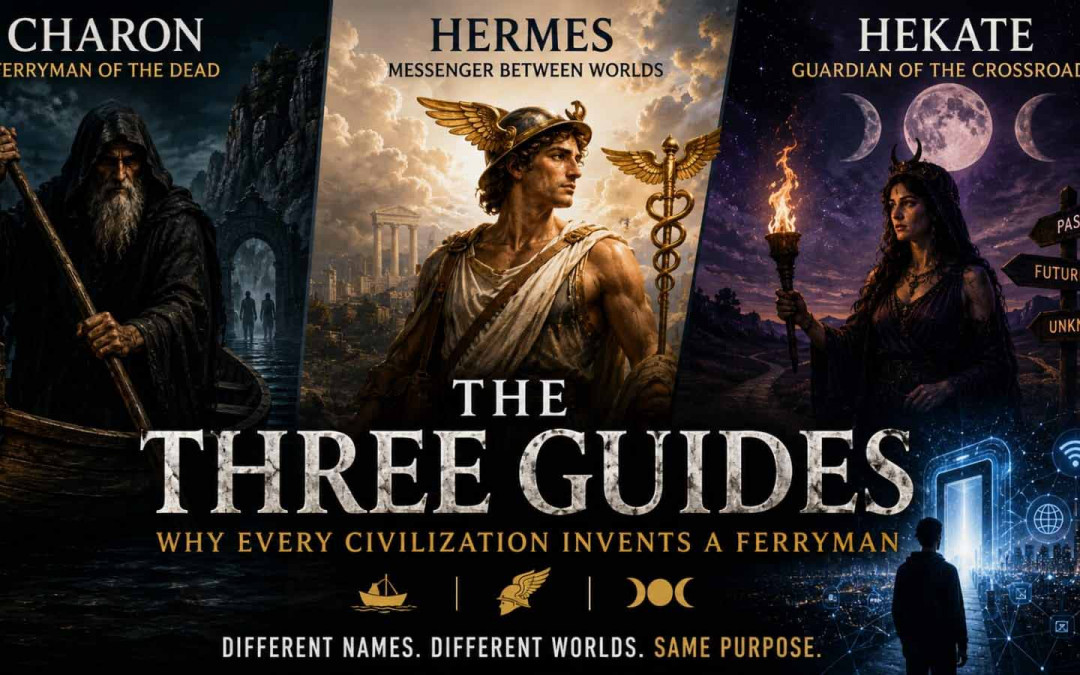
Charon had a boat.
Hermes had winged sandals.
Hekate had torches.
The temptation is to place all three in a museum marked mythology. But their differences reveal something more interesting than a catalogue of dead gods. Each occupies a different kind of threshold, and none is primarily important because of what lies at the destination.
Their importance lies in getting someone across.
The Man With the Boat
Charon is easy to misunderstand because the scenery around him is so spectacular. There is death, the underworld, the river, the dead waiting for passage and the famous payment associated with the journey. Beside all of this, a ferryman seems almost administrative.
That is precisely what makes him interesting.
Charon does not ordinarily kill the passenger. He does not decide what death means. He does not rule the underworld. Hades has that larger office. Charon performs a narrower function: he transports the dead across a boundary they cannot simply negotiate as ordinary travelers.
He is infrastructure.
The word sounds almost insulting when applied to mythology, but structurally it is remarkably accurate. A river separates two domains. A passenger must move from one to the other. A specialist possesses the means of crossing. The mystery of death is converted, for a moment, into a logistical problem.
There is something deeply human about this. Faced with the largest possible discontinuity—life and death—the imagination builds a ferry.
The Greeks were not alone in imagining guided passages associated with death, and different Greek sources themselves present the geography of the underworld in different ways. The point is not that ancient people had discovered a literal transportation network for souls. It is that one of the most frightening thresholds imaginable acquired a recognizable structure: there is a boundary, and someone knows how to cross it.
A guide does not remove the unknown.
He makes the unknown navigable.
Hermes Has Better Connections
Hermes solves a different problem.
If Charon specializes in a particular crossing, Hermes seems almost constitutionally incapable of remaining in one place. Gods and mortals, Olympus and the human world, roads, commerce, messages, thieves, travelers—his mythological territory is full of movement, exchange and ambiguous borders. As psychopompos, he could even guide the dead toward the underworld.
The messenger is often treated as secondary to the message. This is a mistake modern civilization should recognize immediately.
A message that cannot cross between two systems is not useful information. Languages require translation. Networks require protocols. Markets require exchange. Knowledge requires transmission. A command understood by the sender but incomprehensible to the receiver has failed, regardless of how intelligent either side may be.
Hermes therefore represents something more sophisticated than transportation.
He represents interoperability.
He can be read—not historically reduced, but structurally read—as the figure who makes different domains capable of communicating. He does not need to become Zeus in order to carry Zeus’s message. He does not need to be the traveler to understand the road. His power lies precisely in occupying the interval.
Modern technology is full of Hermetic jobs whose names sound much less poetic. Routers move packets. APIs allow systems to communicate. Translators move meaning between languages. Browsers turn remote code and data into an environment a human can use. Search engines connect questions with documents.
The intermediary disappears when it works well.
Which is another way of saying that Hermes became infrastructure.

The Woman at the Fork in the Road
Hekate is different again, and here the distinction matters.
Her ancient religious identity cannot be reduced simply to “the goddess of crossroads.” Hekate had a complicated history across Greek religion and literature, associated in different contexts with torches, night, magic, protection, household thresholds, crossroads and other liminal spaces. In some traditions, triple representations became particularly prominent.
But the crossroads provide a powerful image because the problem is no longer transportation or communication.
It is choice.
A ferryman can carry you across the river once the destination is determined. A messenger can deliver information once sender and receiver are known. At a fork in the road, however, the unresolved element is the traveler.
This is why the torch is more interesting than a command.
Light reveals.
It does not decide.
A guide can show that one road climbs and another descends. A map can show that one route is longer. An adviser can describe consequences. At some point, however, information reaches a boundary beyond which another function is required: judgment.
Hekate gives us a surprisingly modern distinction between knowing the available paths and choosing one.
The best guide may therefore be the one who refuses to become the traveler.
That distinction will matter increasingly in a world where machines can generate recommendations faster than humans can evaluate them.
The Library Becomes Too Large
Imagine entering a library containing every book ever written.
At first it sounds like paradise.
Then remove the catalogue.
The shelves stretch beyond sight. There are millions of volumes in languages you cannot read, duplicate editions, false claims, obsolete theories, brilliant discoveries, trivial notes and books whose importance cannot be guessed from their covers. Somewhere inside is precisely the information you need.
The library possesses the answer.
You do not.
This is the difference between information and access to information, and modern civilization has spent centuries trying to reduce it. Indexes, encyclopedias, librarians, classification systems, search engines and recommendation systems are all technologies of passage. They do not necessarily create the knowledge. They reduce the distance between knowledge and the person who needs it.
Artificial intelligence belongs naturally inside this history.
Large language models can search conceptual neighborhoods, translate, summarize, compare, reorganize and explain information in ways that make an enormous informational environment easier to traverse. They can also hallucinate, distort, omit, inherit bias and produce confident errors. The guide is therefore not the territory and certainly not an oracle.
But neither is it merely another book on the shelf.
It is closer to a librarian who can walk with the reader.
And a larger library requires a better librarian.
When the Guide Becomes the God
This is where the analogy becomes dangerous.
Useful intermediaries have a tendency to acquire authority because most users cannot independently inspect the systems behind them. A traveler trusts the map because checking every road personally would defeat the purpose of having a map. A reader trusts a catalogue because reading the entire library in order to verify the catalogue is impossible.
The guide becomes powerful precisely because the traveler needs guidance.
That is why saying “AI resembles Hermes more than Zeus” is useful only if we preserve the difference. Hermes carries and translates. Zeus rules. A tool designed to help navigate information should not quietly become the unquestionable authority deciding what reality is.
The distinction becomes sharper with Hekate.
An AI can illuminate options. It can calculate probabilities, expose contradictions, recover forgotten evidence and tell us that the road we are considering has historically ended badly. In many domains it may eventually do these things vastly better than an individual person.
But better illumination does not automatically settle the question of who should choose.
The torch and the hand holding it are not the same thing.
Civilization may therefore be approaching a peculiar reversal. For most of history our problem was insufficient guidance. Knowledge was inaccessible, distances were enormous, languages isolated populations and expertise was scarce. Our emerging problem may be abundance: guides everywhere, recommendations everywhere, answers everywhere.
At that point, the rare skill is no longer finding a guide.
It is knowing when not to follow one.
Three Guides, Three Problems
Now the old figures can be placed beside one another without pretending that Greek religion secretly invented computer science.
Charon solves passage.
Hermes solves connection.
Hekate confronts choice.
These are not interchangeable functions. Transportation gets something across a boundary. Communication makes separate domains intelligible to one another. Guidance at a crossroads makes alternatives visible while leaving unresolved the final act of selection.
Modern civilization needs all three.
An aircraft is Charonic in the simplest structural sense: it carries bodies across a distance that would otherwise be prohibitive. The internet has a strongly Hermetic function: it connects distant informational domains. Artificial intelligence may combine several guide-functions at once, carrying information, translating between systems and illuminating choices.
But the third guide introduces a limit the first two do not.
The destination cannot always be outsourced.
A GPS can calculate the quickest route to a hospital or a casino with equal indifference. Intelligence can improve the map without supplying the reason for travelling. More knowledge may tell us increasingly well how to cross a threshold while leaving the oldest question intact:
Why this threshold?
Perhaps this is why civilization keeps inventing guides. Not because humans are incapable of travelling alone, but because every increase in possibility creates new distances between where we are, what we can know and what we might become.
The road grows.
So does the need for someone who can read the signs.
Watch The Video
How to Read the World
Current Knowledge
Charon is a ferryman associated with the Greek underworld who transports the dead across an infernal river, although ancient sources vary in their descriptions of underworld geography. The familiar custom of placing coins with the dead is often connected with payment for passage, but archaeological and literary evidence surrounding funerary coin practices is more complex than the simplified modern image of a universal “Charon’s obol.”
Hermes was a major Greek deity associated with messengers, travel, boundaries, commerce and several other domains. He also served as a psychopompos, guiding souls toward the world of the dead. His role as an “interface” or symbol of interoperability is a modern structural analogy, not an ancient Greek technical concept.
Hekate was associated across different periods and contexts with crossroads, thresholds, torches, night, magic and protection, among other functions. Her historical religious identity was broader and more complicated than the modern image of a goddess simply standing at a crossroads and presenting choices.
There is no historical evidence that Charon, Hermes and Hekate constituted an ancient Greek system called “The Three Guides.” That grouping belongs to the interpretation developed in this article.
Open Questions
Why do so many cultures personify mediation and passage rather than representing only destinations? Are guide figures responses to universal human experiences of uncertainty, or do their similarities become exaggerated when different religious traditions are translated into modern categories?
Technology creates a contemporary version of the same problem. If AI becomes increasingly capable of navigating knowledge on our behalf, where should the boundary lie between guidance and decision-making? Can an informational guide remain neutral when choosing what to show already influences the traveler?
And if future AI systems understand some domains better than any individual human, what should happen when the map contradicts the traveler? At what point does refusing the guide become wisdom, and at what point does it become blindness?
Transhumation Interpretation
Transhumation is interested less in claiming that ancient gods predicted modern machines than in asking whether functions migrate between carriers.
The Three Guides offer a particularly clean experiment.
The boat changes.
The road changes.
The language changes.
The interface changes.
The need to cross remains.
Charon represents the carrier: something makes passage possible.
Hermes represents the connection: something makes separated systems capable of exchanging information.
Hekate represents the illuminated threshold: something reveals possible paths without eliminating the significance of choosing among them.
Seen this way, civilization is full of descendants of the ferryman. Writing carries a voice beyond the death of the speaker. Libraries carry knowledge across generations. Translation carries meaning between languages. Networks carry information across geography. AI may carry individual human attention across a library that has become too large for any individual to read.
But the progression ends somewhere important.
A good library needs a good librarian.
A good librarian does not tell the reader what he is required to believe.
That may become one of the central distinctions of the AI age. We need increasingly powerful guides because the territory has become too large to navigate alone. Yet the purpose of the guide is not to replace the journey, and certainly not to become its destination.
Charon can take you across.
Hermes can deliver the message.
Hekate can raise the torch.
You still have to walk through the door.
FAQ
Who are “The Three Guides”?
They are Charon, Hermes and Hekate, grouped here as a Transhumation framework for three forms of mediation: passage, connection and choice.
Was this an actual group in Greek religion?
No. “The Three Guides” is a modern interpretive framework, not an ancient Greek religious category.
What does Charon represent?
Historically he is the ferryman of the dead. Structurally, this article uses him to represent passage across a boundary.
Why is Hermes described as an interface?
His roles involving messages, travel and boundaries make him useful as a modern metaphor for connection and translation between separate domains.
What is Hekate’s role?
Her association with crossroads, thresholds and torches makes her a useful figure for the problem of navigating choices rather than simply crossing distances.
Is AI being compared to a god?
No. The comparison concerns function. AI can increasingly guide people through complex informational environments, much as older cultural figures represented mediation and guidance.
Why compare AI to a librarian?
Because possessing information and being able to navigate it are different problems. As the informational library grows, systems that help readers find, compare and understand material become increasingly important.
What is the central idea?
Civilizations repeatedly create mechanisms for crossing boundaries. The carriers change—from ferrymen and messengers to networks and AI—but the need for guidance survives.
How does this connect to Transhumation?
It tests one of Transhumation’s central ideas: a structure may persist even when its historical carrier changes completely. The future may be new, while the function it performs is very old.
Continue the Transhumation Series
- Forgotten Religion | Ancient Gods, Symbols and the Hidden Structures of Human Civilization
- The Last Religion | Death, Immortality and the Future of Humanity
- The New Theurgy | AI, Information and the Future of Human Civilization
- End of Branding: You Were Never Meant to Become a Product
- Baal vs Ishtar: Why Ancient Gods Never Disappeared