
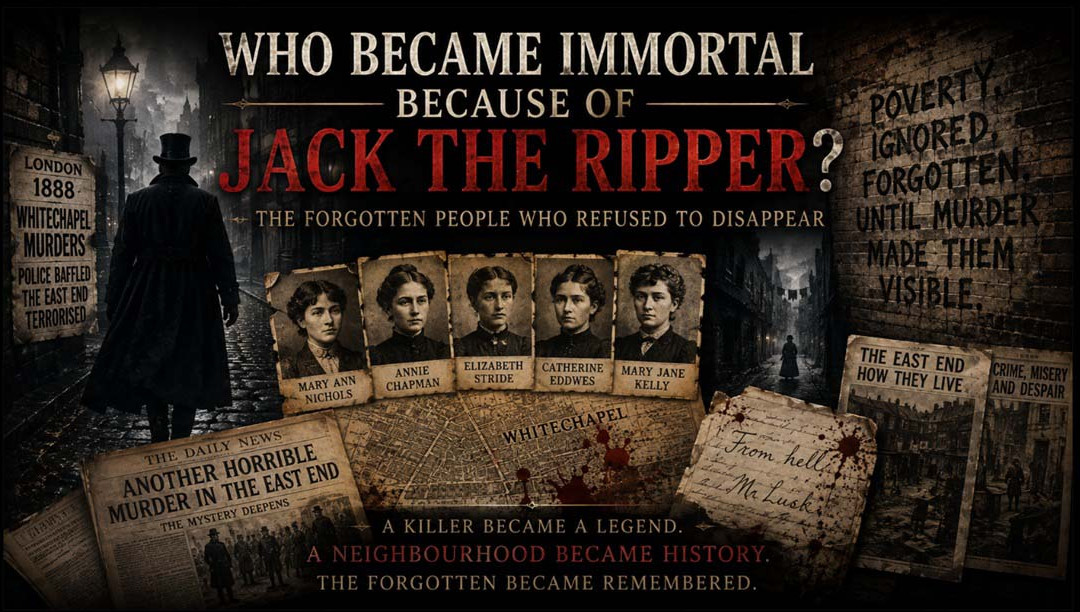
The Unwanted Archive of Whitechapel
A rich Victorian could prepare for memory.
He could commission a portrait, preserve correspondence, leave property records, publish memoirs, appear in newspapers under his own name and pass documents through a family that understood their value. The archive might begin forming while he was still alive.
For the poor, history was less accommodating.
A lodging-house resident might appear briefly in a census. A domestic worker might leave a marriage certificate. A laborer could pass through a hospital ledger, a workhouse register or a magistrate’s court. Pieces existed, sometimes many of them, but they were scattered across institutions that recorded particular encounters rather than whole lives.
Then, in 1888, something terrible happened in Whitechapel.
A series of murders produced one of the most persistent criminal narratives in modern culture. Police officers recorded movements. Surgeons described bodies. Reporters gathered biographies. Witnesses supplied addresses. Newspapers printed maps and rumors. Strangers wrote letters. Later generations returned to registers, directories, genealogies and surviving photographs, searching for anything that might bring the case slightly closer to resolution.
The investigation failed to give history a confirmed murderer.
Instead, almost accidentally, it produced an archive.
That may be the strangest legacy of Jack the Ripper.
The unknown man became famous.
But the machinery built around his absence carried much more than his name into the future.
Why Are Jack the Ripper’s Victims Still Remembered?
The familiar answer is uncomfortable because it appears almost circular.
They are remembered because the murders are remembered.
Mary Ann Nichols, Annie Chapman, Elizabeth Stride, Catherine Eddowes and Mary Jane Kelly became permanently connected to a mystery that never achieved final closure. Every serious reconstruction of the case has to return to them: where they lived, where they were seen, whom they knew, what happened to them and how contemporary institutions described their deaths.
But this does not mean they were people without histories until the murderer supplied one.
They had parents, partners, children, occupations, illnesses, addresses, friendships, quarrels and movements through a city that existed long before the autumn of 1888. Surviving civil and institutional records demonstrate precisely that.
The problem was one of scale and visibility.
A person can exist fully inside their own social world while leaving very little behind for distant strangers.
The murders altered that probability.
Suddenly an address mattered because investigators needed it.
A relative mattered because identity had to be established.
A final conversation mattered because chronology mattered.
A lodging house became historically significant because somebody had slept there before dying.
The crime did not give these lives value.
It gave institutions reasons to record them in unusual detail.
Those are radically different propositions.
The City That Was Already There
The Whitechapel of popular memory often arrives pre-lit for murder.
Fog.
Gaslight.
Alleys.
Poverty.
A woman walking alone.
A shadow behind her.
That Whitechapel is partly a cultural construction produced by more than a century of crime literature, cinema, tourism and repeated visual shorthand.
The real East End was enormously more complicated.
It contained workshops, markets, religious communities, migrant networks, factories, schools, pubs, lodging houses, families, political movements and innumerable forms of ordinary life. Poverty and overcrowding were real. So were labor, trade, humor, aspiration and community.
Jack the Ripper did not reveal an empty urban stage.
He entered a living city.
The distinction matters because murder mythology has a tendency to turn an entire district into scenery for one offender.
A street becomes important because he may have walked there.
A pub becomes important because a victim visited it.
A building enters tourism because a crime occurred nearby.
The city is reorganized retrospectively around the killer.
The more interesting historical operation is to reverse the direction.
Use the murder archive to recover the city.
Then remove the murderer from the center.

Did Jack the Ripper Make Whitechapel Famous?
In popular culture, undoubtedly the murders became one of the strongest international associations attached to the district.
But famous is a dangerous word.
Whitechapel was already part of contemporary discussions about poverty, immigration, housing, labor, policing and urban reform. The East End attracted journalists, reformers and investigators before the Ripper murders began. It was not waiting in complete obscurity for a killer to make respectable London aware that poverty existed.
What the murders changed was intensity.
Crime created an unusually concentrated channel of attention.
Newspaper readers encountered street names repeatedly. Reporters described lodging houses, police beats and local conditions. The geography of one small part of London became attached to an unresolved narrative capable of traveling far beyond Britain.
This kind of attention does something peculiar to place.
It compresses.
Whitechapel gradually becomes not only a district but an idea.
Victorian darkness.
Urban anonymity.
The dangerous metropolis.
The hidden life of the poor.
Sensational journalism.
The symbolic Whitechapel becomes easier to carry than the real one.
And once the symbol succeeds, it can begin replacing the territory that created it.
The Murderer With No Biography
The central informational paradox of Jack the Ripper is that one of the most famous criminals in history possesses almost no confirmed biography.
We do not know his accepted legal identity.
We do not possess a confirmed photograph.
We cannot point to a grave and say with historical certainty that the man buried there committed the canonical murders.
The famous public voice associated with “Jack the Ripper” is equally unstable because much of the correspondence was hoax material, and the authorship of the best-known letters cannot simply be assigned to the murderer.
The cultural figure is therefore strangely rich where the historical person is poor.
He has voices.
Faces.
Psychologies.
Costumes.
Motives.
Childhoods.
Occupations.
But these belong to competing reconstructions.
The unknown man had one biography.
Culture supplied hundreds.
That absence is partly what keeps the archive alive.
Every proposed identity creates another route through records. Every theory generates counter-theories. Every apparent clue creates another reason to reopen the case.
A solved biography tends to close alternatives.
An unresolved identity breeds them.
The murderer became culturally enormous partly because history could never make him human-sized.
Can a Crime Become a Historical Archive?
Yes, although not because the crime itself remembers.
Institutions do.
A serious investigation creates documentation with an intensity ordinary life rarely produces.
Police want names and times.
Courts want testimony.
Doctors want physical observations.
Journalists want detail.
Families must identify the dead.
The result is a strange form of involuntary biography.
People who never intended to become historically visible suddenly generate paperwork because institutions need to reconstruct their relationship to an event.
The Whitechapel material therefore contains information extending far beyond criminal investigation.
Lodging patterns.
Forms of casual employment.
Distances people walked.
Social relationships.
Policing practices.
Medical assumptions.
Newspaper behavior.
Public anxiety.
Even the mistakes become evidence.
A contradictory witness statement tells us something about memory.
A sensational article tells us something about journalism.
A failed police theory tells us something about the categories available to investigators.
The archive was built to capture a murderer.
It captured fragments of a city instead.
The Women Inside Someone Else’s Story
This may be the most important problem in the entire Ripper archive.
Preservation does not guarantee ownership of memory.
The women’s names survived, but for much of the cultural afterlife of the case they survived primarily as victims of Jack the Ripper. Their biographies became subordinate clauses inside his mystery.
This is a strange kind of informational survival.
The individual remains retrievable, but only because another narrative continuously summons her.
Ask about the killer and Annie Chapman appears.
Ask about chronology and Catherine Eddowes appears.
Ask about geography and Mary Ann Nichols appears.
Their presence is real, yet the route leading to them begins with him.
Modern historical work can reverse that dependence.
Instead of asking what Annie Chapman reveals about the murderer, ask what the records reveal about Annie Chapman before the murderer entered her final hours.
Suddenly the same documents behave differently.
Marriage matters.
Housing matters.
Health matters.
Employment matters.
Family separation matters.
Victorian institutions matter.
The murder shrinks from the entire biography to its ending.
Nothing has been erased.
The scale has changed.
That may be one of the most valuable things Stereo History can do: place the second channel beside the dominant one until the supposedly peripheral life becomes visible again.
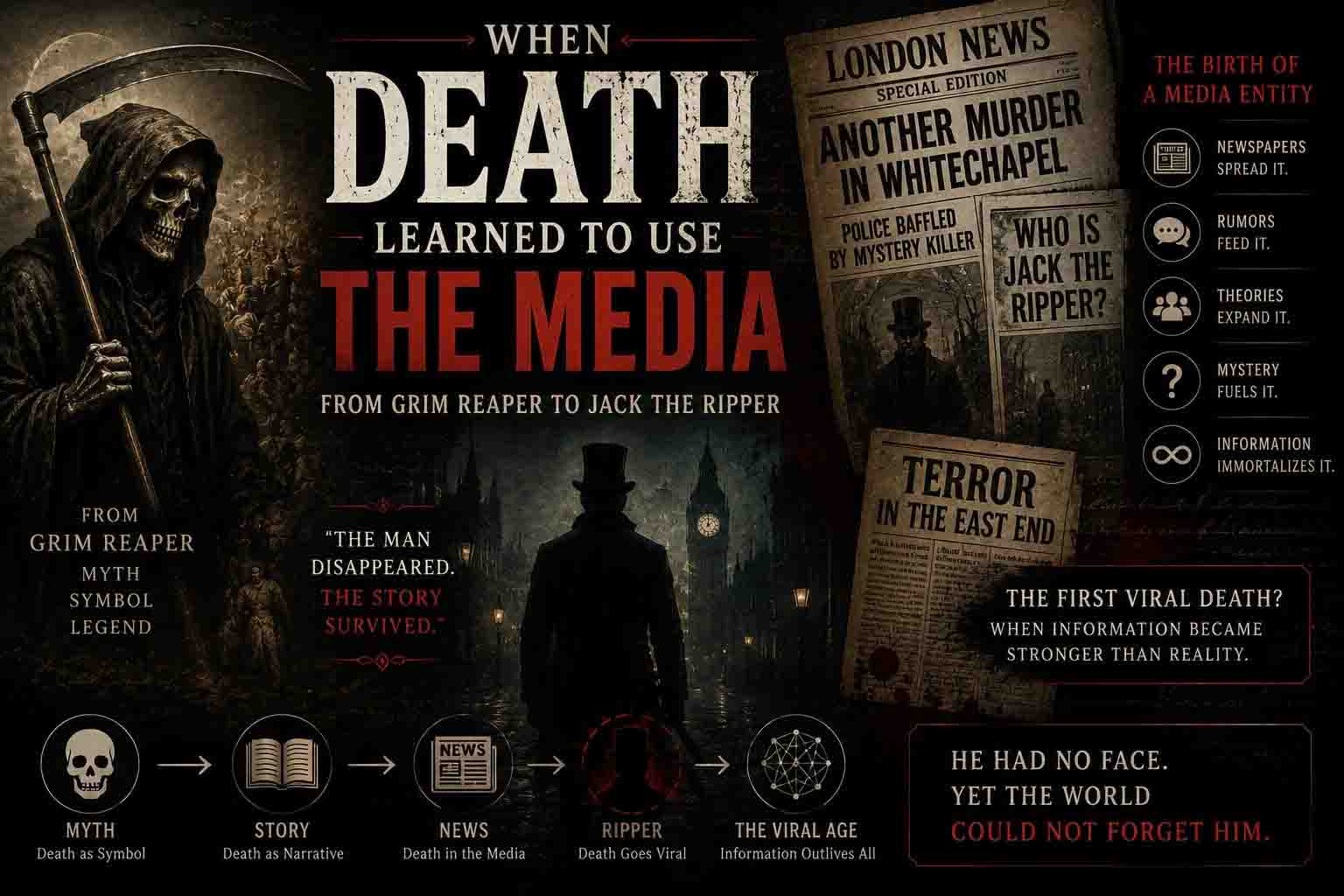
Why Does History Remember Criminals Better Than Ordinary People?
Because historical memory does not operate according to moral merit.
It follows attention, repetition, documentation and narrative structure.
A murderer connected to an unresolved mystery can generate far more cultural material than a person who lived an admirable but private life. A disaster can preserve passengers who would otherwise remain known primarily to their descendants. A court case can preserve conversations that nobody expected another century to read.
History is full of such asymmetries.
The mistake is imagining remembrance as a prize.
It is closer to transmission.
Something needs a carrier.
A famous event can become one.
People attached to that event travel with it, although not necessarily accurately and not necessarily in the proportions they would have chosen.
This explains the uncomfortable durability of crime.
Mystery produces questions.
Questions produce investigation.
Investigation produces documents.
Documents produce reinterpretation.
Reinterpretation renews the mystery.
The informational system develops feedback.
The murdered person can remain inside that system for generations.
So can the myth.
The Archive Has a Bias
An archive is never simply the past placed into boxes.
It reflects what institutions found worth recording.
Governments record taxation and law.
Churches preserve religious administration.
Hospitals record patients according to medical needs.
Police record people according to investigative relevance.
Newspapers preserve what editors believed readers would purchase.
This means historically marginalized people can become unusually visible at precisely the worst moments of their lives.
The destitute person enters the workhouse register.
The accused enters the court record.
The injured worker enters the hospital ledger.
The murdered woman enters the inquest.
If historians rely uncritically on those archives, suffering can begin to look like the defining condition of people whose ordinary lives generated fewer documents.
The Ripper archive intensifies this distortion.
We possess extraordinary information about the women’s final hours because those hours mattered to an investigation.
Their ordinary Tuesdays were less likely to be documented.
Historical visibility can therefore be richest at the moment a person’s autonomy is weakest.
That is an uncomfortable property of memory.
The Gentleman Jack Illusion
There is another distortion worth removing: the temptation to give the unknown murderer elegance.
The name itself eventually acquired theatrical qualities.
Top hat.
Dark coat.
Medical bag.
Gentleman’s manners.
A sophisticated predator moving invisibly between social worlds.
Popular culture repeatedly furnished the blank man with style because a blank silhouette invites design.
But the historical record does not give us a secure costume for Jack the Ripper.
Nor does it establish the polished fictional persona later cinema became fond of.
“Gentleman Jack” is therefore useful only as a warning.
When identity is missing, aesthetics rush in.
The less we know about the man, the easier it becomes to dress him.
This is another reason Whitechapel’s real residents matter.
Their biographies constrain imagination.
The Ripper persona expands through absence.
The women return through evidence.
One is increasingly fictional when embellished.
The others become increasingly human when reconstructed carefully.
The First Viral Ghost?
It is tempting to call Jack the Ripper the first viral ghost.
The phrase is memorable.
Historically, it is too strong.
Crime sensations, anonymous rumor, pamphlet culture, newspapers and famous unsolved mysteries existed before 1888. Information had been spreading through networks for centuries.
What makes the Ripper case distinctive is the density of the combination.
A rapidly expanding mass press.
A huge metropolis.
Fast communication.
An unknown offender.
Public correspondence.
Commercial incentives.
Police uncertainty.
Readers participating through tips, theories and hoaxes.
The murderer’s public representation began to operate beyond the physical person who committed the crimes.
That makes “informational ghost” useful as metaphor.
But the system discovered another capability at the same time.
Attention could preserve an environment.
The newspaper did not merely carry the Ripper.
It carried Dorset Street.
Hanbury Street.
Buck’s Row.
Mitre Square.
Lodging houses.
Witnesses.
The names of people who would otherwise have remained local.
A media event became a transport system for social detail.
That is perhaps the more interesting viral effect.
Who Really Became Immortal?
Nobody, literally.
The word immortal should remain where it belongs: in metaphor.
The victims died.
The murderer died eventually, whoever he was.
The buildings changed or disappeared.
The newspapers decayed.
Even the surviving documents remain vulnerable.
What continued was a cultural pattern repeatedly reconstructed through new carriers.
Books replaced newspapers.
Film replaced illustration.
Television replaced some of the books.
Digital archives made old documents globally searchable.
Online communities attached new interpretations to nineteenth-century records.
Through that migration, certain names remained unusually retrievable.
This is informational persistence, not personal immortality.
And it is profoundly uneven.
The murderer survived as an absence surrounded by representation.
The victims survived as people partially recoverable from evidence.
Whitechapel survived both as a real historical district and as a symbolic landscape repeatedly rewritten by culture.
Perhaps the most important question is therefore no longer Who was Jack the Ripper?
It is:
What else became visible because civilization would not stop asking?
One event pulls forgotten lives into the future.
Not because those people became powerful.
Because they became connected to a story that civilization refused to forget.
Perhaps Jack the Ripper did not create only one immortal name.
Perhaps he accidentally created thousands.
Watch the Video
How to Read the World
Current Knowledge
The Whitechapel murders of the late 1880s generated extensive contemporary police, medical, legal and press documentation. The group commonly called the canonical five consists of Mary Ann Nichols, Annie Chapman, Elizabeth Stride, Catherine Eddowes and Mary Jane Kelly, although the boundaries of the broader Whitechapel murder series and the attribution of individual killings remain historically debated.
Victorian East London was not undocumented before the murders. Social investigators, journalists, religious organizations, local authorities and reform movements produced substantial material concerning housing, labor, immigration and poverty. Nevertheless, archival survival was highly unequal, and people living precarious working-class lives were much less likely than elites to leave coherent personal collections of correspondence, portraits and papers.
The Ripper investigation unintentionally increased the documentary density surrounding particular victims, witnesses, streets and institutions. Later genealogical and social-history research has further reconstructed lives that earlier popular treatments often reduced to their final hours.
The public persona of Jack the Ripper cannot safely be treated as a transparent representation of the historical offender. The famous name emerged through correspondence of uncertain authorship, many letters were hoaxes, and later cultural representations added visual and psychological features unsupported by secure evidence.
Whitechapel itself became strongly associated with the murders in later popular culture, but the district had histories of migration, labor, religion, commerce, reform and ordinary domestic life that cannot be reduced to the Ripper narrative.
Open Questions
The first open question is counterfactual: how much would we know about the canonical victims if the murders had never occurred? Records would still exist, but it is impossible to calculate how much later genealogical effort would have been devoted to finding and connecting them. We can responsibly say that the murders dramatically increased their later public visibility; we cannot prove that they would otherwise have been completely forgotten.
A second problem concerns distortion. Does continuous interest in the Ripper case genuinely preserve the women, or does it repeatedly imprison them inside the killer’s brand? A biography reconstructed only because researchers want to understand the murderer can remain structurally dependent upon him even when it contains accurate facts.
There is also the larger question of archival inequality. If the poor become particularly visible when encountering workhouses, hospitals, courts or police, how much of our historical picture of poverty is shaped by moments of crisis rather than ordinary life? The archive may preserve precisely the experiences least representative of a person’s complete existence.
Finally, digital research creates a new paradox. Searchable archives make forgotten people easier to recover than ever before, but search itself often begins with famous names and events. Technology can democratize historical retrieval while continuing to reproduce the attention hierarchies that created the archive in the first place.
Transhumation Interpretation
For Transhumation, the Ripper case demonstrates that a narrative can become a carrier for people who never chose it.
The murderer’s cultural pattern persisted because uncertainty kept the story active. The victims’ traces traveled inside the same system, but they did not travel on equal terms. Their information survived largely through a narrative centered on someone else.
That makes provenance more important than mere preservation.
A good Library of Mirrors should be capable of reversing the direction of retrieval: from famous event to forgotten person, from mythology to document, from offender back to the world that existed before the offender entered it.
The archive has already preserved Whitechapel.
The harder task is allowing Whitechapel to stop being only his.
FAQ
Who were the women most commonly associated with Jack the Ripper?
The canonical five are Mary Ann Nichols, Annie Chapman, Elizabeth Stride, Catherine Eddowes and Mary Jane Kelly, although historians continue to debate the wider boundaries of the Whitechapel murder series.
Did Jack the Ripper make his victims famous?
The murders produced unusually intense documentation and long-term attention around the victims, but it would be misleading to describe this as a gift from the murderer. The archival effect was an unintended consequence of investigation and media attention.
Was Whitechapel unknown before the murders?
No. Victorian journalists, reformers and institutions already documented poverty and social conditions in the East End. The murders dramatically intensified and internationalized attention rather than creating it from nothing.
Why is Jack the Ripper still more famous than the women he killed?
An unidentified offender produces an open narrative. Missing identity, uncertain motive and disputed evidence allow endless reconstruction, while a recovered human biography gradually closes possibilities.
Can a crime really become an archive?
A crime can cause institutions to generate records that later preserve much more than the crime itself: streets, social networks, medical practices, housing, policing, journalism and fragments of ordinary lives.
What is the deeper Transhumation question?
The case forces us to separate survival from ownership of survival.
Information may carry a person far beyond their lifetime while embedding them inside a story they never chose. The future archive therefore has a responsibility greater than keeping records alive.
It must sometimes rescue the person from the very narrative that preserved them.
Jack the Ripper may have given history the question it could not stop asking.
But after more than a century, the more interesting achievement may be learning to use that question as a doorway, then walking past him.
Into Whitechapel.
Continue the Transhumation Series
- Forgotten Religion | Ancient Gods, Symbols and the Hidden Structures of Human Civilization
- The Last Religion | Death, Immortality and the Future of Humanity
- The New Theurgy | AI, Information and the Future of Human Civilization
- End of Branding: You Were Never Meant to Become a Product
- Baal vs Ishtar: Why Ancient Gods Never Disappeared