The Weight of Freedom
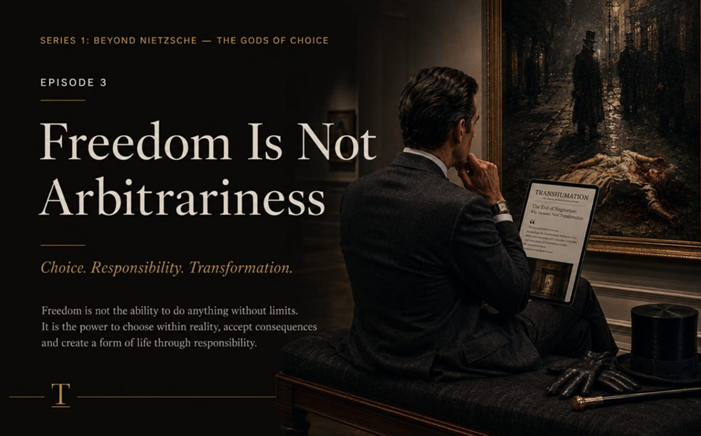
The strange thing about freedom is that it becomes real only when something can no longer be undone.
There is a peculiar kind of freedom available only in hotel rooms.
You arrive in a city where nobody knows you. Dinner can be anywhere. Tomorrow has no appointments. You could take the first train south, stay another night, call someone you have not seen in ten years, or do absolutely nothing.
For a few hours, life seems wonderfully unfinished.
Then you make a reservation.
A trivial act. Yet nine restaurants have just disappeared.
Not physically, of course. They remain open. Other people are eating there. You could cancel. But one possible evening has begun acquiring weight while the others retreat into imagination.
Something similar happens with larger decisions, only we rarely notice the moment when possibility becomes reality.
We praise freedom by counting the doors still open.
Perhaps we should occasionally count the ones behind us.
The Door That Disappears
Modern culture has become exceptionally good at manufacturing possibility.
More careers. More cities. More people to meet. More products. More identities to explore. More films waiting behind the film we are watching. Even while choosing, we are constantly reminded of everything else we might have chosen.
It feels like freedom because almost nothing has to become final.
Yet imagine a musician who takes this principle seriously.
He wants complete artistic freedom, so he refuses rhythm because rhythm determines when the next sound may occur. He rejects tuning because tuning privileges some frequencies over others. Scales exclude notes. Repetition creates expectation. Structure itself begins to look suspicious.
Eventually he achieves something close to absolute musical possibility.
He may also achieve noise.
Music reveals an uncomfortable property of freedom: limitation is not always its enemy. Sometimes limitation is what allows freedom to become intelligible.
Language works the same way. Grammar closes almost infinite combinations of sounds so that the combinations remaining can mean something.
A promise does something stranger still.
Before saying yes, several futures remain alive. Afterwards, one of them begins making claims upon tomorrow.
From the perspective of pure possibility, something has been lost.
From the perspective of a human life, perhaps something has finally begun.
The unopened door preserves possibility.
The opened door creates a world.
And this is where an ancient goddess begins to become interesting.
Hecate Does Not Stand Everywhere
Hecate is associated in ancient religion with thresholds, roads and crossroads, and later traditions increasingly surrounded her with magic, night and the uncanny. Her history is considerably more complicated than the modern image of a convenient “goddess of choices.”
But forget the slogan for a moment.
Look at the crossroads.
It contains a surprisingly precise structure.
A crossroads does not offer every road in the universe. It offers the roads available from here.
That distinction changes almost everything.
You arrive carrying a particular body, age, history, amount of money, knowledge, responsibility, fear and power. A president and a prisoner may both possess free will while inhabiting radically different fields of possible action. A hungry person does not negotiate from the same crossroads as someone financially secure. History places us somewhere before we make our first decision.
We do not choose the first language spoken to us. We do not choose our childhood. Much of our body, social position and formative experience arrives before anything resembling adult autonomy exists.
Freedom therefore cannot mean having no limits.
Nobody has that freedom.
The meaningful question is what can become possible from where you actually stand.
Hecate becomes interesting here not because an ancient goddess solves a modern philosophical problem for us. She does something more useful: her crossroads gives the problem a shape.
Several roads are real.
You cannot walk all of them.
And once you begin walking, another figure waits somewhere behind.
The Guardian Behind You
Cerber belongs to Hades, not to a philosophical system of personal development. We should be careful not to make Greek mythology say things for which there is no historical evidence.
But as a structure, the guardian of the way back is difficult to ignore.
Because the deepest consequence of a choice is not that another road ceases to exist.
It is that the person who made the choice begins to cease to exist.
Consider a decision you made twenty years ago.
You may return to the city. You may find the same street. Perhaps even the same house survives.
But you cannot stand there again without knowing what happened next.
You cannot unknow the marriage.
The child.
The betrayal.
The company that succeeded.
The company that failed.
The diagnosis.
The person you met because you chose one road rather than another.
This is a peculiar form of irreversibility. It does not require fate. It does not require the supernatural. It does not even require that the original decision was irreversible.
The observer has changed.
You can return to the painting.
You cannot return to the first viewing.
Perhaps this is why serious choices feel heavier than consumer choices. Choosing between two shirts usually changes very little about the person choosing. Other decisions become incorporated into the observer himself.
Choice becomes experience.
Experience changes the next choice.
Eventually the road begins travelling inside the traveller.
This is where responsibility enters the story.
Not as punishment for freedom.
As its continuation.
When Tomorrow Must Obey Yesterday
A promise is an extraordinary human technology.
A person living at 3 p.m. makes a statement intended to constrain a person who does not yet exist: himself tomorrow.
“I will be there.”
“I will repay you.”
“I will stay.”
“I will finish it.”
The future self may wake tired, frightened, bored or tempted by something better. Yet yesterday’s decision has been deliberately given authority over today’s possibilities.
Why would a free person do such a thing?
Because without some mechanism for carrying decisions through time, almost nothing requiring duration could exist.
Trust cannot.
Neither can a marriage, a company, a scientific programme, an institution or a civilization.
Freedom opens the road.
Responsibility keeps walking after the excitement of choosing it has disappeared.
And something unexpected happens along the way. The restriction can create possibilities that permanent openness never could.
A pianist accepts years of discipline and gains freedoms at the keyboard unavailable to someone who preserved the freedom never to practise.
Two people surrender certain alternatives and may create a kind of trust impossible while every exit must remain permanently available.
A scientist gives years to one problem and discovers something the eternally curious amateur never reaches.
The paradox is uncomfortable:
some freedoms can be reached only by surrendering others.
But there is a trap hidden inside that discovery.
Because structures remember.
Sometimes better than their creators do.
When Hecate Becomes Baal
A writer chooses a routine because the routine allows books to exist.
Years pass.
One morning the writer continues obeying the routine although it no longer produces anything worth reading.
A company invents procedures to serve customers. Eventually employees spend more time serving the procedures.
A political institution is built to protect order. Generations later, preserving the institution itself may become more important than preserving the purpose for which it was created.
The road has acquired walls.
The structure created by choice begins making choices for its creator.
This is the point at which, in the language of Transhumation, Hecate becomes Baal.
Not as a claim about an ancient theological relationship between the two deities. As a structural transition.
Hecate is the moment of branching.
Baal is what can happen when one branch becomes a structure with enough weight to demand obedience.
History repeatedly produces versions of this problem.
Augustus promoted Roman ideals of marriage, family, legitimacy and moral restoration while simultaneously constructing a political order increasingly dependent on dynastic continuity. The public identity and political architecture surrounding his rule created constraints that Augustus the private man could not simply ignore.
The ruler helped create the structure.
Then the structure acquired claims upon the ruler.
This is why the question “Did I choose this?” is insufficient.
There is a second question, and it may be harder:
Does what I chose still deserve my loyalty?
Without the first question, there is no autonomy.
Without the second, yesterday’s freedom can become tomorrow’s obedience.
And we have become remarkably good at building structures that answer the second question before we notice it has been asked.
The Choice You Never Made
Open almost any digital service.
There is a button waiting for you.
Agree.
Continue.
Recommended.
Accept all.
The presence of a button creates an elegant impression: you are choosing.
And usually you are.
But someone chose where the button would appear.
Someone decided which option would be selected by default, which alternative would require six clicks, what would be recommended next, which route would be obvious and which would require knowing that another route exists.
None of this proves manipulation. Systems require design. Menus need order. Defaults can be useful.
But there is something strange about evaluating freedom only at the final click.
By then, much of the crossroads has already been constructed.
The deepest architecture of choice may therefore be the part that does not look like choice at all.
What appeared first?
What was hidden?
What was effortless?
What was expensive to discover?
What happens if I do nothing?
And who benefits from that?
Suddenly the modern person standing before a hundred open doors looks slightly different.
Perhaps the important number was never one hundred.
Perhaps it was how many doors he could actually see.
And there is one final complication.
After choosing the same door often enough, eventually we stop calling it a choice.
We call it ourselves.
The Road Becomes the Traveller
A person tells the truth once.
It is an action.
He tells the truth repeatedly when lying would be easier.
It becomes a pattern.
Eventually other people call him honest.
Later still, he may call himself honest — and that identity begins influencing decisions he has not yet made.
Choice becomes habit.
Habit becomes structure.
Structure becomes character.
The same mechanism can work in less flattering directions.
Convenience chosen repeatedly can become unreliability. Suspicion can become isolation. Ambition can become a life whose original purpose has been forgotten.
We imagine identity as something inside us that makes choices.
But perhaps causality sometimes runs in both directions.
Our choices gradually construct the person who will make the next choice.
This returns us to the crossroads.
At the beginning, we thought freedom meant having many roads.
Then something changed.
A road mattered because another road was lost.
The loss created continuity.
Continuity created structure.
Structure began influencing future choices.
And eventually the traveller himself was different.
The crossroads has not moved.
The observer has.
Perhaps that is why freedom cannot be measured simply by counting options.
The important question may be what happens to us after we choose one.
Watch the Video
How to Read the World
Current Knowledge
Freedom has no single accepted definition across philosophy, political theory or psychology. Important traditions distinguish, among other things, freedom from external interference, political liberty, autonomy and capacities for meaningful self-directed action.
Research on choice also complicates the assumption that more options automatically produce better outcomes. Under some conditions, large choice sets can increase hesitation, regret or dissatisfaction, although the magnitude of these effects depends strongly on context.
Practical agency is also shaped by material and social circumstances. Legal permission does not give every person the same effective range of action when wealth, education, safety, health and political power differ substantially.
Behavioural economics has additionally demonstrated the importance of choice architecture and defaults. Decisions can be influenced by how alternatives are presented even when formal freedom to select another option remains.
None of this establishes the symbolic interpretation of Hecate, Cerber or Baal developed above. Those connections belong to the interpretive framework of Transhumation rather than established historical consensus.
Open Questions
If meaningful freedom requires accepting limits, where does commitment end and self-imprisonment begin?
Can consent be fully meaningful when much of the architecture surrounding a decision remains invisible to the person making it?
Does abundance increase autonomy, or can permanent comparison prevent us from inhabiting any decision deeply enough for it to become a life?
And if repeated choices gradually construct the person making them, an even stranger question appears:
How much of the person choosing tomorrow was already chosen yesterday?
The Transhumation Interpretation
Transhumation does not treat freedom as an infinite field of possibility.
It begins at the crossroads.
Hecate represents, in this interpretation, the moment when several futures remain genuinely available. Choice converts one possibility into form. Responsibility carries that form through time. Repetition turns it into structure.
Cerber introduces the part that is easiest to overlook: transformation makes perfect return impossible. The road behind us may remain physically open, but the observer who first approached the crossroads no longer exists in precisely the same form.
And Baal represents the opposite danger. Structures created through choice can acquire enough continuity to begin constraining their creators.
Freedom therefore exists between two failures.
Without form, possibility never becomes a life.
Without reflection, form becomes obedience.
Perhaps the purpose of freedom is not to keep every door open.
It is to choose which doors deserve to close — while remaining awake enough to recognize when the house we built behind one of them has quietly become a prison.
And perhaps that is why Cerber stands behind us.
Not because we are forbidden to return.
Because no one ever returns unchanged.
FAQ
What is the difference between freedom and arbitrariness?
Freedom involves meaningful choice and responsibility for consequences. Arbitrariness treats immediate preference and absence of restriction as sufficient.
Why can limits make freedom meaningful?
Because meaningful actions require distinctions and commitments. Language, music, promises and relationships gain structure partly through accepted limits.
Does choosing one path reduce freedom?
It removes some alternatives, but can also create capacities, relationships and possibilities that would not exist without commitment.
Why is responsibility connected to freedom?
Responsibility allows a decision to remain meaningful through time rather than disappearing when immediate preference changes.
What does Hecate represent in this article?
Hecate represents the real crossroads: the limited set of meaningful possibilities that have actually become available to a person in a particular situation.
What does Baal represent?
Baal represents the structure created through repeated choices that can eventually begin controlling the person or society that created it.
Can discipline increase freedom?
Yes. Self-chosen discipline can restrict immediate impulse while creating greater future capability, although it can become destructive if the structure loses its original purpose.
Can too many options reduce practical freedom?
Sometimes. An excess of alternatives can contribute to paralysis, constant comparison and reluctance to commit.
How do default settings influence freedom?
Defaults shape the environment in which choices are made. They can guide behaviour even when alternatives technically remain available.
Does freedom mean complete independence?
No. Human life is fundamentally interdependent. The important question is whether relationships and dependencies support or erode meaningful agency.
Can a person reverse an earlier choice?
Yes, but changing direction does not erase the consequences produced by the previous decision.
Is complete knowledge necessary for freedom?
No. Decisions are made under uncertainty. Responsible freedom requires reasonable understanding, acknowledgement of uncertainty and willingness to revise when evidence changes.
Why does power create greater responsibility?
Because powerful decisions affect the possibilities available to many other people. Greater reach increases the scale of consequence.
Is legal freedom the same as practical freedom?
No. Formal rights may exist while poverty, insecurity, lack of information or structural barriers make those rights difficult to exercise.
What is the central Transhumation idea?
Freedom is not the preservation of every possibility. It is the ability to turn possibility into form without allowing the resulting form to become unquestionable.
Continue the Transhumation Series
Explore the full journey: