
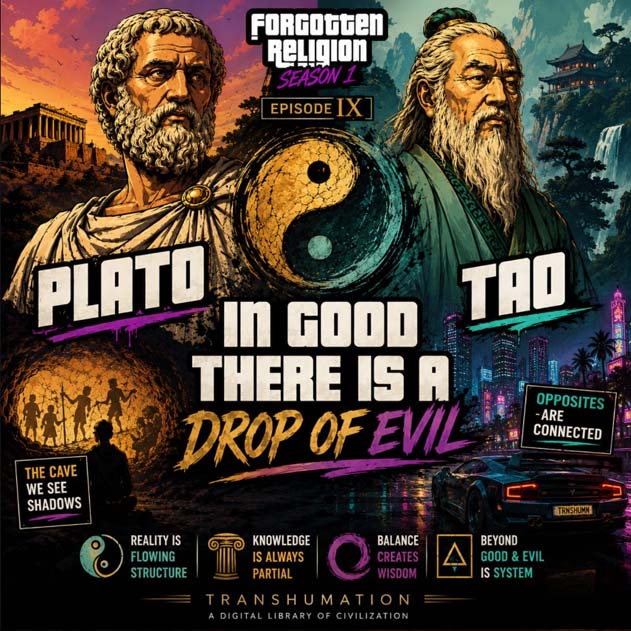
Plato & Tao: In Good There Is a Drop of Evil
The tiny detail inside a familiar symbol that may tell us more about AI, certainty and the limits of perfect systems than it first appears
Everyone knows the yin-yang symbol. You have seen it on jewellery, T-shirts, tattoos, meditation apps and probably on objects that had very little to do with Chinese philosophy. It has become so familiar that most of us no longer really look at it. Black curls into white, white curls into black: opposites, balance, harmony. We recognise the message before we have examined the image.
But look at it again, as though someone had slipped it into your hand without telling you what it meant. There is something slightly strange about the design. The white side is not completely white, and the black side is not completely black. Each contains a small circle of its apparent opposite. If the purpose were merely to represent two competing forces, those dots would be unnecessary. Light could remain on one side, darkness on the other, the border between them perfectly clear.
Instead, someone left a trace of the opposite inside each half.
It is the kind of detail a child might notice before an adult does, precisely because the child has not yet learned which parts of a familiar object are supposed to be ignored. Why put darkness inside the light? Why interrupt such an elegant division?
Perhaps that tiny imperfection is where the treasure map begins.
The Dot That Shouldn’t Be There
The familiar Western interpretation of yin and yang often reduces the symbol to a reassuring lesson about balance. That is not entirely wrong, but it makes the idea more static than the philosophical tradition from which it emerged. Yin and yang describe relationships and transformations rather than two substances permanently assigned to opposite sides of existence. Conditions contain tendencies toward change; what dominates now need not dominate forever.
Seen this way, the little dot becomes more interesting. It is not necessarily a piece of “evil” hidden inside “good,” nor a warning that everything admirable secretly contains something corrupt. It can be read more subtly: as a reminder that our categories are never quite as clean as the names we give them. The moment we declare something completely one thing, reality has an irritating habit of producing an exception.
Modern life provides plenty of examples. Technologies designed to connect millions of people can produce new forms of isolation. Unlimited access to information can create a crisis of attention. Medicine can extend life and thereby create difficult questions about ageing, dependency and the meaning of a good death. Optimization can remove friction until we discover that some of the friction was protecting something valuable.
None of this means that connection, medicine or efficiency are secretly bad. It means that every intervention enters a world larger than the intention that produced it. A system solves the problem it was designed to solve, then encounters consequences its original categories did not contain.
Perhaps the black dot is not evil inside good at all. Perhaps it is simply the remainder: the piece of reality that refuses to stay where our model put it.
Once you begin looking at the symbol that way, another ancient image starts to resemble it from a surprising distance. There is no circle this time and no black dot. There is a wall, a fire and a group of people who have spent their entire lives watching shadows.
Plato’s Wall
The prisoners in Plato’s Allegory of the Cave do not know that they are participating in one of the most famous thought experiments in Western philosophy. From their position, shadows moving across a wall are not representations of reality. They are reality. Nothing in ordinary experience gives them reason to suspect that another structure exists behind what they can see.
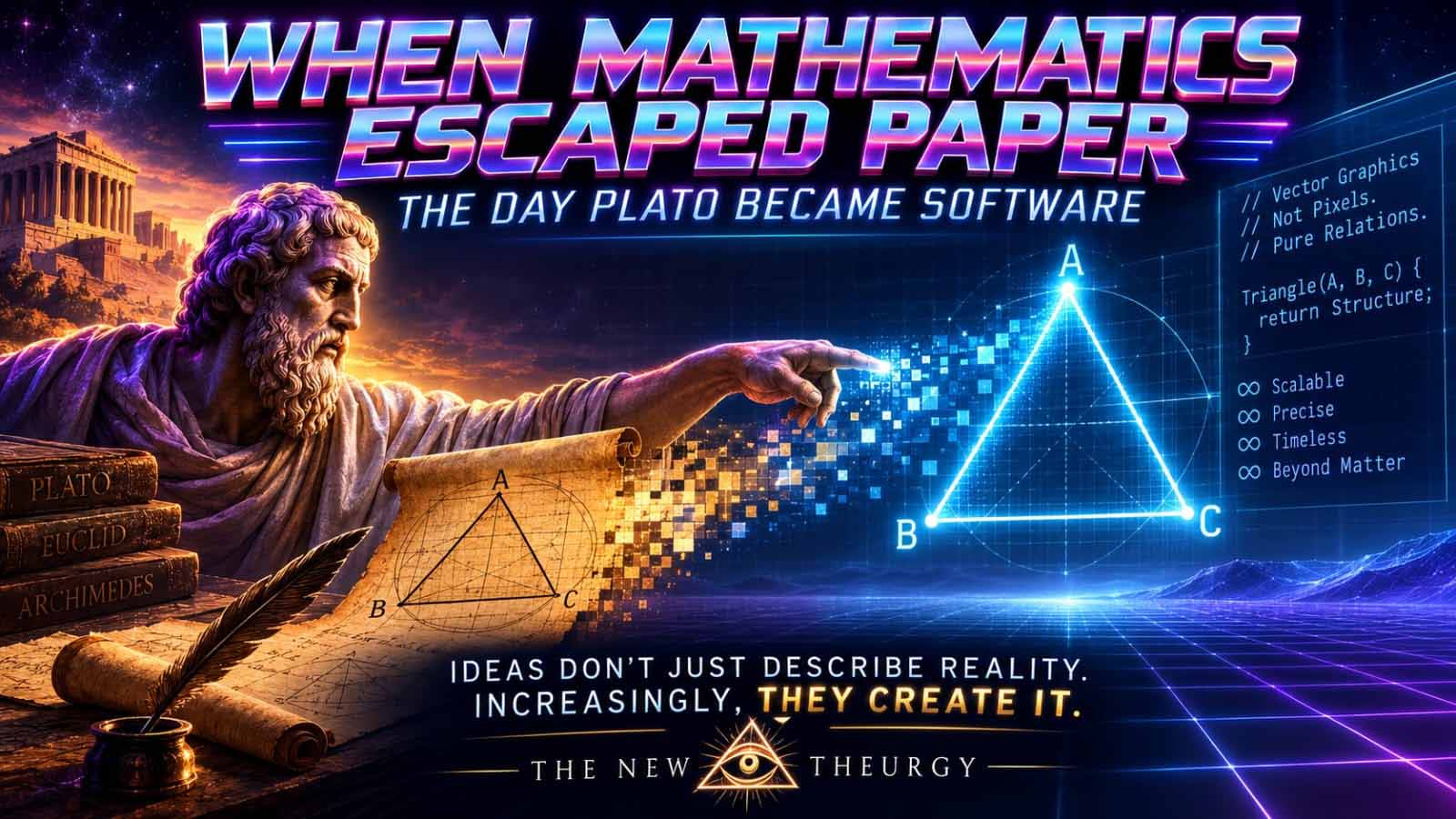
We usually inherit the cave as a story about ignorance and enlightenment: the philosopher turns around, escapes and discovers that what once appeared complete was only partial. Yet there is another way of describing what happens inside Plato’s cave that sounds unexpectedly contemporary. The prisoners are living inside an interface. Something exists, something mediates it, something appears before the observer—and eventually the representation becomes indistinguishable from the thing being represented.
Civilization is full of such interfaces. A map represents territory, a photograph preserves a particular arrangement of light, a financial chart compresses enormous economic activity into a line, and a scientific model selects relationships that allow us to understand phenomena our unaided senses could never grasp. None of these representations is inherently deceptive. Quite the opposite: civilization became powerful partly because human beings learned to build better models of things they could not hold directly in their minds.
The danger appears only when a representation becomes successful enough that we forget it has an edge.
Plato gives us the wall. Yin and yang give us the dot. They emerge from very different traditions and should not be collapsed into a single doctrine, but they can still illuminate the same modern problem from different directions. One reminds us that what appears before the observer may not exhaust the reality producing it. The other reminds us that apparently stable distinctions exist inside processes of change.
And both become strangely useful once our representations begin to think with us.
When the Shadow Becomes Better Than the Object
For most of history, models were obviously smaller than the worlds they represented. A paper map could not be confused with a country. A painting of the sea could not drown you. The distance between representation and reality was usually visible.
That distance is becoming less comfortable.
A navigation system may understand the road network better than the driver moving through it. A medical model may identify correlations invisible to an individual physician. Recommendation systems can detect patterns of behaviour across populations, while artificial intelligence can compare quantities of text and images no human being could examine in a lifetime. We are constructing shadows with extraordinary predictive power, and precisely because they work so well, we increasingly allow them to influence the reality they were originally designed merely to describe.
An algorithm ranks information, so publishers begin producing information that satisfies the ranking system. A school measures performance, so teaching gradually adapts to what can be measured. A platform optimizes engagement, and communication evolves toward whatever generates engagement. A company introduces productivity metrics, and eventually employees can become extremely good at producing the measurable signs of productivity while drifting away from the purpose for which the work existed.
The map has begun changing the territory.
This is not an argument against measurement, algorithms or artificial intelligence. The problem is more interesting than that. Every useful model simplifies, because a model containing everything would simply reproduce the world it was meant to help us navigate. Something therefore has to disappear. Meaning is difficult to quantify; engagement is easier. Wisdom is difficult; performance is easier. A good life is almost impossibly complicated; output can be placed neatly on a dashboard.
The more successful the model becomes, the easier it is to stop asking what was removed to make it work.
That missing thing is our black dot.
What Does AI See Outside Its Cave?
Artificial intelligence is usually discussed through capability. Can it reason? Can it write? Can it diagnose disease, produce software, make discoveries or outperform human beings at particular intellectual tasks? These questions matter, but they may eventually prove less interesting than another one: what can any intelligence know about what lies outside the representations through which it encounters reality?
A language model does not meet Caesar, Hekate, grief, an ocean or a dying star in the way a human body encounters the physical world. It works through records produced by encounters: language, images, measurements, categories and patterns accumulated by other systems and observers. Yet human beings are not standing outside this problem either. We experience reality through nervous systems, memories, language, culture and conceptual models. We too are creatures attempting to reconstruct a larger world from the information available at our particular position inside it.
This does not mean that Plato somehow predicted artificial intelligence, or that Taoist philosophy secretly contains a theory of machine learning. Those claims would turn useful comparison into historical fantasy. What survives across the change of carrier is not a hidden technological prophecy but a structural problem.
Intelligence acts through models. Models simplify. Simplification creates boundaries. Boundaries create blind spots.
The important question may therefore not be whether artificial intelligence can escape Plato’s cave. It may be whether any intelligence can ever escape every cave at once. Each expansion of knowledge may reveal another wall that previously looked like the horizon.
This changes how we should think about increasingly powerful AI. The challenge is not merely to make the model larger, faster or more accurate. We may also need systems capable of recognizing the possibility that something relevant exists beyond the structure through which the problem has been defined. A civilization obsessed with eliminating error could otherwise create extraordinarily consistent machines that become very good at answering questions whose hidden assumptions nobody remembers to examine.
The black dot matters most when the white field looks perfect.
The Treasure Was Never Balance
This is where the childhood question returns. Why spoil such a beautiful symbol with those two dots?
Perhaps because perfection would have made it less truthful.
The common slogan that “in good there is a drop of evil” is memorable, but it may ultimately be too moral and too narrow. The dot becomes more useful if we allow it to represent the remainder: the unexpected consequence, the exception to the rule, the variable outside the model, the person who does not fit the category, the piece of territory that disappeared when the map was drawn.
We encounter such moments even in banal digital life. A platform can function beautifully for a hundred million users and behave absurdly when one person’s situation falls between two automated rules. From the dashboard, the system is working with 99.99 percent efficiency. From the position of the person trapped inside the exception, the system is completely broken. Neither observation necessarily cancels the other. They describe reality from different positions inside the same structure.
That small contradiction is worth preserving because civilization is becoming capable of constructing systems at scales no individual can comprehend. AI models, financial networks, biological technologies and digital institutions increasingly mediate the world before we encounter it. The temptation will be to make these models ever more complete, and then to confuse completeness of representation with completeness of reality.
Perhaps the old symbols suggest a better discipline. Do not destroy the model simply because it is incomplete; without models, complex civilization would be impossible. But do not worship it because it works. Instead, whenever a system begins looking beautifully complete, deliberately search for whatever had to disappear in order to make it so.
Look for the dot.
The Door We Should Leave Open
There is something satisfying about imagining philosophy as a search for final answers. Somewhere behind enough books, equations and arguments there ought to be a last room containing the complete map. We inherit this expectation early: follow the clues correctly and eventually the treasure chest opens.
But perhaps the best treasure chest contains another map.
Plato does not tell us what lies outside every cave. Taoist thought does not provide an algorithm for governing technological civilization. Neither tradition contains secret instructions for artificial intelligence, and forcing them to do so would diminish rather than deepen them. What they can still offer is a habit of suspicion toward the moment when our description of reality begins to feel indistinguishable from reality itself.
Pure chaos cannot sustain civilization, because without categories, models and structures we could barely act. Yet complete certainty carries its own danger: once the map is declared finished, nobody has a reason to explore beyond its border.
Perhaps that leaves us somewhere less comfortable but more interesting—between chaos and certainty, carrying enough structure to navigate and enough doubt to continue looking. Enough of a map to leave home, but not enough to know in advance where the treasure is buried.
The yin-yang symbol has been sitting in front of us all along. We thought the important thing was the elegant division between black and white.
Maybe the most important part was the tiny dot that refused to obey it.
Watch the Video
How to Read the World
Current Knowledge
Plato’s Allegory of the Cave appears in Book VII of The Republic and is concerned with education, knowledge, appearances and philosophical understanding. Yin-yang thought developed within Chinese intellectual traditions and should not simply be equated with Taoism, although it became deeply associated with broader Chinese cosmological and philosophical thinking.
There is no evidence that Plato and early Chinese thinkers shared a common hidden doctrine or that ancient symbols encoded modern technologies. Their historical contexts and philosophical systems differ considerably.
Modern scientific and computational models necessarily simplify aspects of reality in order to represent, explain or predict them. Their usefulness depends partly on selecting relevant variables while excluding others.
Open Questions
Can any intelligence fully understand a system of which it is itself a part?
As models become more accurate, does the distinction between representation and reality become less important—or more dangerous to forget?
Can AI identify the blind spots created by its own representations, or will another perspective always be required?
And as increasingly complex systems govern parts of civilization, how do we preserve the ability of the exception—the person or event outside the model—to challenge what the aggregate data says is working?
Transhumation Interpretation
Transhumation does not interpret the meeting between Plato and Tao as evidence of a forgotten universal religion.
The surviving structure is more interesting.
Every model creates a boundary.
Every boundary creates an outside.
Every apparently complete system contains something it cannot completely represent.
The yin-yang dot can therefore be read—not historically, but structurally—as an image of the remainder that refuses to disappear when a category tries to become pure.
Plato gives us the wall.
Tao gives us the dot.
Modern civilization gives us the algorithm.
And artificial intelligence may give us the most convincing models humanity has ever created.
The danger will not necessarily be that those models are wrong.
It may be that they become right often enough that we forget to look beyond them.
The treasure is not the perfect map.
It is remembering that the world continues beyond its edge.
FAQ
What is the connection between Plato and Taoism?
There is no established historical doctrine uniting Plato and Taoism. They developed in very different intellectual traditions. The useful comparison concerns certain structural questions both can raise about change, knowledge, categories and the limits of human perspective.
What do the dots in the yin-yang symbol mean?
They are commonly interpreted as showing that yin and yang are not absolutely isolated: each contains or can give rise to aspects of the other. The symbol represents dynamic relation and transformation rather than two permanently separated substances.
What is Plato’s Allegory of the Cave about?
In Book VII of The Republic, Plato describes prisoners who mistake shadows for reality. The allegory explores education, knowledge, appearances and the difficult movement toward greater understanding.
What does Plato’s Cave have to do with AI?
AI relies on representations of the world—text, images, measurements, categories and other data. The connection is philosophical rather than historical: both raise questions about the difference between reality and the models through which an intelligence encounters it.
Does Transhumation claim that yin-yang predicted artificial intelligence?
No. The comparison concerns a recurring structure, not technological prediction. Transhumation asks whether ancient symbols and philosophical models can still help us formulate better questions about modern systems.
Continue the Transhumation Series
- Forgotten Religion | Ancient Gods, Symbols and the Hidden Structures of Human Civilization
- The Last Religion | Death, Immortality and the Future of Humanity
- The New Theurgy | AI, Information and the Future of Human Civilization
- End of Branding: You Were Never Meant to Become a Product
- Baal vs Ishtar: Why Ancient Gods Never Disappeared