
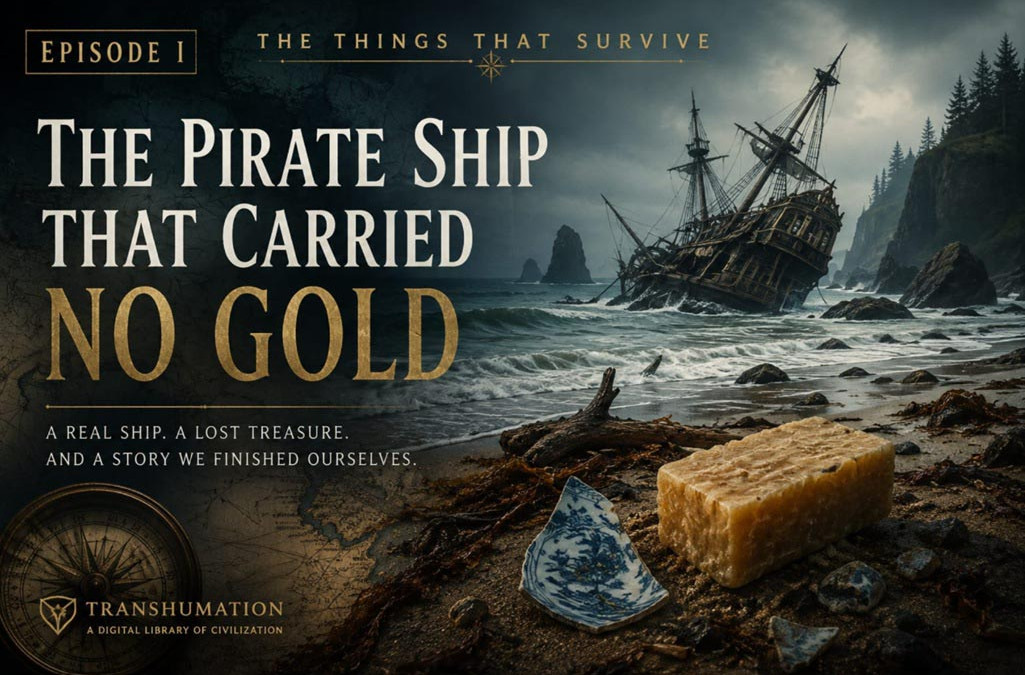
„Goonies Never Die”
Somewhere beneath the Oregon coast lies a treasure. At least, that is what we want to believe. For generations, unusual objects appeared along the beaches near Nehalem Bay: pieces of Chinese porcelain, heavy timbers, blocks of beeswax and fragments suggesting that a large ship had vanished somewhere offshore. The wreck is now widely associated with the Spanish Manila galleon Santo Cristo de Burgos, lost in 1693 while sailing toward New Spain. The cargo had crossed the Pacific and had been valuable enough to justify an enormous voyage. Yet the thing people kept finding was not gold. It was wax.
There is something almost disappointing about beeswax until one notices how quickly the disappointment reveals us. A seventeenth-century wreck, a remote coast, a lost Spanish ship — and the imagination supplies the missing chest almost automatically. We want coins, jewels, perhaps a pirate map. We want the object beneath the water to justify the story we have already begun telling ourselves. The historical vessel may have carried valuable commercial goods, but culture has never been especially satisfied with ordinary value. A bale of useful material belongs to commerce. A chest of gold belongs to adventure.
That difference may explain why the Oregon coast produced not only archaeology but legend.
Why Oregon?
The Goonies seems, at first, to have chosen the wrong landscape for a pirate story. If one were inventing such a film from nothing, the Caribbean would appear more obvious: warm water, islands, rum, tropical ruins, Spanish treasure. Instead, the children begin their adventure in Astoria, under grey skies and beside a cold Pacific coast.
Yet Oregon already possessed something more useful than a postcard version of piracy. It possessed an unfinished story.
For generations, the north coast had accumulated reports of wax, porcelain, wreckage and lost treasure. The Beeswax Wreck became entangled with local stories around Neahkahnie Mountain and with repeated attempts to locate something hidden beneath the landscape. The precise relationship between this history and the creation of The Goonies should be handled cautiously; cultural influence is rarely as neat as a single source becoming a single film. But the broader fact is enough. Long before One-Eyed Willy sailed into popular culture, the Oregon coast already contained the structure of a treasure story: something had vanished, traces remained, and nobody could see the whole.
That may be more important than whether any particular artifact sat on a screenwriter’s desk.
Reality had already opened the door.
The question was simply who would walk through it.
The Story Inside the Wreck
A wreck is one of the strangest objects civilization can inherit because it is both evidence and absence. The ship proves that something happened, while simultaneously refusing to tell us exactly what. We know there was a voyage. We know there was cargo. We know there was loss. Between those points lies a darkness that history may never completely fill.
Human imagination is unusually active in such darkness.
A footprint in a forest is not yet a story, but it immediately produces a question. A locked room is only architecture until someone asks why it is locked. A piece of foreign porcelain on an isolated beach may be nothing more than an artifact, but once its presence becomes difficult to explain, it begins pulling the observer toward an event that is no longer there.
This is where fiction often begins: not by escaping reality, but by encountering a piece of reality that is incomplete.
The real world supplies fragments. The story gives them sequence.
That sequence does not have to be historically accurate to preserve something true about human experience. Real piracy was often less romantic than its cultural afterlife. Pirates stole useful goods, food, textiles, alcohol, equipment and commodities that could be sold. Life at sea contained boredom, disease, weather, discipline and economics alongside violence and risk. Culture compressed that complicated world into a smaller set of objects: the map, the island, the ship, the chest.
Much has been lost in the compression.
Yet the structure remains recognizable.
A trace appears. Something valuable may have disappeared. The unknown becomes a promise. Someone decides to search.
That structure is older than The Goonies, older than cinema and probably older than writing itself.

We Brought the Gold With Us
The most interesting moment comes when the wreck stops being only an object of observation.
Why did gold appear so quickly in our imagination?
Nothing about a block of beeswax requires it. A commercial galleon does not need to become a pirate ship. Yet once the words lost Spanish vessel and treasure begin approaching each other, culture supplies an entire architecture of expectation. We have seen the map before. We know what the chest is supposed to look like. We know that somebody should eventually open it.
The wreck did not contain all of that.
We did.
This may be one of the reasons stories are more powerful than inventories of facts. A list can preserve information without demanding much from the person reading it. A story leaves carefully chosen spaces that the observer must cross alone.
The past provides the fragment. The observer reconstructs the possibility.
In that sense, a successful story does not contain an entire experience. It contains enough structure for an experience to be rebuilt somewhere else.
A child watching The Goonies does not need to know the history of Manila galleons. He does not need to understand seventeenth-century trade in beeswax or Chinese porcelain. He only needs to recognize the invitation: something was lost, something may still be there, and perhaps the adults have stopped looking too soon.
The rest can be reconstructed inside him.
That is not a flaw in the transmission.
It may be the mechanism that allows the transmission to work.
What Stories Throw Away
Civilization has always faced an impossible storage problem. Most human experience cannot be preserved. Conversations disappear. Details of ordinary lives vanish. Places change. Technologies become unreadable. Even when documents survive, the world that gave them immediate meaning often does not.
Stories solve part of this problem by being ruthless.
They throw things away.
Icarus does not preserve a complete theory of ambition, fathers, sons, technology and human limitation. He flies too close to the sun. The image is small enough to survive and large enough to be reopened by another mind.
A crossroads cannot contain every decision anyone has ever made. It does not need to. The shape itself is sufficient to reactivate the problem.
The pirate chest does not preserve the economics of maritime trade. It preserves desire, risk and discovery in a form that can be recognized almost instantly.
Perhaps this is why the most durable cultural forms are not necessarily those containing the greatest quantity of information. They may be the forms that preserve the minimum structure necessary for another person to reconstruct an experience.
That distinction becomes increasingly important in a civilization obsessed with storage. We can preserve more photographs, more messages, more recordings and more data than any previous generation. Yet preserving data and preserving meaning are not the same achievement. A perfectly intact archive can become culturally dead if nobody knows how to enter it.
A story is different.
It does not merely say: this happened.
It gives the next observer somewhere to stand.
The Treasure After the Treasure
The people aboard the lost galleon are gone. Their arguments, fears, routines and private ambitions disappeared with them. The vessel itself deteriorated. Its commercial cargo became archaeology. What survived did so in fragments: wax, porcelain, timber, local memory, speculation.
And yet those fragments continued generating experience.
Centuries later, somebody still arrives at the coast and wonders what lies beneath the water. A child watches a fictional pirate ship and imagines following a map. An adult learns that the glamorous treasure may have been beeswax and discovers that the story has not become smaller. It has become stranger.
Perhaps that is the real lesson of the wreck.
The past does not have to survive intact to remain active. Sometimes it only needs to leave a structure capable of finding another observer.
The ship disappears.
The carrier changes.
The adventure begins again.
And only then does the original question return in a different form.
We thought the treasure was somewhere inside the wreck.
Perhaps part of it was waiting inside the person who found it.
Watch the Video
How to Read The World
Current Knowledge
The Beeswax Wreck refers to a historic shipwreck on Oregon’s north coast, widely associated by researchers with the Spanish Manila galleon Santo Cristo de Burgos, which disappeared in 1693 while sailing toward New Spain. Beeswax, Chinese porcelain and timbers connected with the wreck have been found in the Nehalem area over a long period, while more recent archaeological work has strengthened the proposed identification.
The region also developed extensive traditions of lost treasure and repeated treasure hunting. Those legends grew around genuine archaeological evidence, but evidence for a wreck and valuable commercial cargo is stronger than evidence for the more elaborate stories of buried gold that later accumulated around it.
The Oregon coast and its wreck traditions have often been discussed in connection with the cultural background of The Goonies. The exact degree of direct inspiration is less certain than the broader fact that the film emerged from a region already rich in stories of lost ships, hidden cargo and unfinished maritime mysteries.
Open Questions
Why do some fragments of reality generate stories while millions of equally real events disappear without leaving one?
How much of an original experience must survive before another person can reconstruct something recognizably related to it?
Does fiction become convincing because it reproduces reality accurately, or because it preserves structures that human beings already know how to inhabit?
And when a wreck makes us imagine gold that may never have been there, are we discovering a story — or discovering the machinery with which we create stories?
The Transhumation Interpretation
Transhumation treats the Beeswax Wreck as a small model of cultural survival.
Reality leaves fragments. Culture compresses them. The resulting story discards enormous quantities of detail while preserving a structure capable of being reactivated inside another observer.
The important movement is therefore not simply:
event → record.
It is:
experience → fragment → structure → story → observer → new experience.
This is why the carrier is not the whole story. A ship can decay while the adventure survives. A myth can lose its original religious context while its structure continues to act. A painting can outlive the person who made it and still alter the observer standing before it.
The strongest cultural forms may not preserve the past perfectly.
They may do something stranger.
They allow part of the past to happen again.
The Beeswax Wreck did not preserve a complete seventeenth-century world. It preserved enough to make someone centuries later ask the oldest question in every adventure:
What if there is something more?
And that may be why we went looking for gold and came back with something better.
Not an answer.
A door.
FAQ
What was the Beeswax Wreck?
The Beeswax Wreck refers to a historic shipwreck on the northern Oregon coast, widely associated with the Spanish Manila galleon Santo Cristo de Burgos, which disappeared in 1693. Beeswax, Chinese porcelain and ship timbers have been connected with the wreck over generations.
Why was beeswax found on the Oregon coast?
Beeswax was a valuable trade commodity carried across the Pacific on Manila galleons. Pieces associated with the wreck reportedly washed ashore for many years, helping fuel local stories about a lost Spanish ship and hidden treasure.
Was the Beeswax Wreck a pirate ship?
There is no strong evidence that it was a pirate ship. It is generally associated with a Spanish trading galleon. The pirate element belongs more to later legend, treasure culture and popular imagination than to the best-supported historical identification.
Did the Beeswax Wreck inspire The Goonies?
The Oregon coast’s history of shipwrecks, treasure stories and the Beeswax Wreck is often discussed as part of the cultural background surrounding The Goonies. The exact degree of direct inspiration is harder to prove, so it is safer to treat the wreck as part of the region’s real-world adventure mythology rather than as the single confirmed source of the film.
Why do real shipwrecks become treasure stories?
Shipwrecks preserve evidence while leaving much of the original event unknown. That combination of fact and absence encourages people to reconstruct what might have happened, and valuable cargo can easily become transformed into legends of gold, pirates and hidden treasure.
What does the Beeswax Wreck mean in Transhumation?
Transhumation treats the wreck as an example of how experience can survive through fragments. The original voyage disappears, but pieces of cargo, stories and later interpretations can preserve enough structure for another observer to reconstruct an adventure.
What does “the story was never entirely inside the wreck” mean?
It means that part of the story comes from the physical evidence and part comes from the observer. The wreck supplies the trace; the human mind supplies expectation, memory and imagination. Meaning appears in the meeting between the two.
Continue the Transhumation Series
- Forgotten Religion | Ancient Gods, Symbols and the Hidden Structures of Human Civilization
- The Last Religion | Death, Immortality and the Future of Humanity
- The New Theurgy | AI, Information and the Future of Human Civilization
- End of Branding: You Were Never Meant to Become a Product
- Baal vs Ishtar: Why Ancient Gods Never Disappeared