
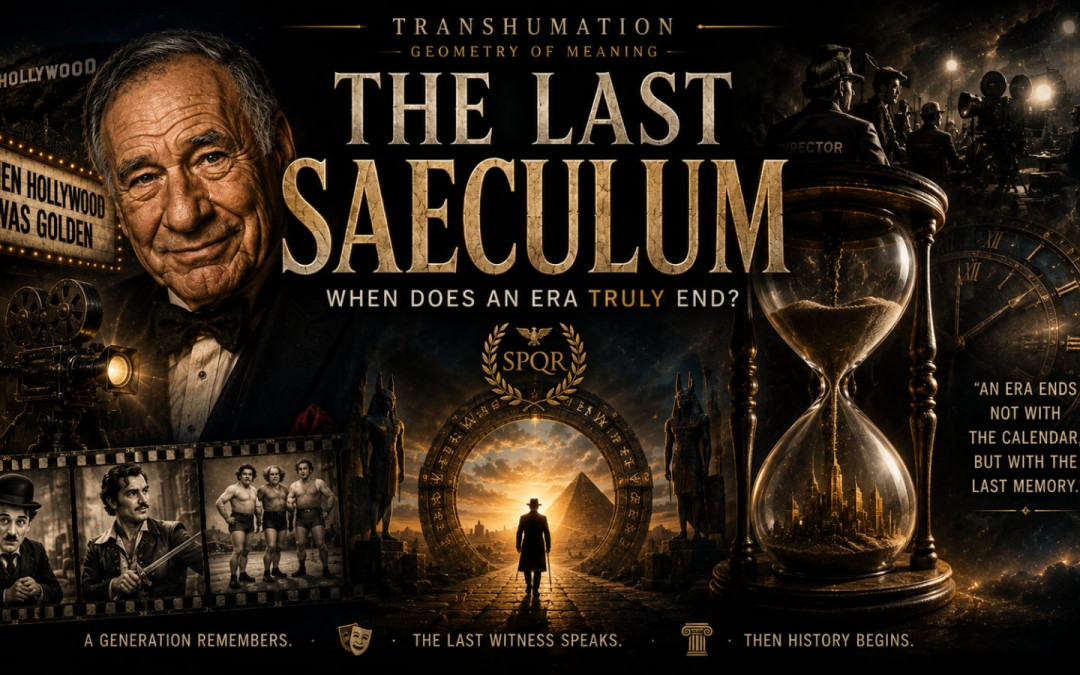
The Last Saeculum
A century has a wonderfully bureaucratic death.
Midnight arrives. The final December disappears. Fireworks go up. Printers change the date. Historians acquire a convenient new heading. One hundred years have been placed neatly inside a box, and another box begins.
Human memory has never been so cooperative.
A person born in 1926 can still sit before a camera in 2026 and speak about a world whose physical environments, manners, technologies and assumptions have largely disappeared. Another person born in the same decade may have died before television became culturally dominant. The calendar places both lives inside the same century. Experience does not.
This is why the old word saeculum deserves another look.
Ancient Roman and Etruscan traditions did not define it in one simple, universally consistent way. Some accounts connected a natural saeculum with the span of the longest human life belonging to a generation; later calculations could assign a civil saeculum a conventional duration of roughly a century or 110 years. Roman celebrations associated with the saeculum were themselves irregular enough that ancient writers debated how long the interval was supposed to be.
That ambiguity is more interesting than a clean definition.
It places biological memory beside calendar time.
And from that tension comes a question our calendars cannot answer:
When does an age stop being something someone remembers and become something everyone must reconstruct?
A Century Is Not the Same Thing as a Human Age
Calendars are magnificent compression devices.
They take billions of individual lives, private experiences, political changes, inventions, wars, marriages, fashions and anxieties and organize them into years, decades and centuries. The compression is indispensable. Without it, history would become almost impossible to navigate.
But navigation is not experience.
Two people can occupy the same historical dates while inhabiting astonishingly different worlds. Someone born in 1900 could have grown up when powered flight was still experimental and lived long enough to watch human beings walk on the Moon. Someone born forty years later entered a world in which airplanes were ordinary infrastructure and nuclear weapons already existed.
The century remained the twentieth.
The human worlds inside it did not.
A date therefore tells us where an event sits chronologically. It does not tell us how far one lived reality is from another.
This distinction becomes especially visible near the end of a very long life.
Mel Brooks was born in Brooklyn on June 28, 1926. His career stretches from the world of mid-century American comedy writing through The Producers, Blazing Saddles, Young Frankenstein and Spaceballs, and into the streaming era. In April 2026, at ninety-nine, he was still contributing to the new Spaceballs sequel; by September 2026, having passed his June birthday, he is one hundred. A hundred years is a calendar measurement.
In Brooks’s case it is also something stranger.
It is a corridor between cultural worlds.
What Did the Romans Mean by Saeculum?
The elegant version of the story says that a Roman saeculum lasted until the last person who remembered its beginning died.
The historical reality is messier.
Ancient discussions distinguish what later scholars call a natural and a civil saeculum. In the Etruscan scheme reported by Censorinus and later antiquarian sources, the natural saeculum could be associated with the longest lifespan of those born around the beginning of a generation or civic period. Other ancient calculations spoke of one hundred years; imperial practice could work with 110. Even Rome’s Ludi Saeculares, the games associated with the beginning of a new age, were not celebrated at perfectly regular intervals.
So we should not pretend there was one perfectly administered Roman philosophy of generational memory.
But inside these competing definitions lies a remarkable intuition.
An age can be measured not only by astronomical motion or the arithmetic of calendars, but by the human lives capable of spanning it.
That is a profoundly different way of looking at time.
A century says: one hundred years have elapsed.
A human age asks: does anyone remain who can still speak from the other side of the transition?
Those are not equivalent questions.
What Happens When the Last Witness Dies?
Imagine a historical event for which one living witness remains.
A researcher can interview that person tomorrow and ask a question nobody thought to ask before.
The answer may be inaccurate. Human memory is reconstructive, vulnerable to suggestion, forgetting and later reinterpretation. Witnesses contradict one another. Living testimony does not give us privileged access to pure historical truth.
But it possesses one capacity an archive does not.
It can respond to a new question.
Once the final witness dies, that possibility disappears.
The recordings remain.
Letters remain.
Photographs remain.
Objects remain.
Earlier interviews remain.
But the event’s participants can no longer be asked anything that was not asked while they were alive.
This is the real threshold.
History does not suddenly begin when memory ends; historians work with living testimony all the time, and written history can be produced immediately after an event. But after the last witness disappears, the archive becomes closed in a new way.
No new first-person testimony can enter it.
We may discover forgotten documents.
We may reinterpret evidence.
We may recover recordings.
But the past can no longer answer a question it was never asked.
Mel Brooks and the Strange Privilege of the Living Archive
This is what makes an exceptionally long-lived cultural figure interesting beyond celebrity.
Mel Brooks does not merely possess information about twentieth-century entertainment that could be reproduced in a chronology. A biography can tell us where he worked. A database can list films. An archive can preserve scripts.
The living person carries something less tidy.
Cadence.
Judgment.
Memory shaped by later experience.
Stories that were never important enough to enter an official archive.
A sense of which absurdities once required explanation and which were simply normal.
Brooks also belongs to a particular comic lineage. He worked in the orbit of Sid Caesar’s television comedy and collaborated with figures such as Carl Reiner; his later filmmaking transformed genres by parodying the assumptions audiences already carried into the cinema.
When someone like Brooks describes that world, we are not receiving an untouched recording of 1950.
We are receiving 1950 filtered through a mind that has also experienced 1968, 1974, 1987, the internet age and now AI.
That makes the testimony less pure and more interesting.
A century is speaking to itself across its own transformation.
Why Comedy Can Preserve What Official History Misses
Official records tend to preserve what institutions consider recordable.
Votes.
Appointments.
Wars.
Prices.
Deaths.
Contracts.
Court decisions.
Comedy preserves a different layer of civilization.
A joke depends on assumptions.
For something to be funny, an audience must recognize the thing being distorted. A parody works only because the original grammar is already familiar. Satire therefore carries fragments of the society against which it pushes.
Watch old comedy carefully and you encounter vanished social expectations everywhere: what could be said openly, what had to be implied, which accents signaled class, what audiences recognized instantly, which authorities could be mocked, which taboos provided tension.
Comedy is not a transparent historical document. A comedian exaggerates, selects and performs. Surviving comedy also suffers from selection bias: we keep some works and forget thousands of others.
But it can preserve something statistics struggle to capture.
Not simply what people believed.
What they expected other people to recognize.
That is an unusually intimate form of historical information.
When Does Memory Become History?
The temptation is to draw a dramatic line.
Before the last witness: memory.
After the last witness: history.
Reality refuses such neatness.
History already exists while witnesses are alive. Memory can persist for generations through family transmission, ritual and storytelling. Archives are created during events, not merely afterward. And historians routinely challenge first-person recollections when physical or documentary evidence points elsewhere.
The real change is not that memory becomes history.
It is that the balance of evidence shifts.
While witnesses survive, the past contains participants capable—at least theoretically—of producing new testimony. Once they are gone, interpretation becomes increasingly dependent on traces that cannot generate new original responses.
The difference resembles the difference between a person and a recording of that person.
The recording may preserve the exact words spoken yesterday.
But today it cannot answer:
“What did you mean by that?”
That unanswered follow-up marks the boundary.
Why the Last Witness Matters More in the Age of AI
Until recently, the distinction between a person and an archive was easy to feel.
Books stayed silent until opened.
Photographs did not move.
Recorded voices repeated the same sentences.
The dead did not answer new questions.
Generative systems complicate the experience.
Imagine a complete archive of a twentieth-century writer: letters, interviews, recordings, manuscripts, photographs and private notes. An AI system could conceivably organize that material and generate plausible answers in the writer’s style.
A future visitor asks:
“What did television feel like when it first entered your home?”
The system replies beautifully.
Perhaps every sentence is consistent with the archive.
But the writer did not answer.
The model did.
This distinction will become increasingly important because responsiveness feels like presence.
The archive stops behaving like storage and begins behaving like conversation.
That can make history more accessible.
It can also make reconstruction dangerously easy to confuse with testimony.
A future library therefore needs a new kind of label.
Not merely authentic or fake.
But:
original testimony;
recorded statement;
historical inference;
generated reconstruction;
unknown.
Without those distinctions, we may accidentally manufacture new witnesses after the last real witness has gone.
The Library Against Time
Libraries have never defeated mortality.
Their achievement is subtler.
They make mortality less efficient at erasing consequences.
Horace can still alter a reader.
A Roman inscription can still correct a historian.
A photograph can still identify a vanished building.
A joke can still make someone laugh centuries after the assumptions surrounding it have become strange.
None of this means the original consciousness remains inside the carrier.
The book does not contain the author as a dormant person.
The recording does not contain a sleeping witness.
What survives is a structure capable of producing effects in another living mind.
This is why a library is less a mausoleum of information than an architecture of delayed encounters.
Someone leaves a trace.
Someone else arrives later.
The carrier waits between them.
A good library keeps the route intact.
Watch the Video
How to Read the World
Current Knowledge
The Latin word saeculum had several historical usages rather than one fixed definition. Ancient and antiquarian traditions could connect it with a human lifespan or generation, while conventional Roman calculations also used periods around one hundred or 110 years. The intervals between Roman Ludi Saeculares were irregular, and ancient writers themselves disagreed about the proper duration of a saeculum.
Modern research on autobiographical memory also shows why living testimony must be treated carefully. Human memory is not a perfect recording of experience; it is reconstructive, selective and subject to later influence. A living witness therefore offers uniquely responsive evidence, but not automatically accurate evidence.
Historical knowledge relies on multiple classes of traces: testimony, contemporary documents, objects, images, recordings, institutional records and later interpretations. The death of the final witness does not make history impossible, but it closes the possibility of obtaining genuinely new first-person testimony from participants.
Mel Brooks provides an unusually vivid contemporary example of a life spanning enormous cultural change. Born in 1926, he moved from mid-century American comedy and early television into film, Broadway and twenty-first-century media; he remained publicly active in 2026.
Open Questions
The first problem is deciding how much epistemic privilege living memory deserves. A witness can answer a question an archive cannot, but the answer may be wrong. Conversely, an impersonal record may preserve details the witness has forgotten. The strongest historical reconstruction often emerges from tension between testimony and independent evidence rather than from treating either as supreme.
A second problem is determining when a cultural era actually ends. Technologies can disappear while habits persist. Political regimes can end overnight while their institutions survive for decades. People born into one media environment may continue carrying its assumptions deep into another. There may therefore be no single last day of an era, only the gradual disappearance of people capable of experiencing its earlier state as normal.
AI creates a third and newer question. If a generated reconstruction becomes capable of answering new questions convincingly, what exactly has been preserved? A style? A statistical pattern? A body of documented knowledge? A social role once occupied by a person? None of these automatically establishes continuity of the original subject.
The most difficult question may concern absence itself. Should a mature archive try to fill every silence? Or should some gaps remain visibly empty because nobody who knew the answer is left to speak?
Transhumation Interpretation
For Transhumation, the saeculum is useful not because ancient Rome secretly invented a theory of informational immortality. It did not.
It is useful because human lifespan gives history another scale.
A civilization contains periods during which the past can still answer back through living participants. Then a threshold arrives after which only traces remain.
AI may become an extraordinary librarian of those traces. It can connect, retrieve and interpret them. But the librarian should never silently become the witness.
The difference between those roles is small on a screen and enormous in civilization.
A living witness can still surprise the archive.
A generated witness can only build from what the archive, model and inference make possible.
The Last Saeculum
Perhaps an era does not end when December turns into January.
Nor does it end neatly when its final witness dies.
But something irreversible does happen then.
The door to new first-person testimony closes.
From that moment forward, the past can still be discovered, disputed and reinterpreted, but it cannot produce another participant who raises a hand and says:
That is not how it felt.
The archive grows more powerful precisely as the witnesses disappear.
And more dangerous.
Because eventually every voice sounds equally distant unless someone preserves the distinction between a voice recorded while it lived and a voice reconstructed afterward.
A century can end on a calendar.
A saeculum gives us a more human question.
When does the world stop containing somebody who remembers what it was like before the world became the one we know?
That day cannot be printed in advance.
But when it arrives, a library somewhere becomes one witness more important.
FAQ
What does saeculum mean?
The Latin term had several meanings. Ancient traditions connected it with a human lifespan or generation, while Roman chronological schemes also used periods of roughly one hundred or 110 years. It should not be treated as a simple synonym for our modern century.
Did Romans believe an era ended when its last witness died?
Not in the simple form often repeated today. Some traditions tied a natural saeculum to the longest lifespan of a generation, which creates an interesting relationship between historical time and human life, but Roman definitions varied.
Why use Mel Brooks as an example?
Brooks was born in 1926 and remained active in 2026, giving his life a century-long span across enormous changes in entertainment, communications and technology.
Does history begin when the last witness dies?
No. History and memory overlap. What changes is that no genuinely new first-person testimony can be collected once all participants are gone.
Why does this matter in the age of AI?
Because generative systems can make archives responsive. A reconstruction may answer questions a dead witness never answered, making it increasingly important to distinguish original testimony from generated interpretation.
What is the deeper Transhumation question?
Whether civilization should use technology to eliminate every silence left by the dead, or whether an honest library must sometimes preserve the words we do not know.
Continue the Transhumation Series
- Forgotten Religion | Ancient Gods, Symbols and the Hidden Structures of Human Civilization
- The Last Religion | Death, Immortality and the Future of Humanity
- The New Theurgy | AI, Information and the Future of Human Civilization
- End of Branding: You Were Never Meant to Become a Product
- Baal vs Ishtar: Why Ancient Gods Never Disappeared