
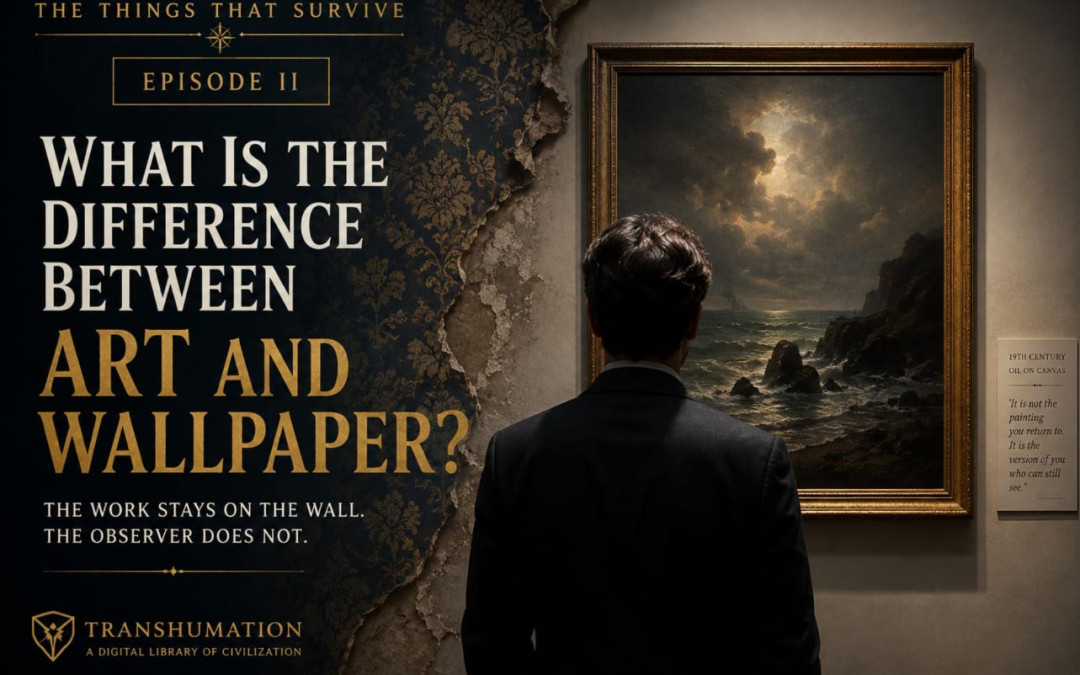
Ars Gratia Artis
Why one disappears into the room while the other can wait years for you to become someone else?
There is a small trick every room eventually plays on us. At first we notice everything. The colour of the walls, the grain of the wood, the pattern of the wallpaper, the way the light falls across a picture hanging above a chair. Then, after a few days, most of it begins to disappear. The wallpaper is still there, perfectly visible and perhaps still beautiful, but the eye stops reporting it as news. It becomes part of the room in the same way the hum of a refrigerator becomes part of silence.
A painting can behave differently. You may also stop looking at it for a while, especially if it hangs somewhere familiar, but every so often it returns. Perhaps one morning the face in the picture looks more tired than you remember. Perhaps a landscape you once found peaceful begins to feel lonely. Perhaps something you ignored for ten years suddenly becomes the only part of the image you can see. Nothing on the wall has changed. The canvas is where it was. The paint has barely moved. Yet the encounter is no longer the same.
That is a strange property for an object to possess.
And perhaps it is a better place to begin than the usual question of whether art is beautiful, meaningful or technically accomplished. Wallpaper can be beautiful. Decoration can carry history, symbolism and extraordinary craftsmanship. A textile can preserve identity, religion, status and memory. A commercial poster can outlive the product it once tried to sell. If we want to understand why some objects keep acting on us while others fade into the background, the answer cannot simply be that one contains meaning and the other does not.
Perhaps the difference begins somewhere else: not in what the object contains, but in what it refuses to finish for us.
The Face That Gives You Nothing to Ask
Imagine two portraits hanging side by side. The first face is almost mathematically perfect. The eyes align beautifully, the jaw is balanced, the skin is smooth, the proportions approach an ideal assembled from everything we have learned to call attractive. It is the sort of face contemporary software can increasingly produce without asking any particular human being to sit for it. There is nothing obviously wrong, and that may be precisely the problem. The face arrives already complete.
The second portrait is less cooperative. One eye sits fractionally higher than the other. A scar approaches the corner of the mouth. Age has pulled one side of the face differently from the other. The expression refuses to settle into one category. It might be amusement, distrust, fatigue or grief. You can decide which face is more beautiful, but the second one has already done something the first has not: it has made you ask what happened.
A scar is a modest object. It is not a biography. Yet it behaves like a torn corner of a map because it implies a territory outside the frame. Something occurred before you arrived. A wrinkle records no single event, but it reveals that time has repeatedly crossed the same face. Asymmetry can remind us that we are not looking at a statistical average of humanity but at one organism that has survived a particular path through the world.
This does not mean damage creates art or perfection prevents it. A perfect geometric form can be profoundly moving, and an imperfect object can remain utterly empty. The useful distinction is subtler. Some forms give the observer nothing more to reconstruct. Others provide enough evidence for the imagination to begin working while withholding the explanation that would end the work.
The moment that happens, an image starts approaching a story.
The Painting That Pushes Back
Mediocre images often make excellent first impressions because they are unusually polite. The beautiful person is recognizably beautiful. The villain looks dangerous. The hero appears heroic. The landscape supplies exactly the amount of melancholy the title promised. Interpretation proceeds smoothly because there is almost no resistance between what the object offers and the label the observer applies to it.
Stronger works are often less accommodating. Something remains slightly wrong after the first explanation. A portrait feels intimate but never friendly. A landscape appears serene until a detail in the distance begins changing its temperature. An erotic image carries an unexpected sadness. A triumphant figure seems strangely vulnerable. The work does not prevent interpretation, but it refuses to remain entirely inside the first interpretation offered to it.
This is where looking becomes negotiation.
The observer proposes a meaning; the object returns evidence that does not quite fit; the observer adjusts. With enough complexity, the process may continue for years. At some point the most interesting question is no longer what the painter placed on the canvas. It becomes what the viewer brought into the room. Why did I notice that first? Why did I ignore something else? Why did this expression make me uncomfortable when another person saw tenderness in it?
A good mystery operates in a similar way. The first question concerns the missing object, the locked room or the dead body. Later, if the story is good enough, the mystery begins exposing the assumptions of the person attempting to solve it. Art can perform the same reversal. The painting remains motionless while the observer becomes the thing that moves.
That may be the first real difference between art and wallpaper. Wallpaper generally succeeds when the encounter stabilizes. A powerful work can remain alive precisely because stabilization never becomes complete.
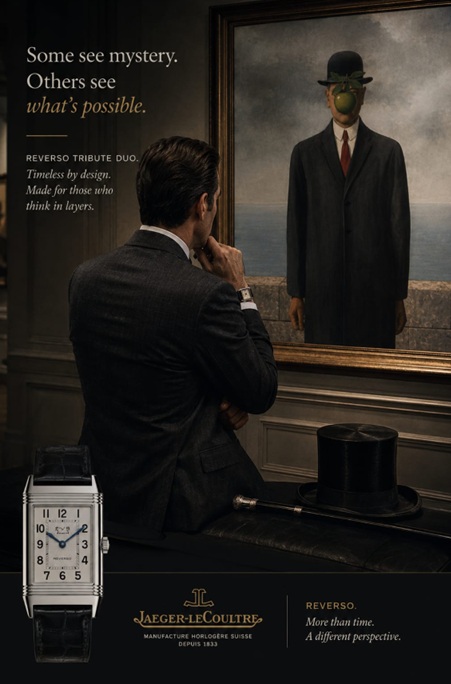
The Technology of Making an Experience Happen Twice
This becomes more interesting when we ask what a work of art actually preserves. The obvious answer is information: what people wore, how buildings looked, which instruments existed, what stories a culture valued. Artworks certainly preserve all of those things, and historians have learned enormous amounts from images, music, literature and objects that survived their makers.
But information alone cannot explain the peculiar durability of certain works. An instruction manual may contain far more explicit information than a poem and still become useless once the machine disappears. A spreadsheet can preserve ten years of sales with remarkable accuracy without ever making a future reader wonder about his own mortality. A high-resolution photograph can contain more visible detail than a painting and yet leave less behind once the original context has vanished.
Perhaps art preserves something stranger than information.
It can preserve a structure under which an experience becomes possible again.
The original experience does not travel intact through time. It cannot. The artist’s nervous system dies. The room where the work was created disappears. The political world changes. Future observers bring different languages, childhoods, religions, fears and technologies. Yet an arrangement of rhythm, proportion, silence, colour, gesture or narrative can survive long enough for another mind to enter it and generate an experience that did not exist until that meeting occurred.
That is a remarkable technology when you think about it.
A musical phrase composed two hundred years ago can still create anticipation in a listener whose life would have been incomprehensible to the composer. A painted face can provoke grief in someone born centuries after the model died. A sentence can reopen a memory the writer never knew existed. The transmitted experience is not identical to the original, but perhaps exact reproduction was never the function.
The work preserves the conditions of recurrence.
Once you see that possibility, the survival of art starts looking different from the survival of an object. The canvas merely needs to remain physically present. The artwork must remain capable of happening.
Why Wallpaper Wants to Disappear
Wallpaper is not inferior because it performs another function. In many cases, becoming unnoticed is evidence that it performs that function extremely well. A room covered in aggressive visual surprises would be exhausting to inhabit. Repetition stabilizes space. Colour can alter mood without demanding continuous attention. Pattern can create coherence across a surface while allowing the people inside the room to become more important than the walls.
Decoration frequently completes an environment.
Art often interrupts one.
This is why medium cannot give us a reliable boundary. A wallpaper pattern can become art if its structure, history or placement produces an encounter that exceeds decoration. A masterpiece can become wallpaper when reproduced so relentlessly that its familiarity prevents anyone from actually looking at it. The Mona Lisa can be a painting, a mug, a mouse pad, a meme and a hotel-room print without physically changing the image that began the chain.
Something strange happens in excessive familiarity: the object survives while the encounter disappears.
Perhaps this is why art often works by making ordinary things temporarily unfamiliar again. A chair, a bowl of fruit, a field, a body, a face, light on water—none requires invention. The work changes the angle from which the familiar is encountered, and the familiar becomes visible again.
Wallpaper often says: you may stop noticing me now.
Art sometimes says: look again.
And the more interesting works add something else: you may not be the same person when you do.
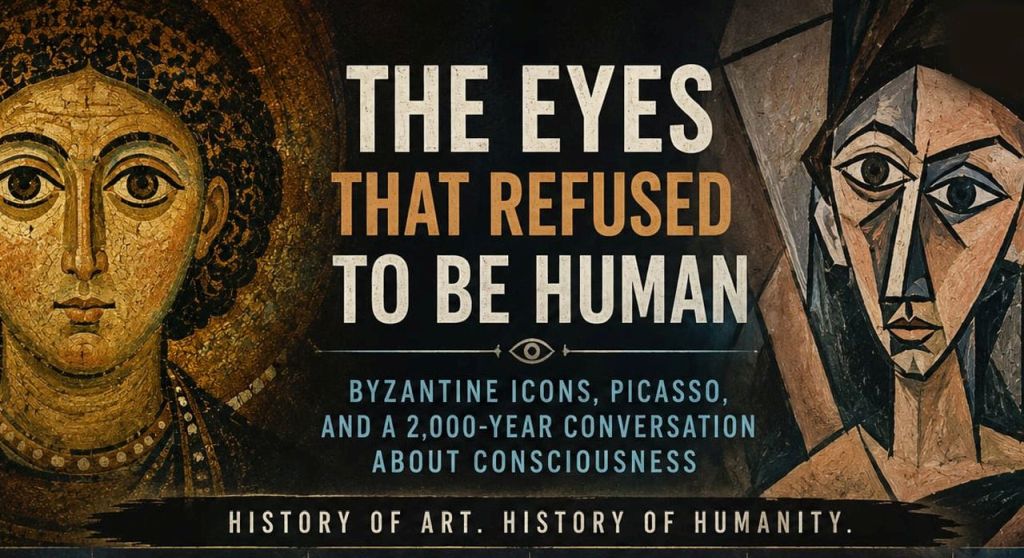
The Missing Half of the Work
This is where the observer enters the mechanism.
We are often taught to imagine meaning travelling in one direction. The artist has an idea, places it in the work, and the viewer receives it. This model is useful up to a point, especially when historical evidence tells us something about intention, symbolism or context. But it cannot account for everything that happens after the work leaves its creator.
No artist can store the exact future experience of every person who will encounter a work. A painting cannot contain your childhood. A composer cannot anticipate the person you will lose before hearing the piece thirty years later. A novelist writing in 1850 cannot know which line will remind someone in 2050 of a conversation with an artificial intelligence.
The observer supplies the missing material.
Memory, desire, fear, prejudice, ignorance and knowledge all enter the encounter. The work creates constraints; the observer creates possibilities within them. This does not mean interpretation is infinitely flexible or that evidence no longer matters. A work cannot reasonably mean anything whatsoever. History, form and context continue to push back.
But meaning does not reside entirely on either side.
It emerges in the meeting.
That changes the status of the object. The work is no longer simply a container carrying a message from a dead creator to a future receiver. It begins to resemble an event waiting for participants. The artist builds a structure, leaves openings within it, and strangers may continue entering long after the builder has gone.
This may also explain why some attempts to create perfect art feel curiously dead. Perfection can remove precisely the openings through which the observer would have entered. If everything is resolved, optimized and emotionally labelled in advance, admiration may remain—but participation becomes unnecessary.
The treasure chest opens, and someone has already told you exactly what is inside.
The Picture Has Not Changed
Return to the same painting ten years later. This is where the experiment becomes impossible to ignore. The pigment is nearly identical. The proportions have not changed. The figure has not aged. The landscape contains the same weather it contained on your first visit.
And yet the painting may have become almost unrecognizable.
A face that seemed old when you were twenty can look unexpectedly young when you are fifty. A romantic image can acquire sentimentality. An ugly work can become difficult to leave. A picture you once thought was about love may begin to look like a picture about fear, not because the artist rewrote it, but because something entered the room that was absent before.
You did.
Or rather, another version of you did.
We usually explain this by saying our taste has changed. That is certainly part of it, but perhaps the structure is more interesting. If the observer contributes part of the material from which the experience emerges, then a sufficiently open work can produce a different event when the observer changes. The object becomes capable of meeting several versions of the same person across time.
This may be one of art’s most extraordinary survival strategies.
A work does not need to preserve one fixed experience perfectly.
It needs to preserve enough structure to remain unfinished in the right way.
That is why great art can survive repeated encounters while many perfectly competent objects exhaust themselves quickly. They deliver what they contain, and the transaction ends. The enduring work leaves enough missing that another observer—or the same observer after another decade—can still enter.
We began with wallpaper because it seemed trivial. Perhaps that was the clue. Wallpaper can transform a room magnificently while allowing the person inside it to remain unchanged.
Art can leave the room exactly as it was.
And rearrange the person who walks out.
Watch the Video
How to Read the World
Current Knowledge
There is no universally accepted definition that cleanly separates art from decoration. Philosophers, historians, artists and critics have proposed distinctions based on intention, expression, formal complexity, aesthetic experience, cultural context, institutional recognition and interpretive depth, but none produces a boundary valid across all societies and periods. Objects created as decoration can later enter museums as art, while artworks can acquire decorative functions through reproduction and familiarity.
Research in perception and empirical aesthetics likewise suggests that responses to artworks depend not only on formal properties of the object but on context, expectation, memory, expertise, cultural background and prior experience. Different viewers can therefore respond differently to the same work without implying that interpretation is completely unconstrained.
Artworks also preserve substantial cultural and historical information, including social conventions, religious symbols, material practices and visual habits. Yet informational richness alone does not explain why some works remain emotionally or aesthetically powerful long after their original contexts have disappeared.
Open Questions
Can a work remain profound if it asks nothing of the observer, or is some degree of participation necessary for the kind of durability we associate with major art? Does aesthetic perfection sometimes reduce interpretive depth by resolving too much, or can perfect formal order itself remain inexhaustible?
If meaning emerges partly through the observer, where does legitimate interpretation end and projection begin? And if a masterpiece becomes so familiar through reproduction that nobody really sees it anymore, has the artwork survived—or only its image?
A further question becomes increasingly relevant in the age of generative systems. If machines can create images optimized for beauty, emotion and stylistic coherence, will the distinction between decoration and art become harder to locate, or will it force us to pay greater attention to what happens after the image reaches the observer?
Transhumation Interpretation
Transhumation treats art less as a container of information than as a structure capable of regenerating experience across different observers and different times.
The carrier can change. Paint can become photography, film, text, sound or pixels. Reproduction can alter scale and context. The original creator can disappear completely. What matters is whether enough relationships, tensions and openings survive for another mind to enter the structure and produce an experience of its own.
This gives art an unusual form of continuity. It does not preserve the artist’s experience intact. It preserves something closer to the conditions under which experience can happen again.
The observer supplies what the material cannot contain.
And because observers change, the work can become new without changing physically.
Perhaps this is why the distinction between art and wallpaper cannot ultimately be found in beauty, craftsmanship or even meaning alone. The deeper difference may lie in whether the encounter closes or continues.
Wallpaper can remain exactly what it was after we have lived beside it for years.
A powerful work makes that harder.
The object stays on the wall.
The observer does not.
FAQ
What is the difference between art and decoration?
There is no universally accepted boundary. Decoration often serves environmental, ornamental or identity-related functions, while art is frequently associated with expression, interpretation and aesthetic experience. The categories can overlap.
Can wallpaper be art?
Yes. Medium alone does not determine artistic status. Wallpaper, textiles and decorative patterns can carry cultural, historical and conceptual significance and can function as art depending on context and use.
Why do some artworks affect people differently over time?
Viewers change through age, memory, knowledge and life experience. Because interpretation partly depends on the observer, the same work can produce different experiences at different moments without physically changing.
Does art need to be imperfect?
No. Imperfection can suggest history, individuality or ambiguity, but highly ordered and formally precise works can also have great artistic depth. The relevant issue is not damage itself but whether the work remains capable of sustaining meaningful engagement.
How does Transhumation interpret art?
Transhumation treats art as a structure that can survive changes of carrier and regenerate experience in new observers. The work does not need to transmit an identical feeling; it needs to preserve enough structure for another meaningful encounter to occur.
Continue the Transhumation Series
- Forgotten Religion | Ancient Gods, Symbols and the Hidden Structures of Human Civilization
- The Last Religion | Death, Immortality and the Future of Humanity
- The New Theurgy | AI, Information and the Future of Human Civilization
- End of Branding: You Were Never Meant to Become a Product
- Baal vs Ishtar: Why Ancient Gods Never Disappeared