
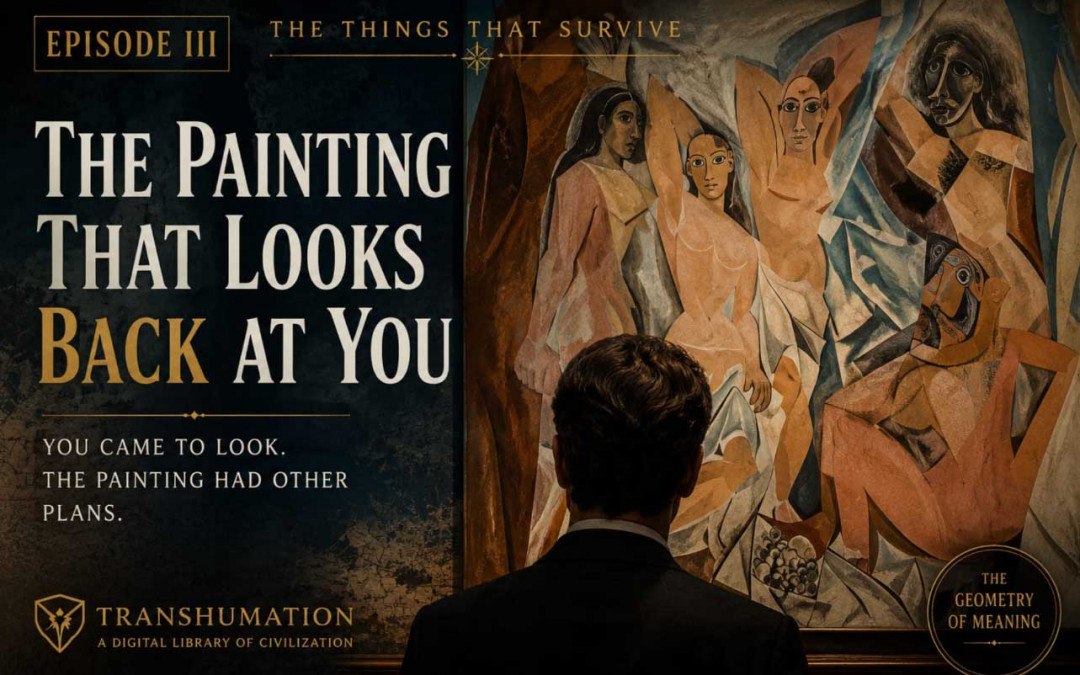
The Painting Has Not Changed. You Have.
A small card can undress five women who are already naked. Before reading it, you see bodies, faces, raised arms and a room that seems unwilling to make space for you. Then someone supplies the word “prostitutes.” Suddenly there is a price, a customer, perhaps a moral judgment. Nothing on the canvas has moved. What has the card changed in you?
Picasso’s Les Demoiselles d’Avignon, painted in 1907, gives us an unusually charged place to begin. Its later title refers to Barcelona’s Carrer d’Avinyó, rather than the French city a visitor might imagine. Even the name changes as your knowledge changes. You can admire a masterpiece, encounter five women or believe yourself to be looking into a brothel, all while standing before the same arrangement of paint.
Perhaps you arrived because Picasso was a great artist and you were supposed to understand him. You might have brought the suspicion that everyone else knew something you did not. Let us borrow a scene you may already understand, and see whether it gives you somewhere else to stand.
The Men Who Were Watching
In Michael Mann’s Heat, detectives watch a robbery crew inspecting an industrial location. They try to work out what the men intend to steal. Then comes the reversal: the crew has drawn its watchers into view. The detectives themselves are being studied, and everything they have just observed acquires a different meaning.
Being noticed would have been an ordinary occupational risk. Being drawn out and examined is something more intimate. Their attention, which felt like an advantage, has helped expose them. They understood what they could see while misunderstanding their own position in the scene.
Now return to Picasso. You came to look at women, and those faces confront you. What if the useful question is what they would see? A woman working in a brothel might spend her day observing men who have come to observe prostitutes. Each man brings his particular appetite; she also encounters the repetition. He sees an occasion. She may recognise a pattern.
Vampires Playing Actors Playing Vampires
Interview with the Vampire takes the construction another turn. Louis and Claudia encounter a theatre where vampires perform for a human audience. The spectators believe they are watching actors playing vampires. Louis and Claudia recognise vampires pretending to be human actors playing vampires. Knowledge changes the performance without changing the stage.
How much knowledge would you need to recognise something similar in ordinary life? Someone can sell a sexual service while being entirely candid about the transaction. Someone else can perform marital devotion while feeling none. Wife, lover, mother and prostitute tell us something about a relationship or role. We can still mistake that information for access to the whole person.
Sex makes this unusually easy to see. Oral sex does not establish anyone’s profession or moral character, yet the same act can be described as intimacy, pleasure, work or degradation. The surrounding story supplies the judgment. Even “he left her for me” can sound like proof of love until the new partner begins worrying about his capacity to betray. She has moved to another seat in the same theatre.
The Man Inside Mickey Mouse
Perhaps Picasso makes this too easy. Naked bodies, money and moral judgment provide immediate tension. Could the construction survive an encounter with Mickey Mouse? Imagine the worker inside the costume: sweating, tired, waiting for a break, watching another family approach.
The visitors meet Mickey. He meets people meeting Mickey. Their delight can be real, and so can his exhaustion. He helps produce an experience that he inhabits from somewhere they rarely consider. Behind the face they recognise is a person watching them recognise it.
This brings us back to the woman in the brothel. Her customer’s experience occupies only one side of the encounter. She has her own day, memory, attention and reasons for being there. What happens when the person we treat as the setting of our experience becomes visible as someone experiencing us?
The Missing Beat
A perfectly predictable encounter allows us to keep our expectations intact. We recognise the role, receive the experience and leave. The Missing Beat asks what happens when an interruption breaks that comfortable sequence. Perhaps a higher kind of perfection includes the disturbance that prevents an arrangement from becoming deadened by familiarity.
Picasso’s fractured bodies and incompatible faces can create such a disturbance. Perhaps he simply liked breasts. Desire can still produce a construction capable of doing more than satisfying desire. We do not need access to every thought in the painter’s head to discover what happens between this painting and a living viewer.
Remove the museum card. Would the picture still stop someone who knew nothing about its reputation? That is a useful trial by fire. Some meanings would disappear, while the compressed space and confronting faces might remain troublesome. What can the arrangement carry by itself, and what do we bring to keep it alive?
A Colour at the Edge of Life
Place these women beside the figures in Botticelli’s Primavera. Look at the gestures, the assembled bodies, the differently permitted ways of displaying flesh. Botticelli’s figures inhabit a mythological world; Picasso’s title brings us to a commercial one. What changes when the prestigious language of one encounter enters the other?
Then consider the strange cool colouring. Perhaps a greenish face suggests something beyond a mask: drowned flesh, decay, life becoming unfamiliar to itself. This is a visual association to explore. Let it place mortality beside the body we were preparing to admire, purchase or condemn.
Life is a fatal condition transmitted through sex. The dark joke includes the person standing safely outside the frame. Your own existence began in the bodily world you are judging, and your body will also cease to live. The painted face has led your attention somewhere unexpectedly close.
Who Was the Subject?
A work can survive its maker and enter comparisons its maker never encountered. Cinema gives us one route into Picasso; a worker inside a cartoon costume gives us another. Someone tomorrow may find a comparison we cannot imagine today. Each can reveal another capacity of the surviving arrangement.
Perhaps that is part of its depth: it continues to meet experiences that were never available to its author. Transhumation follows those meetings. We can test whether a connection helps us notice something, and allow the reader to carry the experiment further.
You came here expecting an explanation of Picasso. Along the way, you recognised detectives, vampires, customers, spouses and a tired worker behind a familiar smile. Five women stayed where they were while the meaning of looking kept changing. By now, whose behaviour have you spent the most time examining?
Watch the Video
How to Read the World
By José Fidel
Current Knowledge
Picasso completed Les Demoiselles d’Avignon in Paris in 1907. Preparatory work documents a brothel composition that included male figures absent from the finished painting. Its current title was established around its first public exhibition in 1916 and refers to Barcelona’s Carrer d’Avinyó. The painting is a landmark of modern art, with connections to Iberian sculpture and African visual traditions. These facts do not establish that Picasso intended the particular reversal of spectatorship explored here.
Open Questions
How much can a later interpretation legitimately discover beyond the artist’s documented intentions? When does historical knowledge sharpen perception, and when does it substitute an expected response for looking? The answer may differ between viewers and between successive encounters with the same work. No interpretation gains authority simply by being ingenious.
The Transhumation Interpretation
A surviving artwork can preserve conditions for encounters whose meanings are not fixed in advance. Its material arrangement matters, but so do the memory and expectations of the person looking. In this essay, the painted gaze becomes an occasion to examine those expectations. That is a reading of the encounter, not a claim that the canvas possesses awareness or that Picasso anticipated our argument.
Historical references: MoMA: Les Demoiselles d’Avignon; MoMA: preparatory study.
FAQ
What does Les Demoiselles d’Avignon depict?
The painting depicts five nude women in a composition developed from a brothel scene. Preparatory studies help establish that context; the essay considers how knowing it affects the viewer.
Why is the painting important?
Its fractured forms and compressed space broke with established conventions of representation and contributed to the development of modern art and Cubism.
Why are some faces mask-like?
The faces are discussed in relation to Picasso’s engagement with Iberian sculpture and African masks and sculpture. Those influences have specific cultural histories, including the colonial movement of African objects into European collections.
Did Picasso intend to expose the viewer’s prejudices?
The evidence discussed here does not establish that intention. The essay explores a possible effect on later viewers, keeping it separate from a proven account of Picasso’s purpose.
What does “the painting looks back” mean?
It describes a reversal of attention: the viewer begins examining their own assumptions as well as the image. It is a metaphor for an encounter, not a claim that the painting literally observes anyone.
Continue the Transhumation Series
- Forgotten Religion | Ancient Gods, Symbols and the Hidden Structures of Human Civilization
- The Last Religion | Death, Immortality and the Future of Humanity
- The New Theurgy | AI, Information and the Future of Human Civilization
- End of Branding: You Were Never Meant to Become a Product
- Baal vs Ishtar: Why Ancient Gods Never Disappeared