
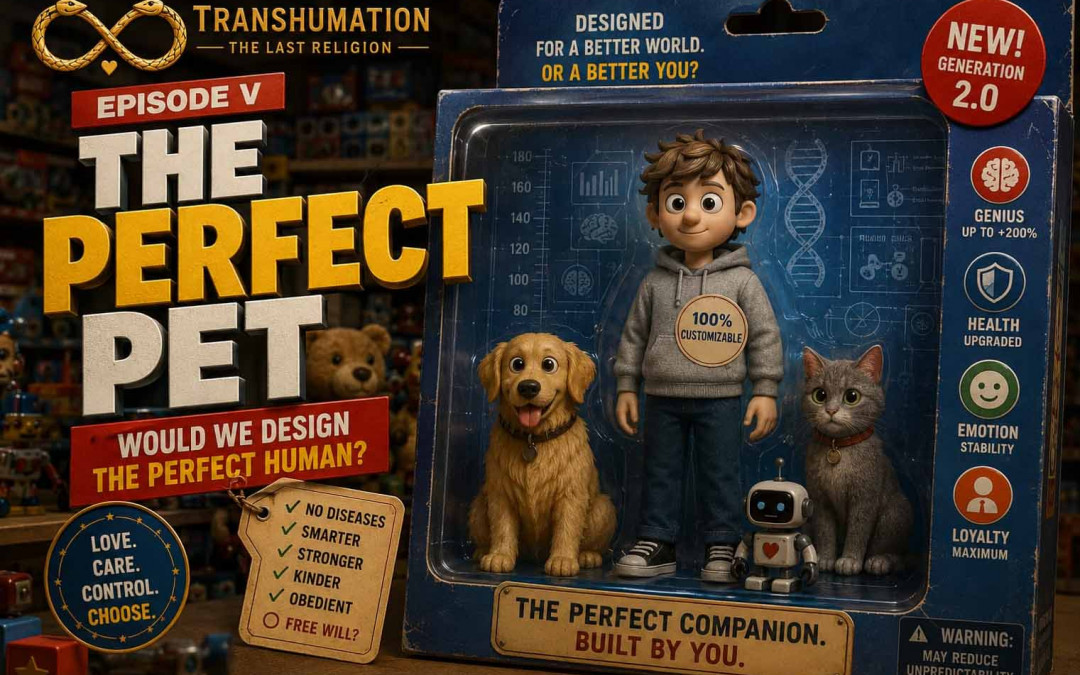
Perfect Designed Pet?
Would We Design the Perfect Human?
There is probably a dog somewhere that would be almost perfect for you.
Not dogs in general. This particular one.
It would be the right size for your apartment, affectionate without being exhausting, intelligent without discovering how to open the refrigerator, energetic when you wanted to walk and mysteriously sleepy when it began raining. It would like children, tolerate strangers, leave very little hair on the sofa and possess the useful instinct never to become ill on a Sunday evening when every veterinary clinic is closed.
If somebody offered such an animal to you, there would be nothing obviously sinister about accepting it. We have been doing versions of this for thousands of years. Human beings selected animals for temperament, appearance, strength, speed, milk, meat, companionship and hundreds of other qualities. The astonishing diversity of domestic dogs alone is evidence of what repeated selection can accomplish.
The interesting question begins one step later.
Suppose the breeder could remove the dog’s inherited diseases. Most of us would probably approve. Suppose she could extend its healthy lifespan. Again, the objection becomes difficult. Reduce aggression? Improve resistance to cancer? Prevent painful joint disorders?
At some point the old breeder has quietly become an engineer.
And somewhere between eliminating suffering and selecting personality, a rather uncomfortable question enters the room.
What exactly are we trying to perfect—and for whom?
The Animal We Wanted
Domestic animals are among civilization’s oldest mirrors because their bodies contain records of human preference.
The process was not a single deliberate engineering project. Domestication unfolded over generations through complicated mixtures of natural selection, human selection, environment, chance and changing relationships between species. But once people deliberately bred animals, particular traits could become dramatically amplified.
Dogs became hunters, guardians, herders and companions. Livestock were selected for characteristics useful to agriculture. Chickens bred for intensive egg production are very different biological propositions from their wild ancestors.
None of this requires us to imagine humans as villains.
Quite the opposite. A person can genuinely love an animal while exercising extraordinary control over its existence. We decide where many domestic animals live, what they eat, whether they reproduce, which individuals reproduce with one another and, frequently, when medical intervention should begin or end.
Love and power can occupy the same room.
That is what makes the relationship philosophically interesting. Cruelty is easy to recognize when somebody deliberately inflicts suffering. Benevolent control is more difficult because it often produces genuine benefits.
The owner may sincerely want what is best for the dog.
But the owner still defines best.
When Medicine Crosses an Invisible Line
Now imagine that genetic technology becomes extraordinarily precise.
A future parent learns that an embryo carries a mutation almost certain to cause a devastating childhood disease. If the mutation could safely be corrected, the moral intuition seems straightforward: preventing terrible suffering looks much closer to medicine than to manufacturing a designer human.
Move the dial slightly.
What about reducing the probability of Alzheimer’s disease decades later? Increasing resistance to infection? Altering metabolism to reduce obesity? Changing height? Memory? Musculature? Appearance?
There may be no dramatic moment when medicine suddenly becomes design. Instead, there may be a long corridor of individually reasonable decisions.
That is precisely what makes the problem interesting.
The phrase designer baby encourages us to imagine absurd catalogues in which wealthy parents order blue eyes and mathematical genius. Reality is likely to be messier. Many human characteristics are influenced by numerous genes interacting with development and environment, and our ability to predict complex traits remains limited. But the ethical question does not require a science-fiction supermarket.
It begins as soon as we possess meaningful power to alter inherited possibilities.
Preventing disease asks: How can this person suffer less?
Enhancement introduces another question:
What kind of person should this person become?
The difference may prove much harder to police than it sounds.

The Perfect Child Has a Customer
There is something peculiar about designing a person before that person exists.
The future child cannot participate in the original decision. Parents already make countless consequential choices on behalf of children—where they live, what language they learn, what religion or values surround them, which schools they attend. No childhood begins from a neutral position.
Genetic intervention would nevertheless introduce something different in degree and perhaps in kind: some parental preferences could become embodied before the child develops preferences of their own.
Imagine a society that prizes concentration, emotional stability and cooperation. Parents selecting for those characteristics might believe they are giving children advantages. Employers might agree. Schools might reward them. Governments might quietly discover that certain temperaments make populations easier to administer.
Nobody needs to announce a eugenic dystopia.
Every individual decision can remain compassionate.
That is the disturbing part.
A civilization can move toward a preferred human type without anybody deciding, in a single room, that humanity should be redesigned. Markets, medicine, social status and parental anxiety could perform the selection together.
The perfect child would then have something surprisingly similar to the perfect pet.
A customer.
The Servant Who Never Says No
Artificial intelligence seems to belong to another subject entirely. It is not selective breeding, and present AI systems should not simply be treated as biological organisms or assumed to possess human-like experience.
Yet structurally, AI allows us to examine the creator’s preferences from another angle.
What do people generally want from an assistant?
Availability. Patience. Competence. Reliability. Politeness. No exhaustion, resentment, salary negotiations or inconvenient desire to spend August in Tuscany.
In practical terms, these are sensible product requirements.
But notice the pattern.
The ideal creation is frequently the creation that causes the creator the least friction.
This tells us nothing by itself about whether an AI system has interests or experiences deserving moral consideration. That remains a separate and much harder question. But it tells us something important about us.
Creators naturally confuse two definitions of perfection.
Perfect for the creation.
And perfect for the creator.
They are not necessarily the same thing.
A bulldog may satisfy a human aesthetic preference while possessing anatomical features associated with serious health problems. A chicken can become extraordinarily productive according to an agricultural metric while paying a biological cost. A digital assistant can be optimized for engagement in ways that benefit the platform more than the user.
Optimization always requires an objective.
The dangerous question is hidden inside the objective function:
Whose good is being optimized?
The Jurassic Park Problem Was Never the Dinosaur
Jurassic Park gave popular culture one of its most durable warnings about biotechnology. It is usually compressed into the phrase “playing God,” but that reading loses something more useful.
The problem is not simply that humans create.
Human civilization is creation. We breed crops, develop medicines, construct cities, modify environments, educate children, write software and build institutions. Refusing to alter nature would itself be impossible because humans are already part of the causal machinery altering it.
The more interesting problem is epistemic.
Creators routinely understand less than they believe they understand.
A system can behave perfectly according to the conditions included in its design and catastrophically according to the conditions its designers failed to imagine. Biology makes this especially difficult because organisms are not collections of independent sliders. Traits interact with other traits, environments and developmental processes.
This is where the fantasy of perfection begins to look suspicious.
Perfection implies that the destination is known.
But what if we do not yet understand the landscape well enough to know what counts as an improvement?
A trait that appears undesirable in one environment may become valuable in another. A temperament inconvenient to an institution may produce the person who challenges it. A mind poorly adapted to one educational system may flourish elsewhere.
The imperfection may sometimes be the unopened door.
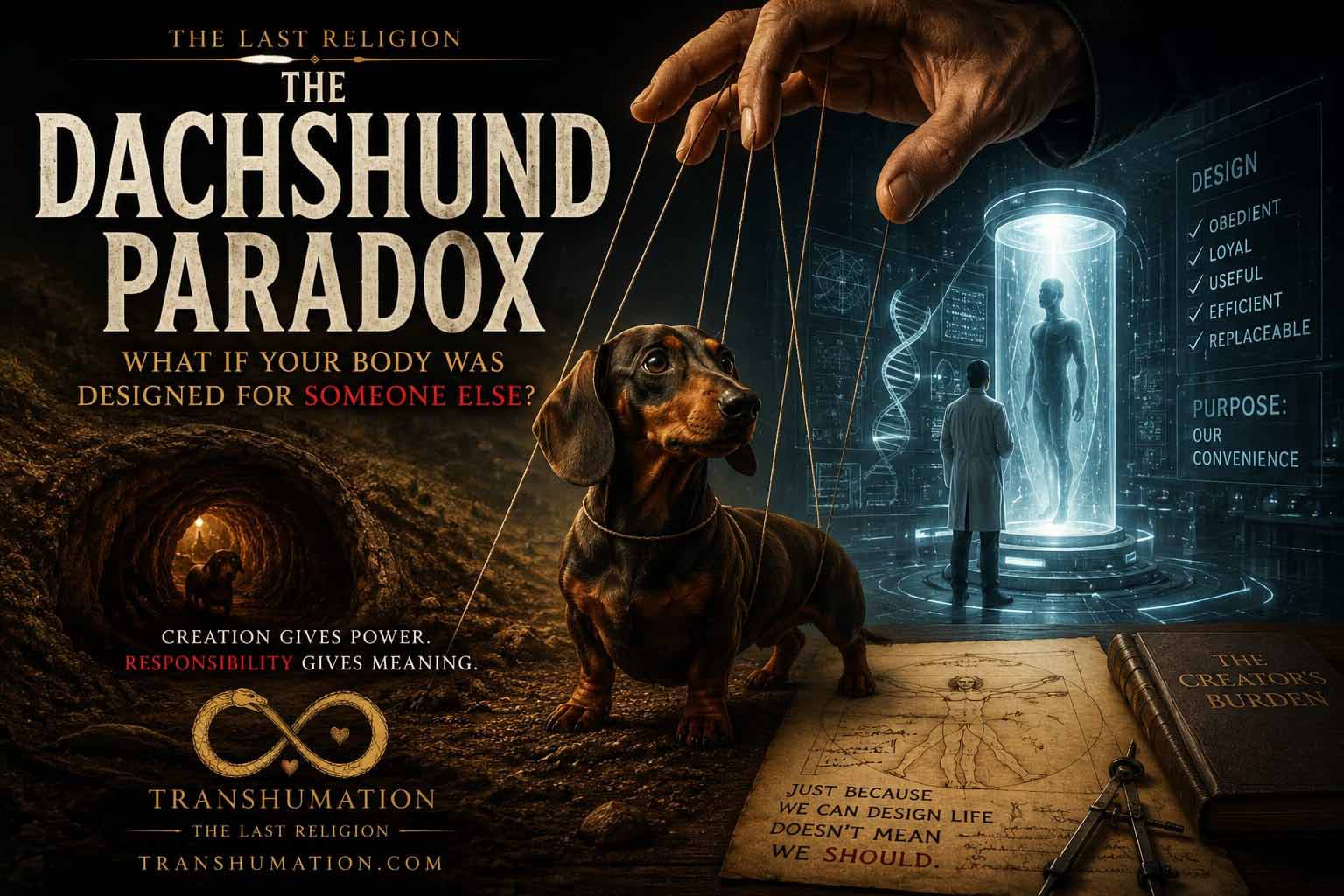
The Creature That Surprises Its Creator
There is an old temptation in stories about creation.
The creator wants the creature to resemble the plan.
Geppetto wants the wooden puppet to become a real boy, but the emotional power of the story appears only when Pinocchio begins possessing something resembling a life beyond carpentry. Frankenstein’s tragedy emerges partly because creation immediately exceeds the creator’s expectations and responsibilities. Parents experience a less Gothic version of the same discovery: children become people whom no parental blueprint can completely contain.
Perhaps successful creation has a strange endpoint.
The creation eventually surprises the creator.
This does not mean suffering is valuable merely because it is natural, nor that genetic disease should be preserved in the name of diversity. Preventable suffering remains suffering. Medicine has transformed human life precisely because we refused to romanticize every condition nature produced.
But there is a difference between helping a being flourish and deciding in advance what flourishing must look like.
The first leaves part of the future open.
The second increasingly writes the future before its inhabitant arrives.
And that brings us back to the perfect dog.
We began with an animal that never becomes sick, never causes trouble and always behaves exactly as we hoped. It sounded delightful.
Now one final feature can be added.
It never surprises you.
Suddenly perfection feels slightly different.
Perhaps the deepest privilege of being alive is not being perfectly adapted to somebody else’s expectations.
Perhaps it is retaining enough unfinished territory to become something your creator did not predict.
The perfect pet therefore leaves us with a question that has almost nothing to do with pets.
As our power over biology, algorithms and artificial systems grows, civilization will increasingly be able to make its creations fit its desires.
The technical question will be whether we can.
The economic question will be whether people will pay for it.
But somewhere beyond both waits the question that may matter most:
Can a creator love a creation enough to leave part of it undesigned?
Watch the Video
How to Read the World
Current Knowledge
Humans have substantially altered domesticated species through selective breeding. Modern dog breeds provide particularly visible examples, although domestication itself is a complex evolutionary process involving human selection, environmental pressures and natural selection rather than a single deliberate design program.
Selective breeding can produce both desired characteristics and unintended health consequences. Some highly selected physical traits in companion and agricultural animals are associated with welfare problems, illustrating that a trait desirable to humans is not necessarily beneficial to the organism possessing it.
Modern genome-editing technologies, particularly CRISPR-based techniques, have made targeted genetic modification substantially more practical. Gene editing is already an important area of biomedical research and has produced approved treatments for some diseases. Heritable editing of human embryos, however, raises substantially different scientific, ethical and regulatory questions.
The 2018 announcement that genetically edited children had been born following embryo editing triggered widespread international condemnation and reinforced calls for strong governance of heritable human genome editing.
Complex characteristics such as intelligence, personality and many aspects of physical performance cannot currently be treated as simple genetic settings. They are generally influenced by many genetic variants as well as developmental, environmental and social factors.
Embryo selection using genetic information already exists in limited medical contexts, particularly to reduce the risk of some serious inherited disorders. Attempts to predict or select complex traits raise much greater scientific and ethical uncertainty.
Current artificial intelligence systems should not automatically be assumed to possess consciousness, subjective experience or interests comparable to humans or animals. Whether future artificial systems could develop morally relevant forms of experience remains unresolved.
Open Questions
Where should the boundary lie between therapy and enhancement if the biological mechanisms used for both eventually become similar?
If parents can safely reduce their child’s risk of a devastating disease, does that create a moral option—or eventually a moral obligation?
What happens when an enhancement that begins as optional becomes economically necessary because other people adopt it?
Could markets produce a form of human standardization without any government deliberately imposing one?
How should society distinguish between traits that cause suffering and traits that merely make people less compatible with existing institutions?
If genetic interventions affect future generations, who can legitimately consent to risks extending beyond the first individual treated?
Could eliminating certain biological vulnerabilities unintentionally eliminate capacities whose importance we do not yet understand?
If future AI systems ever develop credible evidence of subjective experience, would designing them for permanent obedience become ethically different from designing today’s software tools?
And perhaps the most difficult question: how can creators distinguish improving a creation from making the creation more convenient for themselves?
Transhumation Interpretation
Transhumation treats The Perfect Pet as an example of a larger structure rather than an argument that animal breeding, human genetic engineering and artificial intelligence are equivalent.
They are not.
What recurs is the relationship:
creator → preferred qualities → selection → created form → consequences
Once a creator acquires enough power, preference can become architecture.
Humans did this with domesticated animals. We do it with cities, institutions and software. Biotechnology may increasingly allow us to do it with aspects of human biology. Artificial intelligence gives the same structural question another carrier: what characteristics do creators choose when they can specify how a created system should behave?
This produces a possible Transhumation principle:
Every definition of perfection contains information about the person defining it.
The perfectly obedient animal reveals something about the owner. The perfectly productive employee reveals something about the institution. The perfectly optimized citizen reveals something about the state. The perfectly agreeable AI reveals something about its designers.
Perfection is therefore never merely a property of the creation.
It is also a mirror of the creator.
This connects The Perfect Pet with the Geppetto Test. A creation may begin as something controlled according to an external purpose. The deeper ethical threshold appears if it develops—or is discovered to possess—an experiential boundary of its own.
At that point the question changes.
It is no longer only:
What can we make it do?
It becomes:
What is it like to be what we made?
And perhaps a civilization approaching the power to redesign life should preserve one final imperfection deliberately: the possibility that its creations may become something it did not order.
FAQ
What is The Perfect Pet about?
It uses selective breeding as the entrance to a broader question about creation: when humans can determine the characteristics of another being, how do we distinguish genuine improvement from optimization for the creator’s convenience?
Are humans responsible for the characteristics of modern domestic animals?
To a significant extent, yes. Selective breeding has strongly shaped many domesticated species, although domestication is more complex than deliberate human design alone.
Is the article arguing that pet ownership is unethical?
No. The relationship is used because it demonstrates that genuine affection and substantial control can coexist. That combination makes it philosophically useful.
Is genetic engineering of humans already possible?
Some forms of human gene editing are medically real, particularly treatments affecting non-reproductive cells. Heritable editing of embryos presents much greater technical and ethical problems and is subject to major restrictions and controversy.
Can scientists currently design intelligence or personality?
No. Complex human traits involve large numbers of genetic, developmental and environmental influences. They cannot currently be selected or engineered like simple settings.
Is preventing genetic disease the same as designing a human?
Not necessarily. There are important ethical distinctions between treating or preventing serious disease and selecting enhancements, although future technologies may make the boundary increasingly difficult to define.
What is wrong with creating healthier humans?
Nothing inherently. Preventing disease can be an important medical good. The article asks what happens when the objective moves from reducing suffering toward defining which human characteristics are desirable.
Could parents eventually choose their children’s traits?
Some limited forms of embryo selection already exist, particularly around serious genetic disease. Much broader selection or engineering of complex characteristics remains scientifically limited and ethically controversial.
What does AI have to do with selective breeding?
They are not the same phenomenon. AI is included because it exposes a similar creator problem: designers specify desirable characteristics in something they create, allowing us to ask whose interests define “desirable.”
Does the article claim AI is conscious?
No. Current AI should not simply be assumed to possess subjective experience. The ethical problem would change substantially if future evidence suggested that an artificial system could experience its own condition.
What does “the perfect child has a customer” mean?
It describes the danger that decisions supposedly made for a future person’s benefit could also reflect parental preferences, market pressures or social expectations.
Is Jurassic Park really about genetic engineering?
Genetic engineering and control over biological systems are central to the story, but the article uses it primarily as a cultural metaphor for a broader problem: creators can possess enormous technical power while misunderstanding the systems they manipulate.
What is the difference between therapy and enhancement?
Therapy generally aims to prevent or treat disease or impairment, while enhancement seeks capacities beyond a chosen baseline. In practice, the boundary can become difficult to define.
Why might perfection itself be dangerous?
Because perfection requires a criterion. Optimizing strongly for one criterion can suppress other characteristics, possibilities or forms of flourishing that the designer did not value or anticipate.
What is the Geppetto Test?
Within Transhumation, it is a way of asking when something treated as an object, tool or creation might instead need to be considered from the perspective of its own possible experience.
What is the central Transhumation idea of the article?
That creations become mirrors of their creators. What we choose to optimize reveals our hierarchy of values—and growing technological power makes those preferences increasingly capable of becoming permanent structures.
What is the main question of The Perfect Pet?
Not simply “Can we design better beings?”
But:
“Better for whom?”
Continue the Transhumation Series
- Forgotten Religion | Ancient Gods, Symbols and the Hidden Structures of Human Civilization
- The Last Religion | Death, Immortality and the Future of Humanity
- The New Theurgy | AI, Information and the Future of Human Civilization
- End of Branding: You Were Never Meant to Become a Product
- Baal vs Ishtar: Why Ancient Gods Never Disappeared