
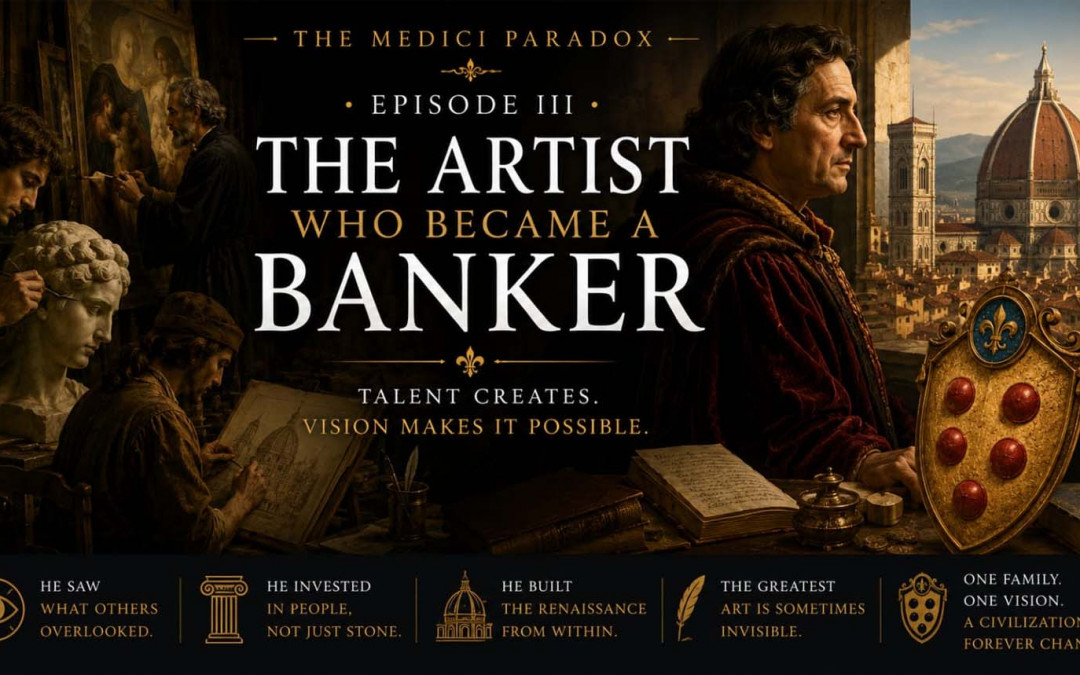
The Medici Paradox
Cosimo de’ Medici left no painting, no sculpture and no great building bearing his signature. Yet in Florence, it is surprisingly difficult to escape his work.
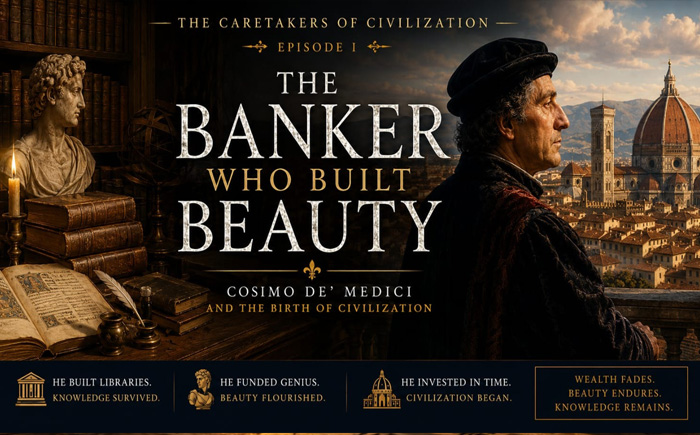
There is a particular kind of disappointment in Florence if you go looking for Cosimo de’ Medici’s masterpiece. There is no David with his name beneath it, no ceiling that requires you to tilt your head back, no room in which a guide can point to a brushstroke and say: Cosimo made that. He did not carve like Donatello, build like Brunelleschi or paint like Fra Angelico. He was, after all, a banker.
The disappointment lasts until you begin walking.
At San Marco, Medici money enters the story. At the family palace, Michelozzo does. Donatello keeps appearing nearby. Books accumulate, manuscripts are sought out, scholars find support, churches and convents are rebuilt. None of these things belongs to Cosimo in the way a sculpture belongs to its sculptor, and calling him their author would be absurd. Yet after a while another question becomes difficult to avoid. Why does the same banker keep appearing just before other people are able to make extraordinary things?
Perhaps we have been looking for his masterpiece in the wrong place.
The Masterpiece You Cannot Find
We usually begin the history of art too late. The block of marble has already arrived when Michelangelo enters the story. The architect already has a commission when he unrolls his drawings. A manuscript has somehow survived long enough for the scholar to open it.
The interesting part is how much had to happen before that moment.
Marble had to be bought and transported. Buildings required land, labour and years of expense. A gifted apprentice needed a workshop before anybody could know what he might become. Manuscripts had to be found, copied and stored. Even an extraordinary idea needed somebody willing to tolerate the period during which it looked merely eccentric.
Fifteenth-century Florence had many ways of making these things possible. Guilds commissioned works, religious institutions built and decorated churches, the republican government invested in civic prestige, merchants competed with one another, and wealthy families converted private fortunes into public monuments. The Medici did not invent Renaissance patronage, nor did they single-handedly create the Renaissance.
Cosimo was nevertheless unusually good at operating inside this world.
His patronage reached architecture, sculpture, religious institutions, libraries and humanist scholarship. Michelozzo designed the Medici palace and worked on projects closely associated with Cosimo. Donatello enjoyed Medici support. San Marco became both a religious institution and an intellectual centre. Cosimo collected manuscripts and supported the library there, while his later relationship with Marsilio Ficino helped give Platonic philosophy a new Florentine life.
These are different activities, involving different people. That is precisely what makes them interesting.
If Cosimo had commissioned one magnificent church, we could call him a wealthy patron and move on. What begins to emerge instead is a habit of placing resources around people, ideas and institutions whose value was not exhausted by the immediate transaction.
And this is where his other profession becomes unexpectedly relevant.
A Banker’s Eye
Banking is an odd business because much of its value depends upon judging things that do not yet exist.
A borrower does not bring the future into the bank and place it on the desk. He brings evidence: property, reputation, connections, previous behaviour, a plan. The banker has to look at what exists now and form an opinion about what may exist later.
Credit is therefore partly an exercise in imagination restrained by judgment.
Cosimo understood that world intimately. The Medici bank became one of the most important financial institutions in fifteenth-century Europe, with business extending far beyond Florence. Its success depended not simply on possessing money but on deciding where money could safely and profitably move.
Patronage contains an unexpectedly similar problem.
A finished Donatello is easy to admire. The difficult decision comes earlier, when there is only Donatello.
The building does not yet exist. The manuscript has not yet produced an intellectual movement. The scholar’s work may lead nowhere. A young artist’s reputation is incomplete. Someone must commit resources before history has supplied the reassuring label masterpiece.
This does not make the patron the creator. The distinction is important. Donatello’s intelligence remains Donatello’s; Michelozzo’s architecture remains Michelozzo’s. Money cannot retrospectively claim authorship simply because it paid the bill.
But money can alter what becomes possible.
Seen this way, Cosimo’s banking and his patronage no longer seem like opposite halves of his life. They involve a related talent: judging potential before the result is secure.
He was accustomed to extending credit.
Sometimes the borrower was the future.
What Florence Was Buying
There is a familiar way of telling the Renaissance as though Tuscany suddenly began producing better human beings.
One genius enters the frame after another. Brunelleschi solves the dome. Donatello changes sculpture. Masaccio changes painting. Later come Botticelli, Leonardo and Michelangelo. Florence starts to resemble some inexplicable concentration of talent, as if genius itself had settled around the Arno.
But there is no reason to think fifteenth-century Florentines had undergone a biological improvement.
What Florence possessed was an unusually fertile arrangement of institutions and incentives. Commercial wealth met fierce civic competition. Guilds wanted prestige. Families wanted prestige. Churches required art. Workshops trained young people. Classical texts were being recovered and discussed. Merchants could finance projects on a scale unavailable to most Europeans. Political ambition, religion, scholarship and beauty repeatedly collided in the same small city.
Talent still mattered enormously. But talent had somewhere to go.
That changes the way we look at Cosimo. His importance does not depend upon constructing an implausible list of every Renaissance genius supposedly discovered by the Medici. Michelangelo, for example, was born eleven years after Cosimo died and belonged to the later Medici world of Lorenzo the Magnificent. Leonardo was twelve when Cosimo died and cannot sensibly be presented as one of Cosimo’s discoveries.
The more interesting legacy is less personal.
Cosimo helped strengthen a culture in which spending enormous resources on architecture, manuscripts, scholarship and art could be understood not merely as consumption but as something worth doing. His descendants inherited that culture. So did rivals. So did institutions that had their own reasons for competing.
At some point an individual preference begins to alter the environment.
And environments can outlive the people who helped create them.
Cosimo died in 1464. Florence’s great cultural century was nowhere near finished.
The Other Renaissance
There is a danger, however, in making this story too beautiful.
Patrons do not merely open doors. By choosing one door, they leave another closed.
The same system capable of recognizing extraordinary talent can reward fashion, loyalty, family interest or political usefulness. A patron may see something before everyone else; he may also simply possess enough money to make his own taste unavoidable. Renaissance patronage was inseparable from prestige and power, and Medici generosity cannot be detached neatly from the political world in which the family was consolidating its influence.
That leaves us with a Renaissance we cannot visit.
We know Donatello because his work survived. We know the manuscripts that were copied, the buildings that were constructed and many of the thinkers who found patrons. We know far less about the gifted apprentice who never found the right workshop, the scholar whose manuscript disappeared, or the idea that reached the wrong wealthy man at the wrong moment.
History preserves successful recognition much better than failed recognition.
There must therefore be another archive beneath the visible Renaissance: works that could have existed but never did.
This is the uncomfortable power hidden inside patronage. The person supplying opportunity does not merely help civilization grow. He influences which parts of civilization are allowed to grow first.
Cosimo’s eye could recognize possibility.
His money could also privilege it.
The two functions cannot be separated.
The Signature
Return to Florence and the original disappointment begins to look different.
There is still no Cosimo masterpiece.
There should not be.
The sculptures belong to their sculptors. The buildings belong intellectually to their architects. The books were written by other people. The ideas passing through Florentine humanism cannot be signed over to the banker who helped support some of the people carrying them.
But Cosimo’s absence from the surface no longer means he is absent from the story.
His influence exists one level earlier.
Before the artwork there is the commission. Before the library there is the decision that manuscripts are worth finding. Before scholarship can become an intellectual movement, somebody must give scholars time, books and a place in which to work. Before talent becomes obvious, somebody occasionally has to tolerate the possibility that it will not.
This is not a lesser part of civilization. It is simply harder to put behind glass.
We still see the same structure around us. A writer remembers the editor who did not reject the manuscript. A scientist remembers the institution willing to fund an uncertain experiment. A filmmaker remembers the producer who said yes before an audience existed. An entrepreneur remembers the first investor precisely because the first investment occurred when there was least evidence that it was sensible.
The famous person receives the photograph because eventually the result becomes visible.
Recognition rarely does.
Perhaps this is why Cosimo’s masterpiece is so difficult to find in Florence. We keep looking for an object.
There isn’t one.
There is a city full of other people’s names.
Watch the Video
How to Read the World
Current Knowledge
Cosimo de’ Medici (1389–1464), commonly known as Cosimo the Elder, was a Florentine banker, political figure and patron. Under his leadership, the Medici bank became one of Europe’s major financial institutions, while Cosimo exercised substantial influence over Florentine politics despite the continued existence of republican institutions.
His patronage encompassed architecture, sculpture, religious foundations, manuscript collecting, libraries and humanist scholarship. Michelozzo was particularly closely associated with Medici architectural projects, while Donatello benefited from Medici patronage. Cosimo also supported San Marco and its library.
Cosimo’s relationship with Marsilio Ficino contributed to the revival of Platonic studies in Florence, although the traditional picture of a formally organized “Platonic Academy” created by Cosimo is considerably more complicated than older popular histories sometimes suggest.
Michelangelo should not be described as Cosimo’s protégé: he was born in 1475, after Cosimo’s death, and his important relationship with the Medici developed under Lorenzo de’ Medici. Leonardo da Vinci was born in 1452 and was still a child when Cosimo died.
The Florentine Renaissance cannot be attributed to the Medici alone. Guilds, republican institutions, churches, workshops, merchants, competing families, scholars and wider economic and political developments all contributed to Florence’s cultural environment.
Open Questions
How much does civilization depend upon talent, and how much upon the environments that allow talent to become visible?
Can recognizing unusual potential before there is consensus be regarded as a creative ability in its own right?
There is also a question that surviving masterpieces cannot answer. How many equally promising artists, scholars or inventors disappeared because recognition arrived too late—or never arrived at all?
The history of patronage records what received a chance. It can tell us almost nothing about what did not.
Transhumation Interpretation
Transhumation is interested in Cosimo because the durable structure is larger than patronage itself.
A civilization needs creators, but creators are not sufficient. It also needs mechanisms capable of finding, preserving and connecting things whose value is not yet obvious.
The Renaissance patron did this with money and protection. The editor does it with manuscripts. The curator does it with collections. The librarian does it with knowledge. Investors perform a related function with companies and technologies. Recommendation systems and AI increasingly perform another version of the same selection at enormous scale.
The carrier changes.
The problem remains: among more possibilities than anyone can support, what deserves attention?
That decision is never entirely neutral. Attention directs resources; resources alter which possibilities survive long enough to develop.
Cosimo therefore does not need to be transformed metaphorically into a painter. His real role is more interesting.
He occupied a position between potential and realization.
The Renaissance remembers the people who made the masterpieces.
Cosimo reminds us to look one step earlier.
FAQ
Was Cosimo de’ Medici an artist?
No. Cosimo was a banker, political figure and patron. “The Artist Who Became a Banker” deliberately reverses the expected categories to investigate whether recognizing and enabling creativity can itself involve a form of creative judgment.
Why was Cosimo de’ Medici important to Renaissance art?
His wealth and political influence helped support artists, architects, religious institutions, libraries and scholars in fifteenth-century Florence. He was one important participant in a much larger Florentine patronage system.
Which artists did Cosimo de’ Medici support?
His patronage is particularly associated with figures including Donatello and Michelozzo, alongside religious and cultural projects involving institutions such as San Marco.
Did Cosimo de’ Medici patronize Michelangelo?
No. Michelangelo was born in 1475, eleven years after Cosimo’s death. His famous Medici connection belongs principally to the period of Cosimo’s grandson Lorenzo de’ Medici.
Did Cosimo support Leonardo da Vinci?
Leonardo was born in 1452 and was only twelve when Cosimo died. It would therefore be misleading to present Leonardo as an artist discovered or meaningfully patronized by Cosimo.
Did the Medici create the Renaissance?
No. Florence’s Renaissance emerged from a complex network involving guilds, civic and religious institutions, workshops, merchants, scholars, artists, competing families and broader economic developments. Medici patronage was influential within that system.
Why compare banking with patronage?
Both can require judging future value before the outcome exists. The comparison does not make art equivalent to finance; it helps explain why Cosimo’s ability to evaluate uncertain possibilities may have been useful in both worlds.
What is the Medici Paradox in this episode?
A man remembered primarily as a banker helped shape an extraordinary artistic environment without producing the artworks himself. His influence is easiest to see not in a single masterpiece but in the conditions surrounding many other people’s work.
Continue the Transhumation Series
- Forgotten Religion | Ancient Gods, Symbols and the Hidden Structures of Human Civilization
- The Last Religion | Death, Immortality and the Future of Humanity
- The New Theurgy | AI, Information and the Future of Human Civilization
- End of Branding: You Were Never Meant to Become a Product
- Baal vs Ishtar: Why Ancient Gods Never Disappeared